
5G Fixed Wireless Access (FWA) Market Size, Share and Trends 2026 to 2035
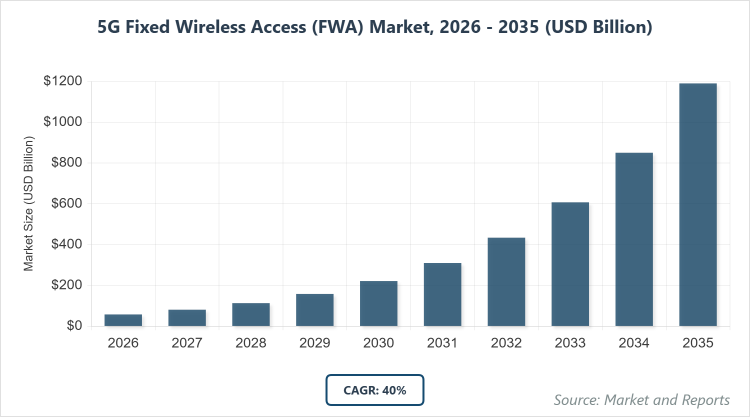
According to MarketnReports, the global 5G Fixed Wireless Access (FWA) market size was estimated at USD 57.6 billion in 2025 and is expected to reach USD 1666.1 billion by 2035, growing at a CAGR of 40% from 2026 to 2035. Surging demand for high-speed broadband in underserved areas and rapid 5G infrastructure rollout.
What are the Key Insights of the 5G Fixed Wireless Access (FWA) Market?
- The 5G Fixed Wireless Access (FWA) market was valued at USD 57.6 billion in 2025 and is projected to reach USD 1666.1 billion by 2035.
- The 5G Fixed Wireless Access (FWA) market is expected to grow at a CAGR of 40% during the forecast period 2026-2035.
- The 5G Fixed Wireless Access (FWA) market is driven by increasing demand for high-speed internet, advancements in 5G technology, and cost-effective alternatives to wired broadband.
- Services dominate the offering segment with a 60% share, due to the need for ongoing network management, optimization, and support services that ensure seamless connectivity.
- Broadband Internet Access dominates the application segment with a 50% share, as it addresses the primary need for reliable high-speed internet in homes and businesses.
- Residential dominates the end-user segment with a 45% share, driven by growing consumer adoption in underserved rural and suburban areas for home connectivity.
- North America dominates the regional segment with a 32% share, owing to extensive 5G deployments by major operators and supportive government policies for broadband expansion.
What is the 5G Fixed Wireless Access (FWA) Market?
Industry Overview
The 5G Fixed Wireless Access (FWA) market encompasses wireless broadband solutions that utilize 5G technology to deliver high-speed internet connectivity to fixed locations, serving as an alternative to traditional wired networks like fiber or cable. Market definition includes hardware such as customer premises equipment and access units, along with services for deployment and management, enabling reliable internet access in residential, commercial, and industrial settings, particularly in areas where laying physical infrastructure is challenging or cost-prohibitive, thereby bridging the digital divide and supporting applications requiring low latency and high bandwidth.
What are the Market Dynamics in the 5G Fixed Wireless Access (FWA) Market?
Growth Drivers
The 5G Fixed Wireless Access (FWA) market is propelled by the escalating demand for high-speed broadband in regions lacking traditional infrastructure, where 5G FWA offers a quick and cost-effective deployment alternative. Advancements in 5G technologies, including mmWave and sub-6 GHz spectrum utilization, enable ultra-fast speeds and low latency, attracting both consumers and enterprises for applications like remote work and IoT. Government initiatives worldwide to bridge the digital divide, coupled with investments in 5G networks by telecom operators, further accelerate adoption by subsidizing deployments and promoting connectivity in rural areas.
Restraints
High initial capital expenditures for 5G infrastructure, including base stations and spectrum acquisition, pose significant restraints, particularly for smaller operators in emerging markets. Regulatory hurdles, such as spectrum allocation delays and varying standards across regions, can slow rollout timelines. Additionally, potential interference issues in densely populated areas and the need for line-of-sight in mmWave deployments limit coverage reliability, deterring widespread implementation.
Opportunities
Opportunities in the 5G Fixed Wireless Access (FWA) market are expanding with the integration of AI and edge computing for network optimization, enabling smarter traffic management and enhanced user experiences. Emerging markets in Asia-Pacific and Africa present untapped potential through urbanization and digital transformation initiatives. Moreover, partnerships between telecoms and content providers for bundled services can drive subscriber growth by offering value-added packages.
Challenges
Challenges include ensuring consistent performance in adverse weather conditions, which can affect signal quality in higher frequency bands. Cybersecurity threats to wireless networks require robust protection measures, increasing operational complexities. Furthermore, competition from fiber-optic expansions in urban areas pressures FWA providers to innovate continuously for differentiation.
5G Fixed Wireless Access (FWA) Market: Report Scope
| Report Attributes | Report Details |
| Report Name | 5G Fixed Wireless Access (FWA) Market |
| Market Size 2025 | USD 57.6 Billion |
| Market Forecast 2035 | USD 1666.1 Billion |
| Growth Rate | CAGR of 40% |
| Report Pages | 220 |
| Key Companies Covered |
Nokia, Ericsson, Huawei Technologies, Qualcomm, Verizon Communications, and Others |
| Segments Covered | By Offering, By Application, By End-User, and By Region |
| Regions Covered | North America, Europe, Asia Pacific (APAC), Latin America, and The Middle East and Africa (MEA) |
| Base Year | 2025 |
| Historical Year | 2020 – 2024 |
| Forecast Year | 2026 – 2035 |
| Customization Scope | Avail customized purchase options to meet your exact research needs. |
What is the Market Segmentation of the 5G Fixed Wireless Access (FWA) Market?
The 5G Fixed Wireless Access (FWA) market is segmented by offering, application, end-user, and region.
Based on Offering Segment, services are the most dominant, holding a 60% share, followed by hardware at 40%. Services’ dominance arises from the essential role in installation, maintenance, and optimization, driving the market by providing end-to-end support that ensures network reliability and scalability for widespread adoption.
Based on Application Segment, broadband internet access is the most dominant with a 50% share, followed by IoT connectivity at 20%. Broadband internet access leads due to its core function in delivering high-speed connectivity to homes and offices, propelling market growth by addressing the global need for affordable and fast internet alternatives.
Based on the end-user segment, residential is the most dominant with a 45% share, followed by commercial at 30%. Residential’s prominence stems from increasing demand in underserved areas for home broadband, boosting market expansion through mass consumer adoption and subscription models.
What are the Recent Developments in the 5G Fixed Wireless Access (FWA) Market?
- In May 2025, Fibocom launched the FG390 5G module based on MediaTek T930, targeting FWA applications like CPEs and gateways to enhance broadband in diverse settings.
- In May 2025, Nokia and Three Sweden expanded 5G FWA access, improving connectivity for households and businesses through advanced network deployments.
- In July 2025, Bharti Airtel partnered with Ericsson to roll out FWA services in India, utilizing Ericsson’s core network for nationwide coverage.
- In March 2025, Qualcomm introduced the Dragonwing FWA Gen 4 platform, featuring 5G Advanced capabilities and AI enhancements for ultra-fast speeds up to 12.5 Gbps.
What is the Regional Analysis of the 5G Fixed Wireless Access (FWA) Market?
- North America is expected to dominate the global market.
North America holds the largest share at 32%, with the United States as the dominating country due to aggressive deployments by operators like Verizon and T-Mobile, supported by government funding for broadband and advanced 5G infrastructure.
Asia Pacific is the fastest-growing region, led by India through massive rollouts by Reliance Jio, driven by urbanization, digital inclusion programs, and investments in 5G for smart cities.
Europe maintains steady growth, with Germany dominating via strong regulatory support for connectivity and collaborations in industrial applications.
Latin America shows emerging potential, dominated by Brazil with increasing investments in 5G networks to serve rural areas and urban expansions.
The Middle East and Africa exhibit gradual expansion, with the UAE leading through ambitious digital transformation and 5G initiatives for economic diversification.
Who are the Key Market Players in the 5G Fixed Wireless Access (FWA) Market?
- Nokia focuses on network expansions and partnerships for FWA deployments, emphasizing high-capacity solutions.
- Ericsson prioritizes core network integrations and collaborations for nationwide rollouts.
- Huawei Technologies drives innovation in hardware and AI-enhanced platforms for global markets.
- Qualcomm leverages chipsets and advanced platforms like Dragonwing for performance boosts.
- Verizon Communications emphasizes subscriber growth through diversified FWA offerings in the US.
What are the Market Trends in the 5G Fixed Wireless Access (FWA) Market?
- Integration of AI for network optimization and predictive maintenance.
- Expansion in rural and underserved areas for digital inclusion.
- Adoption of mmWave for ultra-high speeds in urban settings.
- Growth in enterprise applications like IoT and smart buildings.
- Focus on sustainable and energy-efficient deployments.
What Market Segments and Subsegments are Covered in the Report?
By Offering
- Hardware
- Services
- Platform / Software
- Others
By Application
- Broadband Internet Access
- IoT Connectivity
- Video Streaming and OTT Services
- Smart Home/Smart Building Applications
- Backup and Redundancy for Wired Networks
- Enterprise WAN/Branch Office Connectivity
- Telemedicine and Remote Healthcare
- Virtual Reality and Augmented Reality
- Industrial Automation and Control
- Remote Monitoring and Surveillance
- Others
By End-User
- Residential
- Commercial
- Industrial
- Government & Public Sector
- Others
By Region
- North America
- U.S.
- Canada
- Europe
- UK
- Germany
- France
- Rest of Europe
- Asia Pacific
- China
- India
- Japan
- Rest of Asia Pacific
- Latin America
- Brazil
- Mexico
- Rest of Latin America
- Middle East & Africa
- UAE
- South Africa
- Rest of Middle East & Africa
Frequently Asked Questions
5G Fixed Wireless Access (FWA) is a broadband technology using 5G networks to provide high-speed internet to fixed locations without wired connections.
Factors include 5G infrastructure investments, demand for high-speed internet, and cost-effective alternatives in underserved areas.
The market is projected to grow from USD 80.6 billion in 2026 to USD 1666.1 billion by 2035.
The expected CAGR is 40% from 2026 to 2035.
North America will contribute notably, driven by advanced deployments and policies.
Major players include Nokia, Ericsson, Huawei Technologies, Qualcomm, and Verizon Communications.
The report provides analysis of size, trends, segments, regions, players, and forecasts.
Stages include spectrum allocation, infrastructure deployment, hardware manufacturing, service provision, and end-user connectivity.
Trends favor AI integration and rural expansion, with preferences shifting to reliable, high-speed alternatives.
Spectrum regulations and broadband subsidies drive growth, while energy efficiency concerns influence deployments.