
3D Printing Robots Market Size, Share and Trends 2026 to 2035
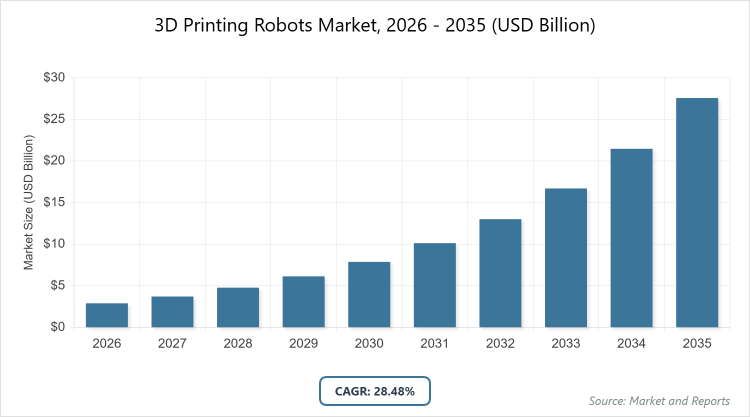
According to MarketnReports, the global 3D Printing Robots market size was estimated at USD 2.89 billion in 2025 and is expected to reach USD 35.41 billion by 2035, growing at a CAGR of 28.48% from 2026 to 2035. The 3D Printing Robots Market is driven by advancements in automation, material science, and the rising demand for customized manufacturing.
What are the Key Insights into 3D Printing Robots?
- The global 3D Printing Robots market was valued at USD 2.89 billion in 2025 and is projected to reach USD 35.41 billion by 2035.
- The market is expected to grow at a CAGR of 28.48% during the forecast period from 2026 to 2035.
- The market is driven by increasing adoption in aerospace and automotive for customized parts, advancements in robotics and AI, and demand for large-scale 3D printing in construction.
- In the type segment, articulated robots dominate with a 40% share due to their versatility in multi-axis movements, enabling complex geometries in manufacturing.
- In the application segment, functional part manufacturing dominates with a 35% share as it supports end-use production with high precision and material efficiency.
- In the end-user segment, aerospace & defense dominates with a 30% share owing to requirements for lightweight, custom components in harsh environments.
- North America dominates the regional market with a 40% share, driven by advanced R&D, a strong aerospace sector, and the presence of key players like 3D Systems.
What is the Industry Overview of 3D Printing Robots?
The 3D Printing Robots market involves robotic systems integrated with additive manufacturing technologies to automate the production of complex structures, offering precision, scalability, and efficiency in creating customized parts through layer-by-layer deposition. Market definition includes articulated, cartesian, and collaborative robots equipped with 3D printing heads for applications requiring high accuracy and flexibility, addressing challenges in material handling, multi-axis printing, and integration with AI for optimized workflows in industries seeking to reduce labor costs and enhance production speed.
What are the Market Dynamics of 3D Printing Robots?
Growth Drivers
The 3D Printing Robots market is propelled by the integration of robotics with additive manufacturing, enabling automated, high-precision production of complex parts that reduce waste and lead times in industries like aerospace and automotive. Advancements in AI and machine learning allow for real-time optimization of printing parameters, enhancing efficiency and quality while supporting large-scale applications in construction. Rising demand for customization in consumer goods and medical devices, coupled with cost savings from reduced labor, drives adoption. Government initiatives for smart manufacturing and sustainability further accelerate growth by promoting energy-efficient robotic systems.
Restraints
High initial costs for robotic 3D printing systems and integration with existing workflows limit adoption among SMEs in developing regions. Technical challenges in material compatibility and print speed for large objects hinder scalability. Regulatory hurdles for safety and certification in critical sectors like healthcare delay market entry. Supply chain disruptions for specialized components and filaments increase prices, while limited skilled labor for operation and maintenance poses barriers.
Opportunities
Opportunities emerge from the expansion of 3D printing in construction for on-site robotic building, offering sustainable and rapid infrastructure solutions in urbanizing areas. Partnerships between robot manufacturers and material scientists can develop advanced filaments for multi-material printing. The rise of Industry 4.0 enables IoT-integrated robots for predictive maintenance, opening niches in smart factories. Emerging markets with growing manufacturing sectors present untapped potential for affordable systems.
Challenges
Challenges include ensuring precision and structural integrity in large-scale prints, requiring ongoing R&D to overcome material limitations. Cybersecurity risks in connected robotic systems threaten data and operational security. Competition from traditional manufacturing methods in high-volume production delays transition. Environmental concerns over plastic waste from printing necessitate eco-friendly innovations, while varying global standards complicate exports.
3D Printing Robots Market: Report Scope
| Report Attributes | Report Details |
| Report Name | 3D Printing Robots Market |
| Market Size 2025 | USD 2.89 Billion |
| Market Forecast 2035 | USD 35.41 Billion |
| Growth Rate | CAGR of 28.48% |
| Report Pages | 220 |
| Key Companies Covered | Stratasys Ltd., 3D Systems Corporation, EOS GmbH, ABB Robotics, KUKA AG, Fanuc Corporation, Yaskawa Electric Corporation, Universal Robots, and Others |
| Segments Covered | By Type, By Application, By End-User, and By Region |
| Regions Covered | North America, Europe, Asia Pacific (APAC), Latin America, and The Middle East and Africa (MEA) |
| Base Year | 2025 |
| Historical Year | 2020 – 2024 |
| Forecast Year | 2026 – 2035 |
| Customization Scope | Avail customized purchase options to meet your exact research needs. |
What is the Market Segmentation of 3D Printing Robots?
The 3D Printing Robots market is segmented by type, application, end-user, and region.
By Type. Articulated robots are the most dominant subsegment, holding approximately 40% market share, due to their multi-joint flexibility, allowing intricate movements for detailed printing. This dominance drives the market by enabling complex designs in aerospace, reducing errors, and enhancing productivity. Cartesian robots rank as the second most dominant, with around 25% share, offering linear precision for large-scale builds, propelling growth through cost-effective solutions in construction.
By Application. Functional part manufacturing emerges as the most dominant subsegment, capturing about 35% share, primarily because it produces end-use components with high strength. This leads to market growth by supporting rapid prototyping to production transition in automotive. Prototyping follows as the second most dominant, with roughly 30% share, accelerating design iterations, driving the market via reduced development times in electronics.
By End-User. Aerospace & defense represents the most dominant subsegment at about 30% share, driven by needs for lightweight, custom parts. This dominance accelerates market expansion through high-value contracts and innovation. Automotive ranks second most dominant, holding around 25% share, due to demand for efficient manufacturing, contributing to growth via EV component production.
What are the Recent Developments in 3D Printing Robots?
- In April 2025, restor3d raised USD 38 million to commercialize 3D printed orthopedic implants using robotic systems for precision manufacturing.
- In January 2025, Stratasys acquired a robotics startup to enhance its FDM printing with multi-axis robotic arms for large-scale production.
- In October 2024, EOS launched a new robotic 3D printing system for metal parts in aerospace, improving automation and material efficiency.
- In July 2024, ABB Robotics partnered with a 3D printing firm to integrate collaborative robots for construction applications.
- In June 2024, 3D Systems introduced AI-driven software for robotic printing, optimizing paths for complex geometries in medical devices.
What is the Regional Analysis of 3D Printing Robots?
- North America is expected to dominate the global market.
North America holds the largest share at approximately 40%, with the United States as the dominating country, attributed to advanced R&D, a strong aerospace sector, and the presence of key players like 3D Systems. This region’s leadership is supported by government funding for manufacturing innovation, high adoption in defense for custom parts, and collaborations between tech firms and universities, fostering rapid technological advancements.
The concentration of venture capital in Silicon Valley accelerates startup growth in robotic printing. NASA’s initiatives for space applications drive demand for lightweight components. High defense budgets fund advanced prototypes. The region’s focus on STEM education ensures a skilled workforce. Reshoring trends boost domestic production capabilities. Strong IP laws protect innovations, encouraging investments.
Europe follows with steady growth, driven by an emphasis on sustainability and precision engineering, where Germany dominates through its automotive and industrial robotics expertise. The region’s expansion benefits from EU grants for smart manufacturing and a focus on green technologies, enhancing efficiency in aerospace and healthcare applications.
Horizon Europe programs support collaborative R&D in multi-material printing. The UK’s post-Brexit tech investments promote local innovation. Multilingual standards facilitate cross-border trade in France and Italy. Circular economy policies recycle printing waste. REACH regulations ensure safe material usage. Industry 4.0 initiatives integrate robots in factories. Aging infrastructure renewal projects adopt construction printing. Emphasis on vocational training builds expertise in robotic operations.
Asia Pacific is the fastest-growing region, exhibiting a high CAGR, with China leading due to its massive industrial base and government initiatives like Made in China 2025. This area’s potential is amplified by low-cost production, rising electronics demand, and investments in construction robotics, positioning it for significant market gains. Massive 5G rollout enables real-time robotic control. India’s Smart Cities mission drives urban construction applications.
Southeast Asian nations like Singapore pioneer medical printing. Cultural shifts toward automation reduce labor dependencies. Export-oriented policies enhance global competitiveness. Vocational programs in Japan build advanced skills. Rising middle-class consumption increases consumer goods printing. Environmental regulations push for energy-efficient systems.
Latin America demonstrates moderate progress, dominated by Brazil’s growing manufacturing and energy sectors, supported by foreign investments, though challenged by infrastructure; growth is aided by the adoption of automotive technologies. Mexico benefits from NAFTA ties, facilitating tech transfers from North America. Government digital initiatives in Argentina promote education in robotics. The rise of EVs in Chile creates demand for component printing.
However, economic volatility affects funding consistency. Emerging aerospace in Colombia adopts a prototype development. Regional trade pacts like Mercosur ease material imports. Vocational training expands in Peru for industrial applications. Biodiversity concerns influence eco-friendly material choices. Urban expansion drives construction robot demand.
The Middle East and Africa remain emerging, with the United Arab Emirates leading through smart city projects and oil & gas diversification, limited by tech access but promising via infrastructure developments. Saudi Arabia’s Vision 2030 funds R&D hubs for localized printing. South Africa’s mining sector adopts equipment repairs. Technology partnerships with European firms build expertise in Egypt.
However, water scarcity impacts cooling in printing processes. Investments in solar-powered robots address energy needs. OPEC policies stabilize oil-related applications. Vocational initiatives in Nigeria train for future jobs. Emerging ports in Kenya require marine component printing. Focusing on sustainable development goals promotes green innovations.
What are the Key Market Players in 3D Printing Robots?
- Stratasys Ltd. focuses on multi-axis robotic printing systems, investing in software for optimized paths to serve aerospace and automotive sectors.
- 3D Systems Corporation. 3D Systems emphasizes integrated robotic solutions for metal and polymer printing, pursuing partnerships for large-scale manufacturing.
- EOS GmbH. EOS specializes in laser-based robotic systems, strategizing on high-precision metal parts for industrial applications.
- ABB Robotics. ABB leverages collaborative robots for 3D printing, focusing on automation in construction and electronics.
- KUKA AG. KUKA develops articulated robots for additive manufacturing, targeting flexibility in automotive prototyping.
- Fanuc Corporation. Fanuc integrates AI in robotic printing, emphasizing efficiency for high-volume production.
- Yaskawa Electric Corporation. Yaskawa offers SCARA robots for precise layering, expanding in medical device fabrication.
- Universal Robots. Universal Robots prioritizes user-friendly cobots for small-scale printing, growing in education and research.
What are the Market Trends in 3D Printing Robots?
- Integration of AI for real-time print optimization and error correction.
- Rise of multi-material and hybrid printing capabilities.
- Adoption of collaborative robots for safe human-robot interaction.
- Expansion in large-scale construction printing.
- Focus on sustainable materials and energy-efficient systems.
- Growth in mobile and gantry robotic printers for on-site use.
What Market Segments and Subsegments are Covered in the 3D Printing Robots Report?
By Type
- Articulated Robots
- Cartesian Robots
- SCARA Robots
- Delta Robots
- Polar Robots
- Collaborative Robots
- Gantry Robots
- Mobile Robots
- Multi-Arm Robots
- Hybrid Robots
- Others
By Application
- Prototyping
- Tooling
- Functional Part Manufacturing
- Large-Scale Construction
- Customized Production
- Repair & Maintenance
- Art & Design
- Medical Device Fabrication
- Aerospace Components
- Automotive Parts
- Others
By End-User
- Aerospace & Defense
- Automotive
- Healthcare
- Construction
- Electronics
- Manufacturing
- Education & Research
- Consumer Goods
- Energy & Utilities
- Food & Beverage
- Others
By Region
-
- North America
- U.S.
- Canada
- Europe
- UK
- Germany
- France
- Rest of Europe
- Asia Pacific
- China
- India
- Japan
- Rest of Asia Pacific
- Latin America
- Brazil
- Mexico
- Rest of Latin America
- Middle East & Africa
- UAE
- South Africa
- Rest of Middle East & Africa
- North America
Frequently Asked Questions
3D Printing Robots are robotic systems equipped with additive manufacturing capabilities for automated, precise layer-by-layer production of objects.
Key factors include AI integration, demand for customization, industrial automation, and advancements in materials.
The market is projected to grow from USD 2.89 billion in 2025 to USD 35.41 billion by 2035.
The CAGR is expected to be 28.48%.
North America will contribute notably, holding around 40% share due to R&D and aerospace demand.
Major players include Stratasys Ltd., 3D Systems Corporation, EOS GmbH, ABB Robotics, and KUKA AG.
The report provides comprehensive analysis including size, trends, segments, regional outlook, key players, and forecasts.
Stages include component sourcing, robot assembly, software integration, testing, distribution, and after-sales service.
Trends evolve toward AI and multi-material printing, with preferences for sustainable, efficient systems.
Safety regulations for robotics and environmental concerns over material waste influence compliance and innovation.