
3D Optical Microscope Market Size, Share and Trends 2026 to 2035
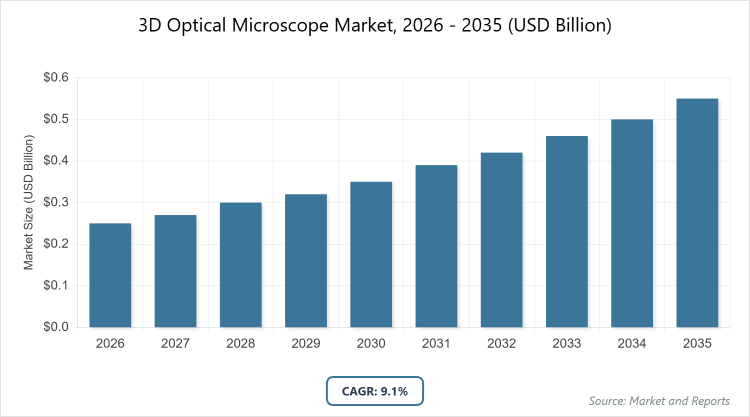
According to MarketnReports, the global 3D Optical Microscope market size was estimated at USD 0.25 billion in 2025 and is expected to reach USD 0.6 billion by 2035, growing at a CAGR of 9.1% from 2026 to 2035. The 3D Optical Microscope Market is driven by the rising demand for high-resolution imaging in semiconductor inspection and life sciences research.
What are the Key Insights into the 3D Optical Microscope?
- The global 3D Optical Microscope market was valued at USD 0.25 billion in 2025 and is projected to reach USD 0.6 billion by 2035.
- The market is expected to grow at a CAGR of 9.1% during the forecast period from 2026 to 2035.
- The market is driven by technological advancements in imaging, increasing R&D in life sciences, demand for precision in semiconductor manufacturing, and growth in additive manufacturing inspection.
- In the type segment, confocal microscopes dominate with a 40% share due to their superior depth resolution and optical sectioning for biological and material analysis.
- In the application segment, semiconductor inspection dominates with a 35% share as it enables nanoscale defect detection critical for chip production quality.
- In the end-user segment, the semiconductor industry dominates with a 30% share owing to stringent precision requirements in fabrication processes.
- North America dominates the regional market with a 35% share, driven by advanced R&D facilities, high-tech industries, and presence of key players like Bruker and Keyence.
What is the Industry Overview of 3D Optical Microscope?
The 3D Optical Microscope market involves advanced imaging systems that capture three-dimensional surface topography and subsurface details using optical techniques like confocal scanning, interferometry, and structured light, providing non-destructive, high-resolution analysis for precise measurements. Market definition includes instruments that utilize light to generate 3D models with nanometer-level accuracy, enabling applications in quality control, research, and diagnostics, while addressing challenges in speed, depth of field, and integration with digital workflows for enhanced data analysis and visualization in diverse fields requiring detailed surface profiling.
What are the Market Dynamics of the 3D Optical Microscope?
Growth Drivers
The 3D Optical Microscope market is fueled by rapid advancements in nanotechnology and semiconductor fabrication, where high-resolution 3D imaging enables precise defect detection and surface metrology, reducing production errors and costs in high-volume manufacturing. Increasing investments in life sciences research for cellular and tissue analysis drive demand for confocal and interferometric systems that provide detailed volumetric data without sample destruction. The rise of Industry 4.0 integrates these microscopes with AI for automated analysis, enhancing efficiency in quality control. Growing applications in cultural heritage for non-invasive artifact scanning and in medical diagnostics for tissue pathology further propel market expansion through versatile, user-friendly designs.
Restraints
High acquisition and maintenance costs for advanced 3D optical systems limit adoption in budget-constrained research labs and small enterprises, particularly in emerging markets. Technical complexities in data processing and interpretation require specialized training, hindering widespread use. Limited field of view and depth penetration in certain techniques restrict applications in large-scale samples. Regulatory compliance for medical-grade imaging adds approval delays and expenses. Competition from electron microscopy for ultra-high resolution offers alternatives in some precision tasks, capping market share.
Opportunities
Opportunities emerge from the integration of AI and machine learning for real-time image enhancement and automated measurements, appealing to high-throughput industries like semiconductors. Expansion into emerging fields like bioprinting and personalized medicine offers growth for customized scanning solutions. Partnerships with software developers for cloud-based data analysis can streamline workflows. Rising demand in Asia’s manufacturing boom presents untapped potential for affordable, portable models. Development of hybrid optical-electron systems could bridge resolution gaps, opening new niches.
Challenges
Challenges include achieving consistent accuracy across diverse sample types, requiring ongoing calibration and environmental control. Rapid technological obsolescence demands frequent upgrades, straining budgets. Data overload from high-resolution scans necessitates advanced storage and processing infrastructure. Privacy concerns in medical imaging under GDPR/HIPAA complicate data sharing. Shortage of skilled operators in developing regions slows adoption, while varying global standards hinder exports.
3D Optical Microscope Market: Report Scope
| Report Attributes | Report Details |
| Report Name | 3D Optical Microscope Market |
| Market Size 2025 | USD 0.25 Billion |
| Market Forecast 2035 | USD 0.6 Billion |
| Growth Rate | CAGR of 9.1% |
| Report Pages | 220 |
| Key Companies Covered | Olympus Corporation, Keyence Corporation, Bruker Corporation, Carl Zeiss AG, Leica Microsystems, Nikon Corporation, Hirox Co., Ltd., Sensofar, Alicona Imaging GmbH, Nanovea, and Others |
| Segments Covered | By Type, By Application, By End-User, and By Region |
| Regions Covered | North America, Europe, Asia Pacific (APAC), Latin America, and The Middle East and Africa (MEA) |
| Base Year | 2025 |
| Historical Year | 2020 – 2024 |
| Forecast Year | 2026 – 2035 |
| Customization Scope | Avail customized purchase options to meet your exact research needs. |
What is the Market Segmentation of the 3D Optical Microscope?
The 3D Optical Microscope market is segmented by type, application, end-user, and region.
By Type. Confocal microscopes are the most dominant subsegment, holding approximately 40% market share, due to their ability to provide optical sectioning and 3D reconstruction for biological samples. This dominance drives the market by enabling non-invasive imaging in life sciences, accelerating research and diagnostics. White light interferometry microscopes rank as the second most dominant, with around 25% share, offering high vertical resolution for surface metrology, propelling growth through applications in semiconductor quality control.
By Application. Semiconductor inspection emerges as the most dominant subsegment, capturing about 35% share, primarily because it facilitates nanoscale feature measurement. This leads to market growth by ensuring defect-free chip production, critical for electronics advancement. Material science follows as the second most dominant, with roughly 20% share, supporting surface analysis, driving the market via innovation in new materials development.
By End-User. The semiconductor industry represents the most dominant subsegment at about 30% share, driven by precision needs in fabrication. This dominance accelerates market expansion through high-volume deployments. Research laboratories rank second most dominant, holding around 25% share, due to versatile use in scientific studies, contributing to growth via R&D investments.
What are the Recent Developments in 3D Optical Microscope?
- In October 2025, Olympus launched the LEXT OLS5100 3D laser confocal microscope with enhanced AI-driven analysis for faster surface measurements.
- In July 2025, Keyence introduced the VK-X3000 series with improved hybrid laser-optical technology for sub-nanometer resolution in material inspection.
- In April 2025, Bruker released the Contour Elite K 3D optical profiler with expanded automation for semiconductor metrology.
- In January 2025, Zeiss unveiled the LSM 980 confocal microscope with Airyscan 2 for super-resolution imaging in life sciences.
- In November 2024, Leica Microsystems partnered with a AI firm to integrate machine learning in its DMi8 S platform for automated cell analysis.
What is the Regional Analysis of 3D Optical Microscope?
- North America to dominate the global market.
North America holds the largest share at approximately 35%, with the United States as the dominating country, owing to advanced R&D facilities, high-tech industries, and the presence of key players like Bruker and Keyence. This region’s leadership is bolstered by strong government funding for nanotechnology, a robust semiconductor sector, and widespread adoption in life sciences, positioning it as an innovation hub with high demand for precision imaging tools. The concentration of biotech clusters in Boston and San Francisco accelerates confocal microscope adoption for cellular research. National Institutes of Health grants fund optical system development. Defense applications in materials inspection drive metrology-grade scanner use. University collaborations at MIT and Caltech advance software for 3D reconstruction. High healthcare spending supports medical research and imaging. Strict FDA guidelines ensure market preference for certified devices.
Europe follows with steady growth, driven by precision engineering and research focus, where Germany dominates through its optics expertise and firms like Zeiss and Leica. The region’s expansion benefits from EU grants for scientific research and a strong pharmaceutical industry, supported by collaborative networks in material science and healthcare. Horizon Europe programs finance multi-modal microscope projects. The UK’s advanced optics hubs in Cambridge promote adoption in life sciences. Multilingual software interfaces support diverse markets in France and Italy. REACH regulations ensure safe optical components. Industry consortia share calibration best practices. Aging infrastructure renewal projects adopt scanners for heritage preservation. Vocational training centers build expertise in metrology applications.
Asia Pacific is the fastest-growing region, exhibiting a high CAGR, with China leading due to massive manufacturing output and government-backed smart manufacturing initiatives. This area’s potential is amplified by rapid adoption in electronics and automotive, cost-effective production, and increasing investments in R&D across Japan and South Korea. Massive semiconductor clusters in Taiwan drive demand for inline inspection. India’s semiconductor mission subsidizes microscope adoption in fabs. Japan’s precision optics tradition favors high-resolution systems. South Korea’s display industry requires sub-micron accuracy. Cultural emphasis on quality control accelerates training programs. Export-oriented policies enhance global competitiveness. Rising middle-class consumption increases medical research imaging.
Latin America demonstrates moderate progress, dominated by Brazil’s growing biotech and manufacturing sectors, supported by foreign investments, though limited by economic variability; growth is aided by adoption in education and industry. Mexico benefits from NAFTA ties, facilitating tech transfers from North America. Government digital initiatives in Argentina promote education in imaging technologies. The rise of EVs in Chile creates demand for material analysis. However, currency fluctuations impact import costs for high-end devices. Emerging biotech in Colombia adopts for cellular research. Regional trade pacts like Mercosur ease equipment imports. Vocational training expands in Peru for industrial applications. Biodiversity concerns influence eco-friendly imaging in heritage sites. Urban expansion drives construction material analysis demand.
The Middle East and Africa remain emerging, with the United Arab Emirates leading through smart health and tech diversification, constrained by access but promising via infrastructure projects. Saudi Arabia’s Vision 2030 funds R&D centers for localized microscope use. South Africa’s universities collaborate on material science research. Technology partnerships with European firms build expertise in Egypt. However, water scarcity impacts cooling in high-end laser systems. Investments in solar farms create demand for panel surface analysis. OPEC policies stabilize oil-related applications. Vocational initiatives in Nigeria train for future jobs. Emerging labs in Kenya require imaging for medical research. Focus on sustainable development goals promotes green imaging innovations.
What are the Key Market Players in 3D Optical Microscope?
- Olympus Corporation. Olympus focuses on confocal and laser scanning systems, investing in AI integration for life sciences to enhance imaging speed and resolution.
- Keyence Corporation. Keyence emphasizes hybrid 3D profilers, pursuing user-friendly designs for industrial metrology to capture manufacturing markets.
- Bruker Corporation. Bruker specializes in optical profilometry, strategizing on high-precision tools for semiconductor and material analysis.
- Carl Zeiss AG. Zeiss develops advanced interferometry microscopes, focusing on super-resolution for research and diagnostics.
- Leica Microsystems. Leica invests in digital holography, targeting healthcare with modular systems for flexible applications.
- Nikon Corporation. Nikon offers structured light solutions, emphasizing portability for field research in archaeology and forensics.
- Hirox Co., Ltd. Hirox targets digital microscopy, expanding in electronics inspection with high-magnification capabilities.
- Sensofar. Sensofar focuses on non-contact metrology, pursuing innovations in surface roughness analysis for automotive.
What are the Market Trends in 3D Optical Microscope?
- Integration of AI for automated image analysis and 3D reconstruction.
- Rise of portable and handheld models for field applications.
- Adoption of multi-modal imaging combining optical techniques.
- Growth in super-resolution methods for nanoscale visualization.
- Expansion of digital holography for real-time 3D imaging.
- Focus on user-friendly software for non-experts.
- Development of eco-friendly, low-energy consumption systems.
What Market Segments and Subsegments are Covered in the 3D Optical Microscope Report?
By Type
- Confocal Microscopes
- White Light Interferometry Microscopes
- Structured Light Microscopes
- Digital Holographic Microscopes
- Optical Coherence Tomography Microscopes
- Phase Shifting Interferometry Microscopes
- Laser Scanning Microscopes
- Stereo Microscopes
- Near-Field Scanning Optical Microscopes
- Atomic Force Microscopes Integrated
- Others
By Application
- Material Science
- Life Science
- Semiconductor Inspection
- Automotive Quality Control
- Aerospace Component Analysis
- Medical Research
- Cultural Heritage Preservation
- Forensic Analysis
- Nanotechnology
- Geology & Mineralogy
- Others
By End-User
- Research Laboratories
- Academic Institutions
- Semiconductor Industry
- Automotive Industry
- Aerospace & Defense
- Healthcare & Medical
- Manufacturing
- Museums & Cultural Institutions
- Government & Regulatory Bodies
- Oil & Gas
- Others
By Region
-
- North America
- U.S.
- Canada
- Europe
- UK
- Germany
- France
- Rest of Europe
- Asia Pacific
- China
- India
- Japan
- Rest of Asia Pacific
- Latin America
- Brazil
- Mexico
- Rest of Latin America
- Middle East & Africa
- UAE
- South Africa
- Rest of Middle East & Africa
- North America
Frequently Asked Questions
3D Optical Microscopes are imaging systems that use light to create three-dimensional surface profiles with high resolution for analysis and measurement.
Key factors include AI integration, semiconductor demand, R&D in life sciences, and Industry 4.0 adoption.
The market is projected to grow from USD 0.25 billion in 2025 to USD 0.6 billion by 2035.
The CAGR is expected to be 9.1%.
North America will contribute notably, holding around 35% share due to R&D and high-tech industries.
Major players include Olympus Corporation, Keyence Corporation, Bruker Corporation, Carl Zeiss AG, and Leica Microsystems.
The report provides detailed analysis of size, trends, segments, regional outlook, key players, and forecasts.
Stages include component sourcing, assembly, software development, calibration, distribution, and after-sales support.
Trends evolve toward AI-enhanced and portable systems, with preferences for high-resolution, user-friendly tools.
Safety regulations for optical systems and environmental standards for energy efficiency influence design and adoption.