
3D Motion Capture Market Size, Share and Trends 2026 to 2035
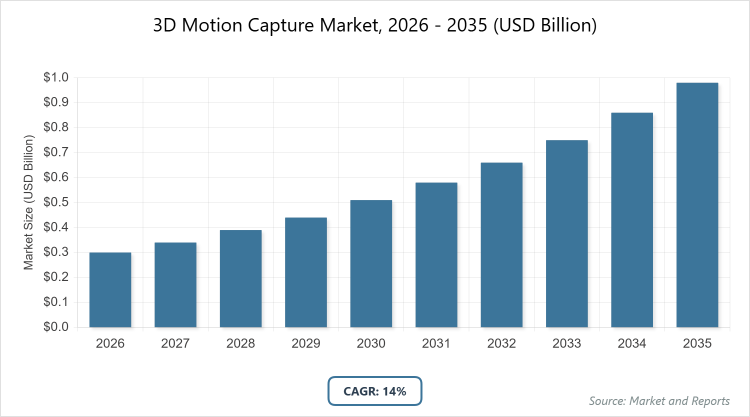
According to MarketnReports, the global 3D Motion Capture market size was estimated at USD 0.3 billion in 2025 and is expected to reach USD 1.1 billion by 2035, growing at a CAGR of 14% from 2026 to 2035. 3D Motion Capture Market is driven by increasing demand for realistic animations in entertainment and gaming.
What is the Industry Overview of the 3D Motion Capture Market?
The 3D motion capture market encompasses technologies that digitally record and analyze human or object movements in three dimensions, translating them into data for applications in animation, biomechanics, and virtual reality. This market involves hardware like cameras and sensors, software for data processing, and services for implementation. Market definition includes systems that capture precise spatial and temporal data of movements, enabling realistic digital representations across industries such as entertainment, where it facilitates lifelike character animations, and healthcare, where it aids in gait analysis and rehabilitation. The industry is characterized by advancements in markerless technology, reducing setup time and costs, and integration with AI for real-time processing, fostering innovation in immersive experiences.
What are the Key Insights into the 3D Motion Capture Market?
– The global 3D motion capture market was valued at USD 0.3 billion in 2025 and is projected to reach USD 1.1 billion by 2035.
- The market is expected to grow at a CAGR of 14% during the forecast period from 2026 to 2035.
- The market is driven by rising adoption in media & entertainment, sports biomechanics, and healthcare for precise movement analysis.
- In the type segment, optical systems dominated with a 63% share due to their high accuracy and widespread use in professional studios for capturing detailed movements without physical constraints.
- In the application segment, media & entertainment held the largest share at 35% owing to the demand for realistic animations in films, games, and virtual productions, which enhances visual effects and immersive storytelling.
- North America dominated the market with a 40% share, driven by advanced technological infrastructure, major entertainment hubs like Hollywood, and significant investments in R&D for motion capture innovations.
What are the Market Dynamics of the 3D Motion Capture Market?
Growth Drivers
The primary growth drivers for the 3D motion capture market include technological advancements in sensor technologies and AI integration, which enhance accuracy and enable real-time data processing. The surging demand for immersive content in gaming and virtual reality applications propels adoption, as these systems allow for lifelike character interactions and user experiences. Additionally, expanding applications in healthcare for biomechanical analysis and rehabilitation, coupled with the rise of sports analytics for performance optimization, fuel market expansion. Increasing investments in film and animation industries, particularly in emerging economies, further drive innovation and accessibility of motion capture solutions.
Restraints
High initial costs associated with advanced hardware and software pose significant restraints, limiting adoption among small-scale studios and independent creators. Data privacy concerns arise from capturing sensitive biometric information, leading to regulatory hurdles and hesitancy in sectors like healthcare. Integration challenges with existing workflows and legacy systems require substantial time and resources, deterring potential users. Moreover, the need for specialized expertise to operate and maintain these systems creates barriers, especially in regions with limited skilled workforce availability.
Opportunities
Opportunities abound in the expansion of markerless motion capture technologies, which eliminate the need for suits and markers, making systems more user-friendly and cost-effective for broader applications. The growing integration with AR/VR platforms opens avenues in education and training simulations, enhancing interactive learning experiences. Emerging markets in Asia Pacific present potential due to rapid digitalization in entertainment and sports sectors. Partnerships between tech firms and content creators can drive customized solutions, fostering innovation in real-time collaboration tools.
Challenges
Challenges include maintaining accuracy in diverse environments, such as outdoor settings or with multiple subjects, where lighting and occlusions can affect data quality. Rapid technological evolution demands continuous upgrades, straining budgets for users. Competition from low-cost alternatives and open-source software intensifies pricing pressures on established players. Ensuring interoperability across different systems and platforms remains a hurdle, complicating seamless data transfer and analysis in multi-vendor ecosystems.
3D Motion Capture Market: Report Scope
| Report Attributes | Report Details |
| Report Name | 3D Motion Capture Market |
| Market Size 2025 | USD 0.3 Billion |
| Market Forecast 2035 | USD 1.1 Billion |
| Growth Rate | CAGR of 14% |
| Report Pages | 220 |
| Key Companies Covered | Vicon Motion Systems Ltd., OptiTrack, Movella Inc., Motion Analysis Corporation, Qualisys AB, and Others |
| Segments Covered | By Type, By Application, By End-User, and By Region |
| Regions Covered | North America, Europe, Asia Pacific (APAC), Latin America, and The Middle East and Africa (MEA) |
| Base Year | 2025 |
| Historical Year | 2020 – 2024 |
| Forecast Year | 2026 – 2035 |
| Customization Scope | Avail customized purchase options to meet your exact research needs. |
What is the Market Segmentation of the 3D Motion Capture Market?
The 3D Motion Capture market is segmented by type, application, end-user, and region.
Based on Type Segment. The optical systems segment is the most dominant, holding a 63% share, due to its superior precision in capturing fine movements, which drives the market by enabling high-fidelity animations in entertainment and accurate biomechanical studies in sports. The non-optical systems segment is the second most dominant at 25%, offering portability and cost-effectiveness without markers, supporting market growth through applications in mobile healthcare and industrial robotics where setup flexibility is crucial.
Based on Application Segment. The media & entertainment segment dominates with 35%, propelled by the need for realistic visual effects in films and games, driving overall market expansion through enhanced content creation efficiency. The sports & biomechanics segment follows as second dominant at 20%, aiding athlete performance analysis and injury prevention, contributing to market growth by integrating with training programs for data-driven insights.
Based on End-User Segment. The film studios and game developers segment leads with 30%, leveraging motion capture for immersive storytelling and interactive experiences, fueling market advancement via streamlined production workflows. The healthcare and medical systems segment is second at 18%, utilizing the technology for rehabilitation and gait analysis, promoting market development through personalized treatment plans and improved patient outcomes.
What are the Recent Developments in the 3D Motion Capture Market?
- In April 2025, Southwest Research Institute launched BEAMoCap, a markerless motion capture system that converts standard video into realistic 3D animations without requiring suits, simplifying processes for film and gaming studios.
- In March 2024, DeepMotion introduced SayMotion, an AI-powered platform for animation creation, enhancing motion capture capabilities with voice-to-motion features for faster content development.
- In November 2023, Move Ai Ltd. released Move One, a single-camera motion capture app using iPhones to capture high-quality data anywhere, expanding accessibility for creators and educators.
- In September 2023, OptiTrack initiated the Educational MoCap Program to support motion capture adoption in schools and universities, providing tools for biomechanics and animation studies.
What is the Regional Analysis of the 3D Motion Capture Market?
North America to dominate the global market.
North America leads the market, driven by advanced infrastructure and major entertainment industries in the United States, which dominates the region with Hollywood’s demand for high-precision systems in film production and gaming.
Europe exhibits strong growth, with the United Kingdom as the dominating country, fueled by vibrant animation studios and sports analytics applications, supported by investments in VR/AR for education and healthcare.
Asia Pacific is the fastest-growing region, led by China, where rapid expansion in gaming, e-sports, and digital media production accelerates adoption, bolstered by technological advancements and increasing content creation demands.
Latin America shows emerging potential, with Brazil dominating due to growing film and animation sectors, enhanced by collaborations in sports biomechanics and affordable markerless solutions.
The Middle East and Africa region is developing, dominated by South Africa, driven by applications in education and healthcare, with investments in AR/VR for training and rehabilitation programs.
Who are the Key Market Players in the 3D Motion Capture Market?
- Vicon Motion Systems Ltd. focuses on high-precision optical systems, investing in AI integration for real-time tracking to maintain leadership in entertainment and biomechanics.
- OptiTrack emphasizes affordable, scalable solutions, partnering with educational institutions and expanding markerless tech to broaden accessibility in sports and VR applications.
- Movella Inc. (Xsens) specializes in inertial systems, pursuing mergers for sensor advancements and targeting healthcare with portable, suit-based motion capture strategies.
- Motion Analysis Corporation prioritizes biomechanical research tools, collaborating with sports teams for data analytics and innovating in hybrid systems for industrial use.
- Qualisys AB develops underwater and hybrid cameras, forming alliances in academia and defense for specialized applications like performance analysis.
- PhaseSpace, Inc. offers LED-based tracking, focusing on cost-effective expansions into robotics and AR, with strategies centered on miniaturization.
- Noitom Ltd. targets affordable inertial suits, partnering with NVIDIA for robotics integration and emphasizing cloud-based workflows for global scalability.
- Rokoko provides markerless solutions, acquiring startups for AI enhancements and targeting indie creators with subscription models.
- Noraxon USA concentrates on EMG-integrated systems for healthcare, investing in software for clinical data analysis and expanding through medical partnerships.
- Codamotion focuses on portable optical tech, collaborating in rehabilitation and pursuing certifications for medical device compliance.
What are the Market Trends in the 3D Motion Capture Market?
- Increasing adoption of markerless systems for easier setup and broader applications in mobile environments.
- Integration with AI and machine learning for real-time data processing and automated animation.
- Growing use in VR/AR for immersive training and gaming experiences.
- Expansion into healthcare for personalized rehabilitation and biomechanical analysis.
- Rise of portable, wearable devices reducing costs and enhancing accessibility.
- Emphasis on hybrid systems combining optical and inertial technologies for improved accuracy.
- Shift towards cloud-based platforms for collaborative workflows and data storage.
- Focus on sustainability with energy-efficient sensors and recyclable materials.
- Partnerships between tech firms and content creators for customized solutions.
- Advancements in high-resolution cameras for detailed facial and full-body capture.
What Market Segments and their Subsegments are Covered in the 3D Motion Capture Report?
By Type
-
Optical Systems
-
Inertial Systems
-
Electromagnetic Systems
-
Marker-Based Systems
-
Markerless Systems
-
Active Optical Systems
-
Passive Optical Systems
-
Hybrid Systems
-
Ultrasonic Systems
-
Motorized Systems
-
Others
By Application
- Media & Entertainment
- Sports & Biomechanics
- Industrial & Robotics
- Healthcare & Medical Systems
- Military & Defense
- Education
- Research & Academia
- AR/VR Development
- Gaming
- Animation
- Others
By End-User
- Film Studios
- Game Developers
- Sports Teams
- Hospitals & Clinics
- Research Institutes
- Manufacturing Companies
- Defense Organizations
- Educational Institutions
- Robotics Firms
- Animation Studios
- Others
By Region
- North America
- U.S.
- Canada
- Europe
- UK
- Germany
- France
- Rest of Europe
- Asia Pacific
- China
- India
- Japan
- Rest of Asia Pacific
- Latin America
- Brazil
- Mexico
- Rest of Latin America
- Middle East & Africa
- UAE
- South Africa
- Rest of Middle East & Africa
Frequently Asked Questions
3D motion capture refers to technologies that record and digitize movements in three dimensions for applications in animation, analysis, and simulation.
Key factors include technological advancements in AI and sensors, rising demand in entertainment and gaming, and expanding applications in healthcare and sports.
The market is projected to grow from USD 0.3 billion in 2025 to USD 1.1 billion by 2035.
The CAGR is expected to be 14% from 2026 to 2035.
North America will contribute notably, holding around 40% of the market share due to advanced infrastructure and entertainment industries.
Major players include Vicon Motion Systems Ltd., OptiTrack, Movella Inc., Motion Analysis Corporation, and Qualisys AB.
The report provides comprehensive analysis including market size, trends, segmentation, regional insights, key players, and forecasts.
Stages include hardware manufacturing, software development, system integration, data processing, application deployment, and end-user services.
Trends show a shift towards markerless and portable systems, with preferences for AI-integrated, real-time solutions in immersive applications.
Data privacy regulations like GDPR impact biometric data handling, while environmental concerns drive demand for energy-efficient and sustainable hardware.