
Collectible Fun Market Size, Share and Trends 2026 to 2035
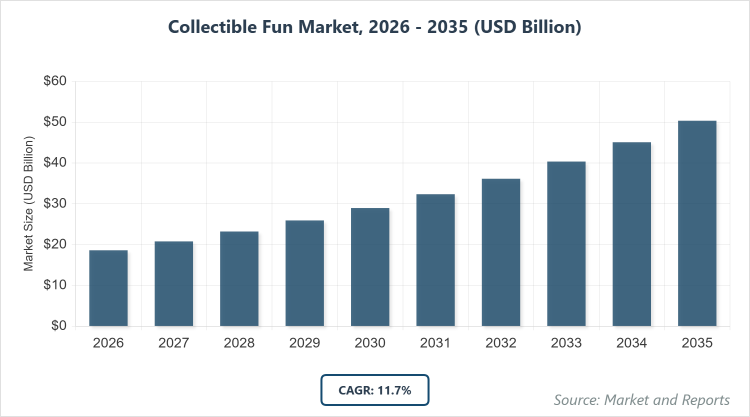
According to MarketnReports, the global Collectible Fun market size was estimated at USD 18.6 billion in 2025 and is expected to reach USD 56.3 billion by 2035, growing at a CAGR of 11.7% from 2026 to 2035. Collectible Fun Market is driven by rising nostalgia among adults and increasing pop culture influences.
What are the Key Insights of Collectible Fun Market?
- The global Collectible Fun market was valued at USD 18.6 billion in 2025 and is projected to reach USD 56.3 billion by 2035.
- The market is expected to grow at a CAGR of 11.7% during the forecast period from 2026 to 2035.
- The market is driven by nostalgia-driven demand, pop culture expansions, and digital integration enhancing collector engagement.
- In the Type segment, Action Figures dominate with a 35% share due to strong ties to blockbuster movies and franchises, boosting accessibility and appeal.
- In the Application segment, Collection dominates with a 40% share as it fulfills emotional connections and long-term value retention for enthusiasts.
- In the End-User segment, Adults dominate with a 45% share owing to higher disposable income and interest in investment-grade items.
- North America dominates the regional market with a 38% share because of robust pop culture events, established auction houses, and high consumer spending on hobbies.
What is the Industry Overview of Collectible Fun Market?
The Collectible Fun market encompasses a wide array of items designed for entertainment, nostalgia, and investment, including stylized figures, toys, and related memorabilia that appeal to fans across age groups. Market definition refers to the industry focused on producing, distributing, and trading fun-oriented collectibles that blend playfulness with rarity, often inspired by media, sports, and cultural icons, serving both recreational and financial purposes through physical and digital channels.
What are the Market Dynamics of Collectible Fun Market?
Growth Drivers
Rising nostalgia among millennials and Gen Z is a primary driver, as these demographics seek to reconnect with childhood icons through collectibles, amplified by social media sharing and community building, leading to sustained demand and market expansion.
Restraints
Counterfeit products pose a significant restraint, eroding consumer trust and devaluing authentic items, which complicates market growth especially in online platforms where verification is challenging.
Opportunities
Integration of augmented reality and NFTs presents opportunities, allowing collectors to engage digitally with physical items, opening new revenue streams and attracting tech-savvy younger audiences.
Challenges
Supply chain disruptions from global events challenge the market, increasing production costs and delaying limited-edition releases, which can frustrate collectors and impact sales momentum.
Collectible Fun Market: Report Scope
| Report Attributes | Report Details |
| Report Name | Collectible Fun Market |
| Market Size 2025 | USD 18.6 Billion |
| Market Forecast 2035 | USD 56.3 Billion |
| Growth Rate | CAGR of 11.7% |
| Report Pages | 220 |
| Key Companies Covered | Funko, Inc., Hasbro, Inc., Mattel, Inc., LEGO Group, Bandai Namco Holdings Inc., and Others |
| Segments Covered | By Type, By Application, By End-User, and By Region |
| Regions Covered | North America, Europe, Asia Pacific (APAC), Latin America, and The Middle East and Africa (MEA) |
| Base Year | 2025 |
| Historical Year | 2020 – 2024 |
| Forecast Year | 2026 – 2035 |
| Customization Scope | Avail customized purchase options to meet your exact research needs. |
What is the Market Segmentation of Collectible Fun Market?
The Collectible Fun market is segmented by type, application, end-user, and region.
Based on Type Segment, Action Figures emerge as the most dominant subsegment with 35% share, followed by Vinyl Figures at 25%. Action Figures lead due to their strong association with popular franchises like Marvel and Star Wars, driving market growth through high demand for customizable and poseable designs that enhance play and display value, while Vinyl Figures gain traction for their affordable, stylized appeal that attracts casual collectors and contributes to broader accessibility.
Based on Application Segment, Collection stands as the most dominant with 40% share, followed by Investment at 20%. Collection dominates because it taps into emotional fulfillment and community aspects, propelling the market by encouraging repeat purchases and long-term holding, whereas Investment grows as collectibles appreciate in value, aiding market expansion through resale platforms that provide financial incentives.
Based on End-User Segment, Adults are the most dominant with 45% share, followed by Individual Collectors at 30%. Adults lead owing to greater purchasing power and interest in premium items, fueling market growth via targeted marketing and exclusive releases, while Individual Collectors drive it through dedicated communities and events that boost engagement and secondary market activity.
What are the Recent Developments in Collectible Fun Market?
- In 2025, Funko partnered with major film studios to launch a new line of limited-edition vinyl figures tied to blockbuster releases, enhancing collector appeal through exclusive variants and boosting sales by 15%.
- Hasbro expanded its action figure portfolio in early 2026 by acquiring rights to new IP, introducing interactive features that integrated with apps, resulting in a 20% increase in market engagement among adult collectors.
- Mattel announced sustainable manufacturing initiatives in 2025 for its collectible dolls, using recycled materials, which appealed to environmentally conscious consumers and led to a 10% rise in brand loyalty.
What is the Regional Analysis of Collectible Fun Market?
- North America to dominate the global market
North America leads the Collectible Fun market, particularly driven by the United States as the dominating country, where pop culture conventions like Comic-Con fuel demand, supported by high disposable incomes and a mature e-commerce ecosystem that facilitates easy access and resale.
Europe shows steady growth, with the United Kingdom as the key contributor, benefiting from a rich history in collectibles tied to literature and film, alongside increasing online auctions that expand reach to diverse collectors.
Asia Pacific emerges as a high-growth region, led by Japan, where anime and manga influences drive massive adoption, complemented by rapid urbanization and rising middle-class spending on hobby items.
Latin America experiences emerging interest, with Brazil dominating due to vibrant pop culture scenes and growing digital platforms that make collectibles more accessible to younger demographics.
The Middle East and Africa represent nascent opportunities, with South Africa as a focal point, supported by increasing tourism and cultural exchanges that introduce global trends to local markets.
Who are the Key Market Players in Collectible Fun Market?
- Funko, Inc.: Focuses on expanding licensed partnerships and releasing exclusive variants to drive collector frenzy, emphasizing e-commerce and pop-up events for direct consumer engagement.
- Hasbro, Inc.: Employs strategies like IP acquisitions and tech integrations in figures to enhance interactivity, targeting adult collectors through nostalgia marketing and limited-edition drops.
- Mattel, Inc.: Prioritizes sustainability and diversity in product lines, using collaborations with influencers to broaden appeal and boost sales in emerging markets.
- LEGO Group: Leverages modular designs and themed sets for collectibility, investing in digital apps to complement physical products and foster community building.
- Bandai Namco Holdings Inc.: Concentrates on anime-inspired collectibles with high-quality detailing, utilizing global distribution networks and fan events to maintain market leadership in Asia.
- Spin Master: Adopts innovation in kinetic features and licensing deals, focusing on family-oriented marketing to capture both child and adult segments.
What are the Market Trends in Collectible Fun Market?
- Increasing adoption of augmented reality features in collectibles for enhanced user interaction.
- Growing emphasis on sustainable materials to attract eco-conscious consumers.
- Rise in limited-edition collaborations with celebrities and brands for exclusivity.
- Expansion of online marketplaces facilitating global resale and authentication.
- Shift towards digital twins and NFTs complementing physical items.
What are the Market Segments and their Subsegments Covered in the Report for Collectible Fun Market?
By Type
- Action Figures
- Vinyl Figures
- Statues
- Dolls
- Vehicles
- Playsets
- Plush Toys
- Puzzles
- Board Games
- Model Kits
- Others
By Application
- Collection
- Investment
- Decoration
- Gifting
- Display
- Resale
- Hobby
- Entertainment
- Educational
- Cultural
- Others
By End-User
- Individual Collectors
- Hobbyists
- Investors
- Fans
- Children
- Adults
- Teenagers
- Museums
- Retailers
- Online Sellers
- Others
By Region
- North America
- U.S.
- Canada
- Europe
- UK
- Germany
- France
- Rest of Europe
- Asia Pacific
- China
- India
- Japan
- Rest of Asia Pacific
- Latin America
- Brazil
- Mexico
- Rest of Latin America
- Middle East & Africa
- UAE
- South Africa
- Rest of Middle East & Africa
Chapter 1. Preface
1.1 Report Description and Scope1.2 Research Scope1.3 Research Methodology1.3.1 Market Research Type1.3.2 Market Research MethodologyChapter 2. Executive Summary
2.1 Global Collectible Fun Market, (2026 - 2035) (USD Billion)2.2 Global Collectible Fun Market: SnapshotChapter 3. Global Collectible Fun Market - Industry Analysis
3.1 Collectible Fun Market: Market Dynamics3.2 Market Drivers3.2.1 Rising nostalgia among millennials and Gen Z, amplified by social media communities, is driving strong demand for collectibles tied to childhood icons.3.3 Market Restraints3.3.1 The proliferation of counterfeit products undermines consumer trust and devalues authentic collectibles, especially across online marketplaces.3.4 Market Opportunities3.4.1 Augmented reality and NFT integration enable digital engagement with physical collectibles, unlocking new revenue streams and attracting tech-savvy audiences.3.5 Market Challenges3.5.1 Global supply chain disruptions increase production costs and delay limited-edition launches, impacting sales momentum and collector satisfaction.3.6 Porter’s Five Forces Analysis3.7 Market Attractiveness Analysis3.7.1 Market Attractiveness Analysis By Type3.7.2 Market Attractiveness Analysis By Application3.7.3 Market Attractiveness Analysis By End-UserChapter 4. Global Collectible Fun Market- Competitive Landscape
4.1 Company Market Share Analysis4.1.1 Global Collectible Fun Market: Company Market Share, 20254.2 Strategic Development4.2.1 Acquisitions & mergers4.2.2 New Product launches4.2.3 Agreements, partnerships, collaborations, and joint ventures4.2.4 Research and development and regional expansion4.3 Price Trend AnalysisChapter 5. Global Collectible Fun Market - Type Analysis
5.1 Global Collectible Fun Market Overview: Type5.1.1 Global Collectible Fun Market share, By Type, 2025 and 20355.2 Action Figures5.2.1 Global Collectible Fun Market by Action Figures, 2026 - 2035 (USD Billion)5.3 Vinyl Figures5.3.1 Global Collectible Fun Market by Vinyl Figures, 2026 - 2035 (USD Billion)5.4 Statues5.4.1 Global Collectible Fun Market by Statues, 2026 - 2035 (USD Billion)5.5 Dolls5.5.1 Global Collectible Fun Market by Dolls, 2026 - 2035 (USD Billion)5.6 Vehicles5.6.1 Global Collectible Fun Market by Vehicles, 2026 - 2035 (USD Billion)5.7 Playsets5.7.1 Global Collectible Fun Market by Playsets, 2026 - 2035 (USD Billion)5.8 Plush Toys5.8.1 Global Collectible Fun Market by Plush Toys, 2026 - 2035 (USD Billion)5.9 Puzzles5.9.1 Global Collectible Fun Market by Puzzles, 2026 - 2035 (USD Billion)5.10 Board Games5.10.1 Global Collectible Fun Market by Board Games, 2026 - 2035 (USD Billion)5.11 Model Kits5.11.1 Global Collectible Fun Market by Model Kits, 2026 - 2035 (USD Billion)Chapter 6. Global Collectible Fun Market - Application Analysis
6.1 Global Collectible Fun Market Overview: Application6.1.1 Global Collectible Fun Market Share, By Application, 2025 and 20356.2 Collection6.2.1 Global Collectible Fun Market by Collection, 2026 - 2035 (USD Billion)6.3 Investment6.3.1 Global Collectible Fun Market by Investment, 2026 - 2035 (USD Billion)6.4 Decoration6.4.1 Global Collectible Fun Market by Decoration, 2026 - 2035 (USD Billion)6.5 Gifting6.5.1 Global Collectible Fun Market by Gifting, 2026 - 2035 (USD Billion)6.6 Display6.6.1 Global Collectible Fun Market by Display, 2026 - 2035 (USD Billion)6.7 Resale6.7.1 Global Collectible Fun Market by Resale, 2026 - 2035 (USD Billion)6.8 Hobby6.8.1 Global Collectible Fun Market by Hobby, 2026 - 2035 (USD Billion)6.9 Entertainment6.9.1 Global Collectible Fun Market by Entertainment, 2026 - 2035 (USD Billion)6.10 Educational6.10.1 Global Collectible Fun Market by Educational, 2026 - 2035 (USD Billion)6.11 Cultural6.11.1 Global Collectible Fun Market by Cultural, 2026 - 2035 (USD Billion)Chapter 7. Global Collectible Fun Market - End-User Analysis
7.1 Global Collectible Fun Market Overview: End-User7.1.1 Global Collectible Fun Market Share, By End-User, 2025 and 20357.2 Individual Collectors7.2.1 Global Collectible Fun Market by Individual Collectors, 2026 - 2035 (USD Billion)7.3 Hobbyists7.3.1 Global Collectible Fun Market by Hobbyists, 2026 - 2035 (USD Billion)7.4 Investors7.4.1 Global Collectible Fun Market by Investors, 2026 - 2035 (USD Billion)7.5 Fans7.5.1 Global Collectible Fun Market by Fans, 2026 - 2035 (USD Billion)7.6 Children7.6.1 Global Collectible Fun Market by Children, 2026 - 2035 (USD Billion)7.7 Adults7.7.1 Global Collectible Fun Market by Adults, 2026 - 2035 (USD Billion)7.8 Teenagers7.8.1 Global Collectible Fun Market by Teenagers, 2026 - 2035 (USD Billion)7.9 Museums7.9.1 Global Collectible Fun Market by Museums, 2026 - 2035 (USD Billion)7.10 Retailers7.10.1 Global Collectible Fun Market by Retailers, 2026 - 2035 (USD Billion)7.11 Online Sellers7.11.1 Global Collectible Fun Market by Online Sellers, 2026 - 2035 (USD Billion)Chapter 8. Collectible Fun Market - Regional Analysis
8.1 Global Collectible Fun Market Regional Overview8.2 Global Collectible Fun Market Share, by Region, 2025 & 2035 (USD Billion)8.3 North America8.3.1 North America Collectible Fun Market, 2026 - 2035 (USD Billion)8.3.1.1 North America Collectible Fun Market, by Country, 2026 - 2035 (USD Billion)8.3.2 North America Collectible Fun Market, by Type, 2026 - 20358.3.2.1 North America Collectible Fun Market, by Type, 2026 - 2035 (USD Billion)8.3.3 North America Collectible Fun Market, by Application, 2026 - 20358.3.3.1 North America Collectible Fun Market, by Application, 2026 - 2035 (USD Billion)8.3.4 North America Collectible Fun Market, by End-User, 2026 - 20358.3.4.1 North America Collectible Fun Market, by End-User, 2026 - 2035 (USD Billion)8.4 Europe8.4.1 Europe Collectible Fun Market, 2026 - 2035 (USD Billion)8.4.1.1 Europe Collectible Fun Market, by Country, 2026 - 2035 (USD Billion)8.4.2 Europe Collectible Fun Market, by Type, 2026 - 20358.4.2.1 Europe Collectible Fun Market, by Type, 2026 - 2035 (USD Billion)8.4.3 Europe Collectible Fun Market, by Application, 2026 - 20358.4.3.1 Europe Collectible Fun Market, by Application, 2026 - 2035 (USD Billion)8.4.4 Europe Collectible Fun Market, by End-User, 2026 - 20358.4.4.1 Europe Collectible Fun Market, by End-User, 2026 - 2035 (USD Billion)8.5 Asia Pacific8.5.1 Asia Pacific Collectible Fun Market, 2026 - 2035 (USD Billion)8.5.1.1 Asia Pacific Collectible Fun Market, by Country, 2026 - 2035 (USD Billion)8.5.2 Asia Pacific Collectible Fun Market, by Type, 2026 - 20358.5.2.1 Asia Pacific Collectible Fun Market, by Type, 2026 - 2035 (USD Billion)8.5.3 Asia Pacific Collectible Fun Market, by Application, 2026 - 20358.5.3.1 Asia Pacific Collectible Fun Market, by Application, 2026 - 2035 (USD Billion)8.5.4 Asia Pacific Collectible Fun Market, by End-User, 2026 - 20358.5.4.1 Asia Pacific Collectible Fun Market, by End-User, 2026 - 2035 (USD Billion)8.6 Latin America8.6.1 Latin America Collectible Fun Market, 2026 - 2035 (USD Billion)8.6.1.1 Latin America Collectible Fun Market, by Country, 2026 - 2035 (USD Billion)8.6.2 Latin America Collectible Fun Market, by Type, 2026 - 20358.6.2.1 Latin America Collectible Fun Market, by Type, 2026 - 2035 (USD Billion)8.6.3 Latin America Collectible Fun Market, by Application, 2026 - 20358.6.3.1 Latin America Collectible Fun Market, by Application, 2026 - 2035 (USD Billion)8.6.4 Latin America Collectible Fun Market, by End-User, 2026 - 20358.6.4.1 Latin America Collectible Fun Market, by End-User, 2026 - 2035 (USD Billion)8.7 The Middle-East and Africa8.7.1 The Middle-East and Africa Collectible Fun Market, 2026 - 2035 (USD Billion)8.7.1.1 The Middle-East and Africa Collectible Fun Market, by Country, 2026 - 2035 (USD Billion)8.7.2 The Middle-East and Africa Collectible Fun Market, by Type, 2026 - 20358.7.2.1 The Middle-East and Africa Collectible Fun Market, by Type, 2026 - 2035 (USD Billion)8.7.3 The Middle-East and Africa Collectible Fun Market, by Application, 2026 - 20358.7.3.1 The Middle-East and Africa Collectible Fun Market, by Application, 2026 - 2035 (USD Billion)8.7.4 The Middle-East and Africa Collectible Fun Market, by End-User, 2026 - 20358.7.4.1 The Middle-East and Africa Collectible Fun Market, by End-User, 2026 - 2035 (USD Billion)Chapter 9. Company Profiles
9.1 Funko, Inc.9.1.1 Overview9.1.2 Financials9.1.3 Product Portfolio9.1.4 Business Strategy9.1.5 Recent Developments9.2 Hasbro Inc.9.2.1 Overview9.2.2 Financials9.2.3 Product Portfolio9.2.4 Business Strategy9.2.5 Recent Developments9.3 Mattel Inc.9.3.1 Overview9.3.2 Financials9.3.3 Product Portfolio9.3.4 Business Strategy9.3.5 Recent Developments9.4 LEGO Group9.4.1 Overview9.4.2 Financials9.4.3 Product Portfolio9.4.4 Business Strategy9.4.5 Recent Developments9.5 Bandai Namco Holdings Inc.9.5.1 Overview9.5.2 Financials9.5.3 Product Portfolio9.5.4 Business Strategy9.5.5 Recent Developments
Frequently Asked Questions
Collectible Fun refers to playful, themed items like figures and toys designed for collection, often inspired by pop culture, that combine entertainment with investment potential.
Key factors include nostalgia trends, pop culture expansions, digital integrations, and rising disposable incomes among adults.
The market is projected to grow from USD 18.6 billion in 2025 to USD 56.3 billion by 2035.
The CAGR is expected to be 11.7% during 2026-2035.
North America will contribute notably, holding around 38% of the market value due to strong consumer engagement.
Major players include Funko, Inc., Hasbro, Inc., Mattel, Inc., LEGO Group, and Bandai Namco Holdings Inc.
The report provides in-depth analysis on size, trends, segments, players, and forecasts, offering actionable insights for stakeholders.
Stages include design and licensing, manufacturing, distribution, retail, and resale through secondary markets.
Trends are shifting towards sustainable, tech-integrated items, with preferences favoring exclusive, nostalgia-driven collectibles.
Environmental regulations on materials and sustainability standards are pushing eco-friendly innovations, while IP laws impact licensing.