
Agricultural Adjuvants Market Size, Share and Trends 2026 to 2035
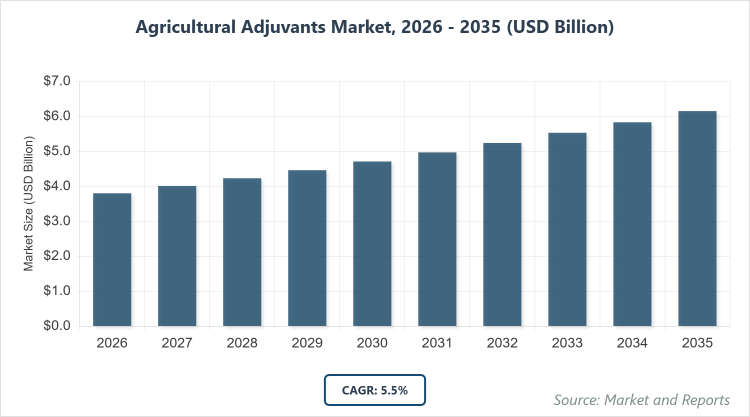
According to MarketnReports, the global Agricultural Adjuvants market size was estimated at USD 3.8 billion in 2025 and is expected to reach USD 6.5 billion by 2035, growing at a CAGR of 5.5% from 2026 to 2035. Agricultural Adjuvants Market is driven by the increasing need for enhanced crop protection and yield optimization.
What is Agricultural Adjuvants? An Industry Overview
Agricultural adjuvants are chemical formulations added to pesticides, herbicides, and fertilizers to improve their efficacy, such as enhancing spray coverage, penetration, or stability, without being active ingredients themselves. The market definition includes activators, surfactants, and utility adjuvants used to optimize agrochemical performance, reduce application rates, and minimize environmental impact, supporting sustainable farming practices while addressing challenges like pest resistance and weather variability to boost crop yields and farmer profitability in a global food security context.
What are the Key Insights of Agricultural Adjuvants Market?
- The global Agricultural Adjuvants market was valued at USD 3.8 billion in 2025 and is projected to reach USD 6.5 billion by 2035.
- The global Agricultural Adjuvants market is expected to grow at a CAGR of 5.5% during the forecast period 2026-2035.
- The Agricultural Adjuvants market is driven by rising demand for efficient crop protection products and sustainable farming practices.
- The activators subsegment dominates the type segment with a 40% share due to their role in enhancing pesticide efficacy and reducing application volumes.
- The herbicides subsegment dominates the application segment with a 50% share owing to widespread use in weed control for major crops.
- The cereals & grains subsegment dominates the crop type segment with a 45% share because of high global production volumes requiring adjuvants for yield protection.
- Asia Pacific dominates the global Agricultural Adjuvants market with a 40% share attributed to extensive agricultural activities and increasing adoption of modern farming techniques in China and India.
What are the Market Dynamics of Agricultural Adjuvants?
Growth Drivers
The agricultural adjuvants market is propelled by the escalating global food demand amid population growth to 9.7 billion by 2050, necessitating enhanced crop yields through efficient agrochemical use, where adjuvants improve absorption by 20-30% in variable weather. Regulatory pushes for reduced pesticide usage, like the EU’s Farm to Fork strategy aiming for 50% reduction by 2030, favor adjuvants that optimize lower doses, minimizing environmental impact. Technological advancements in bio-based adjuvants, derived from natural sources like vegetable oils, align with sustainable farming, attracting investments and enabling premium pricing in organic sectors.
Restraints
Stringent regulations on chemical adjuvants, such as EPA restrictions on volatile organic compounds, increase compliance costs and limit product availability, delaying market entry in developed regions. High R&D expenses for formulating effective, eco-friendly adjuvants, often exceeding USD 10 million per product, deter smaller players. Volatility in raw material prices, like surfactants from petroleum, affects profitability, while farmer resistance to new technologies in traditional markets slows adoption.
Opportunities
The rise of precision agriculture, integrating adjuvants with drone spraying for targeted application, offers opportunities to reduce waste by 40% and expand in tech-savvy farms. Emerging markets in Africa, with expanding arable land, present avenues for affordable adjuvants to boost yields, supported by international aid for sustainable practices. Partnerships for bio-adjuvants, like those using microbial derivatives, can tap into the organic food boom, creating premium segments in health-conscious consumers.
Challenges
Developing adjuvants compatible with diverse agrochemicals and crops requires extensive testing, increasing time-to-market amid climate variability affecting performance. Environmental concerns over non-biodegradable adjuvants demand reformulation, while counterfeit products in unregulated markets erode trust and revenue. Supply chain disruptions from global events affect ingredient availability, complicating just-in-time manufacturing for seasonal demands.
Agricultural Adjuvants Market: Report Scope
| Report Attributes | Report Details |
| Report Name | Agricultural Adjuvants Market |
| Market Size 2025 | USD 3.8 Billion |
| Market Forecast 2035 | USD 6.5 Billion |
| Growth Rate | CAGR of 5.5% |
| Report Pages | 220 |
| Key Companies Covered | BASF, Dow, Syngenta, Croda, Nufarm, Evonik, and Others |
| Segments Covered | By Type, By Application, By Crop Type, and By Region |
| Regions Covered | North America, Europe, Asia Pacific (APAC), Latin America, and The Middle East and Africa (MEA) |
| Base Year | 2025 |
| Historical Year | 2020 – 2024 |
| Forecast Year | 2026 – 2035 |
| Customization Scope | Avail customized purchase options to meet your exact research needs. |
The Agricultural Adjuvants market is segmented by type, application, crop type, and region.
Based on Type Segment: The activators segment is the most dominant, holding a 40% market share, as they enhance pesticide penetration and efficacy, driven by their versatility in various formulations. This dominance drives market growth by reducing chemical usage and improving crop protection outcomes. The surfactants segment is the second most dominant with a 30% share, aiding in spray spreading, which propels the market through better application efficiency.
Based on Application Segment: The herbicides segment is the most dominant, capturing a 50% share, due to the global need for weed management in large-scale farming. Its dominance accelerates market growth by supporting higher yields. The insecticides segment ranks second with a 25% share, addressing pest control, driving the market with integrated pest management.
Based on Crop Type Segment: The cereals & grains segment is the most dominant, with a 45% share, attributed to staple crop production volumes. This leads market growth by ensuring food security. The fruits & vegetables segment is second with a 30% share, requiring adjuvants for quality maintenance, propelling growth through export demands.
What are the Recent Developments in Agricultural Adjuvants Market?
- In 2025, BASF launched a new bio-based surfactant adjuvant for herbicide enhancement, reducing environmental impact.
- Dow introduced an activator formulation with improved rainfastness for crop protection in variable weather.
- Syngenta partnered with a biotech firm for microbial adjuvants targeting sustainable farming.
- Croda expanded its utility adjuvant line with drift control agents for precision application.
- Nufarm acquired a startup for oil concentrate adjuvants, focusing on herbicide efficiency.
What is the Regional Analysis of Agricultural Adjuvants Market?
- Asia Pacific to dominate the global market
Asia Pacific holds a 40% share in the Agricultural Adjuvants market, driven by intensive farming. China dominates, with massive crop production requiring adjuvants for yield optimization, supported by government subsidies.
North America maintains a strong position in the Agricultural Adjuvants market, fueled by precision ag. The United States leads, with BASF and Dow innovations for large farms.
Europe captures a notable share in the Agricultural Adjuvants market, propelled by sustainability. Germany dominates, with strict regulations driving bio-adjuvants.
Latin America is emerging in the Agricultural Adjuvants market, focusing on exports. Brazil leads, using adjuvants for soybean and corn protection.
The Middle East and Africa show potential in the Agricultural Adjuvants market, driven by irrigation advances. India is a key player, adopting for diverse crops.
Who are the Key Market Players and Strategies in Agricultural Adjuvants?
BASF focuses on bio-based innovations, launching surfactants for eco-friendly applications.
Dow emphasizes formulation advancements, partnering for rainfast adjuvants.
Syngenta prioritizes microbial partnerships, expanding sustainable lines.
Croda pursues drift control expansions, targeting precision farming.
Nufarm acquires for oil concentrates, focusing on herbicide synergies.
Evonik develops utility adjuvants, emphasizing compatibility agents.
What are the Market Trends in Agricultural Adjuvants?
- Shift toward bio-based and eco-friendly adjuvants for sustainability.
- Integration with precision agriculture for targeted application.
- Growth in activator formulations for reduced chemical usage.
- Expansion of surfactants in herbicide markets.
- Adoption of microbial adjuvants for organic farming.
- Focus on rainfast and drift-control technologies.
What are the Market Segments and their Subsegment Covered in the Agricultural Adjuvants Report?
By Type
-
- Activators
- Spray Modifiers
- Utility Adjuvants
- Surfactants
- Oil Concentrates
- Compatibility Agents
- Buffers
- Drift Control Agents
- Others
By Application
-
- Herbicides
- Insecticides
- Fungicides
- Plant Growth Regulators
- Others
By Crop Type
-
- Cereals & Grains
- Oilseeds & Pulses
- Fruits & Vegetables
- Others
By Region
-
- North America
- U.S.
- Canada
- Europe
- UK
- Germany
- France
- Rest of Europe
- Asia Pacific
- China
- India
- Japan
- Rest of Asia Pacific
- Latin America
- Brazil
- Mexico
- Rest of Latin America
- Middle East & Africa
- UAE
- South Africa
- Rest of Middle East & Africa
- North America
Chapter 1. Preface
Chapter 2. Executive Summary
Chapter 3. Global Agricultural Adjuvants Market - Industry Analysis
Chapter 4. Global Agricultural Adjuvants Market- Competitive Landscape
Chapter 5. Global Agricultural Adjuvants Market - Type Analysis
Chapter 6. Global Agricultural Adjuvants Market - Application Analysis
Chapter 7. Global Agricultural Adjuvants Market - Crop Type Analysis
Chapter 8. Agricultural Adjuvants Market - Regional Analysis
Chapter 9. Company Profiles
Frequently Asked Questions
Agricultural Adjuvants are additives that enhance the performance of pesticides and fertilizers without being active ingredients.
Key factors include sustainable farming demands, regulatory pressures, and crop protection needs.
The market is projected to grow from USD 4 billion in 2026 to USD 6.5 billion by 2035.
The market is expected to grow at a CAGR of 5.5% during 2026-2035.
Asia Pacific will contribute notably, holding a 40% share due to intensive agriculture.
Major players include BASF, Dow, Syngenta, Croda, Nufarm, and Evonik.
The report provides market size, trends, segmentation, regional insights, key players, and forecasts.
Stages include raw material sourcing, formulation, manufacturing, distribution, and application.
Trends favor bio-based adjuvants, with preferences for eco-friendly, efficient products.
Pesticide reduction regulations and sustainability drive bio-adjuvant adoption.