
Medical Ventilator Market Size, Share and Trends 2026 to 2035
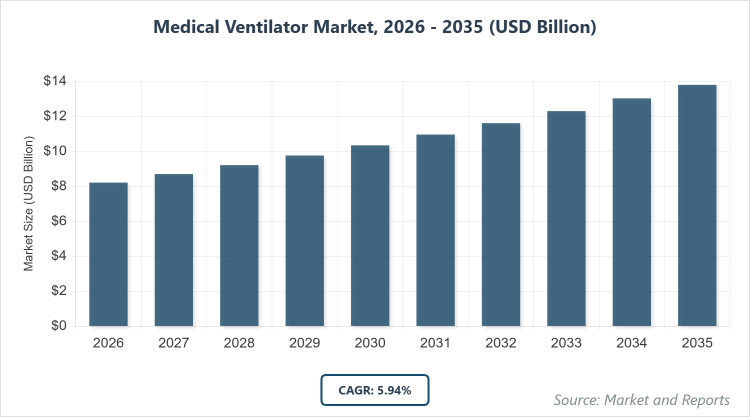
According to MarketnReports, the global Medical Ventilator market size was estimated at USD 8.21 billion in 2025 and is expected to reach USD 14.5 billion by 2035, growing at a CAGR of 5.94% from 2026 to 2035. The rising prevalence of respiratory diseases and advancements in ventilator technology.
What are the Key Insights into the medical ventilator market?
- The global medical ventilator market was valued at USD 8.21 billion in 2025 and is projected to reach USD 14.5 billion by 2035.
- The market is expected to grow at a CAGR of 5.94% during the forecast period from 2026 to 2035.
- The market is driven by the increasing prevalence of respiratory diseases, the rising geriatric population, and advancements in ventilator technology.
- The adult ventilators subsegment dominates the type segment with a 61% share due to the high incidence of respiratory issues in adults and the need for advanced support in critical care.
- The invasive ventilation subsegment dominates the interface segment with a 89% share because of its efficacy in severe cases requiring precise control over breathing parameters.
- The hospitals subsegment dominates the end-user segment with a 56% share owing to the concentration of critical care units and high patient volumes in hospital settings.
- North America dominates the regional segment with a 59% share attributed to advanced healthcare infrastructure, high prevalence of respiratory diseases, and strong presence of key manufacturers.
What is the Medical Ventilators?
Industry Overview
Medical ventilators are life-supporting devices designed to assist or replace spontaneous breathing in patients with respiratory failure, delivering controlled amounts of oxygen and air through various modes to maintain adequate ventilation. The market includes a variety of ventilators ranging from invasive to non-invasive types, used in critical care, emergency, and home settings to support patients with conditions like COPD, ARDS, and post-surgical recovery. Market definition encompasses all mechanical ventilators and associated accessories employed in healthcare facilities and homecare to provide respiratory support, enhancing patient outcomes in acute and chronic respiratory scenarios.
What are the Market Dynamics of Medical Ventilators?
Growth Drivers
The medical ventilator market is driven by the escalating prevalence of chronic respiratory diseases such as COPD, asthma, and pneumonia, exacerbated by aging populations and environmental factors, necessitating advanced ventilatory support in healthcare systems worldwide. Technological innovations, including AI-integrated ventilators that offer adaptive modes and remote monitoring, enhance patient outcomes and operational efficiency, fueling adoption in intensive care units. Government initiatives and increased healthcare spending, particularly post-COVID, have led to expanded critical care infrastructure, boosting demand for both invasive and non-invasive devices. Additionally, the shift towards home-based care for chronic patients drives the development of portable ventilators, supporting market growth through improved accessibility and cost-effectiveness.
Restraints
Restraints include the high costs associated with advanced ventilator systems and their maintenance, which can burden healthcare providers in resource-limited settings, limiting widespread adoption. Complications like ventilator-associated pneumonia and other infections pose clinical risks, leading to cautious usage and increased regulatory scrutiny. Stringent approval processes by bodies like the FDA delay market entry for new technologies, impacting innovation timelines. Moreover, supply chain vulnerabilities, highlighted during pandemics, affect component availability and pricing, constraining market expansion in volatile economic conditions.
Opportunities
Opportunities arise from the integration of artificial intelligence and IoT in ventilators, enabling predictive analytics and personalized ventilation strategies that improve efficacy and reduce complications. The growing demand for homecare solutions amid rising chronic disease burdens opens avenues for portable and user-friendly devices, particularly in emerging markets. Collaborations between manufacturers and healthcare providers can accelerate R&D for cost-effective, non-invasive options tailored to neonatal and pediatric care. Furthermore, expanding telemedicine capabilities presents potential for remote ventilator management, enhancing access in rural areas and driving market penetration.
Challenges
Challenges encompass ensuring patient safety amid risks of ventilator-induced lung injury, requiring ongoing advancements in protective ventilation strategies. The need for skilled healthcare professionals to operate complex devices leads to training gaps, especially in developing regions. Economic disparities hinder equitable access to high-end ventilators, exacerbating healthcare inequalities. Additionally, evolving regulatory landscapes demand continuous compliance, straining resources for smaller manufacturers in a competitive market.
Medical Ventilator Market: Report Scope
| Report Attributes | Report Details |
| Report Name | Medical Ventilator Market |
| Market Size 2025 | USD 8.21 Billion |
| Market Forecast 2035 | USD 14.5 Billion |
| Growth Rate | CAGR of 5.94% |
| Report Pages | 220 |
| Key Companies Covered |
Koninklijke Philips N.V., Hamilton Medical AG, Getinge AB, Medtronic, Vyaire Medical, Inc., and Others |
| Segments Covered | By Type, By Interface, By End-User, and By Region |
| Regions Covered | North America, Europe, Asia Pacific (APAC), Latin America, and The Middle East and Africa (MEA) |
| Base Year | 2025 |
| Historical Year | 2020 – 2024 |
| Forecast Year | 2026 – 2035 |
| Customization Scope | Avail customized purchase options to meet your exact research needs. |
What is the Market Segmentation of Medical Ventilators?
The Medical Ventilator market is segmented by type, interface, end-user, and region.
Based on Type Segment, adult ventilators emerge as the most dominant subsegment, followed by paediatric & neonatal ventilators as the second most dominant. Adult ventilators lead due to the higher prevalence of respiratory failures in adults from conditions like COPD and COVID-19, driving the market by addressing the bulk of critical care needs with versatile modes that support diverse patient profiles; paediatric & neonatal ventilators follow for their specialized designs catering to vulnerable infants, contributing to market growth through advancements in gentle ventilation techniques that improve survival rates in NICUs.
Based on the Interface Segment, invasive ventilation stands out as the most dominant subsegment, with non-invasive ventilation as the second most dominant. Invasive ventilation dominates because it provides precise control in severe cases like ARDS, driving market growth by enabling life-saving support in ICUs where non-invasive methods are insufficient; non-invasive ventilation follows for its reduced risk of infections and comfort in chronic care, propelling the market through broader adoption in home care and less acute settings.
Based on the end-user segment, hospitals are the most dominant subsegment, followed by specialty clinics as the second most dominant. Hospitals lead owing to the concentration of emergency and critical care services requiring advanced ventilators, driving market expansion by handling high-acuity patients and integrating new technologies; specialty clinics rank second for focused respiratory care, aiding market growth by offering outpatient ventilation solutions that alleviate hospital burdens.
What are the Recent Developments in the Medical Ventilator Market?
- In April 2021, Getinge AB received U.S. FDA approval for software and marketing approval for Servo-u MR ventilator, enhancing its portfolio for MRI-compatible ventilation.
- In June 2020, Medtronic partnered with Foxconn to manufacture Puritan Bennett 560 ventilators, ramping up production to meet global demand.
- In April 2020, Koninklijke Philips N.V. increased production capacity for hospital ventilators to address the surge in respiratory care needs.
What is the Regional Analysis of the Medical Ventilator Market?
- North America is expected to dominate the global market.
North America holds the largest market share, driven by the United States as the dominating country with its advanced healthcare systems and high incidence of respiratory diseases. Robust R&D investments and favorable reimbursement policies accelerate the adoption of innovative ventilators, supported by leading manufacturers and post-pandemic infrastructure enhancements.
Europe exhibits steady growth, led by Germany as the dominating country due to its strong medical device industry and emphasis on patient safety standards. EU-wide initiatives for healthcare digitization promote AI-integrated ventilators, enhancing efficiency in critical care across the region.
Asia Pacific is the fastest-growing region, with China as the dominating country owing to rapid healthcare expansion and aging demographics. Government efforts to improve hospital infrastructure and combat pollution-related respiratory issues drive ventilator demand, fostering local manufacturing and affordability.
Latin America shows emerging potential, dominated by Brazil with its increasing focus on public health and ICU expansions. Economic improvements and international aid support ventilator procurement, addressing gaps in respiratory care amid rising chronic diseases.
The Middle East and Africa experience moderate growth, led by South Africa with its advanced medical facilities and response to infectious diseases. Regional investments in healthcare and partnerships with global firms enhance access to ventilators, supporting critical care development.
Who are the Key Market Players in Medical Ventilators and Their Strategies?
- Koninklijke Philips N.V. focuses on expanding production capacities and innovating in non-invasive ventilation, leveraging partnerships to enhance global distribution.
- Hamilton Medical AG emphasizes R&D for intelligent ventilation modes, investing in AI to improve patient outcomes and market penetration.
- Getinge AB pursues regulatory approvals and capacity increases, forming alliances to strengthen its position in critical care solutions.
- Medtronic adopts collaboration strategies with manufacturers to scale production, while advancing portable ventilator technologies.
- Vyaire Medical, Inc. prioritizes donations and expansions in emerging markets, developing cost-effective devices for broader accessibility.
What are the Market Trends in Medical Ventilators?
- Shift towards non-invasive ventilation modes to reduce infection risks and improve patient comfort.
- Integration of AI and connectivity for real-time monitoring and adaptive ventilation.
- Growing demand for portable and home-use ventilators amid rising homecare needs.
- Emphasis on sustainable and energy-efficient designs in ventilator manufacturing.
- Adoption of telemedicine-enabled ventilators for remote patient management.
What Market Segments and Their Subsegments are Covered in the Medical Ventilator Report?
By Type
- Adult Ventilators
- Paediatric Ventilators
- Neonatal Ventilators
- Intensive Care Ventilators
- Portable Ventilators
- Transport Ventilators
- Invasive Ventilators
- Non-Invasive Ventilators
- Home Care Ventilators
- Emergency Ventilators
- Others
By Interface
- Invasive Ventilation
- Non-Invasive Ventilation
- CPAP
- BiPAP
- APAP
- High-Flow Nasal Cannula
- Volume-Controlled Ventilation
- Pressure-Controlled Ventilation
- Assist-Control Ventilation
- SIMV
- Others
By End-User
- Hospitals
- Specialty Clinics
- Homecare Settings
- Ambulatory Surgical Centers
- Long-Term Care Facilities
- Rehabilitation Centers
- Emergency Medical Services
- Neonatal Intensive Care Units
- Pediatric Intensive Care Units
- Adult Intensive Care Units
- Others
By Region
- North America
- U.S.
- Canada
- Europe
- UK
- Germany
- France
- Rest of Europe
- Asia Pacific
- China
- India
- Japan
- Rest of Asia Pacific
- Latin America
- Brazil
- Mexico
- Rest of Latin America
- Middle East & Africa
- UAE
- South Africa
- Rest of Middle East & Africa
Chapter 1. Preface
Chapter 2. Executive Summary
Chapter 3. Global Medical Ventilator Market - Industry Analysis
Chapter 4. Global Medical Ventilator Market- Competitive Landscape
Chapter 5. Global Medical Ventilator Market - Type Analysis
Chapter 6. Global Medical Ventilator Market - Interface Analysis
Chapter 7. Global Medical Ventilator Market - End-User Analysis
Chapter 8. Medical Ventilator Market - Regional Analysis
Chapter 9. Company Profiles
Frequently Asked Questions
Medical ventilators are mechanical devices that assist or replace breathing in patients with respiratory failure by delivering oxygen-enriched air.
Key factors include rising respiratory diseases, technological advancements, aging population, and expanding healthcare infrastructure.
The market is projected to grow from approximately USD 8.65 billion in 2026 to USD 14.5 billion by 2035.
The CAGR is expected to be 5.94% during the forecast period.
North America will contribute notably, holding around 59% of the market share due to advanced healthcare systems.
Major players include Koninklijke Philips N.V., Hamilton Medical AG, Getinge AB, Medtronic, and Vyaire Medical, Inc.
The report provides in-depth analysis of market size, trends, segmentation, regional insights, key players, and forecasts from 2026 to 2035.
The value chain includes raw material sourcing, manufacturing, assembly, distribution, installation, and after-sales service.
Trends are evolving towards AI-integrated, portable devices, with preferences for non-invasive, user-friendly options in homecare.
Stringent FDA approvals and environmental regulations on device manufacturing influence innovation and compliance costs.