
Nanotechnology in Chemicals Market Size, Share and Trends 2026 to 2035
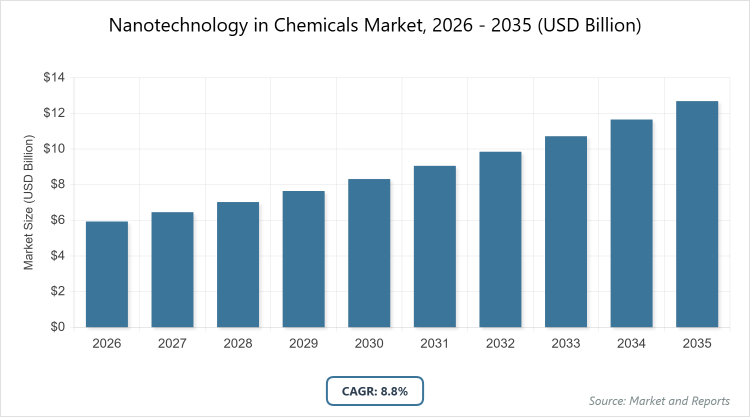
According to MarketnReports, the global Nanotechnology in Chemicals Market size was estimated at USD 5.94 billion in 2025 and is expected to reach USD 13.81 billion by 2035, growing at a CAGR of 8.8% from 2026 to 2035. Nanotechnology in Chemicals Market is driven by increasing demand from electronics, healthcare, and automotive sectors for advanced materials.
What are the Key Insights of the Nanotechnology in Chemicals Market?
- The global Nanotechnology in Chemicals Market was valued at USD 5.94 billion in 2025 and is projected to reach USD 13.81 billion by 2035.
- The Nanotechnology in Chemicals Market is anticipated to grow at a CAGR of 8.8% during the forecast period from 2026 to 2035.
- The Nanotechnology in Chemicals Market is driven by rising adoption in electronics and healthcare for enhanced material properties and efficiency.
- In the type segment, nanoparticles dominate with a 40% share due to their versatile applications in catalysis and drug delivery, offering high surface area and reactivity.
- In the application segment, electronics dominates with a 30% share because of the need for miniaturized components and improved conductivity in semiconductors.
- In the end-user segment, electronics & semiconductors dominate with a 35% share owing to the integration of nanomaterials for advanced chip fabrication and performance.
- Asia Pacific dominates the Nanotechnology in Chemicals Market with a 45% share attributed to rapid industrialization, government investments in R&D, and a strong manufacturing base in countries like China and India.
What is the Nanotechnology in Chemicals Market Industry Overview?
The Nanotechnology in Chemicals Market involves the application of nanoscale materials and processes to enhance chemical properties, enabling innovations in product performance, efficiency, and functionality across various industries. This market focuses on manipulating matter at the atomic and molecular levels to create chemicals with superior characteristics such as increased strength, conductivity, and reactivity. Market definition refers to the global industry dedicated to the production, distribution, and utilization of nanochemicals, including nanoparticles and nanocomposites, which integrate nanotechnology into traditional chemical formulations to address challenges in sustainability, energy efficiency, and advanced manufacturing while complying with evolving regulatory standards.
What are the Market Dynamics of the Nanotechnology in Chemicals Market?
Growth Drivers
The Nanotechnology in Chemicals Market is propelled by advancements in material science that enable the development of high-performance chemicals with enhanced properties, such as improved durability and efficiency, catering to demands in high-tech industries like electronics and automotive. Increasing investments in research and development by governments and private sectors accelerate innovation, leading to new applications in energy storage and environmental remediation. Additionally, the push for sustainable solutions drives adoption, as nanochemicals offer eco-friendly alternatives with reduced material usage and lower environmental impact, supporting global efforts toward green manufacturing and resource conservation.
Restraints
High production costs associated with nanotechnology processes, including specialized equipment and raw materials, limit accessibility for smaller enterprises and slow market penetration in cost-sensitive regions. Regulatory uncertainties and concerns over the safety and environmental impact of nanomaterials, such as potential toxicity, lead to stringent approval processes that delay commercialization. Moreover, technical challenges in scaling up production while maintaining quality and consistency hinder widespread adoption, impacting overall market growth despite promising applications.
Opportunities
The integration of nanotechnology in emerging fields like renewable energy and biomedicine presents avenues for creating advanced batteries and targeted drug delivery systems, attracting investments and fostering innovation. Expanding markets in developing economies offer untapped potential through localized manufacturing and collaborations, driven by rising industrial activities. Furthermore, advancements in AI and digital tools for nanomaterial design can optimize development processes, enabling faster market entry and customized solutions for diverse industry needs.
Challenges
Ensuring the safe handling and disposal of nanomaterials amid growing environmental scrutiny requires ongoing research and standardized protocols, complicating operations. Intellectual property issues and the need for skilled workforce in nanotechnology fields create barriers to entry and innovation. Additionally, supply chain vulnerabilities for rare raw materials used in nanochemicals pose risks to production stability, necessitating diversified sourcing strategies to maintain growth momentum.
Nanotechnology in Chemicals Market: Report Scope
| Report Attributes | Report Details |
| Report Name | Nanotechnology in Chemicals Market |
| Market Size 2025 | USD 5.94 Billion |
| Market Forecast 2035 | USD 13.81 Billion |
| Growth Rate | CAGR of 8.8% |
| Report Pages | 220 |
| Key Companies Covered |
BASF SE, Dow Inc., Evonik Industries AG, SABIC, DuPont de Nemours, Inc., 3M Company, and Others. |
| Segments Covered | By Type, By Application, By End-User, and By Region. |
| Regions Covered | North America, Europe, Asia Pacific (APAC), Latin America, and The Middle East and Africa (MEA) |
| Base Year | 2025 |
| Historical Year | 2020 - 2024 |
| Forecast Year | 2026 - 2035 |
| Customization Scope | Avail customized purchase options to meet your exact research needs. |
What is the Market Segmentation of the Nanotechnology in Chemicals Market?
The Nanotechnology in Chemicals Market is segmented by type, application, end-user, and region.
By Type Segment. Nanoparticles emerge as the most dominant subsegment, followed by nanotubes as the second most dominant. Nanoparticles lead due to their high surface-to-volume ratio enabling superior catalytic and reactive properties in chemical processes; this dominance drives the market by facilitating advancements in efficient energy conversion and pollution control, enhancing overall industry performance. Nanotubes rank second, valued for their exceptional strength and conductivity in composite materials, contributing to market growth through applications in lightweight structures and electronics that demand durability and efficiency.
By Application Segment. Electronics stands out as the most dominant subsegment, with healthcare as the second most dominant. Electronics' dominance stems from the critical use of nanochemicals in semiconductors and displays for miniaturization and performance enhancement, propelling the market by meeting the demand for faster and more efficient devices. Healthcare follows, leveraging nanochemicals for drug delivery and diagnostics, which advances the market by improving treatment precision and patient outcomes in medical applications.
By End-User Segment. Electronics & semiconductors is the most dominant subsegment, while pharmaceuticals & healthcare ranks as the second most dominant. Electronics & semiconductors lead because they require nanochemicals for advanced fabrication techniques, fueling market growth through innovation in high-tech components. Pharmaceuticals & healthcare comes second, utilizing nanochemicals for targeted therapies, which drives the market by addressing complex health challenges with precise solutions.
What are the Recent Developments in the Nanotechnology in Chemicals Market?
- BASF SE announced the launch of a new nanoparticle-based catalyst for industrial chemical processes, aimed at improving efficiency and reducing emissions in petrochemical applications.
- Dow Inc. partnered with a nanotechnology startup to develop advanced nanocomposites for automotive coatings, enhancing durability and scratch resistance.
- Evonik Industries AG invested in expanding its production capacity for nano-silica particles, targeting growth in the electronics and construction sectors.
- DuPont de Nemours, Inc. introduced a line of nano-enhanced polymers for sustainable packaging, focusing on biodegradability and performance.
- SABIC collaborated with research institutions to advance graphene-based materials for energy storage, supporting renewable energy initiatives.
What is the Regional Analysis of the Nanotechnology in Chemicals Market?
Asia Pacific to dominate the global market.
Asia Pacific holds the largest share in the Nanotechnology in Chemicals Market, driven by extensive manufacturing activities and supportive government policies for technological advancement. China, as the dominating country, leads with its massive investments in nanotechnology R&D and a robust electronics industry, fostering innovation and export growth.
North America follows with a strong emphasis on research and commercialization of nanochemicals. The United States dominates this region through its advanced technological ecosystem and funding for nanotechnology initiatives, enabling breakthroughs in healthcare and energy sectors.
Europe focuses on sustainable and regulatory-compliant nanotechnology applications. Germany stands out as the dominating country, renowned for its engineering prowess and investments in green nanochemicals, driving efficiency and environmental standards.
Latin America experiences growth from natural resource utilization and emerging industries. Brazil dominates, leveraging its agricultural and mining sectors to incorporate nanochemicals for enhanced productivity and sustainability.
The Middle East and Africa benefit from diversification efforts in petrochemicals. Saudi Arabia leads as the dominating country, using nanotechnology to optimize oil refining and develop advanced materials for downstream industries.
What are the Key Market Players and Strategies in the Nanotechnology in Chemicals Market?
BASF SE. BASF SE pursues strategies centered on innovation in sustainable nanochemicals, investing in R&D for eco-friendly catalysts and partnerships to expand applications in electronics and coatings.
Dow Inc. Dow Inc. focuses on portfolio expansion through acquisitions and collaborations, emphasizing nanomaterials for high-performance plastics and adhesives to meet industry demands for efficiency.
Evonik Industries AG. Evonik Industries AG leverages specialty nanochemicals, investing in production technologies and sustainability initiatives to strengthen its position in healthcare and energy markets.
SABIC. SABIC prioritizes advanced nanomaterials development, forming alliances for graphene and nanotube applications to enhance product performance in automotive and construction.
DuPont de Nemours, Inc. DuPont de Nemours, Inc. integrates nanotechnology in fibers and composites, strategizing on R&D for lightweight materials and sustainable solutions across sectors.
3M Company. 3M Company employs innovation in nano-enhanced products, focusing on adhesives and coatings with investments in global R&D to drive market leadership.
What are the Market Trends in the Nanotechnology in Chemicals Market?
- Growing adoption of nanoparticles for enhanced catalytic processes in chemical manufacturing to improve efficiency and reduce energy consumption.
- Increasing integration of nanotechnology in sustainable materials, focusing on biodegradable and eco-friendly chemicals amid regulatory pressures.
- Rising demand for nanochemicals in electronics for miniaturized components and improved conductivity in semiconductors.
- Emphasis on R&D for healthcare applications, including targeted drug delivery and diagnostic tools using nanomaterials.
- Expansion in emerging markets driven by government investments in nanotechnology for industrial and agricultural advancements.
- Heightened focus on safety and toxicity assessments to address regulatory concerns and build consumer trust.
What are the Market Segments and their Subsegments Covered in the Report?
By Type- Nanoparticles
- Nanotubes
- Nanofibers
- Nanocomposites
- Nano Titanium Dioxide
- Nano Zinc Oxide
- Nano Silver
- Graphene
- Quantum Dots
- Dendrimers
- Others
- Electronics
- Healthcare
- Automotive
- Energy
- Construction
- Paints & Coatings
- Adhesives & Sealants
- Personal Care
- Rubber
- Textiles
- Others
- Electronics & Semiconductors
- Pharmaceuticals & Healthcare
- Automotive & Transportation
- Energy & Power
- Construction & Building
- Paints & Coatings Industry
- Personal Care & Cosmetics
- Rubber & Plastics
- Aerospace & Defense
- Industrial Manufacturing
- Others
- North America
- U.S.
- Canada
- Europe
- UK
- Germany
- France
- Rest of Europe
- Asia Pacific
- China
- India
- Japan
- Rest of Asia Pacific
- Latin America
- Brazil
- Mexico
- Rest of Latin America
- Middle East & Africa
- UAE
- South Africa
- Rest of Middle East & Africa
Frequently Asked Questions
The Nanotechnology in Chemicals Market involves the use of nanoscale materials to enhance chemical properties and applications across industries.
Key factors include technological advancements, demand from electronics and healthcare, and government investments in R&D.
The market is projected to grow from USD 5.94 billion in 2026 to USD 13.81 billion by 2035.
The CAGR is expected to be 8.8% during this period.
Asia Pacific will contribute significantly, driven by industrialization and R&D in China and India.
Major players include BASF SE, Dow Inc., Evonik Industries AG, SABIC, DuPont de Nemours, Inc., and 3M Company.
The report provides comprehensive insights on market size, trends, segmentation, regional analysis, and strategies.
Stages include raw material sourcing, nanomaterial synthesis, formulation, distribution, and end-use application.
Trends shift toward sustainable nanomaterials, with preferences for eco-friendly and high-performance products.
Stringent safety regulations and environmental assessments for nanomaterials influence adoption and innovation.