
Breast Cancer Treatment Market Size, Share and Trends 2026 to 2035
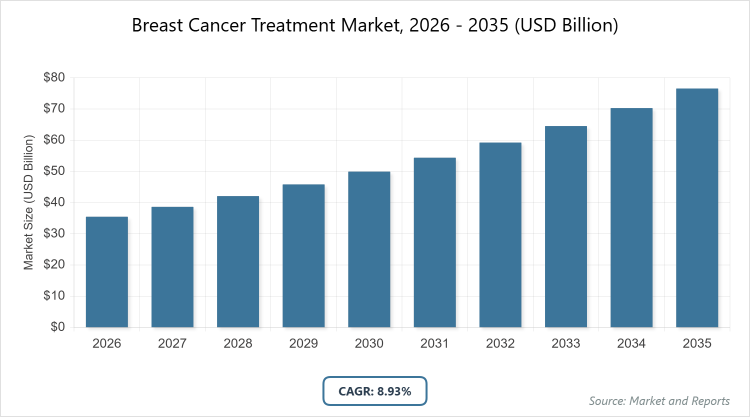
According to MarketnReports, the global Breast Cancer Treatment market size was estimated at USD 35.46 billion in 2025 and is expected to reach USD 90.86 billion by 2035, growing at a CAGR of 8.93% from 2026 to 2035. Breast Cancer Treatment Market is driven by advancements in targeted therapies, rising incidence rates, and increasing adoption of precision medicine.
What are the Key Insights of Breast Cancer Treatment Market?
- Market size valued at USD 35.46 billion in 2025 and projected to reach USD 90.86 billion by 2035
- CAGR of 8.93% during the forecast period 2026-2035
- Market is driven by increasing prevalence of breast cancer, advancements in targeted and immunotherapy, and growing awareness for early detection
- Targeted Therapy dominates the treatment type segment with 40% share due to its precision in attacking specific cancer cells while sparing healthy ones, leading to better outcomes and fewer side effects
- HR+ dominates the cancer type segment with 65% share as it responds well to hormonal therapies, which are cost-effective and widely available, supporting long-term management
- Hospitals dominate the end-user segment with 55% share owing to their comprehensive facilities for multidisciplinary care, including surgery and advanced therapies
- North America dominates with 40% market share attributed to advanced healthcare infrastructure, high R&D investments, and favorable reimbursement policies
What is Breast Cancer Treatment?
The breast cancer treatment market involves a comprehensive range of therapeutic interventions aimed at managing and eradicating breast cancer, encompassing surgical procedures, pharmacological agents, radiation techniques, and emerging immunotherapies tailored to specific cancer subtypes and stages. It includes diagnostics-driven approaches that personalize treatment based on molecular profiles, such as hormone receptor status or HER2 expression, to optimize efficacy and minimize side effects. The market definition refers to the ecosystem of drugs, devices, and services used in chemotherapy, targeted therapy, hormonal therapy, surgery, and supportive care, addressing the growing global burden of breast cancer through innovations in precision oncology, combination regimens, and minimally invasive methods that improve survival rates and quality of life for patients across early-stage to metastatic conditions.
What are the Market Dynamics in Breast Cancer Treatment?
Growth Drivers
The growth drivers in the breast cancer treatment market are fueled by the rising global incidence of breast cancer, driven by aging populations, lifestyle changes, and improved screening leading to earlier diagnoses that expand the treatable patient pool. Innovations in targeted therapies, such as antibody-drug conjugates and PARP inhibitors, offer more effective, less toxic alternatives to traditional chemotherapy, enhancing survival rates and attracting significant investments. Government initiatives and awareness campaigns promote early detection and access to advanced treatments, while collaborations between pharma companies and research institutions accelerate drug development pipelines. The integration of AI in diagnostics and personalized medicine further optimizes treatment regimens, reducing recurrence and supporting market expansion in both developed and emerging regions.
Restraints
Restraints in the breast cancer treatment market include the high costs of advanced therapies like immunotherapies and targeted drugs, which limit accessibility in low-income regions and strain healthcare budgets. Drug resistance in metastatic cases complicates long-term management, requiring ongoing R&D that increases development expenses. Regulatory hurdles and lengthy approval processes for novel treatments delay market entry, while side effects from aggressive regimens affect patient compliance. Limited infrastructure in developing countries hinders the adoption of sophisticated diagnostics and therapies, exacerbating disparities in outcomes.
Opportunities
Opportunities in the breast cancer treatment market stem from the expansion of precision oncology, where genomic profiling enables tailored therapies for subtypes like TNBC, opening avenues for new drug classes and companion diagnostics. Emerging markets in Asia Pacific present growth through rising healthcare expenditures and increasing screening programs. Advancements in combination therapies and biosimilars can reduce costs and improve access, while investments in vaccine development and liquid biopsies for early detection promise preventive breakthroughs. Partnerships for clinical trials in diverse populations can accelerate global approvals and diversify treatment options.
Challenges
Challenges in the breast cancer treatment market involve addressing drug resistance mechanisms, which necessitate continuous innovation in multi-drug regimens and biomarker research. Ensuring equitable access amid economic disparities requires policy interventions and affordable generics. The complexity of integrating new technologies like AI into clinical practice demands training and standardization. Ethical concerns in genetic testing and data privacy, along with managing long-term side effects from therapies, pose ongoing hurdles for patient-centered care.
Breast Cancer Treatment Market: Report Scope
| Report Attributes | Report Details |
| Report Name | Breast Cancer Treatment Market |
| Market Size 2025 | USD 35.46 Billion |
| Market Forecast 2035 | USD 90.86 Billion |
| Growth Rate | CAGR of 8.93% |
| Report Pages | 240 |
| Key Companies Covered | Roche Holding AG, Pfizer Inc., Novartis AG, AstraZeneca Plc, Eli Lilly and Company, Merck & Co., Inc., Gilead Sciences, Inc., Daiichi Sankyo Company, Limited, Bristol-Myers Squibb Company, Sanofi S.A., and Others |
| Segments Covered | By Treatment Type (Chemotherapy, Targeted Therapy, Hormonal Therapy, Immunotherapy, Radiation Therapy, Surgery, Combination Therapy, Biologic Therapy, Gene Therapy, Stem Cell Therapy, and Others), By Cancer Type (Hormone Receptor-Positive (HR+), HER2-Positive (HER2+), Triple-Negative Breast Cancer (TNBC), Ductal Carcinoma In Situ (DCIS), Invasive Ductal Carcinoma (IDC), Invasive Lobular Carcinoma (ILC), Metastatic Breast Cancer, Inflammatory Breast Cancer, Lobular Carcinoma In Situ (LCIS), Phyllodes Tumor, and Others), By End-User (Hospitals, Oncology Clinics, Ambulatory Surgical Centers, Cancer Research Institutes, Specialty Clinics, Diagnostic Centers, Homecare Settings, Retail Pharmacies, Online Pharmacies, Government Healthcare Facilities, and Others), and By Region |
| Regions Covered | North America, Europe, Asia Pacific (APAC), Latin America, and The Middle East and Africa (MEA) |
| Base Year | 2025 |
| Historical Year | 2020 – 2024 |
| Forecast Year | 2026 – 2035 |
| Customization Scope | Avail customized purchase options to meet your exact research needs. |
How is the Breast Cancer Treatment Market Segmented?
The Breast Cancer Treatment market is segmented by treatment type, cancer type, end-user, and region.
Based on Treatment Type Segment. Targeted Therapy is the most dominant with 40% share, followed by Hormonal Therapy as the second most dominant at 30%. Targeted Therapy’s dominance results from its ability to specifically inhibit cancer growth pathways like HER2, driving the market by improving efficacy in subtypes with fewer adverse effects and enabling combination use for better survival; Hormonal Therapy supports as second dominant by effectively managing HR+ cancers through estrogen blockade, propelling growth via long-term oral administration that enhances patient adherence and reduces recurrence rates.
Based on Cancer Type Segment. HR+ is the most dominant with 65% share, followed by HER2+ at 20%. HR+’s leading position arises from its prevalence and responsiveness to endocrine therapies, driving market expansion through accessible, cost-effective treatments that prolong progression-free survival; HER2+ follows as second dominant with targeted agents like monoclonal antibodies, contributing to growth by addressing aggressive cases with high response rates and integrating with chemotherapy for comprehensive care.
Based on End-User Segment. Hospitals are the most dominant with 55% share, followed by Oncology Clinics at 25%. Hospitals dominate due to their capacity for integrated care including surgery and infusion therapies, propelling market growth by handling complex cases and facilitating multidisciplinary approaches; Oncology Clinics as second dominant offer specialized outpatient services, driving the market through efficient delivery of targeted drugs and monitoring, reducing hospital burdens.
What are the Recent Developments in Breast Cancer Treatment?
- In 2025, the FDA approved imlunestrant (Inluriyo™), a new oral selective estrogen receptor degrader for treating HR-positive/HER2-negative, ESR1-mutated advanced breast cancer, offering improved progression-free survival over existing therapies.
- In 2025, datopotamab deruxtecan received FDA approval for HR-positive metastatic breast cancer, demonstrating longer progression-free survival compared to chemotherapy in clinical trials.
- In late 2025, trastuzumab deruxtecan combined with pertuzumab was approved as a first-line treatment for HER2-positive metastatic breast cancer, marking the first major advancement in over a decade with significant improvements in outcomes.
- In 2025, vepdegestrant showed promising results in phase 3 trials for ESR1-mutated breast cancer, gaining fast-track designation for its oral administration and reduced side effects.
How is the Regional Analysis for Breast Cancer Treatment Market?
North America to dominate the global market.
North America dominates the breast cancer treatment market with advanced diagnostic technologies, high awareness levels, and robust reimbursement systems facilitating access to innovative therapies. The United States leads as the dominating country through substantial R&D funding, numerous clinical trials, and presence of key pharma companies driving approvals for targeted drugs.
Europe maintains strong growth supported by universal healthcare coverage and emphasis on personalized medicine under EU regulations. Germany dominates the region with its focus on biotechnology and high adoption of immunotherapies in comprehensive cancer centers.
Asia Pacific experiences rapid expansion due to increasing incidence, improving healthcare infrastructure, and government initiatives for screening. China dominates within the region with large patient populations and investments in biosimilars to make treatments affordable.
Latin America shows emerging potential through rising awareness and partnerships for drug access. Brazil leads the region with expanding oncology networks and adoption of cost-effective generics for hormonal therapies.
The Middle East and Africa lag but grow with investments in specialized facilities. The United Arab Emirates dominates through healthcare modernization and collaborations for advanced treatments in urban centers.
Who are the Key Market Players in Breast Cancer Treatment?
- Roche Holding AG leads with a portfolio including HER2-targeted therapies like Herceptin, focusing on biomarker-driven innovations and global clinical trials to expand indications.
- Pfizer Inc. emphasizes CDK4/6 inhibitors such as Ibrance, employing partnerships for combination therapies and market access strategies in emerging regions.
- Novartis AG specializes in PI3K inhibitors and hormonal agents, with growth through acquisitions and R&D in precision oncology for resistant subtypes.
- AstraZeneca Plc prioritizes PARP inhibitors like Lynparza, using collaborations for ADCs and regulatory fast-tracking to address unmet needs in TNBC.
- Eli Lilly and Company focuses on oral SERDs and immunotherapies, with strategies involving real-world evidence generation and patient support programs.
- Merck & Co., Inc. targets immunotherapy with Keytruda, employing biomarker testing integrations and expansions into early-stage treatments.
- Gilead Sciences, Inc. concentrates on ADCs like Trodelvy, with growth through label expansions and investments in manufacturing scalability.
- Daiichi Sankyo Company, Limited develops Enhertu for HER2-low cancers, focusing on global alliances for distribution and trial accelerations.
- Bristol-Myers Squibb Company advances checkpoint inhibitors, with strategies on combination regimens and health equity initiatives.
- Sanofi S.A. invests in biosimilars and novel biologics, emphasizing affordability and access in developing markets.
What are the Market Trends in Breast Cancer Treatment?
- Rise in antibody-drug conjugates for targeted delivery with reduced toxicity
- Adoption of oral SERDs for convenient hormone receptor-positive management
- Expansion of immunotherapy combinations for triple-negative subtypes
- Focus on PROTACs for degrading resistant estrogen receptors
- Growth in PI3K/AKT pathway inhibitors for mutated cancers
- Integration of AI for personalized treatment planning and predictions
- Emphasis on de-escalation strategies in radiation to minimize side effects
- Proliferation of biosimilars to improve affordability and access
- Advancements in liquid biopsies for real-time monitoring
- Shift toward vaccine development for preventive approaches
What Market Segments and Subsegments are Covered in the Breast Cancer Treatment Report?
By Treatment Type
- Chemotherapy
- Targeted Therapy
- Hormonal Therapy
- Immunotherapy
- Radiation Therapy
- Surgery
- Combination Therapy
- Biologic Therapy
- Gene Therapy
- Stem Cell Therapy
- Others
By Cancer Type
- Hormone Receptor-Positive (HR+)
- HER2-Positive (HER2+)
- Triple-Negative Breast Cancer (TNBC)
- Ductal Carcinoma In Situ (DCIS)
- Invasive Ductal Carcinoma (IDC)
- Invasive Lobular Carcinoma (ILC)
- Metastatic Breast Cancer
- Inflammatory Breast Cancer
- Lobular Carcinoma In Situ (LCIS)
- Phyllodes Tumor
- Others
By End-User
- Hospitals
- Oncology Clinics
- Ambulatory Surgical Centers
- Cancer Research Institutes
- Specialty Clinics
- Diagnostic Centers
- Homecare Settings
- Retail Pharmacies
- Online Pharmacies
- Government Healthcare Facilities
- Others
By Region
- North America
- U.S.
- Canada
- Europe
- UK
- Germany
- France
- Rest of Europe
- Asia Pacific
- China
- India
- Japan
- Rest of Asia Pacific
- Latin America
- Brazil
- Mexico
- Rest of Latin America
- Middle East & Africa
- UAE
- South Africa
- Rest of Middle East & Africa
Frequently Asked Questions
Breast cancer treatment encompasses various therapeutic modalities including surgery, chemotherapy, targeted therapy, and immunotherapy designed to eliminate or control cancerous cells in the breast.
Key factors include rising incidence, technological advancements in precision medicine, increasing awareness, and supportive government policies for research and access.
The market is projected to grow from approximately USD 38.63 billion in 2026 to USD 90.86 billion by 2035.
The CAGR is expected to be 8.93% during 2026-2035.
North America will contribute notably, holding around 40% of the market share due to advanced infrastructure and high investments.
Major players include Roche Holding AG, Pfizer Inc., Novartis AG, AstraZeneca Plc, Eli Lilly and Company, Merck & Co., Inc., Gilead Sciences, Inc., Daiichi Sankyo Company, Limited, Bristol-Myers Squibb Company, and Sanofi S.A.
The report provides detailed insights on market size, segmentation, trends, regional analysis, key players, and forecasts through 2035.
Stages include R&D and drug discovery, clinical trials and approvals, manufacturing and distribution, prescription and administration, and post-treatment monitoring.
Trends are shifting toward minimally invasive and personalized therapies, with preferences for oral drugs and treatments with fewer side effects.
Regulatory factors include accelerated approvals for breakthrough therapies, while environmental factors involve sustainable manufacturing practices to reduce waste.