
Circular Economy & Green Chemistry Market Size, Share and Trends 2026 to 2035
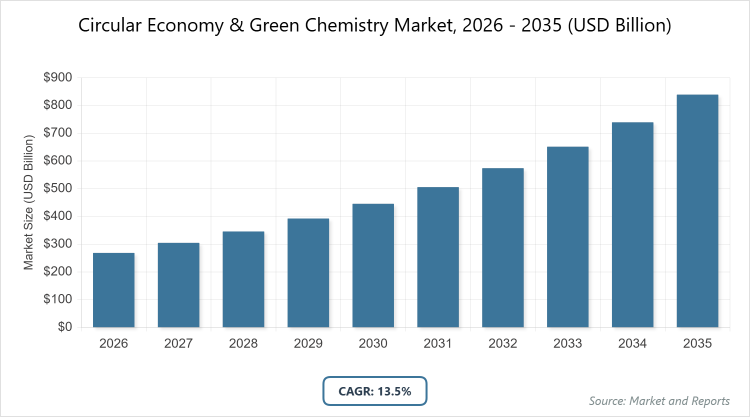
According to MarketnReports, the global Circular Economy & Green Chemistry Market size was estimated at USD 268.5 billion in 2025 and is expected to reach USD 921 billion by 2035, growing at a CAGR of 13.5% from 2026 to 2035. Circular Economy & Green Chemistry Market is driven by stringent environmental regulations and increasing adoption of sustainable practices across industries.
What are the Key Insights of the Circular Economy & Green Chemistry Market?
- The global Circular Economy & Green Chemistry Market was valued at USD 268.5 billion in 2025 and is projected to reach USD 921 billion by 2035.
- The Circular Economy & Green Chemistry Market is anticipated to grow at a CAGR of 13.5% during the forecast period from 2026 to 2035.
- The Circular Economy & Green Chemistry Market is driven by rising regulatory pressures for sustainability and corporate commitments to net-zero emissions.
- In the type segment, bio-based chemicals dominate with a 35% share due to their renewable sourcing and versatility in replacing fossil-based alternatives.
- In the application segment, packaging dominates with a 28% share because of the demand for recyclable and biodegradable materials to reduce plastic waste.
- In the end-user segment, manufacturing dominates with a 30% share owing to the need for efficient, low-waste processes in industrial production.
- Europe dominates the Circular Economy & Green Chemistry Market with a 40% share attributed to robust EU regulations like the Green Deal and strong focus on circularity in member states such as Germany.
What is the Circular Economy & Green Chemistry Market Industry Overview?
The Circular Economy & Green Chemistry Market focuses on the integration of principles that promote resource efficiency, waste reduction, and the use of environmentally benign processes in chemical production and usage. This market involves designing chemicals and systems that minimize hazardous substances, enable recycling and reuse, and utilize renewable feedstocks to create closed-loop systems. Market definition encompasses the global sector dedicated to innovative chemical solutions that align with circular economy models, including bio-based and recyclable materials, which aim to decouple economic growth from resource consumption while mitigating environmental impacts and fostering long-term sustainability in industrial operations.
What are the Market Dynamics of the Circular Economy & Green Chemistry Market?
Growth Drivers
The Circular Economy & Green Chemistry Market is accelerated by global commitments to sustainability, including corporate ESG goals and government policies promoting low-carbon technologies, which encourage the shift from linear to circular models. Innovations in biotechnology and advanced recycling techniques have made green alternatives more cost-effective, broadening their adoption in high-volume sectors like packaging and automotive. Furthermore, consumer demand for eco-friendly products and supply chain resilience drives investments in renewable feedstocks and waste-to-value processes, enhancing market expansion while addressing resource scarcity and environmental degradation.
Restraints
Challenges in scaling up circular processes, such as inconsistent supply of recycled materials and high costs of transitioning infrastructure, limit market penetration in developing regions. Regulatory fragmentation across countries creates compliance complexities for global players, slowing innovation deployment. Additionally, technical barriers in achieving performance parity with traditional chemicals in specialized applications hinder widespread substitution, impacting overall growth despite strong demand signals.
Opportunities
Advancements in digital tools for traceability and AI-driven process optimization offer potential to streamline circular supply chains and reduce operational costs. Emerging markets in Asia and Latin America present growth prospects through localized bio-economy initiatives and partnerships for technology transfer. Moreover, increasing funding from green finance mechanisms enables R&D in novel materials like bio-polymers, positioning companies to capture value from waste streams and align with global sustainability agendas.
Challenges
Standardizing metrics for circularity and green chemistry efficacy remains difficult, complicating comparisons and investment decisions across the value chain. Supply chain vulnerabilities, including dependency on agricultural feedstocks affected by climate variability, pose risks to reliability. Additionally, resistance from established industries accustomed to linear models requires education and incentives to foster adoption, while balancing economic viability with environmental benefits demands ongoing innovation.
Circular Economy & Green Chemistry Market: Report Scope
| Report Attributes | Report Details |
| Report Name | Circular Economy & Green Chemistry Market |
| Market Size 2025 | USD 268.5 Billion |
| Market Forecast 2035 | USD 921 Billion |
| Growth Rate | CAGR of 13.5% |
| Report Pages | 220 |
| Key Companies Covered |
BASF SE, Dow Inc., SABIC, Covestro AG, Solvay S.A., Veolia Environnement S.A., and Others. |
| Segments Covered | By Type, By Application, By End-User, and By Region. |
| Regions Covered | North America, Europe, Asia Pacific (APAC), Latin America, and The Middle East and Africa (MEA) |
| Base Year | 2025 |
| Historical Year | 2020 - 2024 |
| Forecast Year | 2026 - 2035 |
| Customization Scope | Avail customized purchase options to meet your exact research needs. |
What is the Market Segmentation of the Circular Economy & Green Chemistry Market?
The Circular Economy & Green Chemistry Market is segmented by type, application, end-user, and region.
By Type Segment. Bio-based chemicals emerge as the most dominant subsegment, followed by recycled chemicals as the second most dominant. Bio-based chemicals lead due to their derivation from renewable resources like biomass, which reduces carbon emissions and supports sustainable sourcing; this dominance drives the market by enabling the replacement of petroleum-based products, promoting energy independence, and aligning with regulatory incentives for low-impact materials. Recycled chemicals rank second, valued for transforming waste into valuable inputs through advanced processes, contributing to market growth by minimizing landfill use, conserving resources, and fostering closed-loop systems that enhance economic and environmental efficiency.
By Application Segment. Packaging stands out as the most dominant subsegment, with automotive as the second most dominant. Packaging's dominance stems from the urgent need for sustainable alternatives to single-use plastics, utilizing green chemistry for compostable and recyclable options; it propels the market by addressing consumer and regulatory demands for waste reduction, enabling brands to achieve circularity goals. Automotive follows, incorporating lightweight bio-materials and recycled compounds to improve fuel efficiency and reduce emissions; this advances the market by supporting the transition to electric vehicles and complying with stringent environmental standards.
By End-User Segment. Manufacturing is the most dominant subsegment, while consumer goods ranks as the second most dominant. Manufacturing leads because it integrates circular principles to optimize resource use and minimize waste in production lines, fueling market growth through cost savings and enhanced sustainability credentials. Consumer goods comes second, leveraging green chemistry for eco-friendly products like biodegradable packaging and non-toxic formulations, which drives the market by meeting rising demand for responsible consumption and brand differentiation.
What are the Recent Developments in the Circular Economy & Green Chemistry Market?
- In November 2025, Covestro received regulatory approval for its strategic partnership with XRG, involving USD 1.1 billion in capitalization to advance circular economy projects, including investments in recycled polymers.
- In January 2025, SABIC announced the use of its STAMAX long glass fiber polypropylene resin with 25% mechanically recycled content in the structural dashboard carrier of the CUPRA Terramar, enhancing automotive sustainability.
- In June 2025, Syensqo launched Miracare Biopacify, a biodegradable and microplastic-free opacifier for liquid laundry detergents, complying with upcoming European microplastics regulations.
- In 2025, the European Commission updated the Circular Economy Act to create demand for secondary materials and establish a single market for waste, supporting bio-economy strategies.
- Investment in advanced recycling scaled up, with over 9 million tons annually of announced pyrolysis capacity under development, primarily in Europe and North America.
What is the Regional Analysis of the Circular Economy & Green Chemistry Market?
Europe to dominate the global market.
Europe leads the Circular Economy & Green Chemistry Market, supported by comprehensive policies like the Green Deal and Circular Economy Action Plan that incentivize innovation and recycling. Germany, as the dominating country, excels with its advanced chemical industry and investments in green technologies, driving regional growth through R&D hubs and export of sustainable solutions.
Asia Pacific experiences rapid expansion due to industrialization and government initiatives for sustainable development. China dominates this region with large-scale bio-refineries and policies targeting carbon neutrality, fostering domestic production and global supply chain integration.
North America benefits from technological leadership and corporate sustainability commitments. The United States leads as the dominating country, utilizing incentives from the Inflation Reduction Act to advance green chemistry and circular practices in manufacturing.
Latin America grows through resource-rich bio-economies and emerging regulations. Brazil dominates, leveraging its biomass resources for renewable chemicals and supporting regional exports via sustainable agriculture integrations.
The Middle East and Africa focus on diversification from oil-based economies. Saudi Arabia stands out as the dominating country, investing in circular petrochemicals and partnerships to build downstream green industries.
What are the Key Market Players and Strategies in the Circular Economy & Green Chemistry Market?
BASF SE. BASF SE implements strategies emphasizing circularity through investments in bio-based and recycled materials, aiming for carbon neutrality by 2050 via partnerships and innovative process optimizations.
Dow Inc. Dow Inc. focuses on advanced recycling technologies and portfolio shifts to sustainable products, pursuing collaborations to enhance material circularity and reduce environmental footprints.
SABIC. SABIC prioritizes certified circular polymers and renewable feedstocks, expanding capacities through strategic alliances to meet global demands for eco-friendly chemical solutions.
Covestro AG. Covestro AG advances circular economy initiatives with recycled content integrations and bio-materials development, committing significant capital to sustainability projects.
Solvay S.A. Solvay S.A. leverages green chemistry for biodegradable solutions, investing in R&D to align with regulatory changes and consumer preferences for sustainable applications.
Veolia Environnement S.A. Veolia Environnement S.A. employs waste-to-resource strategies, enhancing recycling infrastructures and partnering for closed-loop systems in chemical value chains.
What are the Market Trends in the Circular Economy & Green Chemistry Market?
- Rising investments in advanced recycling technologies to scale up circular polymer production and reduce waste.
- Increasing regulatory frameworks promoting secondary materials and bio-economy strategies globally.
- Growing adoption of bio-based feedstocks to replace fossil fuels and lower carbon emissions.
- Emphasis on digital tools for supply chain traceability and optimization in circular processes.
- Expansion of corporate ESG commitments driving demand for green and recyclable chemicals.
- Heightened focus on innovation in safe and sustainable-by-design frameworks for chemical development.
What are the Market Segments and their Subsegments Covered in the Report?
By Type
- Bio-based Chemicals
- Recycled Chemicals
- Biodegradable Materials
- Green Solvents
- Biocatalysts
- Renewable Polymers
- Eco-friendly Additives
- Platform Chemicals
- Organic Acids
- Ketones
- Others
By Application
- Packaging
- Automotive
- Construction
- Textiles
- Pharmaceuticals
- Agriculture
- Electronics
- Food & Beverages
- Personal Care
- Industrial
- Others
By End-User
- Manufacturing
- Consumer Goods
- Automotive
- Building & Construction
- Healthcare
- Agriculture
- Electrical & Electronics
- Packaging
- Energy
- Textile
- Others
By Region
- North America
- U.S.
- Canada
- Europe
- UK
- Germany
- France
- Rest of Europe
- Asia Pacific
- China
- India
- Japan
- Rest of Asia Pacific
- Latin America
- Brazil
- Mexico
- Rest of Latin America
- Middle East & Africa
- UAE
- South Africa
- Rest of Middle East & Africa
Frequently Asked Questions
The Circular Economy & Green Chemistry Market involves sustainable chemical practices that emphasize resource efficiency, waste minimization, and renewable materials across industries.
Key factors include regulatory advancements, technological innovations in recycling, and corporate sustainability initiatives.
The market is projected to grow from USD 268.5 billion in 2026 to USD 921 billion by 2035.
The CAGR is expected to be 13.5% during this period.
Europe will contribute significantly, driven by the Green Deal and circular economy policies in Germany.
Major players include BASF SE, Dow Inc., SABIC, Covestro AG, Solvay S.A., and Veolia Environnement S.A.
The report provides detailed insights on market size, trends, segmentation, regional analysis, and key strategies.
Stages include renewable sourcing, green manufacturing, distribution, application, recycling, and waste valorization.
Trends shift toward bio-based innovations, with consumers prioritizing low-impact, recyclable products amid sustainability awareness.
Factors include EU directives on circularity, carbon pricing, and incentives for green technologies promoting adoption.