
Non-Hormonal Contraceptives Market Size, Share and Trends 2026 to 2035
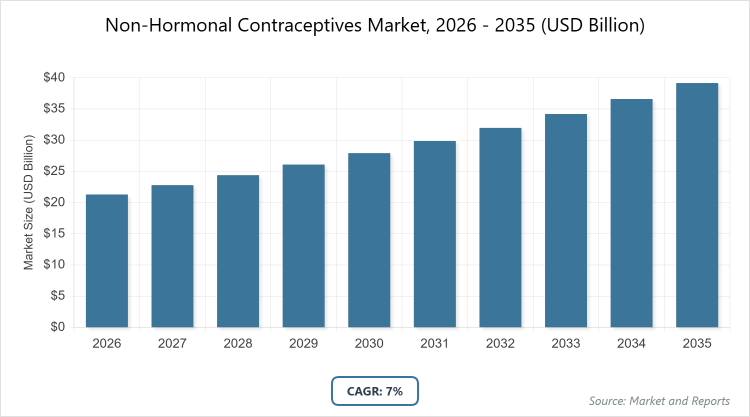
According to MarketnReports, the global Non-Hormonal Contraceptives Market size was estimated at USD 21.3 billion in 2025 and is expected to reach USD 42 billion by 2035, growing at a CAGR of 7% from 2026 to 2035. Non-Hormonal Contraceptives Market is driven by rising preference for hormone-free options and increasing awareness of side effects associated with hormonal methods.
What are the Key Insights into the Non-Hormonal Contraceptives Market?
- The global Non-Hormonal Contraceptives Market was valued at USD 21.3 billion in 2025.
- The market is projected to grow at a CAGR of 7% from 2026 to 2035.
- The Non-Hormonal Contraceptives Market is driven by increasing consumer preference for hormone-free alternatives, rising awareness of reproductive health, and government initiatives promoting safe sex practices.
- Condoms dominate the Product Type segment with approximately 50% share because of their dual role in preventing pregnancy and STDs, high accessibility without prescriptions, and widespread global adoption.
- Birth Control dominates the Application segment with around 45% share as it addresses the primary need for pregnancy prevention in a growing population seeking reliable, non-invasive methods.
- Retail Pharmacies dominate the End-User segment with over 40% share since they offer convenient over-the-counter access, privacy, and a broad range of affordable options for consumers.
- North America dominates the global market with 35% share due to advanced healthcare systems, high awareness levels, supportive reimbursement policies, and strong presence of key manufacturers in the United States.
What is the Industry Overview of the Non-Hormonal Contraceptives Market?
The Non-Hormonal Contraceptives Market comprises a variety of barrier, mechanical, and chemical methods designed to prevent pregnancy without altering hormonal balances, catering to individuals seeking alternatives to hormone-based options due to health concerns, side effects, or personal preferences. This market includes products like condoms, copper intrauterine devices, spermicides, and diaphragms that work through physical barriers, sperm immobilization, or other non-endocrine mechanisms to ensure effective contraception while often providing additional benefits such as STD protection. The market definition emphasizes safe, accessible, and user-friendly solutions that promote reproductive autonomy, align with diverse cultural and medical needs, and support global family planning initiatives amid growing demand for natural and minimally invasive birth control methods.
What are the Market Dynamics of the Non-Hormonal Contraceptives Market?
Growth Drivers
The Non-Hormonal Contraceptives Market is propelled by heightened consumer awareness of the potential side effects of hormonal methods, such as mood changes and cardiovascular risks, leading to a shift toward safer, natural alternatives that maintain hormonal equilibrium. Government campaigns for population control and STD prevention, coupled with innovations in product design for improved comfort and efficacy, further drive adoption, while expanding access in emerging economies through subsidized programs enhances market penetration and inclusivity.
Restraints
Restraints include limited effectiveness of some methods compared to hormonal options, requiring consistent user compliance which can lead to higher failure rates, and cultural or religious barriers in certain regions that discourage usage. Additionally, high upfront costs for devices like copper IUDs and supply chain issues in underdeveloped areas limit availability, while misinformation and lack of education hinder broader acceptance.
Opportunities
Opportunities exist in developing eco-friendly and sustainable products, such as biodegradable condoms and reusable barriers, to appeal to environmentally conscious consumers, alongside digital integration for tracking usage and efficacy. Expansion into male-focused non-hormonal options and partnerships with NGOs for distribution in low-income regions could tap into underserved markets, driven by rising demand for personalized and discreet contraception solutions.
Challenges
Challenges involve overcoming stigma around contraception in conservative societies, ensuring product quality amid counterfeit risks, and addressing accessibility gaps in rural areas. Regulatory variations across countries complicate global standardization, while competition from hormonal alternatives and the need for continuous innovation to improve user experience pose ongoing hurdles for sustained growth.
Non-Hormonal Contraceptives Market: Report Scope
| Report Attributes | Report Details |
| Report Name | Non-Hormonal Contraceptives Market |
| Market Size 2025 | USD 21.3 Billion |
| Market Forecast 2035 | USD 42 Billion |
| Growth Rate | CAGR of 7% |
| Report Pages | 220 |
| Key Companies Covered |
Bayer AG, Church & Dwight Co., CooperCompanies, and Others. |
| Segments Covered | By Product Type, By Application, By End-User, and By Region. |
| Regions Covered | North America, Europe, Asia Pacific (APAC), Latin America, and The Middle East and Africa (MEA) |
| Base Year | 2025 |
| Historical Year | 2020 - 2024 |
| Forecast Year | 2026 - 2035 |
| Customization Scope | Avail customized purchase options to meet your exact research needs. |
What is the Market Segmentation of the Non-Hormonal Contraceptives Market?
The Non-Hormonal Contraceptives Market is segmented by Product Type, Application, End-User, and region.
By Product Type Segment, Condoms represent the most dominant segment while Copper IUDs stand as the second most dominant. Condoms lead due to their affordability, ease of use without medical intervention, and added protection against infections, driving market growth by encouraging widespread adoption in both developed and developing regions through public health campaigns and over-the-counter availability.
By Application Segment, Birth Control is the most dominant segment followed by STD Prevention as the second most dominant. Birth Control dominates as it fulfills the core objective of family planning with reliable, non-invasive options, propelling market expansion by aligning with global efforts to reduce unintended pregnancies and empower users with control over reproductive choices.
By End-User Segment, Retail Pharmacies is the most dominant while Online Pharmacies constitute the second most dominant. Retail Pharmacies prevail owing to their immediate accessibility, expert advice, and discreet purchasing options, supporting market growth by facilitating high-volume sales and consumer education on product selection and usage.
What are the Recent Developments in the Non-Hormonal Contraceptives Market?
- In February 2025, Sebela Women's Health Inc. received FDA approval for MIUDELLA, a hormone-free copper intrauterine system offering up to three years of contraception, expanding options for long-term non-hormonal protection and addressing demand for shorter-duration IUDs.
- Major players like Bayer AG pursued grants from foundations in 2024 to advance research in novel non-hormonal methods, focusing on pre-clinical innovations to enhance efficacy and reduce side effects in barrier technologies.
- The launch of eco-friendly condom lines by companies such as Church & Dwight in late 2025 emphasized sustainable materials, appealing to environmentally aware consumers and boosting market penetration through green marketing strategies.
- Partnerships between Reckitt and NGOs in 2026 aimed at distributing free non-hormonal products in Asia Pacific regions, improving access and awareness to combat unintended pregnancies in underserved communities.
What is the Regional Analysis of the Non-Hormonal Contraceptives Market?
North America to dominate the global market
North America leads the Non-Hormonal Contraceptives Market, primarily driven by the United States with its comprehensive sex education programs, high consumer awareness, and robust retail distribution networks, bolstered by FDA approvals for innovative devices and strong emphasis on STD prevention amid rising infection rates.
Europe shows consistent growth, led by Germany and the UK, where progressive healthcare policies and EU-funded initiatives promote hormone-free options, integrating them into national family planning strategies to address diverse cultural preferences and aging populations.
Asia Pacific emerges as the fastest-growing region, spearheaded by India and China, fueled by massive population control efforts, government subsidies for condoms and IUDs, and urbanization shifting preferences toward convenient, affordable non-hormonal methods.
Latin America demonstrates potential, with Brazil and Mexico at the forefront through public health campaigns and private sector innovations, though economic inequalities and access barriers in rural areas slow uniform expansion.
The Middle East and Africa are progressively advancing, with South Africa and the UAE leading via international aid programs and investments in awareness, constrained by cultural norms but supported by WHO initiatives for reproductive health.
Who are the Key Market Players in the Non-Hormonal Contraceptives Market?
Bayer AG invests in R&D for advanced copper IUDs and barrier innovations, partnering with NGOs for global distribution to enhance accessibility and pursue sustainability-focused product lines.
Church & Dwight Co. emphasizes eco-friendly condom manufacturing and marketing campaigns targeting young consumers, leveraging e-commerce expansions to boost direct-to-consumer sales.
CooperCompanies focuses on clinical trials for next-generation non-hormonal devices, acquiring startups for technology integration to improve user comfort and efficacy.
Reckitt adopts digital health integrations for product tracking apps, collaborating with governments for subsidized programs in emerging markets to drive volume growth.
Veru Inc. prioritizes male contraception research alongside traditional offerings, using data analytics for personalized marketing strategies to capture niche segments.
What are the Market Trends in the Non-Hormonal Contraceptives Market?
- Growing demand for sustainable and biodegradable materials in condoms and barriers to appeal to eco-conscious users.
- Rise in male-focused non-hormonal options, including innovative gels and devices for shared responsibility.
- Integration of digital apps for usage reminders and efficacy tracking with non-hormonal methods.
- Expansion of over-the-counter availability and online sales for discreet purchasing.
- Emphasis on dual-protection products combining contraception with STD prevention.
- Increasing government subsidies and awareness campaigns in developing regions.
- Development of reusable and customizable barrier devices for enhanced user experience.
What Market Segments and their Subsegments are Covered in the Report?
By Product Type
- Condoms
- Copper IUDs
- Spermicides
- Diaphragms
- Cervical Caps
- Contraceptive Sponges
- Vaginal Rings
- Barrier Foams
- Contraceptive Films
- Sterilization Devices
- Others
By Application
- Birth Control
- STD Prevention
- Family Planning
- Temporary Contraception
- Permanent Contraception
- Reproductive Health Management
- Emergency Contraception
- Post-Coital Prevention
- Gynecological Protection
- Sexual Wellness
- Others
By End-User
- Retail Pharmacies
- Online Pharmacies
- Hospitals
- Clinics
- Home Use
- Specialty Stores
- Government Health Centers
- Non-Profit Organizations
- Community Clinics
- Drug Stores
- Others
By Region
- North America
- U.S.
- Canada
- Europe
- UK
- Germany
- France
- Rest of Europe
- Asia Pacific
- China
- India
- Japan
- Rest of Asia Pacific
- Latin America
- Brazil
- Mexico
- Rest of Latin America
- Middle East & Africa
- UAE
- South Africa
- Rest of Middle East & Africa
Frequently Asked Questions
The Non-Hormonal Contraceptives Market includes barrier, mechanical, and chemical methods to prevent pregnancy without hormones, such as condoms, copper IUDs, and spermicides, focusing on safety and dual protection.
Key factors include rising preference for hormone-free options, government family planning initiatives, increasing STD awareness, and innovations in sustainable products.
The market is expected to grow from approximately USD 21.3 billion in 2026 to USD 42 billion by 2035.
The CAGR is projected to be 7% during the forecast period.
North America will contribute notably, driven by high awareness, advanced distribution, and supportive policies in the United States.
Major players include Bayer AG, Church & Dwight Co., CooperCompanies, Reckitt, and Veru Inc.
The report provides in-depth analysis of size, segmentation, dynamics, trends, regional insights, competitive landscape, and future forecasts.
Stages include raw material sourcing, manufacturing, quality testing, distribution through pharmacies and clinics, and end-user education and support.
Trends favor sustainable and digital-integrated products, while consumers prefer discreet, effective, and hormone-free options for health and convenience.
Factors include FDA approvals for new devices, sustainability regulations on materials, and government policies promoting access and education.