
Smart Mobility Market Size, Share and Trends 2026 to 2035
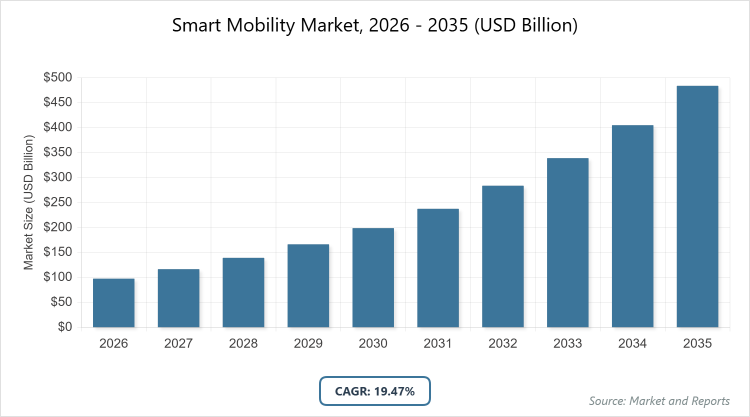
According to MarketnReports, the global Smart Mobility Market size was estimated at USD 97.59 Billion in 2025 and is expected to reach USD 578.05 Billion by 2035, growing at a CAGR of 19.47% from 2026 to 2035. Smart Mobility Market is driven by increasing urbanization and technological advancements in transportation.
What is Smart Mobility Industry Overview?
The smart mobility market encompasses innovative transportation solutions that integrate advanced technologies to enhance efficiency, sustainability, and user experience in urban and rural environments. It includes systems like ride-sharing platforms, autonomous vehicles, intelligent traffic management, and connected infrastructure designed to reduce congestion, lower emissions, and improve accessibility. Market definition: Smart mobility refers to the use of digital technologies, data analytics, and interconnected systems to optimize transportation modes, enabling seamless, on-demand, and eco-friendly mobility services that address modern challenges such as population growth and environmental concerns.
What are Smart Mobility Key Insights?
- The global smart mobility market was valued at USD 97.59 billion in 2025 and is projected to reach USD 578.05 billion by 2035.
- The market is expected to grow at a CAGR of 19.47% during the forecast period from 2026 to 2035.
- The market is driven by rapid urbanization, government initiatives for smart cities, and advancements in AI and IoT technologies.
- In the element segment, ride sharing dominates with a 35% share due to its convenience, cost-effectiveness, and widespread adoption through apps like Uber and Lyft, which reduce vehicle ownership needs and promote shared economy models.
- In the solution segment, traffic management dominates with a 30% share because it effectively alleviates urban congestion using real-time data and predictive analytics, leading to smoother traffic flow and reduced travel times.
- In the technology segment, IoT dominates with a 28% share owing to its ability to connect devices and infrastructure for seamless data exchange, enabling features like smart sensors and vehicle-to-everything communication.
- In the end-user segment, government dominates with a 40% share as public authorities invest heavily in infrastructure to support sustainable urban development and policy-driven initiatives.
- North America dominates the regional market with a 38% share, attributed to high technological adoption, significant investments in smart city projects, and presence of leading innovators like Tesla and Waymo.
What are Smart Mobility Market Dynamics?
Growth Drivers
Rapid urbanization is a primary growth driver, as cities worldwide face increasing population densities that strain traditional transportation systems, prompting the adoption of smart solutions like integrated mobility platforms to manage demand efficiently and reduce environmental impact through optimized routes and shared services.
Restraints
High initial implementation costs pose a significant restraint, particularly for developing regions where infrastructure upgrades require substantial capital investment in sensors, networks, and software, often deterring widespread adoption despite long-term benefits in efficiency and sustainability.
Opportunities
The integration of electric vehicles and 5G networks presents key opportunities, enabling faster data transmission for autonomous driving and charging infrastructure, which can expand market reach by supporting eco-friendly fleets and attracting investments from governments focused on carbon reduction goals.
Challenges
Regulatory and privacy concerns remain major challenges, as varying international standards for data security and vehicle autonomy create compliance hurdles, while public apprehension about data sharing in connected systems could slow consumer acceptance and market penetration.
Smart Mobility Market Report Scope
| Report Attributes | Report Details |
| Report Name | Smart Mobility Market |
| Market Size 2025 | USD 97.59 Billion |
| Market Forecast 2035 | USD 578.05 Billion |
| Growth Rate | CAGR of 19.47% |
| Report Pages | 220 |
| Key Companies Covered | Cisco Systems, Inc., Qualcomm Technologies, Inc., Siemens AG, IBM Corporation, TomTom International BV, Thales Group, Excelfore Corporation, Toyota Motor Corporation, Ford Motor Company, Robert Bosch GmbH, and Others |
| Segments Covered | By Element, By Solution, By Technology, By End-User, and By Region |
| Regions Covered | North America, Europe, Asia Pacific (APAC), Latin America, and The Middle East and Africa (MEA) |
| Base Year | 2025 |
| Historical Year | 2020 - 2024 |
| Forecast Year | 2026 - 2035 |
| Customization Scope | Avail customized purchase options to meet your exact research needs. |
What is Smart Mobility Market Segmentation?
The Smart Mobility Market is segmented by element, solution, technology, end-user, and region. All the segments have been analyzed based on present and future trends and the market is estimated from 2026 to 2035.
Based on Element Segment, The ride sharing subsegment is the most dominant, holding a 35% share, followed by car sharing as the second most dominant with 25%. Ride sharing's dominance stems from its scalability and user-friendly apps that offer affordable, on-demand transport, driving the market by reducing private car usage and emissions; car sharing complements this by providing flexible vehicle access without ownership, aiding market growth through urban space optimization and cost savings for users.
Based on Solution Segment, Traffic management is the most dominant subsegment with 30%, while parking management ranks second with 22%. Traffic management's lead is due to its use of AI-driven analytics for real-time congestion control, which drives the market by improving commute efficiency and safety; parking management supports this by utilizing sensors for space allocation, contributing to overall market expansion through reduced search times and integrated urban planning.
Based on Technology Segment, IoT dominates with 28%, and AI & ML is the second most dominant at 24%. IoT's prominence arises from enabling interconnected ecosystems for data collection and automation, propelling market growth via enhanced connectivity in vehicles and infrastructure; AI & ML bolsters this by providing predictive insights for decision-making, fostering innovation and efficiency in mobility services.
Based on End-User Segment, Government is the most dominant with 40%, followed by transportation operators at 25%. Government's dominance is driven by policy mandates and funding for smart initiatives, accelerating market growth through large-scale deployments; transportation operators contribute by adopting technologies for operational improvements, enhancing service quality and market competitiveness.
What are Recent Developments in Smart Mobility?
- In September 2025, Hyundai Motor Group launched the Next Urban Mobility Alliance (NUMA) to advance urban transportation with technologies like autonomous vehicles and integrated platforms, aiming to collaborate with global partners for sustainable mobility solutions.
- In September 2025, Dubai's Roads and Transport Authority introduced the Dubai Autonomous Zone, a 15-kilometer corridor for driverless vehicles and marine transport, targeting 25% autonomous trips by 2030 to enhance efficiency and reduce emissions.
- In April 2025, Smart Mobility International partnered with China's IM Motors to distribute electric vehicles in the UAE and Saudi Arabia, including after-sales and charging support to expand EV adoption in the region.
- In April 2025, Voi Technology collaborated with Wible in Spain to integrate e-scooters into a multi-modal app, allowing unified access to carsharing and micromobility for improved user convenience.
What is Smart Mobility Regional Analysis?
North America to dominate the global market.
North America leads the smart mobility market due to robust technological infrastructure and high investment in smart cities, with the United States as the dominating country driven by innovations from companies like Tesla and Waymo, extensive 5G networks, and government incentives for EV adoption that enhance connectivity and sustainability.
Europe exhibits strong growth through stringent environmental regulations and urban planning initiatives, with Germany dominating via automotive giants like Bosch and Siemens advancing autonomous tech and V2X systems, fostering integrated transport networks that reduce congestion and support EU green goals.
Asia Pacific is the fastest-growing region fueled by rapid urbanization and population density, where China dominates with massive investments in AI-driven traffic systems and EV infrastructure from firms like Huawei, enabling scalable solutions for mega-cities and aligning with national smart city ambitions.
Latin America shows emerging potential with increasing focus on sustainable transport, led by Brazil through public-private partnerships for ride-sharing and smart traffic in cities like Sao Paulo, addressing urban mobility challenges and promoting economic development.
The Middle East and Africa are gaining traction via oil diversification efforts, with the UAE dominating through projects like Dubai's autonomous zones and partnerships for EVs, leveraging wealth for advanced infrastructure to position as smart mobility hubs.
Who are Key Market Players in Smart Mobility?
Cisco Systems, Inc. Cisco focuses on IoT and networking solutions for connected vehicles and smart infrastructure, employing strategies like partnerships with cities for traffic management systems to enhance data security and scalability, driving revenue through cloud-based platforms.
Qualcomm Technologies, Inc. Qualcomm emphasizes 5G and V2X technologies for autonomous driving, using R&D investments and collaborations with automakers to integrate chipsets, aiming for market leadership in connectivity that supports real-time data exchange.
Siemens AG Siemens pursues integrated mobility solutions via digital twins and AI for rail and road systems, strategizing through acquisitions and smart city contracts to optimize energy efficiency and reduce downtime.
IBM Corporation IBM leverages Watson AI for predictive analytics in mobility intelligence, adopting hybrid cloud strategies and alliances with governments to provide data-driven insights for urban planning.
TomTom International BV TomTom specializes in GPS and mapping for navigation apps, focusing on data aggregation from users and partnerships with ride-sharing firms to improve accuracy and expand into autonomous vehicle mapping.
Thales Group Thales develops cybersecurity and signaling for transport networks, employing defense-tech transfers and international projects to secure connected ecosystems against threats.
Excelfore Corporation Excelfore targets over-the-air updates for vehicles, using agile development and OEM integrations to enable software-defined mobility, enhancing vehicle longevity and feature upgrades.
Toyota Motor Corporation Toyota invests in hybrid and autonomous tech through Woven City initiatives, strategizing global alliances for shared mobility to transition toward sustainable, zero-emission fleets.
Ford Motor Company Ford advances connected services via FordPass app and EV platforms, focusing on subscriptions and micromobility ventures to diversify beyond traditional sales.
Robert Bosch GmbH Bosch innovates in sensors and ADAS, pursuing electrification strategies and supplier networks to dominate in component supply for smart vehicles.
What are Smart Mobility Market Trends?
- Increasing adoption of autonomous vehicles transitioning from pilots to commercial deployments in urban areas.
- Growth in AI agents for personalized mobility services, enhancing user experience through predictive routing.
- Expansion of electric vehicle integration with smart charging infrastructure to support sustainability goals.
- Rise of Mobility-as-a-Service platforms combining multiple transport modes into unified apps.
- Emphasis on 5G-enabled V2X communication for improved safety and traffic efficiency.
- Focus on data privacy regulations influencing technology deployments in connected systems.
- Partnerships between automakers and tech firms for advanced driver-assistance systems.
What Market Segments and their Subsegments are Covered in the Smart Mobility Report?
- By Element
- Ride Sharing
- Car Sharing
- Bike Commuting
- Bike Sharing
- E-Scooters
- Autonomous Shuttles
- Demand Responsive Transport
- Public Transit Apps
- V2X Systems
- Smart Infrastructure
- Others
- By Solution
- Traffic Management
- Parking Management
- Mobility Management
- Infrastructure Management
- Telematics
- Fleet Management
- Toll Management
- Safety & Security
- Environmental Monitoring
- Data Analytics
- Others
- By Technology
- AI & ML
- IoT
- GPS
- RFID
- Embedded System
- 5G
- Cloud Computing
- Big Data
- Blockchain
- Sensors
- Others
- By End-User
- Government
- Municipal Sectors
- Business Development
- Academics
- Civil Work
- Transportation Operators
- Logistics
- Enterprises
- Consumers
- Automotive
- Others
By Region
-
- North America
- U.S.
- Canada
- Europe
- UK
- Germany
- France
- Rest of Europe
- Asia Pacific
- China
- India
- Japan
- Rest of Asia Pacific
- Latin America
- Brazil
- Mexico
- Rest of Latin America
- Middle East & Africa
- UAE
- South Africa
- Rest of Middle East & Africa
- North America
Frequently Asked Questions
The smart mobility market involves technology-driven transportation solutions that optimize movement, reduce emissions, and improve urban efficiency through interconnected systems and data analytics.
Key factors include urbanization, government smart city initiatives, advancements in AI and IoT, sustainability demands, and increasing EV adoption.
The market value is estimated at USD 97.59 billion in 2025 and projected to reach USD 578.05 billion by 2035.
The CAGR is expected to be 19.47% during 2026-2035.
North America will contribute notably, driven by technological innovation and infrastructure investments.
Major players include Cisco Systems, Inc., Qualcomm Technologies, Inc., Siemens AG, IBM Corporation, and Toyota Motor Corporation.
The report provides comprehensive analysis on size, trends, segments, players, and forecasts, offering insights for strategic decision-making.
Stages include technology development, infrastructure deployment, service integration, user adoption, and maintenance/optimization.
Trends lean toward sustainable, on-demand services with preferences for app-based, eco-friendly options like ride-sharing and EVs.
Regulations on emissions and data privacy, plus environmental pushes for green tech, are accelerating growth while posing compliance challenges.