
Biosensors Market Size, Share and Trends 2026 to 2035
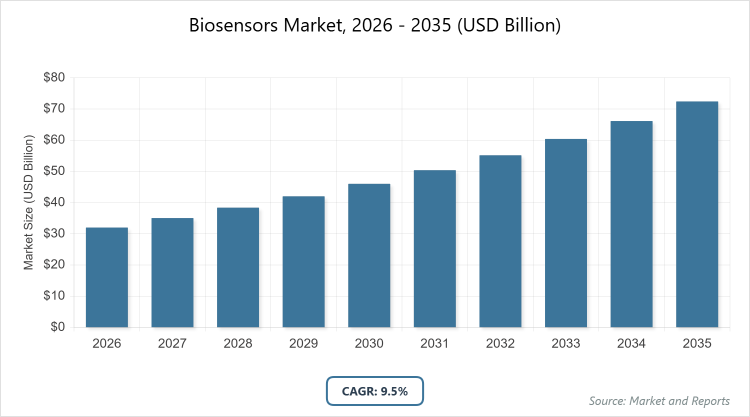
According to MarketnReports, the global Biosensors market size was estimated at USD 32 billion in 2025 and is expected to reach USD 75 billion by 2035, growing at a CAGR of 9.5% from 2026 to 2035. Biosensors Market is driven by the rising prevalence of chronic diseases and demand for point-of-care diagnostics.
What is Biosensors? An Industry Overview
Biosensors are analytical devices that combine a biological sensing element with a transducer to detect and quantify specific substances, such as glucose or pathogens, providing real-time, accurate measurements for applications in healthcare, environmental monitoring, and food safety. The market definition includes wearable, implantable, and non-invasive sensors utilizing technologies like electrochemical or optical methods to convert biological responses into electrical signals, enabling rapid diagnostics, continuous monitoring, and data-driven decisions to improve patient outcomes, ensure product quality, and comply with regulatory standards in a digitally transforming world.
What are the Key Insights of Biosensors Market?
- The global Biosensors market was valued at USD 32 billion in 2025 and is projected to reach USD 75 billion by 2035.
- The global Biosensors market is expected to grow at a CAGR of 9.5% during the forecast period 2026-2035.
- The Biosensors market is driven by technological advancements in wearable devices and increasing demand for home healthcare monitoring.
- The wearable biosensors subsegment dominates the type segment with a 45% share due to rising adoption in fitness and chronic disease management.
- The electrochemical biosensors subsegment dominates the technology segment with a 70% share owing to its cost-effectiveness and high sensitivity for glucose detection.
- The medical diagnostics subsegment dominates the application segment with a 60% share because of the need for rapid and accurate testing in healthcare.
- The point-of-care testing subsegment dominates the end-user segment with a 40% share attributed to convenience and immediate results in clinical settings.
- North America dominates the global Biosensors market with a 40% share due to advanced healthcare infrastructure and strong R&D investments in the U.S.
What are the Market Dynamics of Biosensors?
Growth Drivers
The biosensors market is propelled by the escalating prevalence of chronic diseases like diabetes, affecting over 500 million people globally, driving demand for continuous glucose monitoring systems that provide real-time data for better management. Technological innovations, such as nanotechnology and AI integration, enhance sensor sensitivity and miniaturization, enabling wearable devices for non-invasive testing, which reduces healthcare costs by up to 30% through early detection. Government initiatives, including funding for point-of-care diagnostics in programs like the U.S. NIH’s biosensor grants, further accelerate adoption, fostering collaborations between tech firms and healthcare providers to expand applications in remote monitoring and personalized medicine.
Restraints
High development and manufacturing costs for advanced biosensors, often exceeding USD 100,000 per prototype due to specialized materials and calibration, limit accessibility for small clinics and developing regions. Regulatory hurdles, such as lengthy FDA approval processes averaging 5-7 years, delay market entry and increase compliance burdens. Additionally, concerns over data accuracy in complex biological environments and sensor degradation over time reduce reliability, deterring widespread use in critical applications like implantable devices.
Opportunities
The integration of biosensors with IoT and mobile apps offers opportunities for remote health monitoring, potentially capturing a USD 50 billion telehealth market by enabling real-time data sharing with physicians. Emerging economies in Asia-Pacific present growth avenues through rising healthcare investments, where affordable wearable sensors can address underserved populations with chronic conditions. Partnerships for biosensor applications in food safety and environmental testing, such as detecting contaminants in water, can diversify revenue, leveraging blockchain for secure data traceability.
Challenges
Ensuring biosensor biocompatibility and long-term stability in vivo remains a challenge, as immune responses can degrade performance in implantable devices, requiring ongoing R&D in materials science. Data privacy and cybersecurity risks in connected sensors expose sensitive health information to breaches, necessitating robust encryption standards. Moreover, the lack of standardized protocols across regions complicates global scalability, while competition from alternative diagnostics like lab-based tests demands differentiation through innovation.
Biosensors Market: Report Scope
| Report Attributes | Report Details |
| Report Name | Biosensors Market |
| Market Size 2025 | USD 32 Billion |
| Market Forecast 2035 | USD 75 Billion |
| Growth Rate | CAGR of 9.5% |
| Report Pages | 220 |
| Key Companies Covered | Abbott, Dexcom, Medtronic, Siemens Healthineers, Roche, Nova Biomedical, and Others |
| Segments Covered | By Type, By Technology, By Application, By End-User, and By Region |
| Regions Covered | North America, Europe, Asia Pacific (APAC), Latin America, and The Middle East and Africa (MEA) |
| Base Year | 2025 |
| Historical Year | 2020 – 2024 |
| Forecast Year | 2026 – 2035 |
| Customization Scope | Avail customized purchase options to meet your exact research needs. |
The Biosensors market is segmented by type, technology, application, end-user, and region.
Based on Type Segment: The wearable biosensors segment is the most dominant, holding a 45% market share, as it caters to continuous monitoring needs in fitness and chronic care, driven by user-friendly designs and integration with smartphones. This dominance drives market growth by expanding consumer health applications. The non-wearable biosensors segment is the second most dominant with a 35% share, used in lab settings for precise diagnostics, propelling the market through clinical accuracy.
Based on Technology Segment: The electrochemical biosensors segment is the most dominant, capturing a 70% share, due to its affordability and high sensitivity for analytes like glucose. Its dominance accelerates market growth by enabling mass production for POC devices. The optical biosensors segment ranks second with a 20% share, offering non-invasive detection, driving the market with applications in environmental monitoring.
Based on Application Segment: The medical diagnostics segment is the most dominant, with a 60% share, attributed to the critical need for rapid testing in diseases like diabetes. This leads market growth by improving patient outcomes. The environmental monitoring segment is second with a 15% share, addressing pollution detection, propelling growth through regulatory compliance.
Based on End-User Segment: The point-of-care testing segment is the most dominant, holding a 40% share, as it provides immediate results in clinics. This dominance fosters market expansion by reducing hospital visits. The home healthcare diagnostics segment is second with a 30% share, enabling self-monitoring, driving the market with aging populations.
What are the Recent Developments in Biosensors Market?
- In 2025, Abbott launched an advanced continuous glucose monitor with AI integration for predictive alerts, enhancing diabetes management.
- Dexcom partnered with a tech firm to develop a non-invasive optical biosensor for sweat-based glucose detection.
- Medtronic expanded its implantable biosensors for cardiac monitoring, receiving FDA approval for extended battery life.
- Siemens Healthineers acquired a startup for piezoelectric sensors in environmental testing applications.
- Roche introduced a multiplex biosensor for simultaneous pathogen detection in food safety.
What is the Regional Analysis of Biosensors Market?
- North America to dominate the global market
North America holds a 40% share in the Biosensors market, driven by robust R&D and healthcare spending. The United States dominates, with innovations from companies like Abbott and Dexcom, supported by NIH funding and FDA approvals for POC devices.
Europe maintains a strong position in the Biosensors market, fueled by regulatory frameworks like MDR. Germany leads, with Siemens advancing optical sensors for diagnostics, aligned with EU health initiatives.
Asia-Pacific is the fastest-growing region for Biosensors, propelled by population health needs. China dominates, with massive production of electrochemical sensors for diabetes, backed by national health reforms.
Latin America is emerging in the Biosensors market, focusing on affordable diagnostics. Brazil leads, adopting wearable sensors for chronic care, supported by public health programs.
The Middle East and Africa show potential in Biosensors, driven by environmental applications. The UAE is a key player, investing in biosensors for water quality, attracting global partnerships.
Who are the Key Market Players and Strategies in Biosensors?
Abbott focuses on continuous monitoring innovations, partnering for AI-enhanced glucose sensors.
Dexcom emphasizes non-invasive tech, investing in optical biosensors for broader applications.
Medtronic prioritizes implantable devices, expanding through acquisitions for cardiac monitoring.
Siemens Healthineers pursues diagnostic integrations, collaborating on piezoelectric advancements.
Roche specializes in multiplex testing, forming alliances for pathogen detection.
Nova Biomedical develops POC solutions, targeting emerging markets with affordable electrochemical sensors.
What are the Market Trends in Biosensors?
- Rise of wearable and implantable devices for continuous monitoring.
- Integration of AI and machine learning for predictive analytics.
- Growth in non-invasive optical and sweat-based sensors.
- Adoption of biosensors in food safety and environmental testing.
- Focus on miniaturization and portability for home use.
- Expansion of multiplex sensors for simultaneous analyte detection.
What are the Market Segments and their Subsegment Covered in the Biosensors Report?
By Type
-
- Wearable Biosensors
- Non-Wearable Biosensors
- Implantable Biosensors
- Invasive Biosensors
- Non-Invasive Biosensors
- Continuous Monitoring Biosensors
- Others
By Technology
-
- Electrochemical Biosensors
- Optical Biosensors
- Piezoelectric Biosensors
- Thermal Biosensors
- Nanomechanical Biosensors
- Acoustic Biosensors
- Magnetic Biosensors
- Others
By Application
-
- Medical Diagnostics
- Food Toxicity Detection
- Industrial Process Control
- Environmental Monitoring
- Agricultural Testing
- Drug Discovery
- Security & Biodefense
- Others
By End-User
-
- Point-of-Care Testing
- Home Healthcare Diagnostics
- Research Laboratories
- Food Industry
- Security & Biodefense
- Hospitals & Clinics
- Others
By Region
-
- North America
- U.S.
- Canada
- Europe
- UK
- Germany
- France
- Rest of Europe
- Asia Pacific
- China
- India
- Japan
- Rest of Asia Pacific
- Latin America
- Brazil
- Mexico
- Rest of Latin America
- Middle East & Africa
- UAE
- South Africa
- Rest of Middle East & Africa
- North America
Chapter 1. Preface
Chapter 2. Executive Summary
Chapter 3. Global Biosensors Market - Industry Analysis
Chapter 4. Global Biosensors Market- Competitive Landscape
Chapter 5. Global Biosensors Market - Type Analysis
Chapter 6. Global Biosensors Market - Technology Analysis
Chapter 7. Global Biosensors Market - Application Analysis
Chapter 8. Global Biosensors Market - End-User Analysis
Chapter 9. Biosensors Market - Regional Analysis
Chapter 10. Company Profiles
Frequently Asked Questions
Biosensors are devices that detect biological substances using a bioreceptor and transducer, providing real-time analysis for applications like diagnostics and monitoring.
Key factors include chronic disease prevalence, technological innovations, and demand for POC testing.
The market is projected to grow from USD 35 billion in 2026 to USD 75 billion by 2035.
The market is expected to grow at a CAGR of 9.5% during 2026-2035.
North America will contribute notably, holding a 40% share due to advanced healthcare systems.
Major players include Abbott, Dexcom, Medtronic, Siemens Healthineers, Roche, and Nova Biomedical.
The report provides market size, trends, segmentation, regional insights, key players, and forecasts.
Stages include raw material sourcing, sensor fabrication, integration, testing, and distribution.
Trends favor wearables and AI integration, with consumers preferring non-invasive, home-based monitoring.
Stringent FDA approvals and sustainability in manufacturing drive innovation and compliance.