
Metadata Management Tools Market Size, Share and Trends 2026 to 2035
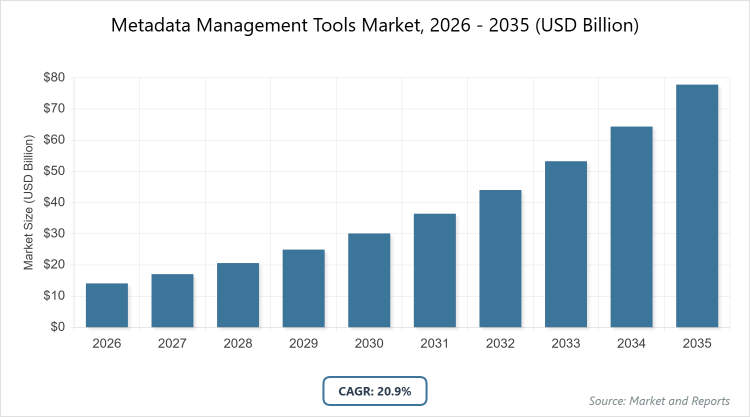
According to MarketnReports, the global Metadata Management Tools Market size was estimated at USD 14.1 Billion in 2025 and is expected to reach USD 94.4 Billion by 2035, growing at a CAGR of 20.9% from 2026 to 2035. Metadata Management Tools Market is driven by the escalating need for centralized data governance amid surging data volumes and AI adoption.
What is the Industry Overview of Metadata Management Tools?
The metadata management tools market encompasses software solutions designed to organize, govern, and utilize metadata—data that provides information about other data—to enhance data accessibility, quality, and security across enterprises. Market definition refers to the ecosystem of tools that enable the capture, storage, integration, and analysis of metadata, supporting functions like data lineage tracking, compliance adherence, and collaborative data usage in complex digital environments. This industry serves organizations dealing with vast data landscapes, facilitating better decision-making by ensuring data assets are discoverable, trustworthy, and aligned with business objectives.
What are the Key Insights into Metadata Management Tools?
- The metadata management tools market was valued at USD 14.1 billion in 2025 and is projected to reach USD 94.4 billion by 2035.
- The market is anticipated to grow at a CAGR of 20.9% during the forecast period from 2026 to 2035.
- The market is driven by the rising demand for data governance, compliance with regulations, and integration of AI for automated metadata handling.
- In the metadata type segment, technical metadata dominates with a 45% share due to its critical role in supporting IT infrastructure and data integration processes.
- In the application segment, data governance dominates with a 35% share as it enables organizations to maintain data accuracy and regulatory compliance, driving overall market efficiency.
- In the end-use segment, BFSI dominates with a 28% share owing to stringent financial regulations and the need for secure data handling in banking operations.
- In the deployment mode segment, cloud-based dominates with a 60% share because of its scalability, cost-effectiveness, and ease of integration with modern hybrid environments.
- North America dominates the regional market with a 40% share, attributed to advanced technological infrastructure, presence of key players, and early adoption of data management solutions.
What are the Market Dynamics of Metadata Management Tools?
Growth Drivers
The primary growth drivers for the metadata management tools market include the exponential increase in data generation from digital transformation initiatives, which necessitates robust tools for metadata organization to prevent data silos and ensure seamless access. Additionally, the integration of artificial intelligence and machine learning into these tools automates metadata classification and lineage tracking, reducing manual efforts and enhancing accuracy. Stricter global regulations, such as GDPR and CCPA, compel organizations to adopt metadata management for compliance and risk mitigation, further fueling market expansion. The shift toward cloud computing environments amplifies the need for metadata tools that support hybrid and multi-cloud setups, driving innovation and adoption across industries.
Restraints
High implementation costs pose a significant restraint, as deploying comprehensive metadata management solutions often requires substantial upfront investments in software, training, and integration with existing systems, deterring small and medium-sized enterprises. The complexity of managing diverse metadata from disparate sources can lead to integration challenges, prolonging deployment timelines and increasing operational overheads. A shortage of skilled professionals proficient in metadata governance and advanced tools hampers effective utilization, leading to underperformance and reluctance in adoption. Data privacy concerns and potential security vulnerabilities in metadata repositories also act as barriers, as organizations hesitate to centralize sensitive information without assured protection.
Opportunities
Emerging opportunities lie in the incorporation of AI-driven analytics within metadata tools, enabling predictive insights and automated governance that can open new revenue streams for vendors. The growing adoption of big data and IoT in developing regions presents untapped markets for scalable, affordable metadata solutions tailored to local needs. Partnerships between tool providers and cloud service giants can facilitate seamless integrations, expanding market reach. Additionally, the rise of data democratization in enterprises creates demand for user-friendly metadata platforms that empower non-technical users, fostering innovation in collaborative features and driving long-term growth.
Challenges
Interoperability issues between legacy systems and modern metadata tools remain a key challenge, as organizations struggle to migrate and synchronize data without disruptions. Evolving regulatory landscapes demand continuous updates to metadata management practices, straining resources and requiring agile adaptations. The rapid pace of technological advancements, such as edge computing, complicates metadata handling across distributed environments, posing scalability challenges. Ensuring data quality and consistency in real-time amid increasing data velocity adds operational complexity, challenging vendors to deliver reliable solutions without compromising performance.
Metadata Management Tools Market Report Scope
| Report Attributes | Report Details |
| Report Name | Metadata Management Tools Market |
| Market Size 2025 | USD 14.1 Billion |
| Market Forecast 2035 | USD 94.4 Billion |
| Growth Rate | CAGR of 20.9% |
| Report Pages | 220 |
| Key Companies Covered | IBM, Oracle, Informatica, SAP, Collibra, Microsoft, Alation, ASG Technologies, Adaptive, Cambridge Semantics, and Others |
| Segments Covered | By Metadata Type, By Application, By End-Use, By Deployment Mode, and By Region |
| Regions Covered | North America, Europe, Asia Pacific (APAC), Latin America, and The Middle East and Africa (MEA) |
| Base Year | 2025 |
| Historical Year | 2020 - 2024 |
| Forecast Year | 2026 - 2035 |
| Customization Scope | Avail customized purchase options to meet your exact research needs. |
What is the Market Segmentation of Metadata Management Tools?
The Metadata Management Tools Market is segmented by metadata type, application, end-use, deployment mode, and region. All the segments have been analyzed based on present and future trends and the market is estimated from 2026 to 2035.
Based on Metadata Type Segment, technical metadata emerges as the most dominant subsegment, holding approximately 45% market share, primarily because it provides essential details on data structures, formats, and storage, which are foundational for IT operations, system integrations, and ensuring data interoperability in complex enterprise ecosystems; this dominance drives the market by enabling efficient data processing and reducing errors in analytics workflows, while business metadata ranks as the second most dominant with around 30% share, offering contextual insights like data ownership and business rules that bridge technical and business users, thereby enhancing decision-making and compliance efforts to propel overall market growth.
Based on Application Segment, data governance stands out as the most dominant subsegment with about 35% market share, driven by its ability to enforce policies for data quality, security, and usage, which is crucial for regulatory compliance and trustworthy analytics in data-heavy industries; this leadership contributes to market expansion by minimizing risks and optimizing data assets, whereas risk and compliance management is the second most dominant at roughly 25%, focusing on identifying vulnerabilities and ensuring adherence to standards like GDPR, thereby supporting market momentum through proactive risk mitigation and fostering confidence in data-driven strategies.
Based on End-Use Segment, BFSI is the most dominant subsegment, capturing nearly 28% market share, owing to the sector's high-stakes environment requiring stringent data accuracy, security, and regulatory compliance to manage financial transactions and customer information effectively; this position accelerates market growth by addressing fraud prevention and personalized services, while telecom and IT follows as the second most dominant with about 20% share, leveraging metadata tools for network optimization, customer data management, and innovation in services, thus driving the market through enhanced operational efficiency and support for emerging technologies like 5G.
Based on Deployment Mode Segment, cloud-based deployment dominates with a 60% market share, attributed to its flexibility, lower maintenance costs, and ability to scale with growing data needs, making it ideal for remote workforces and global operations; this supremacy boosts the market by facilitating faster deployments and integrations with AI tools, and on-premises ranks second with 30% share, preferred for its control over sensitive data and customization options in regulated industries, contributing to market advancement by ensuring data sovereignty and reliability in hybrid setups.
What are the Recent Developments in Metadata Management Tools?
- In September 2024, HCL Software completed its acquisition of Zeenea, a Paris-based data catalog and governance solutions provider, enhancing its Actian Data Platform with advanced data discovery capabilities to strengthen its position in the data and analytics market.
- In June 2024, Immuta introduced new data governance and audit features for Retrieval Augmented Generation (RAG)-based GenAI applications, offering a multi-layer architecture to secure, monitor, and audit sensitive data across cloud platforms.
- In May 2024, Informatica integrated its AI Assistant, Claire GPT, into the Intelligent Data Management Cloud (IDMC), enabling users to manage metadata more efficiently through natural language queries and automation.
- In March 2024, SAP launched the SAP Datasphere solution, expanding its data management portfolio, and formed strategic partnerships with Collibra, Confluent, Databricks, and DataRobot to unify data from SAP and non-SAP sources for improved governance.
- In 2024, Collibra expanded its partnership with Microsoft by integrating the Collibra Data Intelligence Cloud into the Azure Marketplace, simplifying access for customers to advanced data intelligence features.
What is the Regional Analysis of Metadata Management Tools?
North America to dominate the global market.
North America leads the metadata management tools market, driven by its robust technological ecosystem, high adoption of cloud and AI technologies, and stringent data regulations like CCPA, with the United States dominating due to the presence of major tech hubs in Silicon Valley and a concentration of key players innovating in data governance; this region's emphasis on digital transformation in sectors like finance and healthcare ensures sustained demand, fostering market growth through investments in R&D and partnerships.
Europe holds a significant share, propelled by GDPR compliance requirements and a focus on data privacy, with Germany dominating as a manufacturing and automotive powerhouse that relies on metadata tools for supply chain optimization and Industry 4.0 initiatives; the region's collaborative efforts among EU countries to standardize data practices enhance interoperability, contributing to steady market expansion amid increasing AI integrations.
Asia Pacific is experiencing rapid growth, fueled by digitalization in emerging economies and rising data volumes from e-commerce and IoT, with China dominating through its massive tech investments and government-driven data initiatives like the Digital Silk Road; this positions the region for explosive adoption, driving market dynamics via affordable cloud solutions and skill development programs.
Latin America shows emerging potential, supported by increasing cloud adoption and regulatory reforms for data protection, with Brazil dominating as the largest economy leveraging metadata tools for fintech innovations and agribusiness data management; challenges like infrastructure gaps are offset by foreign investments, gradually boosting market penetration.
The Middle East and Africa region is growing steadily, driven by oil and gas sector digitization and smart city projects, with the United Arab Emirates dominating through initiatives like Dubai's data-driven governance and investments in AI hubs; this fosters market opportunities despite connectivity hurdles, emphasizing tools for resource optimization and economic diversification.
Who are the Key Market Players in Metadata Management Tools?
IBM focuses on leveraging AI and machine learning in its Watson Knowledge Catalog to automate metadata discovery and governance, enabling hybrid cloud integrations and targeting enterprises for enhanced data trust and compliance strategies.
Oracle emphasizes autonomous database features in its Oracle Data Management suite, incorporating metadata tools for real-time lineage and security, with strategies centered on acquisitions and cloud expansions to capture market share in data-intensive industries.
Informatica prioritizes its Intelligent Data Management Cloud with AI-powered Claire GPT for metadata automation, pursuing partnerships and innovations in multi-cloud environments to drive efficiency and address governance needs across global clients.
SAP integrates metadata management into its Datasphere platform, forming alliances with firms like Collibra to unify data landscapes, with a strategy focused on enterprise resource planning synergies and AI enhancements for comprehensive data insights.
Collibra specializes in data intelligence clouds, expanding through Microsoft Azure integrations and partnerships, aiming to democratize data access with governance-focused strategies that appeal to regulated sectors.
Microsoft advances metadata tools via Azure Purview, emphasizing unified data governance across ecosystems, with strategies involving ecosystem integrations and AI capabilities to support digital transformation.
Alation promotes active metadata management with its data search and discovery platform, using machine learning for collaboration, and strategies include customer-centric innovations and recognitions in Gartner reports.
ASG Technologies offers comprehensive metadata repositories, focusing on mainframe-to-cloud migrations, with strategies geared toward acquisitions and tailored solutions for legacy system modernizations.
Adaptive provides flexible metadata management for agile environments, prioritizing user-friendly interfaces and integrations, with growth strategies centered on SMB expansions and feature enhancements.
Cambridge Semantics leverages knowledge graphs for semantic metadata, targeting life sciences and finance, with strategies involving open-source contributions and partnerships for advanced analytics.
What are the Market Trends in Metadata Management Tools?
- Integration of AI and machine learning for automated metadata classification, lineage tracking, and predictive governance to handle complex data ecosystems.
- Shift toward cloud-based and hybrid deployments for scalability and cost efficiency in managing distributed data.
- Emphasis on active metadata management to enable real-time data insights and collaboration among business users.
- Growing focus on data privacy and compliance features amid evolving regulations like GDPR and CCPA.
- Adoption of semantic technologies and knowledge graphs for enhanced data context and interoperability.
- Rise in partnerships between vendors and cloud providers to unify metadata across multi-cloud environments.
- Incorporation of GenAI-specific governance tools to secure and audit data in AI applications.
What Market Segments and Their Subsegments are Covered in the Metadata Management Tools Report?
- By Metadata Type
- Business Metadata
- Technical Metadata
- Operational Metadata
- Semantic Metadata
- Reference Metadata
- Statistical Metadata
- Usage Metadata
- Quality Metadata
- Administrative Metadata
- Legal Metadata
- Others
- By Application
- Data Governance
- Risk and Compliance Management
- Incident Management
- Product and Process Management
- Data Quality Management
- Master Data Management
- Data Integration
- Business Intelligence
- Data Security
- Analytics
- Others
- By End-Use
- BFSI
- Telecom and IT
- Healthcare and Life Sciences
- Retail and Consumer Goods
- Government
- Manufacturing
- Media and Entertainment
- Transportation and Logistics
- Energy and Utilities
- Education
- Others
- By Deployment Mode
- Cloud-Based
- On-Premises
- Hybrid
By Region
-
- North America
- U.S.
- Canada
- Europe
- UK
- Germany
- France
- Rest of Europe
- Asia Pacific
- China
- India
- Japan
- Rest of Asia Pacific
- Latin America
- Brazil
- Mexico
- Rest of Latin America
- Middle East & Africa
- UAE
- South Africa
- Rest of Middle East & Africa
- North America
Frequently Asked Questions
The metadata management tools market involves software solutions that help organizations capture, store, and govern metadata to improve data discoverability, quality, and compliance.
Key factors include rising data volumes, AI integration, regulatory compliance needs, cloud adoption, and the demand for centralized data governance.
The market was valued at USD 14.1 billion in 2025 and is projected to reach USD 94.4 billion by 2035.
The CAGR is expected to be 20.9% during 2026-2035.
North America will contribute notably, holding around 40% of the market share due to advanced infrastructure and key players.
Major players include IBM, Oracle, Informatica, SAP, Collibra, Microsoft, Alation, ASG Technologies, Adaptive, and Cambridge Semantics.
The report provides in-depth analysis of market size, trends, segments, regional insights, key players, and forecasts from 2026 to 2035.
Stages include tool development, integration and deployment, consulting services, maintenance and support, and end-user application for data governance.
Trends are shifting toward AI automation and cloud solutions, with preferences favoring user-friendly, scalable tools for compliance and real-time insights.
Regulations like GDPR and CCPA drive demand for compliance features, while environmental factors include sustainable data centers influencing cloud deployments.