
Elderly Care Market Size, Share and Trends 2026 to 2035
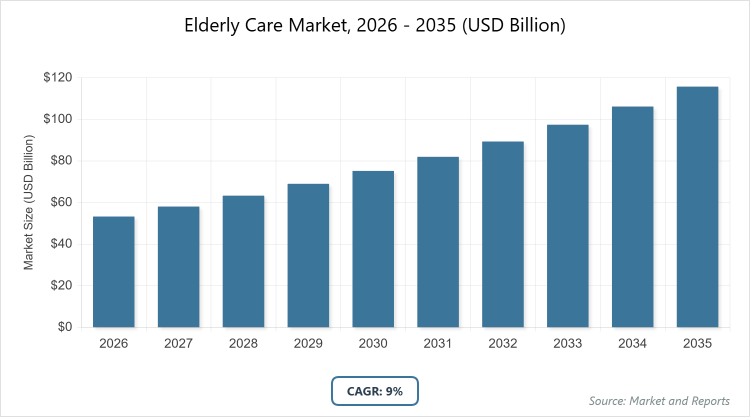
According to MarketnReports, the global Elderly Care Market size was estimated at USD 53.29 billion in 2025 and is expected to reach USD 125 billion by 2035, growing at a CAGR of 9% from 2026 to 2035. Elderly Care Market is driven by the rapidly increasing global aging population and rising demand for personalized home-based care services.
What are the Key Insights into the Elderly Care Market?
- The global Elderly Care Market was valued at USD 53.29 billion in 2025.
- The market is projected to grow at a CAGR of 9% from 2026 to 2035.
- The Elderly Care Market is driven by the surging geriatric population, advancements in telehealth and remote monitoring technologies, and growing preferences for cost-effective home-based care over institutional settings.
- Home Care Services dominate the Product Type segment with approximately 55% share because they offer flexible, personalized support that allows seniors to age in place, reducing healthcare costs and improving emotional well-being through familiar surroundings.
- Chronic Disease Management dominates the Application segment with around 40% share as the high prevalence of conditions like diabetes, hypertension, and dementia among the elderly necessitates ongoing monitoring and intervention to prevent complications.
- Home-Based dominates the End-User segment with over 50% share since it aligns with consumer desires for independence, leverages family involvement, and benefits from policy incentives promoting community care.
- North America dominates the global market with 33% share due to its advanced healthcare infrastructure, substantial government funding through programs like Medicare, and a large aging baby boomer population driving demand for diverse care options.
What is the Industry Overview of the Elderly Care Market?
The Elderly Care Market comprises a wide array of services, products, and solutions aimed at enhancing the quality of life for individuals aged 65 and older, addressing their healthcare, daily living, and emotional needs through integrated and compassionate approaches. This market includes professional caregiving, residential facilities, medical devices, and digital health tools designed to support independence while managing age-related conditions such as mobility issues, cognitive decline, and chronic diseases. The market definition focuses on holistic care ecosystems that prioritize preventive, rehabilitative, and palliative elements, adapting to evolving demographics, technological innovations, and policy frameworks to ensure accessible, affordable, and dignified support for seniors globally.
What are the Market Dynamics of the Elderly Care Market?
Growth Drivers
The primary growth drivers in the Elderly Care Market stem from the unprecedented rise in the global elderly population, projected to double by 2050 according to international health organizations, coupled with increasing life expectancies that heighten the need for long-term care solutions. Technological advancements, such as AI-powered monitoring devices and telehealth platforms, are revolutionizing service delivery by enabling remote health management and early intervention, while supportive government policies and insurance expansions in regions like North America and Europe make these services more accessible and affordable, fostering market expansion through innovation and inclusivity.
Restraints
Significant restraints include the escalating costs of specialized care services and advanced assistive technologies, which can burden low- and middle-income families, particularly in developing regions with limited reimbursement options. Additionally, a persistent shortage of qualified caregivers and healthcare professionals trained in geriatrics hampers service scalability, while regulatory inconsistencies across countries create barriers to standardized care delivery and innovation adoption.
Opportunities
Opportunities abound in the integration of emerging technologies like wearable health trackers, smart home systems, and robotics for companionship, which can enhance care efficiency and open new revenue streams in underserved markets. The shift toward preventive and personalized care models, combined with expanding public-private partnerships in high-growth areas such as Asia Pacific, presents avenues for innovative service bundles and telecare expansions to meet the diverse needs of aging populations.
Challenges
Key challenges involve addressing caregiver burnout and workforce shortages amid rising demand, as well as ensuring data security and privacy in digital care solutions amidst increasing cyber threats. Cultural variations in care preferences, such as family-centric models in some regions versus institutional care in others, alongside economic disparities, complicate the development of universally effective strategies and sustainable funding models.
Elderly Care Market: Report Scope
| Report Attributes | Report Details |
| Report Name | Elderly Care Market |
| Market Size 2025 | USD 53.29 Billion |
| Market Forecast 2035 | USD 125 Billion |
| Growth Rate | CAGR of 9% |
| Report Pages | 220 |
| Key Companies Covered |
Brookdale Senior Living, Inc., Amedisys, Inc., Sunrise Senior Living, and Others. |
| Segments Covered | By Product Type, By Application, By End-User, and By Region. |
| Regions Covered | North America, Europe, Asia Pacific (APAC), Latin America, and The Middle East and Africa (MEA) |
| Base Year | 2025 |
| Historical Year | 2020 - 2024 |
| Forecast Year | 2026 - 2035 |
| Customization Scope | Avail customized purchase options to meet your exact research needs. |
What is the Market Segmentation of the Elderly Care Market?
The Elderly Care Market is segmented by Product Type, Application, End-User, and region.
By Product Type Segment, Home Care Services represent the most dominant segment while Institutional Care Services stand as the second most dominant. Home Care Services lead because they provide cost-effective, customized assistance that promotes autonomy and integrates seamlessly with family support systems and digital tools, driving overall market growth by catering to the majority preference for non-intrusive care that minimizes disruptions and supports long-term health management.
By Application Segment, Chronic Disease Management is the most dominant segment followed by Post-Acute Care as the second most dominant. Chronic Disease Management dominates owing to the widespread occurrence of age-related ailments requiring continuous oversight, medication management, and lifestyle guidance, which propels market expansion through sustained demand for integrated services that reduce hospital readmissions and enhance quality of life.
By End-User Segment, Home-Based is the most dominant while Nursing Homes and Skilled Nursing Facilities constitute the second most dominant. Home-Based prevails as it fulfills the strong inclination toward independent living with professional support, benefiting from technological enablers and cost savings, thereby accelerating market growth by broadening accessibility and encouraging preventive care adoption among a larger demographic.
What are the Recent Developments in the Elderly Care Market?
- In 2025, major providers accelerated the adoption of AI-driven remote monitoring systems, integrating them into home care platforms to improve fall detection and vital sign tracking, resulting in reduced emergency visits and enhanced patient safety for independent seniors.
- Strategic acquisitions by key players, such as Brookdale Senior Living's expansion of its assisted living portfolio, have strengthened market presence and diversified service offerings to address growing demand for memory care and rehabilitation services.
- The rollout of hybrid care models combining telehealth with in-person visits gained momentum, particularly in response to caregiver shortages, enabling efficient resource allocation and broader coverage in rural and urban areas alike.
- Government initiatives in regions like Europe focused on funding digital geriatric tools, leading to partnerships between tech firms and care providers for innovative solutions in preventive health management.
What is the Regional Analysis of the Elderly Care Market?
North America to dominate the global market
North America maintains dominance in the Elderly Care Market, led by the United States with its extensive Medicare and Medicaid programs, advanced technological infrastructure, and a high concentration of aging individuals requiring specialized services. The region's emphasis on innovation, such as widespread telehealth adoption and robust private insurance coverage, supports comprehensive care delivery while addressing chronic conditions prevalent among seniors.
Europe exhibits steady growth, driven by countries like Germany and the United Kingdom, where universal healthcare systems and strong social welfare policies facilitate access to home and institutional care. Focus on quality regulations and integration of elderly services into national health strategies ensures sustained demand amid an aging populace.
Asia Pacific is the fastest-growing region, spearheaded by Japan and China, due to rapid demographic shifts, urbanization, and government investments in elderly infrastructure. Increasing awareness and rising incomes are shifting preferences from family care to professional services, including assistive technologies.
Latin America shows promising development, with Brazil and Mexico leading through improving healthcare access and growing private sector involvement, though affordability and infrastructure gaps limit pace compared to developed areas.
The Middle East and Africa are evolving gradually, with the UAE and South Africa at the forefront via investments in premium facilities and international collaborations, bolstered by rising life expectancies but constrained by resource limitations and traditional family caregiving norms.
Who are the Key Market Players in the Elderly Care Market?
Brookdale Senior Living, Inc. employs strategies focused on expanding assisted living and memory care facilities, leveraging technology for resident engagement and health monitoring to enhance occupancy and differentiate in competitive markets.
Amedisys, Inc. prioritizes home health and hospice services, utilizing data analytics and telehealth integrations to optimize patient outcomes, drive acquisitions for geographic expansion, and align with value-based care reimbursements.
Sunrise Senior Living concentrates on premium senior communities with personalized wellness programs, investing in staff training and sustainable designs to attract high-end clients and achieve superior satisfaction ratings.
Kindred Healthcare focuses on post-acute and transitional care, partnering with hospitals for seamless patient flows and emphasizing rehabilitation expertise to reduce readmissions and build network strength.
Home Instead, Inc. adopts a franchise model for non-medical in-home care, emphasizing caregiver matching algorithms and training programs to ensure reliable, compassionate service delivery and global scalability.
What are the Market Trends in the Elderly Care Market?
- Rising integration of AI and IoT in remote monitoring for real-time health tracking and predictive analytics.
- Shift toward home-based and community care models to support aging in place and reduce institutional reliance.
- Expansion of telehealth services for virtual consultations and chronic disease management.
- Growing emphasis on mental health and social engagement programs to combat isolation among seniors.
- Adoption of robotics and assistive technologies for companionship and daily task assistance.
- Focus on preventive care and wellness initiatives to extend healthy lifespans.
- Increasing public-private partnerships for affordable and innovative care solutions.
What Market Segments and their Subsegments are Covered in the Report?
By Product Type
- Home Care Services
- Institutional Care Services
- Adult Day Care Services
- Hospice and Palliative Care
- Telecare and Remote Monitoring
- Mobility Aids
- Incontinence Products
- Assistive Devices
- Rehabilitation Equipment
- Nutritional Supplements
- Others
By Application
- Chronic Disease Management
- Post-Acute Care
- Preventive Health Management
- End-of-Life Care
- Companion Care
- Personal Care Assistance
- Rehabilitation and Recovery
- Homemaking Services
- Mental Health Support
- Nutritional Support
- Others
By End-User
- Home-Based
- Hospitals and Clinics
- Nursing Homes and Skilled Nursing Facilities
- Assisted Living Facilities
- Adult Day Care Centers
- Rehabilitation Centers
- Hospice Facilities
- Community Health Centers
- Government and Non-Profit Organizations
- Private Care Providers
- Others
By Region
- North America
- U.S.
- Canada
- Europe
- UK
- Germany
- France
- Rest of Europe
- Asia Pacific
- China
- India
- Japan
- Rest of Asia Pacific
- Latin America
- Brazil
- Mexico
- Rest of Latin America
- Middle East & Africa
- UAE
- South Africa
- Rest of Middle East & Africa
Frequently Asked Questions
The Elderly Care Market involves services, products, and technologies dedicated to supporting the health, independence, and well-being of older adults, including home care, institutional facilities, and assistive devices.
Key factors include the growing elderly population, technological innovations in monitoring and telehealth, rising chronic disease rates, favorable government policies, and increasing demand for affordable home-based solutions.
The market is anticipated to expand from USD 53.29 billion in 2026 to approximately USD 125 billion by 2035.
The CAGR is projected to be 9% over the forecast period.
North America will contribute significantly, driven by its robust healthcare systems, high elderly demographics, and substantial investments in care infrastructure.
Major players include Brookdale Senior Living, Inc., Amedisys, Inc., Sunrise Senior Living, Kindred Healthcare, and Home Instead, Inc.
The report offers in-depth analysis of market size, segmentation, dynamics, trends, regional insights, competitive strategies, and future forecasts for informed decision-making.
Stages encompass raw material suppliers for devices, technology developers, service providers for care delivery, payers including insurers and governments, and end-users such as seniors and families, with distribution and quality assurance integrated throughout.
Trends are moving toward digital health tools and hybrid models, while consumers increasingly prefer personalized, home-based care emphasizing independence, wellness, and technology-enabled support.
Factors include reimbursement policies, staffing regulations, data privacy laws for tech solutions, and sustainability requirements in facility operations, alongside incentives for green and accessible care practices.