
Skin Longevity Market Size, Share and Trends 2026 to 2035
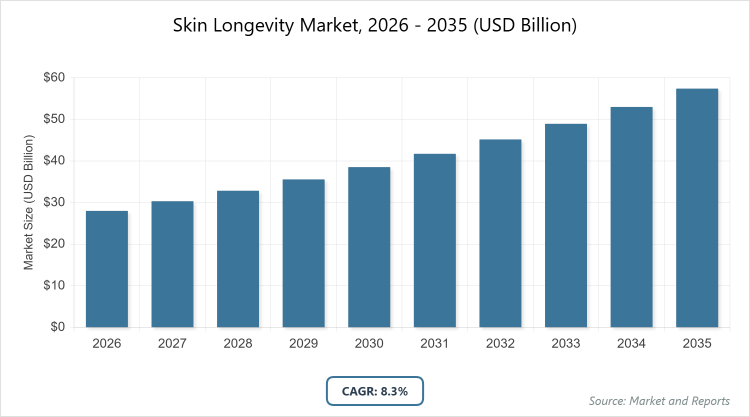
According to MarketnReports, the global Skin Longevity market size was estimated at USD 28 billion in 2025 and is expected to reach USD 62 billion by 2035, growing at a CAGR of 8.3% from 2026 to 2035. Skin Longevity Market is driven by rising consumer focus on long-term skin health through preventive care, biotechnology advancements addressing aging hallmarks, and demand for science-backed holistic solutions.
What are the Key Insights of the Skin Longevity Market?
- The Skin Longevity Market was valued at USD 28 billion in 2025 and is projected to reach USD 62 billion by 2035.
- It is growing at a CAGR of 8.3% during the forecast period 2026-2035.
- The market is driven by increasing aging populations, demand for preventive and personalized skincare, and integration of longevity science into daily routines.
- In the Product Type segment, Serums dominate with approximately 35% share because they deliver high-concentration actives like peptides, retinoids, and NAD+ precursors directly to address cellular longevity markers efficiently.
- In the Application segment, Anti-Aging dominates with approximately 50% share because it aligns directly with core consumer goals of maintaining skin function and resilience over time.
- In the End-User segment, Female Consumers dominate with approximately 62% share because of higher awareness, spending on skincare, and adoption of preventive routines influenced by beauty standards and social media.
- North America dominates with approximately 40% share because of high disposable incomes, advanced adoption of biotech ingredients, strong regulatory framework for innovative products, and presence of leading R&D hubs.
What is the Industry Overview of the Skin Longevity Market?
The Skin Longevity market involves a range of products, treatments, and technologies aimed at extending the healthy lifespan of skin by supporting its natural repair mechanisms, barrier integrity, and resistance to intrinsic and extrinsic aging factors.
Skin Longevity is defined as the proactive maintenance and optimization of skin health at the cellular and molecular level focusing on hallmarks such as mitochondrial function, inflammation control, and extracellular matrix preservation rather than solely reversing visible signs of aging, encompassing topical formulations, oral supplements, devices, and clinical interventions that promote sustained youthful function and resilience.
What are the Market Dynamics in the Skin Longevity Market?
Growth Drivers
The primary growth drivers include the global aging population seeking preventive rather than corrective solutions, advancements in biotechnology and genomics enabling targeted ingredients like senolytics and antioxidants, rising consumer awareness through social media and influencer marketing about long-term skin health, and increasing disposable incomes in emerging markets that fuel demand for premium, science-backed products. These factors collectively encourage consistent adoption of routines that address root causes of skin aging for sustained results.
Restraints
High costs of advanced biotech-infused products and devices limit accessibility in price-sensitive regions, while stringent regulatory approvals for novel claims related to cellular longevity slow market entry. Additionally, consumer skepticism toward unproven “longevity” claims and potential side effects from potent actives like high-strength retinoids or injectables can hinder widespread uptake.
Opportunities
Emerging opportunities lie in personalization via AI-driven skin analysis, expansion of oral nutraceuticals combining skincare with systemic longevity benefits, growth in men’s grooming and younger demographics adopting preventive routines, and penetration into developing Asia-Pacific markets through affordable clean-beauty lines. Partnerships between cosmetics firms and biotech startups further open avenues for innovative delivery systems like microneedling patches or microbiome-targeted formulas.
Challenges
Key challenges encompass scientific validation of longevity claims requiring long-term clinical trials, intense competition from traditional anti-aging brands, supply chain issues for rare biotech ingredients, and counterfeit products eroding trust in premium segments. Evolving environmental regulations on packaging and ingredient sourcing also pressure manufacturers to balance efficacy with sustainability.
Skin Longevity Market: Report Scope
| Report Attributes | Report Details |
| Report Name | Skin Longevity Market |
| Market Size 2025 | USD 28 Billion |
| Market Forecast 2035 | USD 62 Billion |
| Growth Rate | CAGR of 8.3% |
| Report Pages | 220 |
| Key Companies Covered | L’Oréal S.A., The Estée Lauder Companies Inc., Procter & Gamble Co., Unilever PLC, Shiseido Company Limited, Johnson & Johnson Consumer Inc., Beiersdorf AG, Coty Inc., Avon Products Inc., Revlon Inc., Oriflame Holding AG, Nu Skin Enterprises, Cureveda, Decode Age, PMD Beauty / Age Sciences Inc., GNC Holdings LLC |
| Segments Covered | By Product Type, By Application, By End-User, and By Region |
| Regions Covered | North America, Europe, Asia Pacific (APAC), Latin America, and The Middle East and Africa (MEA) |
| Base Year | 2025 |
| Historical Year | 2020 – 2024 |
| Forecast Year | 2026 – 2035 |
| Customization Scope | Avail customized purchase options to meet your exact research needs. |
What is the Market Segmentation of the Skin Longevity Market?
The Skin Longevity market is segmented by product type, application, end-user, and region.
Based on Product Type Segment, Serums hold the dominant position due to their ability to penetrate deeply with concentrated bioactives that target multiple aging hallmarks simultaneously, offering visible yet sustainable improvements in elasticity and radiance while driving market growth through repeat purchases and innovation in multi-peptide or exosome formulations; the second most dominant is Creams & Moisturizers, favored for daily barrier support and broad accessibility that encourages habitual use across demographics.
Based on Application Segment, Anti-Aging leads as the core focus aligning with longevity principles by addressing DNA repair, collagen synthesis, and oxidative stress reduction, propelling overall market expansion through evidence-based efficacy that builds consumer loyalty; Skin Hydration ranks second, as maintaining optimal moisture levels is foundational to skin resilience and underpins other applications by preventing transepidermal water loss that accelerates aging.
Based on End-User Segment, Female Consumers dominate owing to established cultural emphasis on skincare routines, higher engagement with wellness trends, and greater willingness to invest in multi-step regimens that support long-term skin vitality, significantly contributing to volume sales and premiumization; Male Consumers represent the second dominant group, growing rapidly due to shifting norms around grooming, awareness of preventive benefits, and targeted marketing that expands the addressable base.
What are the Recent Developments in the Skin Longevity Market?
- Leading brands have launched next-generation serums incorporating NAD+ boosters and senolytic compounds to directly influence cellular energy and clearance of aged cells, with clinical trials showing improved skin firmness over 12 weeks.
- Strategic acquisitions of biotech startups by major cosmetics companies have accelerated integration of microbiome and epigenetic research into consumer products, enabling personalized longevity formulas via app-linked diagnostics.
- Regulatory approvals for over-the-counter devices using low-level light therapy and radiofrequency for at-home skin repair have expanded accessibility, with new launches emphasizing portability and AI-guided usage for consistent long-term outcomes.
- Sustainability initiatives include refillable packaging and plant-derived alternatives to synthetic actives, responding to consumer demand for eco-friendly longevity solutions while maintaining high efficacy standards.
What is the Regional Analysis of the Skin Longevity Market?
- North America to dominate the global market
North America commands the largest share through mature consumer markets in the US and Canada, where high healthcare spending, widespread dermatologist recommendations, and strong innovation ecosystems foster rapid adoption of premium biotech products; the US leads within the region due to influential beauty influencers, robust e-commerce, and favorable reimbursement for certain aesthetic treatments, driving consistent double-digit growth in preventive skincare.
Europe exhibits steady expansion supported by stringent EU regulations promoting safe, effective ingredients, aging demographics in countries like Germany and the UK, and a cultural preference for natural, clean formulations; France and Germany dominate here owing to established luxury skincare heritage and R&D investments in longevity biotech.
Asia Pacific is the fastest-growing region fueled by rising middle-class affluence in China, Japan, and South Korea, cultural emphasis on youthful appearance, and booming K-beauty innovations incorporating traditional herbs with modern longevity science; China and South Korea lead due to massive online retail penetration and younger consumers adopting multi-functional products early.
Latin America shows promising uptake driven by Brazil and Mexico’s growing beauty industries, increasing awareness via digital platforms, and demand for affordable anti-aging options amid urbanization; however, economic variability tempers growth compared to developed regions.
The Middle East and Africa experiences emerging demand primarily in UAE and South Africa, where luxury tourism, high disposable incomes among expatriates, and rising local manufacturing support market entry, though limited awareness and infrastructure in other areas constrain broader penetration.
Who are the Key Market Players and Their Strategies in the Skin Longevity Market?
L’Oréal focuses on R&D partnerships with biotech firms for epigenetic and microbiome technologies, heavy investment in AI personalization apps, global marketing campaigns emphasizing scientific validation, and sustainable sourcing to capture premium segments while expanding direct-to-consumer channels.
The Estée Lauder Companies prioritizes acquisitions of innovative startups in peptide and antioxidant delivery, launches of clinically proven longevity lines with long-term efficacy studies, premium positioning through celebrity endorsements, and omnichannel retail strategies including pop-up experiences to build brand loyalty.
Procter & Gamble leverages mass-market scale for affordable entry-level longevity products, supply chain optimization for cost efficiency, digital influencer collaborations, and expansion into oral supplements to diversify beyond topicals while targeting value-conscious consumers.
Beiersdorf AG (Nivea) emphasizes dermatological expertise and clinical backing for barrier-repair focused formulas, international distribution networks, sustainability certifications, and targeted regional adaptations to drive volume growth in emerging markets.
Shiseido Company, Limited integrates traditional Japanese ingredients with cutting-edge longevity research, invests in advanced device technologies, strong presence in Asia with premium retail, and focus on male and younger demographics through specialized product lines.
What are the Market Trends in the Skin Longevity Market?
- Shift from reactive anti-aging to proactive skin longevity protocols emphasizing cellular health and prevention.
- Rise of clean, biotech-infused ingredients like peptides, exosomes, and plant-derived senolytics.
- Personalization through AI skin scanning and genomic testing for customized routines.
- Growth in hybrid oral + topical regimens for systemic skin support.
- Integration of at-home aesthetic devices with app connectivity for monitored progress.
- Emphasis on sustainability, microbiome balance, and gender-inclusive formulations.
- Influence of wellness culture blending skincare with overall longevity practices.
What Market Segments and Their Subsegments are Covered in the Report?
By Product Type
- Serums
- Creams & Moisturizers
- Oral Supplements
- Aesthetic Devices
- Sunscreens
- Facial Cleansers
- Masks & Peels
- Eye Care Products
- Anti-Aging Injectables
- Others
By Application
- Anti-Aging
- Skin Hydration
- UV Protection
- Skin Repair
- Pigmentation Control
- Acne Prevention
- Scar Reduction
- Barrier Repair
- Brightening
- Others
By End-User
- Female Consumers
- Male Consumers
- Dermatological Clinics
- Home Care
- Spas & Salons
- Hospitals
- Millennials
- Gen X
- Baby Boomers
- Others
By Region
- North America
- U.S.
- Canada
- Europe
- UK
- Germany
- France
- Rest of Europe
- Asia Pacific
- China
- India
- Japan
- Rest of Asia Pacific
- Latin America
- Brazil
- Mexico
- Rest of Latin America
- Middle East & Africa
- UAE
- South Africa
- Rest of Middle East & Africa
Chapter 1. Preface
1.1 Report Description and Scope1.2 Research Scope1.3 Research Methodology1.3.1 Market Research Type1.3.2 Market Research MethodologyChapter 2. Executive Summary
2.1 Global Skin Longevity Market Market, (2026 - 2035) (USD Billion)2.2 Global Skin Longevity Market Market: SnapshotChapter 3. Global Skin Longevity Market Market - Industry Analysis
3.1 Skin Longevity Market Market: Market Dynamics3.2 Market Drivers3.2.1 The skin longevity market is driven by aging populations, biotech and genomics advances, rising awareness of preventive skincare, influencer impact, and higher disposable incomes in emerging markets.3.3 Market Restraints3.3.1 High product costs, strict regulatory approvals, consumer skepticism toward longevity claims, and concerns over side effects from potent actives limit wider adoption.3.4 Market Opportunities3.4.1 Key opportunities include AI-powered personalization, growth of oral nutraceuticals, rising men’s and preventive skincare demand, Asia-Pacific expansion, and biotech–cosmetics collaborations.3.5 Market Challenges3.5.1 The market faces challenges from the need for long-term clinical validation, intense competition, biotech ingredient supply constraints, counterfeit products, and stricter sustainability regulations.3.6 Porter’s Five Forces Analysis3.7 Market Attractiveness Analysis3.7.1 Market Attractiveness Analysis By Product Type3.7.2 Market Attractiveness Analysis By Application3.7.3 Market Attractiveness Analysis By End-UserChapter 4. Global Skin Longevity Market Market- Competitive Landscape
4.1 Company Market Share Analysis4.1.1 Global Skin Longevity Market Market: Company Market Share, 20254.2 Strategic Development4.2.1 Acquisitions & mergers4.2.2 New Product launches4.2.3 Agreements, partnerships, collaborations, and joint ventures4.2.4 Research and development and regional expansion4.3 Price Trend AnalysisChapter 5. Global Skin Longevity Market Market - Product Type Analysis
5.1 Global Skin Longevity Market Market Overview: Product Type5.1.1 Global Skin Longevity Market Market share, By Product Type, 2025 and 20355.2 Serums5.2.1 Global Skin Longevity Market Market by Serums, 2026 - 2035 (USD Billion)5.3 Creams & Moisturizers5.3.1 Global Skin Longevity Market Market by Creams & Moisturizers, 2026 - 2035 (USD Billion)5.4 Oral Supplements5.4.1 Global Skin Longevity Market Market by Oral Supplements, 2026 - 2035 (USD Billion)5.5 Aesthetic Devices5.5.1 Global Skin Longevity Market Market by Aesthetic Devices, 2026 - 2035 (USD Billion)5.6 Sunscreens5.6.1 Global Skin Longevity Market Market by Sunscreens, 2026 - 2035 (USD Billion)5.7 Facial Cleansers5.7.1 Global Skin Longevity Market Market by Facial Cleansers, 2026 - 2035 (USD Billion)5.8 Masks & Peels5.8.1 Global Skin Longevity Market Market by Masks & Peels, 2026 - 2035 (USD Billion)5.9 Eye Care Products5.9.1 Global Skin Longevity Market Market by Eye Care Products, 2026 - 2035 (USD Billion)5.10 Anti-Aging Injectables5.10.1 Global Skin Longevity Market Market by Anti-Aging Injectables, 2026 - 2035 (USD Billion)5.11 Others5.11.1 Global Skin Longevity Market Market by Others, 2026 - 2035 (USD Billion)Chapter 6. Global Skin Longevity Market Market - Application Analysis
6.1 Global Skin Longevity Market Market Overview: Application6.1.1 Global Skin Longevity Market Market Share, By Application, 2025 and 20356.2 Anti-Aging6.2.1 Global Skin Longevity Market Market by Anti-Aging, 2026 - 2035 (USD Billion)6.3 Skin Hydration6.3.1 Global Skin Longevity Market Market by Skin Hydration, 2026 - 2035 (USD Billion)6.4 UV Protection6.4.1 Global Skin Longevity Market Market by UV Protection, 2026 - 2035 (USD Billion)6.5 Skin Repair6.5.1 Global Skin Longevity Market Market by Skin Repair, 2026 - 2035 (USD Billion)6.6 Pigmentation Control6.6.1 Global Skin Longevity Market Market by Pigmentation Control, 2026 - 2035 (USD Billion)6.7 Acne Prevention6.7.1 Global Skin Longevity Market Market by Acne Prevention, 2026 - 2035 (USD Billion)6.8 Scar Reduction6.8.1 Global Skin Longevity Market Market by Scar Reduction, 2026 - 2035 (USD Billion)6.9 Barrier Repair6.9.1 Global Skin Longevity Market Market by Barrier Repair, 2026 - 2035 (USD Billion)6.10 Brightening6.10.1 Global Skin Longevity Market Market by Brightening, 2026 - 2035 (USD Billion)6.11 Others6.11.1 Global Skin Longevity Market Market by Others, 2026 - 2035 (USD Billion)Chapter 7. Global Skin Longevity Market Market - End-User Analysis
7.1 Global Skin Longevity Market Market Overview: End-User7.1.1 Global Skin Longevity Market Market Share, By End-User, 2025 and 20357.2 Female Consumers7.2.1 Global Skin Longevity Market Market by Female Consumers, 2026 - 2035 (USD Billion)7.3 Male Consumers7.3.1 Global Skin Longevity Market Market by Male Consumers, 2026 - 2035 (USD Billion)7.4 Dermatological Clinics7.4.1 Global Skin Longevity Market Market by Dermatological Clinics, 2026 - 2035 (USD Billion)7.5 Home Care7.5.1 Global Skin Longevity Market Market by Home Care, 2026 - 2035 (USD Billion)7.6 Spas & Salons7.6.1 Global Skin Longevity Market Market by Spas & Salons, 2026 - 2035 (USD Billion)7.7 Hospitals7.7.1 Global Skin Longevity Market Market by Hospitals, 2026 - 2035 (USD Billion)7.8 Millennials7.8.1 Global Skin Longevity Market Market by Millennials, 2026 - 2035 (USD Billion)7.9 Gen X7.9.1 Global Skin Longevity Market Market by Gen X, 2026 - 2035 (USD Billion)7.10 Baby Boomers7.10.1 Global Skin Longevity Market Market by Baby Boomers, 2026 - 2035 (USD Billion)7.11 Others7.11.1 Global Skin Longevity Market Market by Others, 2026 - 2035 (USD Billion)Chapter 8. Skin Longevity Market Market - Regional Analysis
8.1 Global Skin Longevity Market Market Regional Overview8.2 Global Skin Longevity Market Market Share, by Region, 2025 & 2035 (USD Billion)8.3 North America8.3.1 North America Skin Longevity Market Market, 2026 - 2035 (USD Billion)8.3.1.1 North America Skin Longevity Market Market, by Country, 2026 - 2035 (USD Billion)8.3.2 North America Skin Longevity Market Market, by Product Type, 2026 - 20358.3.2.1 North America Skin Longevity Market Market, by Product Type, 2026 - 2035 (USD Billion)8.3.3 North America Skin Longevity Market Market, by Application, 2026 - 20358.3.3.1 North America Skin Longevity Market Market, by Application, 2026 - 2035 (USD Billion)8.3.4 North America Skin Longevity Market Market, by End-User, 2026 - 20358.3.4.1 North America Skin Longevity Market Market, by End-User, 2026 - 2035 (USD Billion)8.4 Europe8.4.1 Europe Skin Longevity Market Market, 2026 - 2035 (USD Billion)8.4.1.1 Europe Skin Longevity Market Market, by Country, 2026 - 2035 (USD Billion)8.4.2 Europe Skin Longevity Market Market, by Product Type, 2026 - 20358.4.2.1 Europe Skin Longevity Market Market, by Product Type, 2026 - 2035 (USD Billion)8.4.3 Europe Skin Longevity Market Market, by Application, 2026 - 20358.4.3.1 Europe Skin Longevity Market Market, by Application, 2026 - 2035 (USD Billion)8.4.4 Europe Skin Longevity Market Market, by End-User, 2026 - 20358.4.4.1 Europe Skin Longevity Market Market, by End-User, 2026 - 2035 (USD Billion)8.5 Asia Pacific8.5.1 Asia Pacific Skin Longevity Market Market, 2026 - 2035 (USD Billion)8.5.1.1 Asia Pacific Skin Longevity Market Market, by Country, 2026 - 2035 (USD Billion)8.5.2 Asia Pacific Skin Longevity Market Market, by Product Type, 2026 - 20358.5.2.1 Asia Pacific Skin Longevity Market Market, by Product Type, 2026 - 2035 (USD Billion)8.5.3 Asia Pacific Skin Longevity Market Market, by Application, 2026 - 20358.5.3.1 Asia Pacific Skin Longevity Market Market, by Application, 2026 - 2035 (USD Billion)8.5.4 Asia Pacific Skin Longevity Market Market, by End-User, 2026 - 20358.5.4.1 Asia Pacific Skin Longevity Market Market, by End-User, 2026 - 2035 (USD Billion)8.6 Latin America8.6.1 Latin America Skin Longevity Market Market, 2026 - 2035 (USD Billion)8.6.1.1 Latin America Skin Longevity Market Market, by Country, 2026 - 2035 (USD Billion)8.6.2 Latin America Skin Longevity Market Market, by Product Type, 2026 - 20358.6.2.1 Latin America Skin Longevity Market Market, by Product Type, 2026 - 2035 (USD Billion)8.6.3 Latin America Skin Longevity Market Market, by Application, 2026 - 20358.6.3.1 Latin America Skin Longevity Market Market, by Application, 2026 - 2035 (USD Billion)8.6.4 Latin America Skin Longevity Market Market, by End-User, 2026 - 20358.6.4.1 Latin America Skin Longevity Market Market, by End-User, 2026 - 2035 (USD Billion)8.7 The Middle-East and Africa8.7.1 The Middle-East and Africa Skin Longevity Market Market, 2026 - 2035 (USD Billion)8.7.1.1 The Middle-East and Africa Skin Longevity Market Market, by Country, 2026 - 2035 (USD Billion)8.7.2 The Middle-East and Africa Skin Longevity Market Market, by Product Type, 2026 - 20358.7.2.1 The Middle-East and Africa Skin Longevity Market Market, by Product Type, 2026 - 2035 (USD Billion)8.7.3 The Middle-East and Africa Skin Longevity Market Market, by Application, 2026 - 20358.7.3.1 The Middle-East and Africa Skin Longevity Market Market, by Application, 2026 - 2035 (USD Billion)8.7.4 The Middle-East and Africa Skin Longevity Market Market, by End-User, 2026 - 20358.7.4.1 The Middle-East and Africa Skin Longevity Market Market, by End-User, 2026 - 2035 (USD Billion)Chapter 9. Company Profiles
9.1 L’Oréal S.A.9.1.1 Overview9.1.2 Financials9.1.3 Product Portfolio9.1.4 Business Strategy9.1.5 Recent Developments9.2 The Estée Lauder Companies Inc.9.2.1 Overview9.2.2 Financials9.2.3 Product Portfolio9.2.4 Business Strategy9.2.5 Recent Developments9.3 Procter & Gamble Co.9.3.1 Overview9.3.2 Financials9.3.3 Product Portfolio9.3.4 Business Strategy9.3.5 Recent Developments9.4 Unilever PLC9.4.1 Overview9.4.2 Financials9.4.3 Product Portfolio9.4.4 Business Strategy9.4.5 Recent Developments9.5 Shiseido Company Limited9.5.1 Overview9.5.2 Financials9.5.3 Product Portfolio9.5.4 Business Strategy9.5.5 Recent Developments9.6 Johnson & Johnson Consumer Inc.9.6.1 Overview9.6.2 Financials9.6.3 Product Portfolio9.6.4 Business Strategy9.6.5 Recent Developments9.7 Beiersdorf AG9.7.1 Overview9.7.2 Financials9.7.3 Product Portfolio9.7.4 Business Strategy9.7.5 Recent Developments9.8 Coty Inc.9.8.1 Overview9.8.2 Financials9.8.3 Product Portfolio9.8.4 Business Strategy9.8.5 Recent Developments9.9 Avon Products Inc.9.9.1 Overview9.9.2 Financials9.9.3 Product Portfolio9.9.4 Business Strategy9.9.5 Recent Developments9.10 Revlon Inc.9.10.1 Overview9.10.2 Financials9.10.3 Product Portfolio9.10.4 Business Strategy9.10.5 Recent Developments9.11 Oriflame Holding AG9.11.1 Overview9.11.2 Financials9.11.3 Product Portfolio9.11.4 Business Strategy9.11.5 Recent Developments9.12 Nu Skin Enterprises9.12.1 Overview9.12.2 Financials9.12.3 Product Portfolio9.12.4 Business Strategy9.12.5 Recent Developments9.13 Cureveda9.13.1 Overview9.13.2 Financials9.13.3 Product Portfolio9.13.4 Business Strategy9.13.5 Recent Developments9.14 Decode Age9.14.1 Overview9.14.2 Financials9.14.3 Product Portfolio9.14.4 Business Strategy9.14.5 Recent Developments9.15 PMD Beauty / Age Sciences Inc.9.15.1 Overview9.15.2 Financials9.15.3 Product Portfolio9.15.4 Business Strategy9.15.5 Recent Developments9.16 GNC Holdings LLC9.16.1 Overview9.16.2 Financials9.16.3 Product Portfolio9.16.4 Business Strategy9.16.5 Recent Developments
Frequently Asked Questions
Skin Longevity refers to approaches and products that maintain and extend the functional health and youthful characteristics of skin over time by targeting underlying biological processes like cellular repair, inflammation reduction, and barrier strengthening, going beyond superficial anti-aging effects.
Key factors include demographic aging, technological advances in biotech ingredients, consumer shift toward preventive wellness, personalization via digital tools, and expanding access in emerging economies, all amplifying demand for efficacious, long-term solutions.
The market is projected to grow from approximately USD 28 billion in 2025 to USD 62 billion by 2035, reflecting robust expansion driven by innovation and awareness.
The CAGR is expected to be 8.3%, indicating strong compounded growth supported by premiumization and scientific validation.
North America will contribute notably due to its dominant share from high adoption rates, innovation leadership, and affluent consumer base, while Asia Pacific will drive significant incremental value through rapid growth.
Major players include L’Oréal S.A., The Estée Lauder Companies Inc., Procter & Gamble Co., Unilever PLC, Shiseido Company Limited, Johnson & Johnson Consumer Inc., Beiersdorf AG, Coty Inc., Avon Products Inc., Revlon Inc., Oriflame Holding AG, Nu Skin Enterprises, Cureveda, Decode Age, PMD Beauty / Age Sciences Inc., GNC Holdings LLC, through R&D, acquisitions, and targeted marketing of longevity-focused innovations.
The report provides comprehensive analysis of market size, segmentation, dynamics, regional insights, competitive strategies, trends, and forecasts to guide stakeholders in strategic decision-making.
Stages include raw material sourcing (biotech actives, botanicals), R&D and formulation, manufacturing and quality testing, packaging and branding, distribution via retail/e-commerce/clinics, and end-consumer usage with aftercare support.
Preferences are evolving toward simple, effective, science-backed routines focused on prevention and cellular health, with rising demand for clean, personalized, sustainable, and multi-benefit products that integrate wellness and technology.
Regulatory factors include strict claims substantiation for longevity benefits, ingredient safety approvals, and sustainability mandates on packaging; environmental concerns drive demand for eco-friendly sourcing and reduced plastic use, influencing product development and consumer choice.