
AI Agents in Banking Market Size, Share and Trends 2026 to 2035
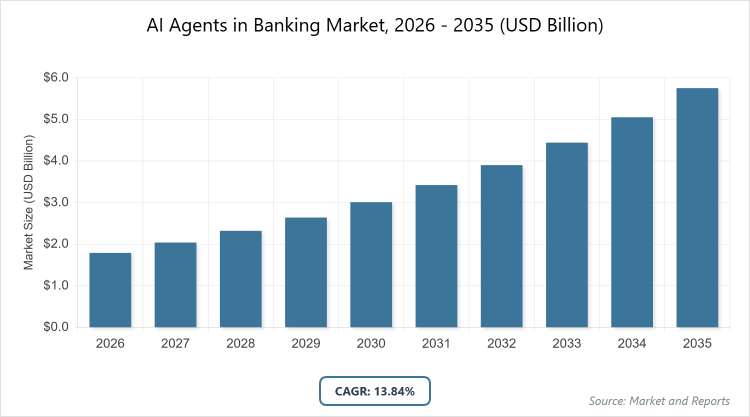
According to MarketnReports, the global AI Agents in Banking market size was estimated at USD 1.79 billion in 2025 and is expected to reach USD 6.54 billion by 2035, growing at a CAGR of 13.84% from 2026 to 2035. AI Agents in Banking Market is driven by the increasing adoption of intelligent automation for operational efficiency and customer engagement.
What are the Key Insights into AI Agents in Banking Market?
- The global AI Agents in Banking market was valued at USD 1.79 billion in 2025 and is projected to reach USD 6.54 billion by 2035.
- The market is expected to grow at a CAGR of 13.84% during the forecast period from 2026 to 2035.
- The market is driven by rising demand for automation in customer service and risk management amid digital transformation in banking.
- The Conversational Agents subsegment dominates the product type segment with a 40% share due to their widespread use in chatbots for real-time customer support; Autonomous Decision-Making Agents hold the second position with 25% share owing to their efficiency in credit approvals and trading.
- The Customer Service & Chatbots subsegment dominates the application segment with a 35% share because of enhanced user engagement; Fraud Detection & Prevention holds 30% share, driven by increasing cyber threats.
- The Retail Banks subsegment dominates the end-user segment with a 50% share, as they prioritize customer-facing AI; Commercial Banks hold 25% share due to complex operational needs.
- North America dominates the market with a 40.5% share, driven by advanced technological infrastructure and regulatory support for AI adoption in banking.
What is the Industry Overview of AI Agents in Banking Market?
The AI Agents in Banking market involves the deployment of autonomous software entities powered by artificial intelligence to perform tasks such as customer interaction, fraud detection, and decision-making within financial institutions. These agents leverage technologies like machine learning and natural language processing to enhance efficiency, personalize services, and mitigate risks in banking operations. Market definition encompasses intelligent systems that operate independently or semi-independently to handle complex banking processes, distinguishing it from traditional AI applications by emphasizing proactive, goal-oriented behaviors that transform customer experiences and back-office functions in the financial sector.
What are the Market Dynamics Affecting AI Agents in Banking Growth?
Growth Drivers
Growth drivers for the AI Agents in Banking market are propelled by the digital transformation wave, where banks adopt AI to streamline operations, reduce costs by up to 30% through automation, and deliver personalized customer experiences via predictive analytics. The surge in cyber threats necessitates advanced fraud detection agents, while regulatory pressures for compliance encourage risk monitoring tools. Additionally, the integration of generative AI enables innovative services like real-time advisory, attracting tech-savvy millennials and boosting customer retention rates.
Restraints
Restraints encompass data privacy concerns under regulations like GDPR, which limit AI deployment due to potential breaches and require robust security measures, increasing implementation costs. High initial investments for AI infrastructure, often exceeding $1 million for large banks, deter smaller institutions. Skill gaps in AI talent and integration challenges with legacy systems further slow adoption, leading to fragmented implementations.
Opportunities
Opportunities lie in emerging markets where fintech collaborations can introduce affordable AI agents for unbanked populations, potentially capturing 20% more customers through mobile banking. Advancements in agentic AI, enabling autonomous decision-making, open avenues for hyper-personalized wealth management. Partnerships with cloud providers like AWS can scale solutions cost-effectively, while exploring blockchain integration enhances security and trust in AI-driven transactions.
Challenges
Challenges include ethical AI biases in credit scoring, which could lead to discriminatory outcomes and regulatory fines, necessitating transparent algorithms. Rapid technological evolution demands continuous updates, straining IT resources. Interoperability issues between AI agents and existing banking software complicate seamless operations, while consumer trust in AI decisions remains a hurdle requiring education and proven reliability.
AI Agents in Banking Market: Report Scope
| Report Attributes | Report Details |
| Report Name | AI Agents in Banking Market |
| Market Size 2025 | USD 1.79 Billion |
| Market Forecast 2035 | USD 6.54 Billion |
| Growth Rate | CAGR of 13.84% |
| Report Pages | 210 |
| Key Companies Covered |
JPMorgan Chase, Bank of America, Wells Fargo, Citigroup, HSBC, and Others |
| Segments Covered | By Product Type, By Application, By End-User, and By Region |
| Regions Covered | North America, Europe, Asia Pacific (APAC), Latin America, and The Middle East and Africa (MEA) |
| Base Year | 2025 |
| Historical Year | 2020 – 2024 |
| Forecast Year | 2026 – 2035 |
| Customization Scope | Avail customized purchase options to meet your exact research needs. |
How is the AI Agents in Banking Market Segmented?
The AI Agents in Banking market is segmented by type, application, end-user, and region.
By Product Type. The most dominant subsegment is Conversational Agents with a 40% share, essential for 24/7 customer interactions that improve satisfaction and reduce support costs, driving the market by enabling scalable service delivery; the second most dominant is Autonomous Decision-Making Agents with 25% share, critical for real-time approvals, contributing to growth through faster processing and reduced human error.
By Application. The most dominant subsegment is Customer Service & Chatbots with a 35% share, as it enhances engagement and loyalty, propelling the market via personalized experiences; the second most dominant is Fraud Detection & Prevention with 30% share, vital for security, aiding expansion by minimizing losses.
By End-User. The most dominant subsegment is Retail Banks with a 50% share, focusing on consumer-facing innovations, boosting the market with high adoption rates; the second most dominant is Commercial Banks with 25% share, where complex needs drive efficiency gains, supporting overall growth.
What are the Recent Developments in AI Agents in Banking Industry?
- In January 2026, fintechs like Stripe advanced agentic AI for payments, processing $1.4 trillion annually with fraud detection and optimization, leading competitive pressure on traditional banks.
- In October 2025, PwC highlighted AI agents piloting real-time trade reconciliation and regulatory validation, potentially improving efficiency ratios by 15% for banks embracing full AI integration.
- In November 2025, BCG reported AI agents accounting for 17% of total AI value in banking, with projections to 29% by 2028, transforming retail banking from branches to bots.
How Does Regional Analysis Impact AI Agents in Banking Market?
- North America is expected to dominate the global market.
North America holds the largest share at 40.5%, with the United States as the dominating country due to its pioneering fintech ecosystem, supportive regulations from the OCC and Fed encouraging AI innovation, and major institutions like JPMorgan Chase allocating billions to AI for fraud detection and personalized services, centered in tech hubs like Silicon Valley and New York. The U.S. benefits from a mature digital banking landscape, with over 80% consumer adoption of mobile apps driving demand for conversational agents, while Canada’s Toronto-Waterloo corridor fosters AI research through institutions like Vector Institute, integrating agents in risk management for banks like RBC. The region’s projected CAGR of 14.2% is fueled by venture capital inflows exceeding $10 billion annually in fintech AI, though challenges include stringent data privacy under CCPA and talent competition.
Europe accounts for 25%, led by Germany, where Industry 4.0 initiatives and EU-wide regulations like PSD2 promote open banking, enabling AI agents for compliance and trading optimization at institutions like Deutsche Bank in Frankfurt’s financial district. Germany’s strength lies in precision engineering applied to predictive analytics agents, supported by BaFin’s sandbox for AI testing, while the UK’s London fintech scene post-Brexit leverages AI for wealth management at HSBC. France’s Paris Europlace hub focuses on fraud prevention agents amid rising cyber threats, and Nordic countries like Sweden emphasize ethical AI in credit scoring. The region’s CAGR of 13.5% reflects growth from Horizon Europe funding for AI research, but restraints include GDPR compliance costs averaging €500,000 per bank and fragmented markets.
Asia Pacific represents 20%, dominated by China, propelled by rapid digital banking expansion under the Digital Yuan project and government policies like the 14th Five-Year Plan, with Alibaba and Tencent deploying AI agents for credit scoring in massive user bases exceeding 1 billion. China’s leadership is evident in Shenzhen’s tech clusters innovating autonomous agents for portfolio optimization, while Japan’s Tokyo banks like Mitsubishi UFJ use AI for operational efficiency amid aging demographics. India’s Mumbai fintech boom, driven by UPI, adopts fraud detection agents at HDFC, and Singapore’s MAS sandbox accelerates AI in wealth advisory. The region’s highest CAGR of 15.1% is driven by mobile-first consumers and 5G infrastructure, though challenges encompass regulatory variances and data localization laws.
Latin America holds 10%, with Brazil leading through the SUS-inspired digital health integrations spilling into banking, where Pix payment system boosts AI agents for loan processing at Banco do Brasil in São Paulo’s financial centers. Brazil’s growth is supported by open banking regulations from BCB, enabling predictive agents for risk assessment, while Mexico’s CNBV promotes AI in commercial banks near U.S. borders for cross-border fraud prevention. Argentina and Chile see niche adoption in investment banks for trading agents. The region’s CAGR of 12.8% is tempered by economic volatility but enhanced by regional pacts like Pacific Alliance harmonizing fintech standards.
The Middle East and Africa account for 4.5%, dominated by the UAE, where Abu Dhabi Global Market’s RegLab fosters AI agents for secure transactions in Dubai’s DIFC, aligning with Vision 2031 for smart financial services at banks like Emirates NBD. The UAE’s market thrives on oil-funded digital transformations, emphasizing compliance agents amid international trade, while Saudi Arabia’s NEOM integrates AI in central banking for economic diversification. South Africa’s Johannesburg leads in Africa with AI for credit unions combating fraud, supported by SARB guidelines. The region’s CAGR of 13.0% reflects infrastructure booms, but faces hurdles from political instability and skill shortages.
Who are the Key Market Players in AI Agents in Banking Sector?
- JPMorgan Chase. JPMorgan Chase invests in proprietary AI agents for fraud detection and trading, leveraging data analytics to enhance decision-making and customer personalization.
- Bank of America. Bank of America deploys conversational AI like Erica for virtual assistance, focusing on integration with mobile banking to improve user engagement and operational efficiency.
- Wells Fargo. Wells Fargo utilizes predictive agents for risk assessment, emphasizing compliance and cybersecurity strategies to mitigate threats in real-time.
- Citigroup. Citigroup develops autonomous agents for wealth management, adopting cloud-based solutions to optimize portfolios and provide advisory services.
- HSBC. HSBC implements AI for global compliance monitoring, pursuing partnerships with tech firms to expand agent capabilities across international markets.
What are the Market Trends Shaping AI Agents in Banking Future?
- Rise of agentic AI for autonomous decision-making in lending and investments.
- Integration of generative AI for personalized customer interactions.
- Emphasis on ethical AI to address biases in credit scoring.
- Growth in cloud deployment for scalable AI agent solutions.
- Adoption of multi-agent systems for complex banking operations.
What Market Segments and Subsegments are Covered in AI Agents in Banking Report?
By Product Type
- Conversational Agents
- Autonomous Decision-Making Agents
- Predictive Analytics Agents
- Compliance & Risk Monitoring Agents
- Robotic Process Automation Agents
- Fraud Detection Agents
- Customer Service Bots
- Wealth Management Agents
- Credit Scoring Agents
- Portfolio Optimization Agents
- Others
By Application
- Customer Service & Chatbots
- Fraud Detection & Prevention
- Credit Scoring & Underwriting
- Wealth Management & Advisory
- Trading & Portfolio Optimization
- Compliance & Regulatory Reporting
- Loan Processing Automation
- Risk Assessment
- Personalized Banking
- Operational Efficiency
- Others
By End-User
- Retail Banks
- Commercial Banks
- Investment Banks
- Central Banks
- Credit Unions
- Fintech Companies
- Private Banks
- Cooperative Banks
- Online Banks
- Savings Banks
- Others
By Region
-
- North America
- U.S.
- Canada
- Europe
- UK
- Germany
- France
- Rest of Europe
- Asia Pacific
- China
- India
- Japan
- Rest of Asia Pacific
- Latin America
- Brazil
- Mexico
- Rest of Latin America
- Middle East & Africa
- UAE
- South Africa
- Rest of Middle East & Africa
- North America
Chapter 1. Preface
Chapter 2. Executive Summary
Chapter 3. Global AI Agents in Banking Market - Industry Analysis
Chapter 4. Global AI Agents in Banking Market- Competitive Landscape
Chapter 5. Global AI Agents in Banking Market - Product Type Analysis
Chapter 6. Global AI Agents in Banking Market - Application Analysis
Chapter 7. Global AI Agents in Banking Market - End-User Analysis
Chapter 8. AI Agents in Banking Market - Regional Analysis
Chapter 9. Company Profiles
Frequently Asked Questions
AI Agents in Banking are autonomous software systems using AI to perform tasks like customer service, fraud detection, and decision-making in financial operations.
Key factors include digital transformation, regulatory compliance needs, cybersecurity threats, and demand for personalized banking services.
The market is projected to grow from USD 2.04 billion in 2026 to USD 6.54 billion by 2035.
The CAGR is expected to be 13.84% from 2026 to 2035.
North America will contribute notably, holding the largest share due to technological advancements and regulatory support.
Major players include JPMorgan Chase, Bank of America, Wells Fargo, Citigroup, and HSBC.
The report offers comprehensive analysis, market forecasts, segmentation details, competitive landscape, and regional outlooks.
Stages include technology development, system integration, deployment in banks, data management, and ongoing maintenance.
Trends favor agentic AI for autonomy; preferences shift toward seamless, personalized digital banking experiences.
Factors include data privacy laws like GDPR and sustainable AI practices reducing energy consumption in data centers.