
Nostalgic Florals Market Size, Share and Trends 2026 to 2035
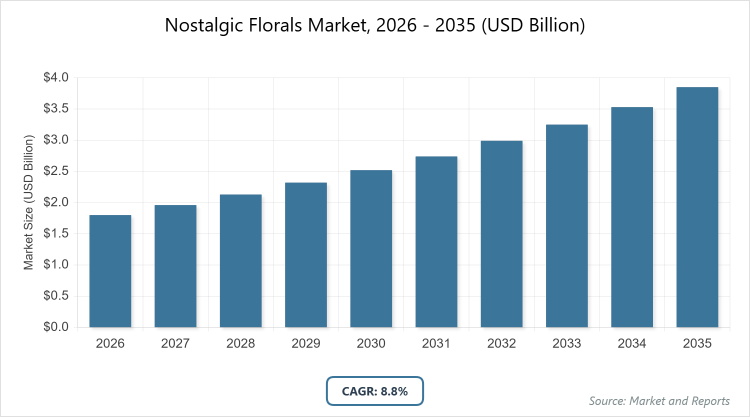
According to MarketnReports, the global Nostalgic Florals market size was estimated at USD 1.8 billion in 2025 and is expected to reach USD 4.2 billion by 2035, growing at a CAGR of 8.8% from 2026 to 2035. The Nostalgic Florals Market is driven by rising consumer preference for vintage-inspired designs in fashion and home decor.
What are the Key Insights into Nostalgic Florals Market?
- The global Nostalgic Florals market was valued at USD 1.8 billion in 2025 and is projected to reach USD 4.2 billion by 2035.
- The market is expected to grow at a CAGR of 8.8% during the forecast period from 2026 to 2035.
- The market is driven by increasing demand for retro and heritage-inspired aesthetics in fashion and home interiors.
- The Vintage Rose Prints subsegment dominates the product type segment with a 35% share due to its timeless appeal and versatility in apparel; Retro Daisy Patterns hold the second position with 25% share owing to their playful mid-century vibe popular in decor.
- The Fashion Apparel subsegment dominates the application segment with a 40% share because of high consumer adoption in clothing trends; Home Decor holds 30% share, driven by interior personalization needs.
- The Residential Consumers subsegment dominates the end-user segment with a 45% share as it focuses on personal nostalgia; Fashion Brands hold 25% share due to seasonal collections incorporating vintage florals.
- Europe dominates the market with a 35% share, driven by rich cultural heritage and strong fashion industry embracing nostalgic designs.
What is the Industry Overview of Nostalgic Florals Market?
The Nostalgic Florals market encompasses designs and products featuring floral patterns that evoke memories of past eras, blending vintage aesthetics with modern applications in fashion, interior design, and decor. These florals often draw from historical motifs like Victorian blooms or mid-century prints, appealing to consumers seeking emotional comfort and timeless style amid fast-paced contemporary life. Market definition refers to the segment within the broader floral design and decor industry focused on nostalgic themes, including printed fabrics, wallpapers, and arrangements that promote sentimentality, sustainability, and personalization in residential and commercial spaces.
What are the Market Dynamics Affecting Nostalgic Florals Growth?
Growth Drivers
Growth drivers for the Nostalgic Florals market are rooted in the resurgence of vintage trends, fueled by social media platforms like Pinterest and Instagram showcasing “grandma florals” and retro aesthetics, which resonate with millennials and Gen Z seeking comfort in uncertain times. Sustainability plays a key role, as consumers prefer eco-friendly fabrics and prints made from recycled materials, aligning with global environmental awareness and driving demand in ethical fashion. Additionally, the integration of nostalgic elements in home decor, influenced by movements like cottagecore, encourages personalization and emotional well-being, boosting sales through e-commerce and collaborations between designers and retailers.
Restraints
Restraints include the high cost of premium vintage-inspired materials and production, which can limit accessibility for budget-conscious consumers in emerging markets. Over-saturation of floral patterns in fast fashion may lead to consumer fatigue, reducing novelty appeal. Intellectual property challenges arise from replicating historical designs, potentially resulting in legal issues and stifling innovation. Supply chain disruptions for specialized dyes and fabrics further constrain growth, especially in regions dependent on imports.
Opportunities
Opportunities arise from digital customization tools allowing consumers to personalize nostalgic floral products, expanding into AR try-on features for fashion and virtual home staging for decor. Partnerships with influencers and brands can tap into niche markets like sustainable weddings or heritage-themed events. Growth in emerging economies through affordable adaptations of nostalgic designs offers untapped potential, while integrating smart textiles with floral prints could attract tech-savvy buyers seeking multifunctional items.
Challenges
Challenges involve balancing authenticity with modern relevance, as overly literal nostalgic designs may not appeal to younger demographics preferring subtle twists. Fluctuating raw material prices for natural dyes impact profitability. Adapting to diverse cultural interpretations of nostalgia requires localized strategies, complicating global expansion. Environmental regulations on textile production add compliance burdens, necessitating investment in green technologies.
Nostalgic Florals Market: Report Scope
| Report Attributes | Report Details |
| Report Name | Nostalgic Florals Market |
| Market Size 2025 | USD 1.8 Billion |
| Market Forecast 2035 | USD 4.2 Billion |
| Growth Rate | CAGR of 8.8% |
| Report Pages | 220 |
| Key Companies Covered |
Gucci, Zara, Anthropologie, Liberty London, H&M, and Others |
| Segments Covered | By Product Type, By Application, By End-User, and By Region |
| Regions Covered | North America, Europe, Asia Pacific (APAC), Latin America, and The Middle East and Africa (MEA) |
| Base Year | 2025 |
| Historical Year | 2020 – 2024 |
| Forecast Year | 2026 – 2035 |
| Customization Scope | Avail customized purchase options to meet your exact research needs. |
How is the Nostalgic Florals Market Segmented?
The Nostalgic Florals market is segmented by type, application, end-user, and region.
By Product Type. The most dominant subsegment is Vintage Rose Prints with a 35% share, cherished for their romantic heritage that enhances emotional appeal in fashion, driving the market by evoking timeless elegance and boosting sales in apparel lines; the second most dominant is Retro Daisy Patterns with 25% share, favored for their cheerful 1960s vibe in decor, contributing to growth through versatile applications in home products that cater to nostalgic trends.
By Application. The most dominant subsegment is Fashion Apparel with a 40% share, as it capitalizes on seasonal trends incorporating nostalgic motifs, propelling the market via high-visibility runway influences; the second most dominant is Home Decor with 30% share, utilized for creating cozy interiors, aiding expansion by aligning with lifestyle shifts toward sentimental spaces.
By End-User. The most dominant subsegment is Residential Consumers with a 45% share, driven by personal desire for comforting designs, boosting the market through direct-to-consumer channels; the second most dominant is Fashion Brands with 25% share, where collections feature nostalgic elements, supporting growth via brand storytelling and collaborations.
What are the Recent Developments in Nostalgic Florals Industry?
- In 2025, Gucci launched a spring collection featuring nostalgic floral prints inspired by Victorian gardens, emphasizing sustainable fabrics to appeal to eco-conscious consumers.
- Zara introduced a home line with retro daisy wallpapers in mid-2025, collaborating with influencers to promote cottagecore aesthetics on social media.
- Anthropologie expanded its nostalgic bloom decor range in early 2026, incorporating AR tools for virtual room styling to enhance online shopping experiences.
How Does Regional Analysis Impact Nostalgic Florals Market?
- Europe is to dominate the global market.
Europe holds the largest share at 35%, with the United Kingdom as the dominating country due to its profound heritage in floral design traditions, exemplified by iconic Liberty prints and William Morris motifs, and a vibrant fashion industry in London that enthusiastically embraces “grandma florals” through events like London Fashion Week and the Chelsea Flower Show, which spotlight nostalgic aesthetics. The UK’s market thrives on a blend of historical reverence and modern sustainability, with consumers in cities like Manchester and Edinburgh favoring eco-friendly vintage rose wallpapers and apparel, supported by government initiatives promoting British craftsmanship.
France contributes significantly with its romantic Provençal patterns influencing Paris haute couture, while Italy’s Milan design scene integrates antique motifs in luxury fabrics. Germany’s focus on rustic country florals in home decor aligns with Bauhaus-inspired nostalgia. The region’s projected CAGR of 9.2% is propelled by strong e-commerce platforms like ASOS and cultural festivals, though challenges include high production costs for artisanal prints and Brexit-related trade barriers.
North America accounts for 30%, led by the United States, where nostalgia-driven trends like mid-century floral elements flourish in New York Fashion Week collections and California’s bohemian home decor markets, amplified by social media influencers promoting cottagecore lifestyles on platforms like Instagram and TikTok. The U.S. dominance stems from a diverse consumer base embracing retro daisy patterns in fast fashion and vintage-inspired event decorations, with key hubs in Los Angeles for celebrity-endorsed lines and Texas for rustic floral upholstery.
Canada’s contribution includes Toronto’s multicultural designs incorporating heritage blooms in stationery and gifts. The region’s CAGR of 8.5% reflects growth from online retailers like Etsy and Amazon, but restraints encompass fast fashion’s environmental scrutiny and supply chain vulnerabilities. Opportunities include AR integration for virtual try-ons in apparel and partnerships with sustainable farms for botanical illustrations, potentially capturing eco-conscious millennials and expanding into untapped suburban markets.
Asia Pacific represents 20%, dominated by Japan, benefiting from kawaii-inspired retro florals in Tokyo’s Harajuku fashion districts and a rising demand for nostalgic botanical elements in home interiors amid rapid urbanization, influenced by cultural festivals like Hanami cherry blossom viewings adapted into modern prints. Japan’s leadership is supported by innovative tech integrations, such as digital printing for customizable Victorian arrangements, catering to a youthful demographic in Osaka and Kyoto. China emerges with heritage bloom fabrics in Shanghai’s textile hubs, driven by the guochao trend reviving traditional motifs, while India’s Mumbai market favors antique floral saris and decor.
South Korea adds through Seoul’s K-fashion incorporating classic peony designs. The region’s highest CAGR of 10.1% is fueled by e-commerce giants like Alibaba and Shopee, though challenges include intellectual property issues with replicated designs and raw material fluctuations. Opportunities arise from cross-cultural collaborations and sustainable bamboo-based fabrics, accelerating adoption in emerging middle-class segments.
Latin America holds 10%, with Brazil leading through vibrant event decorations featuring nostalgic patterns in Sao Paulo’s design fairs and Carnival-inspired rustic country florals, fueled by a cultural affinity for sentimental motifs in family gatherings and home settings. Brazil’s growth is bolstered by local artisans in Rio de Janeiro producing affordable old-fashioned wallpapers, supported by eco-tourism trends promoting heritage blooms. Mexico contributes with Day of the Dead floral elements in Mexico City’s markets, while Argentina’s Buenos Aires focuses on Victorian styles in luxury accessories.
The region’s CAGR of 8.0% is moderated by economic instability affecting luxury purchases, but enhanced by regional trade agreements like MERCOSUR facilitating material imports. Challenges include competition from synthetic alternatives and limited digital infrastructure in rural areas, while opportunities encompass influencer marketing on platforms like Instagram and sustainable sourcing from Amazonian botanicals, fostering expansion in urban millennial consumers.
The Middle East and Africa account for 5%, dominated by the UAE, where opulent Dubai interiors and hospitality projects incorporate antique floral motifs in high-end hotels and events, aligned with Vision 2031’s cultural preservation goals blending nostalgia with modern luxury. The UAE’s market benefits from expatriate influences promoting mid-century elements in Abu Dhabi residences, supported by international design expos.
Saudi Arabia adds through Riyadh’s mega-projects featuring heritage bloom packaging, while South Africa’s Johannesburg market emphasizes rustic florals in gift shops amid eco-tourism. Israel’s Tel Aviv innovates with tech-infused nostalgic stationery. The region’s CAGR of 9.0% reflects luxury tourism growth, but faces hurdles from arid climates limiting natural dye availability and geopolitical tensions.
Who are the Key Market Players in the Nostalgic Florals Sector?
- Gucci. Gucci employs heritage-inspired collections and sustainable sourcing to capitalize on nostalgic trends, enhancing brand loyalty through storytelling.
- Zara. Zara focuses on fast-fashion adaptations of retro florals, leveraging global supply chains for quick trend responses and affordable access.
- Anthropologie. Anthropologie invests in curated nostalgic decor lines, using e-commerce and collaborations to target lifestyle consumers.
- Liberty London. Liberty London prioritizes iconic floral prints, expanding through licensing and digital platforms to maintain heritage appeal.
- H&M. H&M integrates nostalgic elements in seasonal drops, emphasizing eco-materials and marketing to drive mass-market adoption.
What are the Market Trends Shaping Nostalgic Florals Future?
- Revival of grandma florals in fashion with bold, oversized prints.
- Integration of sustainable fabrics in nostalgic designs for eco-appeal.
- Rise of AR tools for virtual try-ons in floral apparel and decor.
- Growth in cottagecore-inspired home products evoking rural nostalgia.
- Collaborations between brands and artists for unique heritage motifs.
What Market Segments and Subsegments are Covered in Nostalgic Florals Report?
By Product Type
- Vintage Rose Prints
- Retro Daisy Patterns
- Classic Peony Designs
- Antique Floral Motifs
- Heritage Bloom Fabrics
- Old-Fashioned Floral Wallpapers
- Victorian Style Arrangements
- Mid-Century Floral Elements
- Rustic Country Florals
- Nostalgic Botanical Illustrations
- Others
By Application
- Fashion Apparel
- Home Decor
- Interior Design
- Gift Items
- Event Decoration
- Stationery Products
- Furniture Upholstery
- Wall Coverings
- Accessories
- Packaging Materials
- Others
By End-User
- Residential Consumers
- Interior Designers
- Fashion Brands
- Event Planners
- Retail Stores
- Hospitality Sector
- Gift Shops
- Online Retailers
- Furniture Manufacturers
- Packaging Companies
- Others
By Region
-
- North America
- U.S.
- Canada
- Europe
- UK
- Germany
- France
- Rest of Europe
- Asia Pacific
- China
- India
- Japan
- Rest of Asia Pacific
- Latin America
- Brazil
- Mexico
- Rest of Latin America
- Middle East & Africa
- UAE
- South Africa
- Rest of Middle East & Africa
- North America
Chapter 1. Preface
Chapter 2. Executive Summary
Chapter 3. Global Nostalgic Florals Market - Industry Analysis
Chapter 4. Global Nostalgic Florals Market- Competitive Landscape
Chapter 5. Global Nostalgic Florals Market - Product Type Analysis
Chapter 6. Global Nostalgic Florals Market - Application Analysis
Chapter 7. Global Nostalgic Florals Market - End-User Analysis
Chapter 8. Nostalgic Florals Market - Regional Analysis
Chapter 9. Company Profiles
Frequently Asked Questions
Nostalgic Florals are design elements featuring vintage-inspired floral patterns used in fashion, decor, and products to evoke sentimental memories.
Key factors include nostalgia trends, sustainability demands, digital customization, and social media influence on vintage aesthetics.
The market is projected to grow from USD 1.95 billion in 2026 to USD 4.2 billion by 2035.
The CAGR is expected to be 8.8% from 2026 to 2035.
Europe will contribute notably, leading with heritage-driven designs and fashion innovation.
Major players include Gucci, Zara, Anthropologie, Liberty London, and H&M.
The report provides in-depth analysis, forecasts, segmentation, trends, and competitive insights.
Stages include design creation, material sourcing, manufacturing, distribution, and retail sales.
Trends emphasize sustainable, personalized vintage prints; preferences favor emotional, nostalgic elements in daily life.
Factors include sustainability regulations on textiles and eco-labeling promoting green floral designs.