
Yacht Market Size, Share and Trends 2026 to 2035
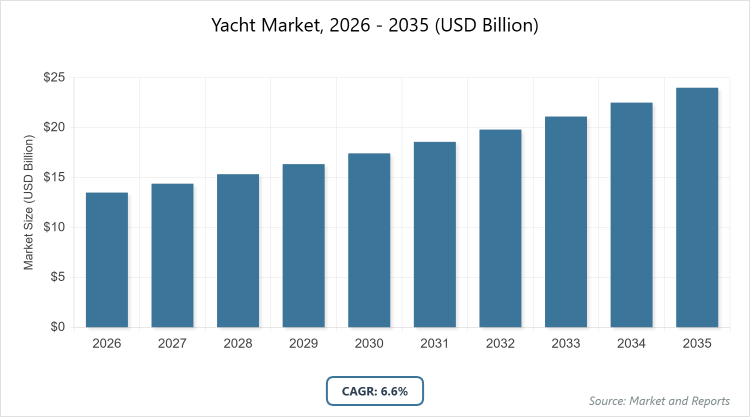
According to MarketnReports, the global Yacht Market size was estimated at USD 13.5 Billion in 2025 and is expected to reach USD 25.6 Billion by 2035, growing at a CAGR of 6.6% from 2026 to 2035. Yacht Market is driven by the rising number of high-net-worth individuals and increasing demand for luxury marine tourism experiences.
What is the Industry Overview of the Yacht Market?
The yacht market encompasses the design, manufacturing, sales, chartering, and maintenance of luxury vessels primarily used for recreational and leisure purposes, ranging from small motor yachts to expansive superyachts equipped with advanced amenities. This market serves affluent individuals, charter companies, and tourism operators seeking personalized sea-based experiences, blending engineering innovation with opulent lifestyle elements. Market definition includes all yachts over 24 meters in length, excluding commercial shipping vessels, and focuses on segments driven by customization, sustainability, and experiential travel.
What are the Key Insights into the Yacht Market?
- The global yacht market was valued at USD 13.5 billion in 2025 and is projected to reach USD 25.6 billion by 2035.
- The market is anticipated to grow at a CAGR of 6.6% during the forecast period from 2026 to 2035.
- The yacht market is driven by increasing high-net-worth individuals, advancements in sustainable propulsion technologies, and rising demand for personalized luxury experiences.
- In the type segment, cruiser yachts dominate with a 32.5% share due to their versatility, comfort for extended voyages, and appeal to families and leisure users seeking balanced performance and amenities.
- In the length segment, yachts between 20-50 meters dominate with approximately 45% share, as they offer a sweet spot between affordability, manageability, and luxury features without the extreme costs of larger vessels.
- In the propulsion segment, diesel propulsion holds the leading position with over 60% share, attributed to its reliability, long-range capabilities, and established infrastructure in marinas worldwide.
- In the application segment, leisure cruising leads with around 40% share, fueled by growing interest in private escapes and marine adventures post-pandemic.
- In the end-user segment, private individuals command the largest share at about 55%, driven by wealth accumulation among ultra-high-net-worth individuals investing in status symbols and lifestyle assets.
- North America dominates the global yacht market with a 46% share, owing to a high concentration of wealthy individuals, extensive coastline infrastructure, and strong marine tourism industry in the United States.
What are the Market Dynamics of the Yacht Market?
Growth Drivers
The yacht market is propelled by a surge in the global population of high-net-worth individuals (HNWIs), who view yachts as ultimate symbols of luxury and freedom, enabling exclusive travel experiences away from crowded destinations. Technological advancements, such as hybrid propulsion systems and smart navigation, enhance fuel efficiency and safety, attracting environmentally conscious buyers. Additionally, the expansion of marine tourism and charter services in emerging economies boosts demand for versatile yachts suitable for short-term rentals and adventure trips, further stimulating market growth through increased accessibility.
Restraints
High initial acquisition costs, coupled with ongoing maintenance, docking, and crew expenses, pose significant barriers, limiting the market to a niche affluent demographic and deterring potential mid-tier buyers. Stringent environmental regulations on emissions and waste disposal increase compliance burdens for manufacturers, potentially raising production costs and slowing innovation in traditional diesel models. Economic volatility, including recessions or geopolitical tensions, can reduce discretionary spending among HNWIs, leading to deferred purchases and a slowdown in new yacht orders.
Opportunities
Emerging markets in Asia-Pacific and the Middle East present untapped potential, with rising wealth creation and government investments in marina infrastructure opening avenues for yacht manufacturers to expand through localized production and customized offerings. The shift toward sustainable yachting, including electric and solar-powered models, creates opportunities for innovation in green technologies, appealing to eco-aware consumers and aligning with global decarbonization goals. Partnerships with tourism operators for experiential charters, such as wellness retreats or adventure expeditions, can diversify revenue streams beyond outright sales.
Challenges
Supply chain disruptions, exacerbated by global events like material shortages or labor constraints in shipyards, delay yacht deliveries and inflate costs, impacting customer satisfaction and market timelines. Intense competition among key players necessitates continuous R&D investment to differentiate through unique features, straining resources for smaller manufacturers. Evolving consumer preferences toward shared ownership models or fractional charters challenge traditional sales approaches, requiring adaptation to maintain market share amid shifting economic priorities.
Yacht Market Report Scope
| Report Attributes | Report Details |
| Report Name | Yacht Market |
| Market Size 2025 | USD 13.5 Billion |
| Market Forecast 2035 | USD 25.6 Billion |
| Growth Rate | CAGR of 6.6% |
| Report Pages | 220 |
| Key Companies Covered | Azimut Benetti, Ferretti Group, Sunseeker, Lurssen, Feadship, Sanlorenzo, and Others |
| Segments Covered | By Type, By Length, By Propulsion, By Application, By End-User, and By Region |
| Regions Covered | North America, Europe, Asia Pacific (APAC), Latin America, and The Middle East and Africa (MEA) |
| Base Year | 2025 |
| Historical Year | 2020 - 2024 |
| Forecast Year | 2026 - 2035 |
| Customization Scope | Avail customized purchase options to meet your exact research needs. |
What is the Market Segmentation of the Yacht Market?
The Yacht Market is segmented by type, length, propulsion, application, end-user, and region. All the segments have been analyzed based on present and future trends and the market is estimated from 2026 to 2035.
Based on Type Segment, cruiser yachts emerge as the most dominant subsegment, holding about 32.5% share, due to their optimal blend of speed, stability, and onboard amenities that cater to family-oriented leisure, while motor yachts rank as the second most dominant with around 25% share, prized for their power and luxury interiors; both drive the market by fulfilling the growing demand for versatile vessels that support extended cruises and entertainment, enhancing overall accessibility and appeal in recreational boating.
Based on Length Segment, the 20-50 meters category dominates with approximately 45% share, offering a cost-effective yet spacious option for private owners seeking manageable yet impressive yachts, followed by the 50-75 meters segment at about 30% share, which appeals to those desiring greater customization and long-range capabilities; these segments propel market growth by balancing affordability with prestige, attracting a broader range of HNWIs and charter operators investing in mid-sized vessels for profitable operations.
Based on Propulsion Segment, diesel remains the most dominant with over 60% share, valued for its proven reliability and extensive refueling network, while hybrid propulsion is the second most dominant at around 20% share, gaining traction for its eco-friendly efficiency; together, they drive the market by addressing diverse needs for performance and sustainability, encouraging upgrades and new builds that align with regulatory pressures and consumer shifts toward greener technologies.
Based on Application Segment, leisure cruising leads with roughly 40% share, driven by the desire for relaxed sea voyages and escapes, with charter services as the second most dominant at about 25% share, supported by rising tourism demands; these applications fuel market expansion by creating recurring revenue through rentals and personal use, broadening the yacht's utility beyond ownership and stimulating investments in fleet expansions.
Based on End-User Segment, private individuals dominate with a 55% share, as they invest heavily in personalized luxury assets, followed by charter companies at approximately 25% share, which leverage yachts for commercial profitability; both contribute to market momentum by increasing demand for high-end customizations and operational vessels, fostering innovation and growth in manufacturing and services.
What are the Recent Developments in the Yacht Market?
- In 2025, Azimut Benetti launched a new line of hybrid superyachts featuring advanced battery systems for zero-emission cruising in sensitive marine areas, aiming to capture the growing eco-luxury segment and reduce operational costs for owners.
- Ferretti Group announced a strategic partnership with a leading electric propulsion firm in late 2025, integrating AI-driven navigation into their yacht models to enhance safety and user experience, targeting tech-savvy HNWIs.
- Sunseeker introduced an expanded customization program in 2026, allowing clients to incorporate sustainable materials and smart home integrations, responding to demands for personalized and environmentally responsible designs.
What is the Regional Analysis of the Yacht Market?
North America to dominate the global market.
North America leads the yacht market with a significant share, primarily driven by the United States as the dominating country, where extensive coastlines, robust marina infrastructure, and a high concentration of HNWIs fuel demand for luxury vessels; the region's growth is supported by strong economic conditions, marine tourism hubs like Florida and California, and innovations in yacht chartering that make experiences more accessible.
Europe follows closely, with Italy as the dominating country renowned for its world-class shipyards and design heritage; the market thrives on superyacht production, Mediterranean cruising popularity, and regulatory support for sustainable boating, attracting affluent buyers from across the globe and bolstering export-driven growth.
Asia Pacific is emerging rapidly, led by China as the dominating country amid rising wealth and government investments in coastal developments; the region benefits from increasing interest in leisure yachting, expanding marinas in Singapore and Hong Kong, and a shift toward luxury lifestyles, positioning it for substantial future expansion.
Latin America shows moderate growth, with Brazil dominating through its vibrant coastal culture and growing tourism sector; opportunities arise from natural attractions like the Amazon waterways and Caribbean influences, though challenges include economic instability affecting high-end purchases.
The Middle East and Africa exhibit potential, dominated by the United Arab Emirates with its opulent lifestyle and events like Dubai Boat Show; the market is driven by oil wealth, luxury resorts, and investments in yacht-friendly infrastructure, despite environmental and regulatory hurdles in some areas.
What are the Key Market Players in the Yacht Market?
Azimut Benetti. As a leading Italian yacht builder, Azimut Benetti focuses on innovation through hybrid technologies and bespoke designs, expanding its global footprint via strategic acquisitions and partnerships with sustainability-focused suppliers to cater to eco-conscious clients.
Ferretti Group. This prominent player emphasizes luxury customization and performance, employing digital twin technology for virtual prototyping and collaborating with high-end brands for interior enhancements, aiming to strengthen its position in the superyacht segment.
Sunseeker. Known for British craftsmanship, Sunseeker adopts a strategy of modular builds for faster delivery and invests in R&D for lightweight materials, targeting emerging markets with entry-level luxury models to broaden its customer base.
Lurssen. A German powerhouse in megayachts, Lurssen prioritizes engineering excellence and privacy features, utilizing advanced simulation tools for hull optimization and forging alliances with naval architects to deliver record-breaking vessels.
Feadship. This Dutch firm specializes in fully custom superyachts, with strategies centered on sustainable practices like low-emission builds and client co-creation processes, enhancing its reputation among ultra-HNWIs through exclusive events and collaborations.
Sanlorenzo. Sanlorenzo pursues artistic innovation by integrating contemporary art into yacht designs and adopting agile manufacturing for quicker adaptations, focusing on the Asian market expansion via localized sales networks.
What are the Market Trends in the Yacht Market?
- Increasing adoption of electric and hybrid propulsion systems to meet environmental regulations and appeal to sustainability-focused buyers.
- Rise in smart yacht technologies, including AI navigation and IoT for enhanced safety and convenience.
- Growing popularity of experiential charters, such as wellness and adventure-themed voyages, driving demand for versatile vessels.
- Expansion of fractional ownership models to make yachting more accessible to mid-affluent consumers.
- Focus on customization with eco-friendly materials and personalized amenities to differentiate in a competitive landscape.
- Surge in explorer yachts for remote destinations, reflecting a trend toward off-the-beaten-path luxury travel.
What Market Segments and their Subsegments are Covered in the Yacht Market Report?
- By Type
- Motor Yachts
- Sailing Yachts
- Catamarans
- Trawlers
- Expedition Yachts
- Sport Fishing Yachts
- Flybridge Yachts
- Displacement Yachts
- Semi-Displacement Yachts
- Planing Yachts
- Others
- By Length
- Up to 20 Meters
- 20-50 Meters
- 50-75 Meters
- 75-100 Meters
- Above 100 Meters
- Others
- By Propulsion
- Diesel
- Gasoline
- Electric
- Hybrid
- Sail
- Solar
- Others
- By Application
- Leisure Cruising
- Charter Services
- Fishing
- Racing
- Business Events
- Adventure Travel
- Tourism
- Special Occasions
- Private Vacations
- Expedition Trips
- Others
- By End-User
- Private Individuals
- Charter Companies
- Corporations
- High-Net-Worth Individuals
- Tour Operators
- Government Agencies
- Families
- Adventure Groups
- Sports Clubs
- Luxury Resorts
- Others
- By Region
-
- North America
- U.S.
- Canada
- Europe
- UK
- Germany
- France
- Rest of Europe
- Asia Pacific
- China
- India
- Japan
- Rest of Asia Pacific
- Latin America
- Brazil
- Mexico
- Rest of Latin America
- Middle East & Africa
- UAE
- South Africa
- Rest of Middle East & Africa
- North America
Frequently Asked Questions
The yacht market refers to the industry involved in the production, sale, charter, and servicing of luxury recreational vessels designed for leisure, typically featuring advanced amenities and customization options.
Key factors include rising high-net-worth individuals, technological advancements in propulsion, expanding marine tourism, sustainability trends, and infrastructure developments in emerging regions.
The market was valued at USD 13.5 billion in 2025 and is projected to reach USD 25.6 billion by 2035.
The CAGR is expected to be 6.6% during the forecast period.
North America will contribute notably, holding the largest share due to its affluent population and advanced marine facilities.
Major players include Azimut Benetti, Ferretti Group, Sunseeker, Lurssen, Feadship, and Sanlorenzo, among others.
The report provides comprehensive analysis including market size, trends, segmentation, regional insights, key players, and forecasts.
Stages include design and engineering, raw material procurement, manufacturing and assembly, sales and distribution, chartering services, maintenance, and aftermarket upgrades.
Trends are shifting toward sustainable and tech-integrated yachts, with consumers preferring customizable, eco-friendly vessels for experiential travel.
Stricter emission regulations and marine conservation policies are pushing manufacturers toward green technologies, while also increasing compliance costs.