
Cloud based Product Lifecycle Management (PLM) Market Size, Share and Trends 2026 to 2035
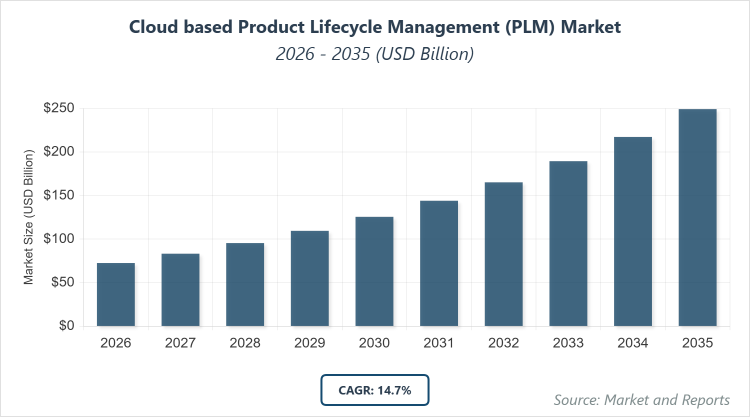
According to MarketnReports, the global Cloud based Product Lifecycle Management (PLM) Market size was estimated at USD 72.51 Billion in 2025 and is expected to reach USD 285.76 Billion by 2035, growing at a CAGR of 14.7% from 2026 to 2035. Cloud based Product Lifecycle Management (PLM) Market is driven by increasing digital transformation and adoption of Industry 4.0 technologies.
What is the Industry Overview of Cloud based Product Lifecycle Management (PLM) Market?
Cloud-based Product Lifecycle Management (PLM) refers to a suite of software solutions hosted on cloud platforms that manage the entire lifecycle of a product from inception through design, manufacturing, service, and disposal. This market encompasses tools that facilitate collaboration, data management, and process optimization in a scalable, remote-accessible environment. The market definition includes all cloud-deployed PLM systems that enable real-time sharing of product data, streamline workflows, and integrate with other enterprise systems like ERP and CAD, catering primarily to industries requiring efficient product development and compliance management.
What are the Key Insights into the Cloud based Product Lifecycle Management (PLM) Market?
- The global Cloud-based PLM market was valued at USD 72.51 billion in 2025 and is projected to reach USD 285.76 billion by 2035.
- The market is expected to grow at a CAGR of 14.7% from 2026 to 2035.
- The market is driven by digital transformation initiatives, adoption of Industry 4.0 technologies, and the need for enhanced collaboration and cost efficiency.
- In the Component segment, Software dominates with a 65% share due to its core role in providing essential functionalities like data management and simulation tools that form the backbone of PLM systems.
- In the Application segment, Product Data Management (PDM) dominates with a 25% share because it centralizes product information, ensuring accuracy and accessibility, which is critical for reducing errors and speeding up development cycles.
- In the End-User segment, Automotive and Transportation dominates with a 30% share owing to the sector’s complex supply chains, regulatory requirements, and need for rapid innovation in vehicle design and manufacturing.
- In the Enterprise Size segment, Large Enterprises dominate with a 70% share as they require robust, scalable solutions to handle vast data volumes and global operations.
- North America holds the largest regional share at 40% because of its advanced technological infrastructure, high adoption of cloud technologies, and presence of major manufacturing hubs.
What are the Market Dynamics in Cloud based Product Lifecycle Management (PLM) Market?
Growth Drivers
The primary growth drivers for the Cloud-based PLM market include the accelerating digital transformation across industries, where companies are shifting to cloud solutions to enhance agility and reduce operational costs. The integration of advanced technologies like AI, IoT, and big data analytics into PLM platforms is enabling predictive maintenance, real-time collaboration, and data-driven decision-making, which significantly boosts efficiency. Additionally, the rise of remote workforces and global supply chains necessitates accessible, scalable tools that cloud-based PLM provides, allowing seamless interaction among distributed teams. The push towards sustainability and compliance with environmental regulations further drives adoption, as these systems help track product lifecycles for eco-friendly practices.
Restraints
Despite its growth, the market faces restraints such as data security and privacy concerns, as cloud platforms involve storing sensitive product designs and intellectual property online, making them vulnerable to cyber threats. Integration challenges with legacy systems in established enterprises can lead to high migration costs and downtime, deterring adoption. Moreover, the dependency on stable internet connectivity poses issues in regions with underdeveloped infrastructure, limiting market penetration. High initial subscription fees and the need for ongoing training to utilize advanced features also act as barriers for smaller organizations.
Opportunities
Opportunities in the Cloud-based PLM market are abundant, particularly with the emergence of AI and machine learning integrations that automate routine tasks and provide insightful analytics for product optimization. The expansion into emerging markets in Asia-Pacific and Latin America, where manufacturing is booming, presents untapped potential for vendors to offer tailored solutions. Partnerships with cloud providers like AWS and Microsoft Azure can enhance platform capabilities, opening doors to hybrid models. Furthermore, the growing emphasis on circular economy principles creates demand for PLM tools that support product recycling and remanufacturing processes.
Challenges
Key challenges include the rapid pace of technological evolution, requiring constant updates to PLM platforms to incorporate new features like generative AI and digital twins, which can strain vendor resources. Ensuring interoperability between different PLM systems and third-party applications remains complex, often leading to fragmented data silos. Regulatory variations across regions complicate compliance management within global operations. Additionally, the shortage of skilled professionals proficient in cloud PLM technologies hinders effective implementation and maximization of ROI for end-users.
Cloud based Product Lifecycle Management (PLM) Market Report Scope
| Report Attributes | Report Details |
| Report Name | Cloud based Product Lifecycle Management (PLM) Market |
| Market Size 2025 | USD 72.51 Billion |
| Market Forecast 2035 | USD 285.76 Billion |
| Growth Rate | CAGR of 14.7% |
| Report Pages | 220 |
| Key Companies Covered | Siemens AG, PTC Inc., Dassault Systemes, Autodesk Inc., SAP SE, Oracle Corporation, Aras Corporation, Arena Solutions, Infor, Accenture, and Others |
| Segments Covered | By Component, By End-User, By Enterprise Size, and By Region |
| Regions Covered | North America, Europe, Asia Pacific (APAC), Latin America, and The Middle East and Africa (MEA) |
| Base Year | 2025 |
| Historical Year | 2020 – 2024 |
| Forecast Year | 2026 – 2035 |
| Customization Scope | Avail customized purchase options to meet your exact research needs. |
How is the Cloud based Product Lifecycle Management (PLM) Market Segmented?
The Cloud based Product Lifecycle Management (PLM) Market is segmented by Component, Application, End-User, Enterprise Size, and region. All the segments have been analyzed based on present and future trends and the market is estimated from 2026 to 2035.
Based on Component Segment, Software is the most dominant subsegment, holding approximately 65% market share, followed by Services as the second most dominant at 35%. The Software subsegment dominates because it provides the foundational tools for product design, data management, and simulation, which are essential for streamlining the entire product lifecycle and enabling innovation. This dominance drives the market by reducing time-to-market and improving product quality through integrated digital workflows that eliminate silos and foster collaboration across teams.
Based on Application Segment, Product Data Management is the most dominant subsegment with about 25% share, while Collaborative Design and Engineering is the second most dominant at 20%. Product Data Management leads due to its critical function in centralizing and securing product information, ensuring consistency and accessibility throughout the lifecycle. It drives market growth by minimizing errors, accelerating development processes, and supporting compliance, thereby enhancing overall efficiency and competitiveness for businesses.
Based on End-User Segment, Automotive and Transportation dominates with a 30% share, followed by Aerospace and Defense at 25%. The Automotive and Transportation subsegment is dominant owing to the industry’s need for managing complex designs, supply chains, and regulatory standards in a fast-evolving landscape. This drives the market by facilitating rapid prototyping, cost reduction, and innovation in electric and autonomous vehicles, ultimately improving operational resilience and market responsiveness.
Based on Enterprise Size Segment, Large Enterprises hold the largest share at 70%, with Small and Medium-sized Enterprises (SMEs) as the second at 30%. Large Enterprises dominate because they handle extensive operations requiring scalable, feature-rich PLM solutions for global coordination. This segment propels market expansion by leveraging cloud PLM for advanced analytics and integration, leading to optimized processes and strategic advantages in competitive industries.
What are the Recent Developments in Cloud based Product Lifecycle Management (PLM) Market?
- In January 2026, Siemens acquired ASTER Technologies to bolster its PCB test engineering solutions within the Teamcenter PLM platform, enhancing capabilities for electronics manufacturing and quality assurance.
- In January 2026, PTC introduced the Windchill AI Parts Rationalization Capability, aimed at optimizing part inventories using AI to reduce redundancy and costs in product development.
- In December 2025, PTC announced cloud-native CAD, PDM, and PLM solutions for regulated industries on AWS GovCloud, ensuring compliance and secure data handling for sectors like defense and healthcare.
- In September 2025, PTC launched a new version of its Windchill PLM software incorporating AI-driven insights for improved decision-making in product lifecycle processes.
- In August 2025, Siemens formed a strategic partnership with a leading cloud service provider to advance its PLM offerings, focusing on scalability and multi-tenant environments.
- In July 2025, Dassault Systemes unveiled a sustainability initiative to minimize the carbon footprint in product development, integrating eco-design tools into its 3DEXPERIENCE platform.
- In March 2025, Aletiq raised US$6.5 million in funding to develop PLM tools tailored for small manufacturers, emphasizing ease of use and affordability.
- In February 2025, Centric Software acquired Contentserv for US$230.6 million, expanding its PLM capabilities to include product content management for consumer goods.
What is the Regional Analysis of Cloud based Product Lifecycle Management (PLM) Market?
North America to dominate the global market
North America holds the dominant position in the Cloud-based PLM market, driven by its robust technological ecosystem and high adoption rates of cloud solutions. The region’s leadership is bolstered by the presence of key players and significant investments in R&D, particularly in the United States, which accounts for the majority of the regional share due to its advanced manufacturing sectors like automotive and aerospace. The U.S. benefits from a mature IT infrastructure and government initiatives promoting digitalization, enabling seamless integration of PLM with emerging technologies like AI and IoT.
Europe follows as a strong contender, with growth fueled by stringent regulatory frameworks and a focus on sustainability. Germany dominates within Europe, thanks to its powerhouse manufacturing industry, including automotive giants that leverage cloud PLM for efficient supply chain management and innovation. The region’s emphasis on Industry 4.0 initiatives supports widespread adoption, enhancing collaboration and reducing time-to-market for products.
Asia-Pacific is the fastest-growing region, propelled by rapid industrialization and increasing digital transformation efforts. China leads the charge, with its massive manufacturing base and government-backed policies like “Made in China 2025” driving PLM adoption to improve efficiency and competitiveness in sectors such as electronics and consumer goods.
Latin America shows promising growth, albeit from a smaller base, with Brazil as the dominating country due to its expanding automotive and aerospace industries. The region benefits from increasing foreign investments and the need for cost-effective cloud solutions to modernize operations.
The Middle East and Africa region is emerging, with the United Arab Emirates leading through investments in diversification beyond oil, focusing on high-tech manufacturing and smart cities that require advanced PLM systems for project management and innovation.
Who are the Key Market Players in Cloud based Product Lifecycle Management (PLM)?
Siemens AG focuses on integrating AI and digital twin technologies into its Teamcenter platform, emphasizing partnerships with cloud providers like AWS to enhance scalability and security, while expanding its footprint through acquisitions such as ASTER Technologies to strengthen electronics capabilities.
PTC Inc. prioritizes innovation in AI-driven features for its Windchill software, pursuing cloud-native solutions and collaborations with AWS for regulated industries, alongside strategic launches like parts rationalization tools to optimize costs and efficiency for clients.
Dassault Systemes employs a strategy of sustainability integration and platform expansion via the 3DEXPERIENCE cloud, forming alliances with Microsoft Azure and initiating eco-friendly programs to appeal to environmentally conscious industries.
Autodesk Inc. concentrates on user-friendly, collaborative tools like Fusion Lifecycle, targeting SMEs with affordable cloud-based solutions and continuous updates to incorporate generative design and real-time collaboration features.
SAP SE leverages its enterprise expertise to integrate PLM with ERP systems, focusing on hybrid cloud models and AI analytics to provide end-to-end visibility and streamline operations for large enterprises.
Oracle Corporation emphasizes secure, scalable cloud infrastructures, partnering with industry leaders to offer comprehensive PLM solutions that prioritize data integrity and compliance for global operations.
Aras Corporation adopts an open-source approach to PLM, providing flexible, low-barrier entry solutions that allow customization and rapid deployment, attracting a diverse range of enterprises seeking cost-effective alternatives.
Arena Solutions targets mid-market companies with all-in-one cloud PLM platforms, stressing ease of use and quick implementation to drive adoption among growing businesses.
Infor focuses on industry-specific customizations within its cloud PLM offerings, utilizing IoT and analytics to enhance supply chain management and product development for sectors like manufacturing and retail.
Accenture provides consulting-led PLM implementations, partnering with technology vendors to deliver tailored digital transformation strategies that incorporate cloud migration and advanced analytics.
What are the Market Trends in Cloud based Product Lifecycle Management (PLM)?
- Integration of AI and machine learning for predictive analytics and automated design optimization.
- Adoption of digital twins for real-time simulation and monitoring throughout the product lifecycle.
- Emphasis on sustainability features to track and reduce environmental impact in product development.
- Rise of cloud-native platforms offering seamless scalability and no-install deployments.
- Enhanced collaboration tools supporting remote and global teams with real-time data sharing.
- Incorporation of IoT for connected product data management and predictive maintenance.
- Focus on cybersecurity enhancements to protect sensitive intellectual property in cloud environments.
- Growth in generative AI copilots for engineering workflows and decision-making.
- Expansion of low-code/no-code interfaces to democratize access for non-technical users.
- Strategic partnerships between PLM vendors and cloud providers for hybrid solutions.
What Market Segments and Subsegments are Covered in the Cloud based Product Lifecycle Management (PLM) Report?
- By Component
-
- Software
- Services
- Others
- By Application
- Portfolio Management
- Product Data Management
- Collaborative Design and Engineering
- Customer Needs Management
- Compliance Management
- Manufacturing Process Management
- Digital Manufacturing
- Simulation and Analysis
- Quality Management
- Supply Chain Collaboration
- Others
- By End-User
- Aerospace and Defense
- Automotive and Transportation
- Healthcare and Life Sciences
- IT and Telecom
- Industrial Machinery and Heavy Equipments
- Electronics and Semiconductor
- Energy and Utilities
- Retail
- Marine
- Pharmaceutical and Biotech
- Others
- By Enterprise Size
- Large Enterprises
- Small and Medium-sized Enterprises (SMEs)
- Others
- By Region
- North America
- U.S.
- Canada
- Europe
- UK
- Germany
- France
- Rest of Europe
- Asia Pacific
- China
- India
- Japan
- Rest of Asia Pacific
- Latin America
- Brazil
- Mexico
- Rest of Latin America
- Middle East & Africa
- UAE
- South Africa
- Rest of Middle East & Africa
- North America
Chapter 1. Preface
Chapter 2. Executive Summary
Chapter 3. Global Cloud based Product Lifecycle Management Market - Industry Analysis
Chapter 4. Global Cloud based Product Lifecycle Management Market- Competitive Landscape
Chapter 5. Global Cloud based Product Lifecycle Management Market - Component Analysis
Chapter 6. Global Cloud based Product Lifecycle Management Market - Application Analysis
Chapter 7. Global Cloud based Product Lifecycle Management Market - End-User Analysis
Chapter 8. Global Cloud based Product Lifecycle Management Market - Enterprise Size Analysis
Chapter 9. Cloud based Product Lifecycle Management Market - Regional Analysis
Chapter 10. Company Profiles
Frequently Asked Questions
Cloud-based Product Lifecycle Management (PLM) Market involves software solutions hosted on cloud platforms that manage a product's entire lifecycle, from concept to disposal, enabling collaboration, data management, and process efficiency.
Key factors include digital transformation, Industry 4.0 adoption, AI and IoT integration, sustainability demands, and the need for scalable, collaborative tools in global supply chains.
The market was valued at USD 72.51 billion in 2025 and is projected to reach USD 285.76 billion by 2035.
The CAGR is expected to be 14.7% during 2026-2035.
North America will contribute notably, holding about 40% share due to advanced infrastructure and high technology adoption.
Major players include Siemens AG, PTC Inc., Dassault Systemes, Autodesk Inc., SAP SE, Oracle Corporation, Aras Corporation, Arena Solutions, Infor, and Accenture.
The report offers in-depth analysis of market size, trends, segments, regional insights, key players, and forecasts from 2026 to 2035.
Stages include ideation and design, development and testing, manufacturing and assembly, distribution and sales, service and maintenance, and end-of-life management.
Trends are shifting towards AI-driven automation, sustainability-focused tools, and cloud-native platforms, while consumers prefer user-friendly, scalable solutions with strong security features.
Regulatory factors include data privacy laws like GDPR and environmental standards pushing for sustainable practices, influencing PLM adoption for compliance and eco-design.