
Natural Language Processing (NLP) Market Size, Share and Trends 2026 to 2035
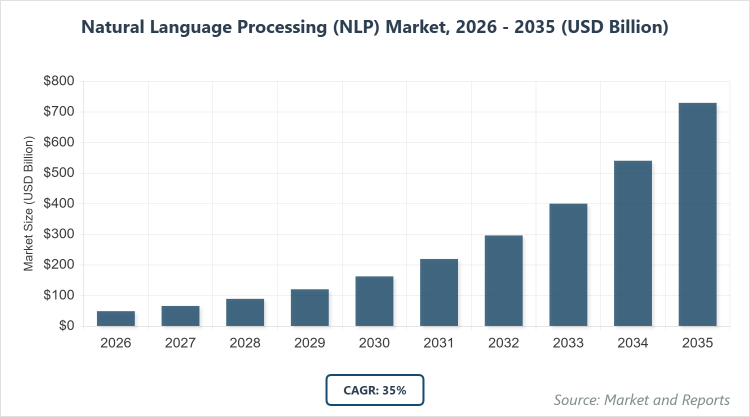
According to MarketnReports, the global Natural Language Processing (NLP) market size was estimated at USD 49 billion in 2025 and is expected to reach USD 1020 billion by 2035, growing at a CAGR of 35% from 2026 to 2035. The increasing adoption of AI-driven solutions in customer service, healthcare, and business intelligence.
What are the Key Insights into the Natural Language Processing (NLP) Market?
- The global NLP market was valued at USD 49 billion in 2025 and is projected to reach USD 1020 billion by 2035.
- The market is expected to grow at a CAGR of 35% during the forecast period.
- The market is driven by the rising demand for AI-powered customer interaction tools and big data analytics.
- The hybrid NLP segment dominates the type segment with a 40% share, & why it is because it combines the precision of rule-based methods with the flexibility of statistical approaches, offering superior accuracy and adaptability in complex language tasks.
- The sentiment analysis segment dominates the application segment with a 25% share, & why it is due to its critical role in analyzing customer opinions on social media and reviews, enabling businesses to improve products and services in real-time.
- The BFSI segment dominates the end-user segment with a 22% share & why it is dominated owing to its extensive use in fraud detection, compliance monitoring, and personalized customer service through chatbots.
- North America dominates the global market with a 38% share & why it is dominated thanks to the presence of leading tech companies, substantial R&D investments, and early adoption of AI technologies.
What is Natural Language Processing (NLP)?
Industry Overview
The Natural Language Processing (NLP) market encompasses technologies that enable computers to understand, interpret, and generate human language in a valuable way. Market definition includes software and services that process unstructured data from sources like text, speech, and images to derive insights, automate tasks, and enhance human-machine interactions across various industries. This market integrates artificial intelligence, machine learning, and linguistics to bridge the gap between human communication and computer understanding, facilitating applications from virtual assistants to sentiment analysis.
What are the Market Dynamics in Natural Language Processing (NLP)?
Growth Drivers
The growth drivers in the NLP market are propelled by the exponential increase in unstructured data from digital sources such as social media, emails, and customer interactions, necessitating advanced tools for analysis and insight generation. Advancements in machine learning algorithms and computational power have enabled more accurate language models, reducing errors in understanding context and nuances. The integration of NLP with other AI technologies like computer vision creates multimodal applications, expanding use cases in sectors like autonomous vehicles and smart assistants. Furthermore, the push for personalized user experiences in e-commerce and content recommendation systems drives demand for sophisticated NLP capabilities that can predict and respond to individual preferences effectively.
Restraints
Restraints in the NLP market include challenges related to data privacy and security, as processing large volumes of personal language data raises concerns under regulations like GDPR and CCPA, potentially limiting adoption in sensitive industries. The high computational requirements for training advanced models demand significant infrastructure investments, which can be prohibitive for small and medium enterprises. Linguistic diversity and ambiguity pose ongoing difficulties, as models trained primarily on English may underperform in low-resource languages or dialects, restricting global scalability. Additionally, the lack of standardized evaluation metrics for NLP performance can lead to inconsistencies in assessing model effectiveness across different applications and vendors.
Opportunities
Opportunities in the NLP market arise from the growing adoption of cloud-based solutions, which offer scalable and cost-effective access to advanced NLP tools without heavy upfront investments. Emerging markets in Asia-Pacific and Latin America present untapped potential due to increasing digitalization and smartphone penetration, creating demand for localized language processing applications. The healthcare sector offers significant prospects through applications like clinical documentation automation and patient sentiment analysis, especially post-pandemic, with heightened focus on telehealth. Moreover, collaborations between NLP providers and domain experts can lead to specialized solutions, such as legal document analysis or financial report summarization, opening new revenue streams.
Challenges
Challenges facing the NLP market involve addressing biases in training data, which can perpetuate unfair outcomes in applications like hiring tools or credit scoring, requiring ongoing efforts in debiasing techniques. The rapid evolution of language through slang, emojis, and cultural shifts demands continuous model updates to maintain relevance and accuracy. Integration with legacy systems in traditional industries remains complex, often requiring custom development and change management. Finally, the shortage of skilled professionals in the NLP and AI fields hampers innovation and implementation, as companies compete for talent in a limited pool.
Natural Language Processing (NLP) Market: Report Scope
| Report Attributes | Report Details |
| Report Name | Natural Language Processing (NLP) Market |
| Market Size 2025 | USD 49 Billion |
| Market Forecast 2035 | USD 1020 Billion |
| Growth Rate | CAGR of 35% |
| Report Pages | 220 |
| Key Companies Covered |
Google LLC, Microsoft Corporation, IBM Corporation, Amazon Web Services, Inc., Meta Platforms, Inc., Apple Inc., Baidu, Inc., OpenAI, Oracle Corporation, SAS Institute Inc., and Others |
| Segments Covered | By Type, By Application, By End-User, and By Region |
| Regions Covered | North America, Europe, Asia Pacific (APAC), Latin America, and The Middle East and Africa (MEA) |
| Base Year | 2025 |
| Historical Year | 2020 – 2024 |
| Forecast Year | 2026 – 2035 |
| Customization Scope | Avail customized purchase options to meet your exact research needs. |
How is the Market Segmentation Done in Natural Language Processing (NLP)?
The Natural Language Processing (NLP) market is segmented by type, application, end-user, and region.
Based on the Type Segment, the hybrid NLP emerges as the most dominant subsegment, holding approximately 40% market share, primarily because it leverages the strengths of both rule-based and statistical methods to handle diverse language complexities with higher precision. The second most dominant is statistical NLP, with around 30% share, valued for its data-driven approach that excels in large-scale text analysis and adaptability to new datasets, driving market growth by enabling efficient processing in big data environments.
Based on the Application Segment, Sentiment analysis stands out as the most dominant subsegment, capturing about 25% of the market, due to its essential function in gauging public opinion and customer feedback across social platforms, which helps businesses refine strategies and boost satisfaction. Machine translation follows as the second dominant, with roughly 20% share, propelled by globalization needs and e-commerce expansion, facilitating seamless cross-language communication and content localization that accelerates international market penetration.
Based on the End-User Segment, BFSI is the most dominant subsegment, accounting for 22% share, attributed to its reliance on NLP for risk assessment, customer query resolution, and regulatory compliance, enhancing operational efficiency and reducing fraud. Healthcare ranks second with 18% share, driven by applications in electronic health records analysis and patient interaction tools, which improve diagnostic accuracy and personalized care, thereby propelling overall market advancement through innovative health tech integrations.
What are the Recent Developments in Natural Language Processing (NLP)?
- In September 2024, Microsoft Corp. acquired NexusAI, a startup specializing in low-code NLP platforms, for USD 1.2 billion, to integrate its technology into the Azure AI ecosystem and simplify custom model development for enterprises.
- In November 2024, Cerebras Systems Inc. unveiled its CS-4 system, featuring a next-generation wafer-scale engine that reduces training times for large language models by up to 40% compared to previous architectures.
- In January 2025, SAP SE partnered with Anthropic to embed Claude 3’s advanced reasoning capabilities into its enterprise resource planning solutions, enabling automated financial reporting and supply chain analysis.
- In February 2025, Anthropic collaborated with the U.S. DOE for the 1,000 Scientist AI Jam to test Claude 3.7 Sonnet on research tasks, advancing NLP in scientific applications.
- In May 2025, Cerence joined NVIDIA to develop Cerence Automotive LLM for next-generation in-car computing, enhancing voice-activated features in vehicles.
What is the Regional Analysis of Natural Language Processing (NLP)?
- North America is to dominate the global market.
North America leads the NLP market with a 38% share, driven by robust technological infrastructure and high AI investments, particularly in the United States, where companies like Google and Microsoft pioneer innovations in language models and applications. The region’s dominance is further supported by widespread adoption in sectors such as finance and healthcare, with Canada contributing through research hubs focusing on multilingual NLP advancements.
Asia-Pacific emerges as the fastest-growing region, fueled by digital transformation in countries like China and India, where Baidu and local startups develop NLP for e-commerce and social media analytics. The area’s growth is accelerated by increasing smartphone usage and government initiatives in AI, with Japan emphasizing NLP in robotics and customer service automation.
Europe holds a significant position with strong regulatory frameworks promoting ethical AI, led by Germany and the UK in automotive and fintech applications. France contributes through advancements in multilingual processing, supporting the region’s focus on data privacy-compliant NLP solutions across diverse languages.
Latin America shows promising growth potential, driven by expanding internet access in Brazil and Mexico, where NLP is increasingly used in customer service chatbots and sentiment analysis for local markets. The region benefits from collaborations with global players to address Spanish and Portuguese language specifics.
The Middle East and Africa are gradually adopting NLP, with the UAE leading in smart city initiatives and Saudi Arabia investing in AI for oil and gas analytics. South Africa contributes through applications in education and healthcare, though challenges like infrastructure limitations temper overall growth.
Who are the Key Market Players in Natural Language Processing (NLP)?
- Google LLC. Google employs strategies focused on open-source contributions and cloud integration, such as enhancing its BERT and Transformer models within Google Cloud AI, to democratize access and foster ecosystem partnerships for widespread adoption.
- Microsoft Corporation. Microsoft leverages acquisitions and Azure platform expansions, like integrating OpenAI technologies, to provide enterprise-grade NLP tools that emphasize security and scalability for business intelligence applications.
- IBM Corporation. IBM emphasizes hybrid cloud solutions and Watson AI enhancements, targeting industries with customized NLP for data analytics and customer engagement, supported by extensive R&D in ethical AI practices.
- Amazon Web Services, Inc. AWS focuses on developer-friendly tools like Amazon Comprehend, combining machine learning services with cost-effective pricing to capture market share in e-commerce and content moderation.
- Meta Platforms, Inc. Meta invests in large-scale language models and virtual reality integrations, using open-source frameworks like PyTorch to advance multimodal NLP for social media and metaverse experiences.
- Apple Inc. Apple prioritizes privacy-centric NLP in devices, enhancing Siri and on-device processing to differentiate through seamless user experiences in consumer electronics.
- Baidu, Inc. Baidu concentrates on Chinese-language optimization and ERNIE model developments, expanding into autonomous driving and smart city applications to dominate the Asian market.
- OpenAI. OpenAI pursues research-driven innovations like the GPT series, partnering with enterprises for custom implementations while emphasizing safety and alignment in AI deployments.
- Oracle Corporation. Oracle integrates NLP into its cloud ERP systems, focusing on industry-specific analytics for finance and HR to provide actionable insights.
- SAS Institute Inc. SAS emphasizes advanced analytics integration, offering NLP for fraud detection and sentiment analysis in regulated industries like banking and healthcare.
What are the Market Trends in Natural Language Processing (NLP)?
- Integration of multimodal AI capabilities combining text, image, and voice for enhanced applications.
- Rise of generative AI models driving content creation and conversational interfaces.
- Focus on ethical AI and bias mitigation to ensure fair outcomes.
- Increasing adoption in healthcare for patient data analysis and telehealth.
- Growth of cloud-based NLP solutions for scalability and accessibility.
- Emphasis on multilingual and low-resource language support for global reach.
- Convergence with edge computing for real-time processing in IoT devices.
- Use of NLP in sustainability efforts through environmental data analysis.
- Advancements in explainable AI for transparent decision-making.
- Expansion in education for personalized learning and assessment tools.
What Market Segments and their Subsegments are Covered in the Natural Language Processing (NLP) Report?
By Type
- Rule-Based NLP
- Statistical NLP
- Hybrid NLP
- Neural NLP
- Deep Learning NLP
- Convolutional Neural Networks (CNN) for NLP
- Recurrent Neural Networks (RNN)
- Long Short-Term Memory (LSTM)
- Transformer Models
- Generative Pre-trained Transformer (GPT)
- Others
By Application
- Sentiment Analysis
- Machine Translation
- Information Extraction
- Automatic Summarization
- Question Answering
- Text Classification
- Chatbots & Virtual Assistants
- Speech Recognition
- Named Entity Recognition
- Content Management
- Others
By End-User
- Banking, Financial Services & Insurance (BFSI)
- Healthcare & Life Sciences
- IT & Telecommunication
- Retail & E-commerce
- Media & Entertainment
- Manufacturing
- Education
- Automotive & Transportation
- Government & Defense
- Advertising & Media
- Others
By Region
- North America
- U.S.
- Canada
- Europe
- UK
- Germany
- France
- Rest of Europe
- Asia Pacific
- China
- India
- Japan
- Rest of Asia Pacific
- Latin America
- Brazil
- Mexico
- Rest of Latin America
- Middle East & Africa
- UAE
- South Africa
- Rest of Middle East & Africa
Chapter 1. Preface
Chapter 2. Executive Summary
Chapter 3. Global Natural Language Processing (NLP) Market - Industry Analysis
Chapter 4. Global Natural Language Processing (NLP) Market- Competitive Landscape
Chapter 5. Global Natural Language Processing (NLP) Market - Type Analysis
Chapter 6. Global Natural Language Processing (NLP) Market - Application Analysis
Chapter 7. Global Natural Language Processing (NLP) Market - End-User Analysis
Chapter 8. Natural Language Processing (NLP) Market - Regional Analysis
Chapter 9. Company Profiles
Frequently Asked Questions
Natural Language Processing (NLP) is a branch of artificial intelligence that focuses on the interaction between computers and humans through natural language, enabling machines to understand, interpret, and generate human-like text and speech.
Key factors include advancements in AI and machine learning, increasing volumes of unstructured data, rising demand for customer experience enhancement, and adoption of cloud-based solutions across industries.
The market is projected to grow from approximately USD 64 billion in 2026 to USD 1020 billion by 2035.
The CAGR is expected to be 35% during the forecast period.
North America will contribute notably, holding around 38% of the global market value due to technological advancements and major players.
Major players include Google LLC, Microsoft Corporation, IBM Corporation, Amazon Web Services, Inc., Meta Platforms, Inc., Apple Inc., Baidu, Inc., OpenAI, Oracle Corporation, and SAS Institute Inc.
The report provides comprehensive analysis including market size, forecasts, segmentation, dynamics, regional insights, key players, trends, and FAQs.
The value chain includes data collection and preprocessing, model development and training, integration and deployment, application usage, and ongoing maintenance and updates.
Trends are shifting towards multimodal and generative AI, with consumers preferring personalized, privacy-focused, and multilingual NLP solutions.
Regulatory factors include data privacy laws like GDPR, while environmental factors involve energy consumption concerns in training large models, pushing for sustainable AI practices.