
Artificial Intelligence (AI) in Food and Beverages Market Size, Share and Trends 2026 to 2035
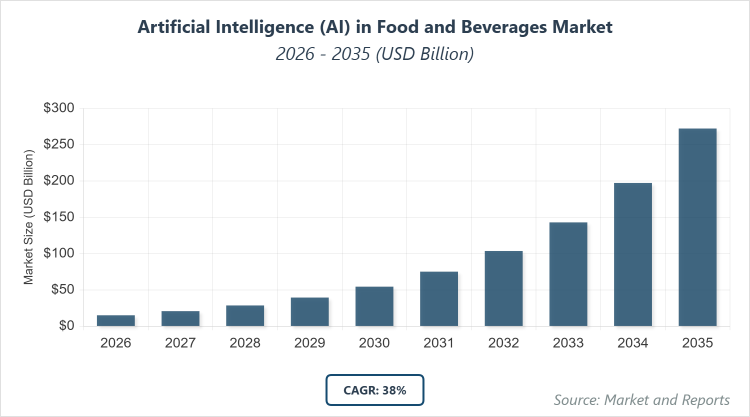
According to MarketnReports, the global Artificial Intelligence (AI) in Food and Beverages Market size was estimated at USD 15 Billion in 2025 and is expected to reach USD 300 Billion by 2035, growing at a CAGR of 38% from 2026 to 2035. Artificial Intelligence (AI) in Food and Beverages Market is driven by increasing demand for operational efficiency and personalized consumer experiences.
What is the Industry Overview of Artificial Intelligence (AI) in Food and Beverages Market?
The Artificial Intelligence (AI) in Food and Beverages Market encompasses the integration of advanced AI technologies into various aspects of the food and beverage industry, revolutionizing traditional processes from production to consumption. This market involves the application of AI solutions such as machine learning algorithms, computer vision systems, and predictive analytics to enhance efficiency, quality, and innovation. Market definition refers to the ecosystem where AI tools are deployed to optimize supply chains, improve food safety, personalize nutrition, and automate manufacturing, ultimately addressing challenges like waste reduction and consumer demand variability in a sector focused on delivering safe, sustainable, and high-quality products.
What are the Key Insights into Artificial Intelligence (AI) in Food and Beverages Market?
The global Artificial Intelligence (AI) in Food and Beverages Market size was estimated at USD 15 Billion in 2025 and is expected to reach USD 300 Billion by 2035.
- The market is expected to grow at a CAGR of 38% from 2026 to 2035.
- The market is driven by rising adoption of AI for efficiency, personalization, and sustainability in food production and distribution.
- The Machine Learning subsegment dominates the Technology segment with a 30% share due to its versatility in data analysis and predictive modeling, enabling precise forecasting and optimization.
- The Quality Control and Safety Compliance subsegment dominates the Application segment with a 39% share because it ensures regulatory compliance and reduces contamination risks through real-time monitoring.
- The Food Manufacturers subsegment dominates the End-User segment with a 40% share owing to the need for scalable automation in large-scale production environments.
- North America dominates the global market with a 40% share, driven by advanced technological infrastructure and high investment in AI innovations.
What are the Market Dynamics of Artificial Intelligence (AI) in Food and Beverages Market?
Growth Drivers
AI is propelling growth in the food and beverages sector by enabling predictive analytics for demand forecasting, which minimizes overproduction and waste while aligning supply with consumer trends. Automation through robotics and computer vision streamlines manufacturing processes, reducing labor costs and enhancing precision in tasks like sorting and packaging. Personalization of products, such as tailored nutrition plans via AI-driven apps, caters to health-conscious consumers, boosting market penetration. Additionally, AI’s role in supply chain optimization ensures traceability and resilience against disruptions, fostering sustainable practices that appeal to environmentally aware stakeholders.
Restraints
High implementation costs pose a significant barrier, particularly for small and medium enterprises, as integrating AI requires substantial investment in technology and training. Data privacy concerns and regulatory hurdles complicate adoption, with stringent food safety laws demanding transparent AI systems that are challenging to develop. Limited access to quality data in developing regions hampers AI model accuracy, while ethical issues around job displacement from automation create resistance within the workforce.
Opportunities
Emerging opportunities lie in AI’s potential for sustainable agriculture, where tools like predictive modeling can optimize resource use and reduce environmental impact. Expansion into personalized nutrition markets offers growth through AI-powered apps that analyze consumer data for customized diets. Collaborations between tech firms and food companies can drive innovation in product development, such as rapid flavor formulation. Furthermore, AI can enhance global food security by improving yield predictions and distribution efficiency in underserved areas.
Challenges
Integrating AI with legacy systems presents technical challenges, often requiring extensive overhauls that disrupt operations. Ensuring AI transparency and explainability is crucial for regulatory approval but difficult to achieve in complex models. Skill gaps in the workforce necessitate ongoing training, while cybersecurity threats to AI-driven supply chains could lead to data breaches and operational vulnerabilities.
Artificial Intelligence (AI) in Food and Beverages Market Report Scope
| Report Attributes | Report Details |
| Report Name | Artificial Intelligence (AI) in Food and Beverages Market |
| Market Size 2025 | USD 15 Billion |
| Market Forecast 2035 | USD 300 Billion |
| Growth Rate | CAGR of 38% |
| Report Pages | 220 |
| Key Companies Covered | TOMRA Sorting Solutions AS, Rockwell Automation Inc., ABB Ltd, Honeywell International Inc., Key Technology Inc., IBM Corporation, Microsoft Corporation, Google LLC, and Others |
| Segments Covered | By Technology, By Application, By End-User, and By Region |
| Regions Covered | North America, Europe, Asia Pacific (APAC), Latin America, and The Middle East and Africa (MEA) |
| Base Year | 2025 |
| Historical Year | 2020 – 2024 |
| Forecast Year | 2026 – 2035 |
| Customization Scope | Avail customized purchase options to meet your exact research needs. |
What is the Market Segmentation of Artificial Intelligence (AI) in Food and Beverages Market?
The Artificial Intelligence (AI) in Food and Beverages Market is segmented by Technology, Application, End-User, and Region. All the segments have been analyzed based on present and future trends and the market is estimated from 2026 to 2035.
Based on Technology Segment, Machine Learning emerges as the most dominant subsegment, followed by Computer Vision as the second most dominant. Machine Learning’s dominance stems from its ability to process vast datasets for predictive insights, driving efficiency in demand forecasting and personalization, which propels overall market growth by enabling data-driven decisions that reduce costs and enhance product relevance.
Based on Application Segment, Quality Control and Safety Compliance is the most dominant subsegment, with Supply Chain Management as the second most dominant. Quality Control and Safety Compliance leads due to its critical role in ensuring compliance with health regulations through real-time defect detection, fueling market expansion by minimizing recalls and building consumer trust in safe, high-quality products.
Based on End-User Segment, Food Manufacturers is the most dominant subsegment, followed by Restaurants and Food Service Providers as the second most dominant. Food Manufacturers dominate because AI optimizes large-scale production processes like automation and maintenance, accelerating market growth by improving throughput and sustainability in high-volume operations.
What are the Recent Developments in Artificial Intelligence (AI) in Food and Beverages Market?
- In January 2024, CES 2024 showcased AI-powered appliances and chef-like robots, highlighting advancements in kitchen gadgets that integrate AI for enhanced food preparation and beverage innovation.
- In February 2025, Fresh Blends launched a cloud platform with AI-driven analytics modules like DataStudio, enabling better insights into consumer preferences and operational efficiencies.
- In April 2025, GrubMarket acquired Delta Fresh Produce, expanding its AI-powered supply-chain platform into new regions for improved traceability.
- In June 2025, Tate & Lyle acquired CP Kelco for USD 1.8 billion, focusing on synergies in sweetening and fortification using AI tools.
What is the Regional Analysis of Artificial Intelligence (AI) in Food and Beverages Market?
North America to dominate the global market.
North America leads the market with a 40% share, driven by robust technological infrastructure and significant AI investments. The United States dominates within the region, with companies like IBM and Microsoft pioneering AI applications in quality control and personalization, supported by favorable regulations and a focus on innovation.
Asia Pacific is the fastest-growing region, fueled by rapid industrialization and government initiatives in smart manufacturing. China dominates here, leveraging AI for supply chain optimization in its vast food processing sector, while India benefits from incentives for AI in traceability and waste reduction.
Europe holds a strong position with emphasis on sustainability and food safety. Germany leads, utilizing AI in predictive maintenance for beverage production, aided by EU policies promoting digital transformation.
Latin America shows emerging potential, with Brazil dominating through AI adoption in agriculture and export-oriented food industries to enhance yield predictions.
The Middle East and Africa represent smaller but growing shares, with South Africa leading in AI for supply chain resilience amid resource constraints.
Who are the Key Market Players in Artificial Intelligence (AI) in Food and Beverages Market?
Rockwell Automation Inc. employs AI in industrial automation, offering predictive maintenance tools that optimize production lines for beverage manufacturers, emphasizing efficiency and downtime reduction.
ABB Ltd specializes in robotics and AI integration for food handling, providing collaborative robots that improve safety and speed in packaging, with strategies centered on digital twins for process simulation.
Honeywell International Inc. leverages AI for supply chain visibility, using IoT-enabled platforms to forecast demand and ensure compliance in food safety.
Key Technology Inc. develops AI-based inspection systems for contaminant detection, targeting high-volume food producers with strategies for expanding into emerging markets.
IBM Corporation offers Watson AI for product development and consumer insights, collaborating with brands like Kerry for trend prediction.
Microsoft Corporation provides Azure AI for cloud-based analytics in restaurants, focusing on personalization and operational optimization.
Google LLC utilizes AI for data-driven flavor innovation and market analysis, partnering with food companies for enhanced R&D.
What are the Market Trends in Artificial Intelligence (AI) in Food and Beverages Market?
- Rise in agentic AI for autonomous R&D, enabling faster ingredient discovery and formulation.
- Adoption of AI in sustainable practices, such as optimizing resource use and reducing food waste.
- Growth in predictive analytics for real-time supply chain management and demand forecasting.
- Expansion of computer vision for quality control and contamination detection in processing.
- Emphasis on ethical AI with focus on transparency, data privacy, and bias mitigation.
- Collaborations between tech giants and food companies for innovative product development.
- Use of AI in climate-resilient agriculture to predict yields and enhance food security.
What Market Segments and their Subsegments are Covered in the Artificial Intelligence (AI) in Food and Beverages Report?
By Technology
- Machine Learning
- Computer Vision
- Natural Language Processing
- Robotics and Automation
- Predictive Analytics
- Chatbots
- Visual Inspection Systems
- Autonomous Systems
- Recommendation Engines
- AI Integration Services
- Others
By Application
- Quality Control and Safety Compliance
- Supply Chain Management
- Food Sorting
- Production and Packaging
- Consumer Engagement
- Demand Forecasting
- Predictive Maintenance
- Product Development
- Inventory Management
- Dynamic Pricing
- Others
By End-User
- Food Manufacturers
- Beverage Producers
- Restaurants and Food Service Providers
- Retailers and Grocery
- Farmers and Growers
- Hotels and Catering
- E-commerce Platforms
- Food Processing Companies
- Agritech Firms
- Supply Chain Operators
- Others
By Region
-
- North America
- U.S.
- Canada
- Europe
- UK
- Germany
- France
- Rest of Europe
- Asia Pacific
- China
- India
- Japan
- Rest of Asia Pacific
- Latin America
- Brazil
- Mexico
- Rest of Latin America
- Middle East & Africa
- UAE
- South Africa
- Rest of Middle East & Africa
- North America
Chapter 1. Preface
Chapter 2. Executive Summary
Chapter 3. Global Artificial Intelligence (AI) in Food and Beverages Market - Industry Analysis
Chapter 4. Global Artificial Intelligence (AI) in Food and Beverages Market- Competitive Landscape
Chapter 5. Global Artificial Intelligence (AI) in Food and Beverages Market - Technology Analysis
Chapter 6. Global Artificial Intelligence (AI) in Food and Beverages Market - Application Analysis
Chapter 7. Global Artificial Intelligence (AI) in Food and Beverages Market - End-User Analysis
Chapter 8. Artificial Intelligence (AI) in Food and Beverages Market - Regional Analysis
Chapter 9. Company Profiles
Frequently Asked Questions
The Artificial Intelligence (AI) in Food and Beverages Market involves the use of AI technologies to optimize processes, enhance safety, and drive innovation across the industry.
Key factors include technological advancements, demand for personalization, sustainability initiatives, and regulatory pressures for food safety.
The market value is estimated at USD 15 Billion in 2025 and projected to reach USD 300 Billion by 2035.
The CAGR is expected to be 38% during 2026-2035.
North America will contribute notably, holding around 40% of the market share.
Major players include TOMRA Sorting Solutions AS, Rockwell Automation Inc., ABB Ltd, Honeywell International Inc., and IBM Corporation.
The report provides in-depth analysis, forecasts, trends, segmentation, and competitive landscape insights.
Stages include raw material sourcing, production and processing, distribution and supply chain, retail and consumption, and waste management.
Trends are shifting towards sustainability and personalization, with consumers preferring AI-driven customized nutrition and eco-friendly practices.
Stringent food safety regulations and environmental sustainability mandates are pushing AI adoption for compliance and resource optimization.