
Intelligent Power Modular (Ipl) Market Size, Share and Trends 2026 to 2035
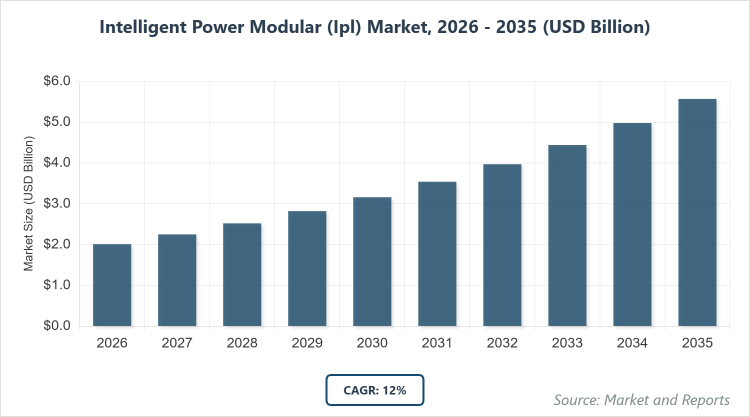
According to MarketnReports, the global Intelligent Power Modular (Ipl) Market size was estimated at USD 2.01 billion in 2025 and is expected to reach USD 6.25 billion by 2035, growing at a CAGR of 12% from 2026 to 2035. Intelligent Power Modular (Ipl) Market is driven by rising demand for energy-efficient power electronics in industrial and consumer applications.
What are the Key Insights into the Intelligent Power Modular (Ipl) Market?
- The global intelligent power modular market was valued at USD 2.01 billion in 2025 and is projected to reach USD 6.25 billion by 2035.
- The market is expected to grow at a CAGR of 12% during the forecast period from 2026 to 2035.
- The market is driven by increasing adoption in electric vehicles and renewable energy systems.
- IGBT-based dominates the type segment with a 62% share due to suitability for high-voltage applications; industrial dominates the application segment with 35% share owing to extensive use in automation and motor drives.
- Asia Pacific holds the largest regional share at 40% due to rapid industrialization and manufacturing hubs in China and Japan.
What is the Industry Overview of the Intelligent Power Modular (Ipl) Market?
The intelligent power modular market involves integrated semiconductor devices that combine power switches, gate drivers, and protection circuits into a single module to efficiently manage power conversion, distribution, and control in various electronic systems. Market definition includes modules based on technologies like IGBT and MOSFET, designed for applications requiring high efficiency, compact size, and reliability, such as motor drives and inverters. This market is part of the broader power electronics sector, focusing on energy savings, reduced heat dissipation, and enhanced performance in industries facing increasing demands for electrification and automation, while adapting to advancements in wide-bandgap materials for superior thermal and electrical properties.
What are the Market Dynamics of the Intelligent Power Modular (Ipl) Market?
Growth Drivers
Growth drivers are anchored by the surge in electric vehicle adoption worldwide, where intelligent power modules enable efficient traction inverters, onboard chargers, and battery management, supported by government incentives for clean mobility and declining battery costs. Advancements in wide-bandgap semiconductors like SiC and GaN enhance module efficiency and power density, meeting demands for compact, high-performance solutions in renewable energy inverters and industrial drives. Rising industrial automation, driven by Industry 4.0 initiatives, boosts demand for reliable motor control, while stringent energy efficiency regulations compel manufacturers to integrate these modules in appliances and HVAC systems, fostering overall market acceleration.
Restraints
Restraints stem from high initial development and manufacturing costs, particularly for advanced SiC and GaN-based modules, which limit adoption in price-sensitive emerging markets and small-scale applications. Supply chain vulnerabilities for rare materials like silicon carbide exacerbate price volatility and lead times, hindering scalability. Complex integration requirements and the need for specialized design expertise pose barriers for end-users, while competition from discrete components in low-power scenarios erodes market share. Economic uncertainties and fluctuating raw material prices further constrain investments in R&D and production capacity.
Opportunities
Opportunities are amplified by the expansion of renewable energy infrastructure, where modules support efficient power conversion in solar and wind systems, aligned with global decarbonization goals and increasing grid investments. Emerging applications in data centers and 5G networks demand high-efficiency power management, opening avenues for customized modules. Collaborations between semiconductor firms and automotive OEMs for EV platforms can accelerate innovation, while growth in smart grids and energy storage systems offers new deployment scopes. Advancing miniaturization and thermal management technologies enable penetration into consumer electronics, driving diversified revenue streams.
Challenges
Challenges include navigating stringent regulatory standards for safety and electromagnetic compatibility, which increase compliance costs and delay product launches. Rapid technological obsolescence requires continuous R&D investment to incorporate new materials, risking market lag for slower innovators. Thermal management issues in high-power applications demand advanced cooling solutions, complicating designs. Geopolitical tensions disrupt global supply chains for critical components, while addressing interoperability with legacy systems in industrial retrofits poses integration hurdles, straining resources and adoption rates.
Intelligent Power Modular (Ipl) Market: Report Scope
| Report Attributes | Report Details |
| Report Name | Intelligent Power Modular (Ipl) Market |
| Market Size 2025 | USD 2.01 Billion |
| Market Forecast 2035 | USD 6.25 Billion |
| Growth Rate | CAGR of 12% |
| Report Pages | 220 |
| Key Companies Covered |
Mitsubishi Electric Corporation, Infineon Technologies AG, Fuji Electric Co., Ltd., ON Semiconductor Corporation, ROHM Co., Ltd., and Others. |
| Segments Covered | By Type, By Application, By End-User, and By Region. |
| Regions Covered | North America, Europe, Asia Pacific (APAC), Latin America, and The Middle East and Africa (MEA) |
| Base Year | 2025 |
| Historical Year | 2020 - 2024 |
| Forecast Year | 2026 - 2035 |
| Customization Scope | Avail customized purchase options to meet your exact research needs. |
How is the Market Segmentation of the Intelligent Power Modular (Ipl) Market?
The Intelligent Power Modular (Ipl) Market is segmented by type, application, end-user, and region.By Type Segment: IGBT-based is the most dominant subsegment, holding around 62% market share, as it excels in high-voltage and high-current handling for demanding applications like EV inverters, driving the market by enabling efficient power conversion and reducing energy losses in large-scale systems. MOSFET-based is the second most dominant, with about 25% share, preferred for low-voltage efficiency and fast switching, contributing to growth through applications in consumer electronics and compact designs.
By Application Segment: Industrial is the most dominant subsegment, capturing approximately 35% market share, due to widespread use in motor drives and automation equipment for enhanced control and reliability, fueling market expansion via Industry 4.0 integrations. Automotive follows as the second most dominant, with around 30% share, driven by EV electrification needs, aiding growth by supporting battery efficiency and range extension.
By End-User Segment: Manufacturing dominates the end-user segment with about 40% share, leveraging modules for precision machinery and energy savings, propelling the market through automation upgrades. Automotive is the second most dominant, holding roughly 25% share, as OEMs adopt for vehicle electrification, supporting dynamics by advancing sustainable transport solutions.
What are the Recent Developments in the Intelligent Power Modular (Ipl) Market?
- In May 2025, Infineon released EasyPACK CoolGaN 650 V modules enabling 70 kW per phase in data-center and charger applications.
- In April 2025, Alpha and Omega Semiconductor unveiled Mega IPM-7 modules for brushless DC appliance motors, offering 600 V ratings in compact footprints.
- In March 2025, onsemi introduced EliteSiC SPM 31 IPMs that cut system cost for HVAC and data-center drives.
- In February 2025, Mitsubishi Electric showcased J3-Series SiC modules using trench technology for compact EV inverters.
How is the Regional Analysis of the Intelligent Power Modular (Ipl) Market?
Asia Pacific to dominate the global market.Asia Pacific holds the largest market share at 40%, propelled by rapid industrialization, EV manufacturing boom, and renewable energy investments, with China dominating through massive solar deployments and BEV production, followed by Japan with advanced semiconductor innovations.
North America accounts for around 26% share, driven by automotive electrification and grid modernization, led by the United States with strong EV incentives and industrial automation.
Europe represents about 22% share, focusing on energy efficiency regulations and green transitions, with Germany leading via automotive giants and renewable integrations.
Latin America holds approximately 7% share, growing through infrastructure developments, with Brazil dominating via industrial expansions.
The Middle East and Africa comprise around 5% share, with opportunities in solar projects, dominated by the UAE through energy diversification efforts.
Who are the Key Market Players in the Intelligent Power Modular (Ipl) Market?
Mitsubishi Electric Corporation focuses on SiC-based innovations for EV and renewable applications, expanding through R&D investments.
Infineon Technologies AG emphasizes high-efficiency IGBT and MOSFET modules, leveraging partnerships in automotive electrification.
Fuji Electric Co., Ltd. prioritizes compact IPMs for industrial drives, enhancing global supply chains.
ON Semiconductor Corporation drives growth with EliteSiC series, targeting data centers and HVAC.
ROHM Co., Ltd. specializes in GaN technologies for consumer electronics, focusing on miniaturization.
STMicroelectronics N.V. advances automotive-grade modules, investing in wide-bandgap materials.
Semikron Danfoss GmbH & Co. KG targets renewable energy converters, emphasizing reliability.
Sanken Electric Co. Ltd develops hybrid topologies for motion control, expanding in Asia.
Texas Instruments Incorporated introduces GaN IPMs for motor drives, prioritizing energy efficiency.
Hitachi, Ltd. integrates AI-enhanced controls, focusing on industrial automation.
What are the Market Trends in the Intelligent Power Modular (Ipl) Market?
- Increasing adoption of SiC and GaN for higher efficiency and power density.
- Growing integration in electric vehicles for traction and charging systems.
- Rise in AI-enhanced motor controls for smart applications.
- Expansion in renewable energy inverters and storage.
- Focus on miniaturization and thermal management advancements.
- Surge in industrial automation with Industry 4.0.
- Emphasis on energy efficiency regulations compliance.
- Development of hybrid topologies for versatile use.
What Market Segments and their Subsegments are Covered in the Report?
By Type
- IGBT-based
- MOSFET-based
- SiC-based
- GaN-based
- Hybrid
- Others
By Application
- Industrial
- Automotive
- Consumer Electronics
- Renewable Energy
- Servo Drives
- Others
By End-User
- Manufacturing
- Automotive
- Consumer Electronics
- Energy & Utilities
- Aerospace & Defense
- Others
By Region
- North America
- U.S.
- Canada
- Europe
- UK
- Germany
- France
- Rest of Europe
- Asia Pacific
- China
- India
- Japan
- Rest of Asia Pacific
- Latin America
- Brazil
- Mexico
- Rest of Latin America
- Middle East & Africa
- UAE
- South Africa
- Rest of Middle East & Africa
Frequently Asked Questions
The intelligent power modular market encompasses integrated devices for efficient power management in electronics, including switches and drivers.
Key factors include EV adoption, renewable energy growth, and industrial automation advancements.
The market is projected to grow from USD 2.01 billion in 2026 to USD 6.25 billion by 2035.
The CAGR is expected to be 12%.
Asia Pacific will contribute notably, holding the largest share due to industrialization in China.
Major players include Mitsubishi Electric Corporation, Infineon Technologies AG, Fuji Electric Co., Ltd., ON Semiconductor Corporation, and ROHM Co., Ltd.
The report offers analysis of size, trends, segments, regions, players, and forecasts to 2035.
Stages include raw material sourcing, semiconductor fabrication, module assembly, testing, and distribution.
Trends shift toward SiC/GaN integration, with preferences for efficient, compact modules.
Efficiency standards and decarbonization policies drive adoption of advanced modules.