
Golf Simulators Market Size, Share and Trends 2026 to 2035
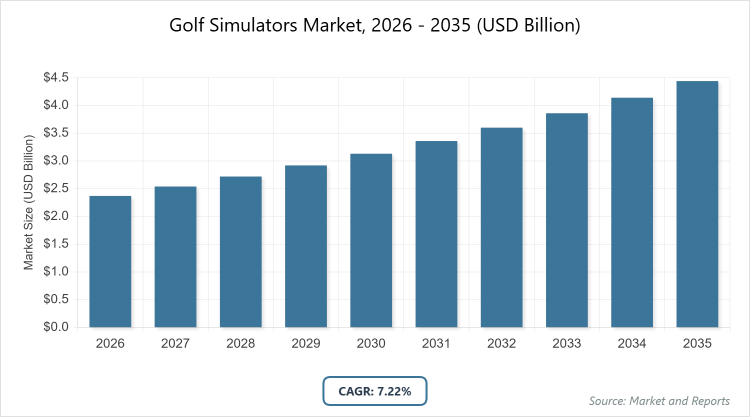
According to MarketnReports, the global Golf Simulators Market size was estimated at USD 2.37 billion in 2025 and is expected to reach USD 4.75 billion by 2035, growing at a CAGR of 7.22% from 2026 to 2035. Golf Simulators Market is driven by increasing demand for indoor entertainment and advancements in VR and AI technologies.What are the Key Insights into the Golf Simulators Market?
- The global golf simulators market was valued at USD 2.37 billion in 2025 and is projected to reach USD 4.75 billion by 2035.
- The market is expected to grow at a CAGR of 7.22% during the forecast period from 2026 to 2035.
- The market is driven by rising urbanization and demand for convenient indoor sports solutions.
- Full swing simulators dominate the product type segment with a 55% share due to their comprehensive tracking and realistic experience; commercial entertainment dominates the application segment with 45% share owing to the popularity of simulator-based venues.
- North America holds the largest regional share at 41% due to high golf participation rates and advanced adoption in the United States.
What is the Industry Overview of the Golf Simulators Market?
The golf simulators market comprises sophisticated systems that use sensors, high-speed cameras, projectors, and software to replicate authentic golfing experiences indoors, allowing users to practice swings, analyze performance, and play virtual courses regardless of weather or location. Market definition includes hardware components like launch monitors and screens, along with software for data analytics and virtual reality integration, catering to training, entertainment, and recreational purposes. This market intersects with sports technology and leisure industries, emphasizing accessibility for urban dwellers, year-round usability, and data-driven improvements in gameplay, while evolving through innovations in accuracy, portability, and immersive features to attract a broader demographic beyond traditional golfers.
What are the Market Dynamics of the Golf Simulators Market?
Growth Drivers
Growth drivers in the golf simulators market are propelled by urbanization and shrinking access to outdoor courses, making indoor alternatives essential for year-round play in space-constrained or weather-challenged areas. Technological progress in AI, VR, and sensor accuracy enhances user engagement, drawing in both novices and professionals seeking data-rich training. The expansion of commercial venues like simulator bars and corporate entertainment spaces capitalizes on social trends, boosting revenue through group activities. Post-pandemic shifts toward home fitness and leisure have surged residential demand, while declining costs of entry-level systems broaden market accessibility, fostering inclusive participation across demographics.
Restraints
Restraints encompass high upfront costs for premium setups, deterring budget-conscious consumers and small businesses from adoption. Space requirements for full installations limit feasibility in urban homes or compact venues, restricting market penetration. Technical complexities, including setup and maintenance, can overwhelm non-expert users, leading to underutilization. Market saturation in mature regions like North America intensifies competition, pressuring margins, while economic fluctuations reduce discretionary spending on non-essential tech.
Opportunities
Opportunities emerge from integrating multi-sport functionalities, allowing simulators to support activities beyond golf and attracting diverse users in fitness centers. Expansion into emerging markets in Asia-Pacific, driven by rising middle-class incomes and golf interest, offers untapped potential via affordable, localized models. Advancements in cloud-based multiplayer and subscription services can generate recurring revenue. Partnerships with golf academies and e-sports platforms enhance visibility, while sustainable designs using energy-efficient components align with eco-conscious trends.
Challenges
Challenges involve keeping pace with rapid tech evolution, necessitating frequent updates to avoid obsolescence and maintain competitiveness. Data privacy concerns in connected systems with user analytics require robust security measures. Variability in simulation accuracy across brands confuses buyers and erodes trust. Supply chain issues for components like sensors can cause delays and cost hikes, while addressing diverse user needs, from casual to pro, demands versatile yet user-friendly designs.
Golf Simulators Market: Report Scope
| Report Attributes | Report Details |
| Report Name | Golf Simulators Market |
| Market Size 2025 | USD 2.37 Billion |
| Market Forecast 2035 | USD 4.75 Billion |
| Growth Rate | CAGR of 7.22% |
| Report Pages | 220 |
| Key Companies Covered |
TrackMan, Foresight Sports, Full Swing Golf, GOLFZON, SkyTrak, and Others. |
| Segments Covered | By Product Type, By Application, By End-User, and By Region. |
| Regions Covered | North America, Europe, Asia Pacific (APAC), Latin America, and The Middle East and Africa (MEA) |
| Base Year | 2025 |
| Historical Year | 2020 - 2024 |
| Forecast Year | 2026 - 2035 |
| Customization Scope | Avail customized purchase options to meet your exact research needs. |
How is the Market Segmentation of the Golf Simulators Market?
The Golf Simulators Market is segmented by product type, application, end-user, and region.By Product Type Segment: Full swing simulators is the most dominant subsegment, holding around 55% market share, as they provide complete ball and club tracking with immersive course replication, driving the market by enabling professional-level training and entertainment that boosts repeat usage. Launch monitors is the second most dominant, with about 25% share, valued for portability and precise metrics, contributing to growth through affordable access for personal and coaching applications.
By Application Segment: Commercial entertainment is the most dominant subsegment, capturing approximately 45% market share, fueled by the rise of indoor golf bars and venues offering social experiences, propelling the market via high-traffic revenue models. Golf training & academies follows as the second most dominant, with around 30% share, supported by demand for skill enhancement tools, aiding expansion through institutional integrations.
By End-User Segment: Golf clubs & academies dominate the end-user segment with about 40% share, leveraging simulators for consistent training and member retention, driving the market with bulk investments. Home users are the second most dominant, holding roughly 30% share, as remote work trends boost personal setups, supporting growth via consumer electronics channels.
What are the Recent Developments in the Golf Simulators Market?
- In November 2025, the National Golf Foundation released a report highlighting a surge in simulator participation, with users doubling since 2019, emphasizing non-golfer engagement.
- In August 2025, Uneekor announced price adjustments for its EYE XO series to enhance accessibility, reaffirming commitment to broader market adoption.
- In July 2025, Golfzon partnered with new franchises to expand indoor golf venues, integrating advanced VR features for immersive experiences.
- In April 2025, TrackMan launched updated software with AI analytics, improving swing data for professional training.
How is the Regional Analysis of the Golf Simulators Market?
North America to dominate the global market.North America holds the largest market share at 41%, attributed to robust golf culture, high disposable incomes, and widespread commercial venues, with the United States dominating through innovation leaders like Foresight Sports and urban simulator bars in cities like New York.
Europe accounts for around 25% share, driven by seasonal demand and premium leisure trends, led by the UK and Germany with academy integrations and tech-focused clubs.
Asia Pacific represents about 20% share, experiencing rapid growth from rising affluence and urbanization, with South Korea and China leading via manufacturing hubs and indoor entertainment adoption.
Latin America holds approximately 8% share, expanding through tourism and middle-class growth, with Brazil dominating via resort installations.
The Middle East and Africa comprise around 6% share, with opportunities in luxury sectors, dominated by the UAE through high-end hospitality venues.
Who are the Key Market Players in the Golf Simulators Market?
TrackMan excels in radar technology, focusing on precision analytics and partnerships with pros for market expansion.
Foresight Sports innovates with camera-based systems, emphasizing affordability and integration for residential growth.
Full Swing Golf offers tour-proven simulators, targeting commercial venues with realistic graphics and endorsements.
GOLFZON leads in immersive setups, expanding via franchises and VR enhancements for global reach.
SkyTrak provides portable solutions, driving entry-level adoption through direct sales and app integrations.
TruGolf delivers versatile packages, growing through multi-sport features and academy collaborations.
Uneekor specializes in overhead sensors, focusing on space efficiency and price accessibility.
OptiShot Golf targets casual users with gaming-oriented simulators, leveraging affordability.
aboutGOLF creates high-end systems, emphasizing club and training facility installations.
HD Golf innovates with ultra-HD visuals, positioning for premium entertainment markets.
What are the Market Trends in the Golf Simulators Market?
- Integration of AI for personalized coaching and performance insights.
- Rise of VR/AR for enhanced immersive and multiplayer experiences.
- Growth in multi-sport simulators for broader appeal in fitness venues.
- Increasing portability and affordability for home and mobile use.
- Adoption of cloud-based platforms for remote competitions and updates.
- Focus on sustainable, energy-efficient designs.
- Expansion of commercial entertainment like simulator bars.
- Use of biomechanical tracking for advanced training analytics.
What Market Segments and their Subsegments are Covered in the Report?
By Product Type- Full Swing Simulators
- Launch Monitors
- Portable Simulators
- Indoor Golf Simulators
- VR Golf Simulators
- Others
- Commercial Entertainment
- Golf Training & Academies
- Residential Use
- Corporate Events
- Others
- Golf Clubs & Academies
- Home Users
- Sports Bars & Entertainment Venues
- Corporate Offices
- Others
By Region
- North America
- U.S.
- Canada
- Europe
- UK
- Germany
- France
- Rest of Europe
- Asia Pacific
- China
- India
- Japan
- Rest of Asia Pacific
- Latin America
- Brazil
- Mexico
- Rest of Latin America
- Middle East & Africa
- UAE
- South Africa
- Rest of Middle East & Africa
Frequently Asked Questions
The golf simulators market involves technologies and systems for indoor golf replication, including hardware and software for training and entertainment.
Key factors include technological advancements, urbanization, and demand for year-round indoor activities.
The market is projected to grow from USD 2.37 billion in 2026 to USD 4.75 billion by 2035.
The CAGR is expected to be 7.22%.
North America will contribute notably, with the largest share driven by the US market.
Major players include TrackMan, Foresight Sports, Full Swing Golf, GOLFZON, and SkyTrak.
The report includes market size, trends, segments, regional analysis, key players, and forecasts to 2035.
Stages include component manufacturing, system assembly, software development, distribution, and installation services.
Trends lean toward AI/VR integration and portability, with preferences for immersive, data-driven experiences.
Energy efficiency standards and data privacy regulations influence product design and adoption.