
Mitral Valve Disease Market Size, Share and Trends 2026 to 2035
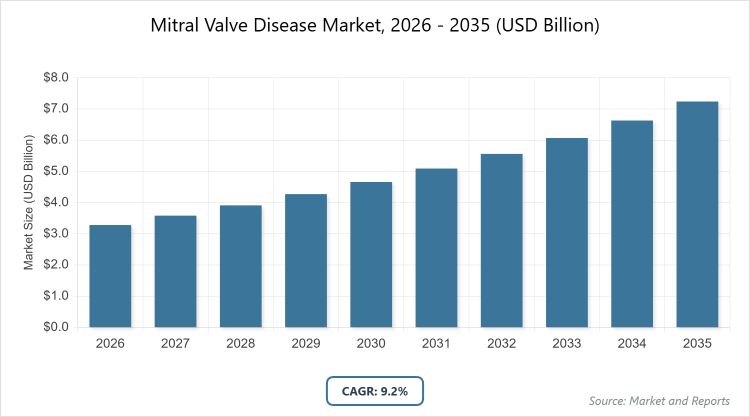
According to MarketnReports, the global Mitral Valve Disease Market size was estimated at USD 3.28 billion in 2025 and is expected to reach USD 7.5 billion by 2035, growing at a CAGR of 9.2% from 2026 to 2035. Mitral Valve Disease Market is driven by increasing prevalence of cardiovascular diseases and advancements in minimally invasive treatments.What are the Key Insights into the Mitral Valve Disease Market?
- The global mitral valve disease market was valued at USD 3.28 billion in 2025 and is projected to reach USD 7.5 billion by 2035.
- The market is expected to grow at a CAGR of 9.2% during the forecast period from 2026 to 2035.
- The market is driven by rising incidences of valvular heart diseases and technological innovations in treatment options.
- Mitral valve repair dominates the treatment type segment with a 42% share due to its superior long-term outcomes and preservation of native valve function; mitral valve regurgitation dominates the indication segment with 37% share owing to its high prevalence among the elderly and associated comorbidities.
- North America holds the largest regional share at 40% due to advanced healthcare infrastructure, high awareness, and significant R&D investments in countries like the United States.
What is the Industry Overview of the Mitral Valve Disease Market?
The mitral valve disease market involves the diagnosis, treatment, and management of conditions affecting the mitral valve, which regulates blood flow between the left atrium and ventricle of the heart, encompassing disorders like regurgitation, stenosis, and prolapse that can lead to heart failure if untreated. Market definition includes therapeutic interventions such as surgical repairs, replacements, therapeutics, and resynchronization therapies, along with diagnostic tools and devices aimed at restoring valve function and improving patient outcomes. This market is part of the broader cardiovascular sector, driven by an aging population, lifestyle-related risk factors, and innovations in transcatheter and minimally invasive procedures that offer less invasive alternatives to open-heart surgery, enhancing accessibility and recovery times for patients worldwide.
What are the Market Dynamics of the Mitral Valve Disease Market?
Growth Drivers
The growth drivers for the mitral valve disease market are primarily fueled by the increasing prevalence of cardiovascular disorders, exacerbated by an aging global population that heightens susceptibility to conditions like mitral regurgitation and stenosis, necessitating advanced therapeutic interventions. Technological advancements in minimally invasive procedures, such as transcatheter mitral valve repair and replacement, have revolutionized treatment by reducing surgical risks, hospital stays, and recovery times, thereby expanding the patient pool eligible for these options. Rising healthcare expenditures in emerging economies, coupled with improved diagnostic capabilities through echocardiography and MRI, enable early detection and timely management, boosting demand. Additionally, supportive government initiatives for cardiac health awareness and favorable reimbursement policies in developed regions further propel market expansion by making treatments more accessible.
Restraints
Restraints in the mitral valve disease market include the high costs associated with advanced treatments and devices, which limit accessibility in low- and middle-income countries where healthcare budgets are constrained and out-of-pocket expenses are burdensome. Stringent regulatory approvals for new devices and therapeutics delay market entry and increase development expenses for manufacturers. Complications such as device failure, thrombosis, or procedural risks deter adoption among certain patient groups, while a shortage of skilled cardiologists and interventional specialists in underserved regions hampers effective implementation. Economic downturns and disparities in healthcare infrastructure further exacerbate these issues, restricting overall market penetration.
Opportunities
Opportunities in the mitral valve disease market arise from the expanding adoption of innovative technologies like AI-integrated diagnostics and 3D-printed valves, which promise personalized and precise treatments, opening new avenues for market players to differentiate their offerings. The untapped potential in emerging markets, driven by rising disposable incomes and improving healthcare systems in Asia-Pacific and Latin America, presents significant growth prospects through localized manufacturing and partnerships. Increasing focus on regenerative medicine and stem cell therapies for valve repair could transform long-term outcomes, attracting investments. Moreover, collaborations between pharmaceutical companies and device manufacturers for combination therapies, along with telemedicine for remote monitoring, can enhance patient management and expand reach in rural areas.
Challenges
Challenges encompass the complexity of treating diverse patient profiles, as comorbidities like atrial fibrillation or renal issues complicate procedures and outcomes, requiring tailored approaches that increase clinical trial demands. Supply chain vulnerabilities for specialized materials and components can lead to shortages and price fluctuations, impacting production timelines. Evolving reimbursement landscapes and varying regulatory standards across regions create barriers for global expansion. Additionally, patient reluctance toward invasive treatments due to perceived risks, coupled with the need for ongoing post-procedure monitoring, strains healthcare resources and adherence.
Mitral Valve Disease Market: Report Scope
| Report Attributes | Report Details |
| Report Name | Mitral Valve Disease Market |
| Market Size 2025 | USD 3.28 Billion |
| Market Forecast 2035 | USD 7.5 Billion |
| Growth Rate | CAGR of 9.2% |
| Report Pages | 220 |
| Key Companies Covered |
Edwards Lifesciences Corporation, Medtronic Plc, Abbott Laboratories, Boston Scientific Corporation, Corcym UK Limited, and Others |
| Segments Covered | By Treatment Type, By Indication, By End-User, and By Region |
| Regions Covered | North America, Europe, Asia Pacific (APAC), Latin America, and The Middle East and Africa (MEA) |
| Base Year | 2025 |
| Historical Year | 2020 - 2024 |
| Forecast Year | 2026 - 2035 |
| Customization Scope | Avail customized purchase options to meet your exact research needs. |
How is the Market Segmentation of the Mitral Valve Disease Market?
The Mitral Valve Disease Market is segmented by treatment type, indication, end-user, and region.By Treatment Type Segment: Mitral valve repair is the most dominant subsegment, holding around 42% market share, as it preserves native valve anatomy, offers better durability, and reduces the need for lifelong anticoagulation, driving the market by improving patient survival rates and encouraging adoption in minimally invasive formats. Mitral valve replacement is the second most dominant, with about 30% share, due to its efficacy in severe cases where repair is not feasible, contributing to market growth through advancements in bioprosthetic and mechanical valves that enhance hemodynamic performance.
By Indication Segment: Mitral valve regurgitation is the most dominant subsegment, capturing approximately 37% market share, owing to its high prevalence linked to aging and degenerative changes, fueling market expansion via demand for targeted therapies like edge-to-edge repair that address backward blood flow effectively. Mitral valve prolapse follows as the second most dominant, with around 25% share, driven by genetic factors and increasing diagnoses, aiding market growth by promoting early interventions and preventive strategies.
By End-User Segment: Hospitals dominate the end-user segment with about 60% share, as they provide comprehensive care with advanced surgical facilities and multidisciplinary teams, propelling the market through high-volume procedures and integration of cutting-edge technologies. Ambulatory surgical centers are the second most dominant, holding roughly 20% share, favored for cost-effective outpatient treatments and quicker recovery, supporting market dynamics by catering to minimally invasive trends and reducing healthcare burdens.
What are the Recent Developments in the Mitral Valve Disease Market?
- In May 2025, Edwards Lifesciences announced the acquisition of Innovalve Bio Medical for approximately $300 million, aiming to enhance its portfolio in mitral and tricuspid valve therapies with innovative transcatheter solutions.
- In April 2025, Medtronic released one-year results from the SMART study, demonstrating the efficacy of the Evolut TAVR platform for severe aortic stenosis, with implications for mitral valve applications in high-risk patients.
- In May 2025, BIOTRONIK reported positive one-year outcomes from the Bionetic-I study on the Dynetic-35 iliac stent, highlighting advancements in vascular interventions that support broader cardiac device integrations.
- In 2024, Abbott launched an updated version of its MitraClip system, focusing on improved clip deployment for better outcomes in mitral regurgitation patients.
How is the Regional Analysis of the Mitral Valve Disease Market?
North America to dominate the global market.North America holds the largest market share at 40%, driven by high healthcare spending, advanced medical technologies, and a high prevalence of cardiovascular diseases, with the United States dominating through robust R&D, major players like Edwards Lifesciences, and widespread adoption of minimally invasive procedures, while Canada contributes via increasing mitral valve surgeries and supportive health policies.
Europe accounts for around 25% share, emphasizing innovative treatments and strong regulatory frameworks, led by Germany with its focus on precision engineering in valve devices and the United Kingdom through advancements in transcatheter technologies and national health initiatives.
Asia Pacific represents about 20% share, growing rapidly due to an aging population and rising healthcare access, with China leading via large patient volumes and investments in medical infrastructure, followed by India with expanding cardiac care centers and affordable treatment options.
Latin America holds approximately 8% share, expanding through improving healthcare systems, with Brazil dominating via high surgical volumes and Mexico benefiting from proximity to North American innovations and medical tourism.
The Middle East and Africa comprise around 7% share, with potential in urban healthcare hubs, dominated by Saudi Arabia through government-funded cardiac programs and the UAE via advanced hospitals attracting international patients.
Who are the Key Market Players in the Mitral Valve Disease Market?
Edwards Lifesciences Corporation focuses on innovative transcatheter therapies like the SAPIEN and PASCAL systems, expanding through acquisitions and clinical trials to enhance mitral repair outcomes.
Medtronic Plc emphasizes minimally invasive solutions such as the Evolut platform, leveraging global R&D and partnerships to address valve regurgitation and improve patient accessibility.
Abbott Laboratories drives growth with MitraClip advancements, investing in AI-integrated diagnostics and real-world evidence studies for better procedural efficacy.
Boston Scientific Corporation prioritizes durable valve technologies, using acquisitions and regulatory approvals to target high-risk patients.
Corcym UK Limited specializes in bioprosthetic valves, focusing on sustainability and long-term performance through material innovations.
Artivion, Inc. advances cryopreserved allografts, employing clinical collaborations for enhanced valve replacement strategies.
ShockWave Medical, Inc. innovates in lithotripsy for calcified valves, expanding applications via trials and market entries.
Valcare Medical develops annuloplasty rings, emphasizing minimally invasive delivery systems for repair procedures.
Braile Biomedica offers cost-effective solutions for emerging markets, focusing on local manufacturing and training programs.
Labcor Laboratorios Ltda provides customized prosthetics, leveraging R&D for improved biocompatibility and durability.
What are the Market Trends in the Mitral Valve Disease Market?
- Increasing adoption of transcatheter mitral valve repair and replacement for minimally invasive options.
- Rise in AI and imaging technologies for precise diagnostics and procedural planning.
- Growing focus on regenerative therapies and bioengineered valves for long-term solutions.
- Expansion of telemedicine for post-procedure monitoring and patient management.
- Shift toward personalized medicine with genetic testing for prolapse risks.
- Emphasis on combination therapies integrating drugs and devices for better outcomes.
- Surge in clinical trials for tricuspid-mitral combined interventions.
- Influence of value-based care models promoting cost-effective treatments.
What Market Segments and their Subsegments are Covered in the Report?
By Treatment Type- Mitral Valve Repair
- Mitral Valve Replacement
- Cardiac Resynchronization Therapy
- Mitral Valve Therapeutics
- Others
- Mitral Valve Stenosis
- Mitral Valve Prolapse
- Mitral Valve Regurgitation
- Others
- Hospitals
- Ambulatory Surgical Centers
- Specialty Clinics
- Cardiac Rehabilitation Centers
- Others
By Region
- North America
- U.S.
- Canada
- Europe
- UK
- Germany
- France
- Rest of Europe
- Asia Pacific
- China
- India
- Japan
- Rest of Asia Pacific
- Latin America
- Brazil
- Mexico
- Rest of Latin America
- Middle East & Africa
- UAE
- South Africa
- Rest of Middle East & Africa
Frequently Asked Questions
The mitral valve disease market encompasses treatments, devices, and therapeutics for conditions affecting the mitral valve, including regurgitation, stenosis, and prolapse.
Key factors include aging populations, technological advancements in minimally invasive procedures, and rising cardiovascular disease prevalence.
The market is projected to grow from USD 3.28 billion in 2026 to USD 7.5 billion by 2035.
The CAGR is expected to be 9.2%.
North America will contribute notably, with the largest share due to advanced infrastructure in the US.
Major players include Edwards Lifesciences Corporation, Medtronic Plc, Abbott Laboratories, Boston Scientific Corporation, and Corcym UK Limited.
The report provides analysis of market size, trends, segments, regional insights, key players, and forecasts from 2026 to 2035.
Stages include raw material sourcing, device manufacturing, clinical trials, regulatory approval, distribution, and patient treatment.
Trends are evolving toward minimally invasive and personalized treatments, with preferences for durable, low-risk options.
Stringent device approvals and sustainability demands for biocompatible materials influence development and adoption.