
Moisturizer Market Size, Share and Trends 2026 to 2035
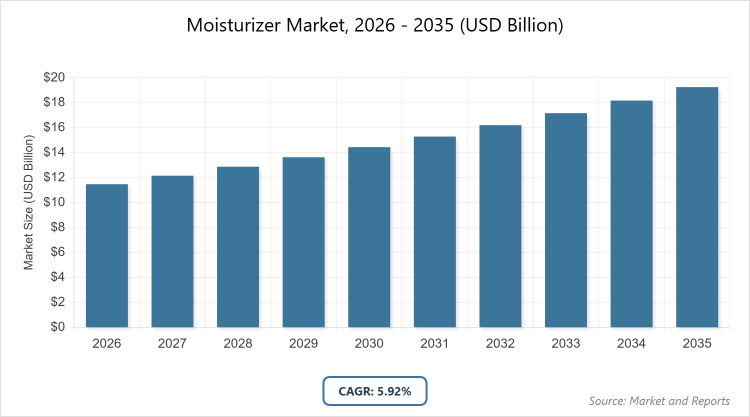
According to MarketnReports, the global Moisturizer Market size was estimated at USD 11.47 billion in 2025 and is expected to reach USD 20 billion by 2035, growing at a CAGR of 5.92% from 2026 to 2035. Moisturizer Market is driven by increasing consumer awareness about skincare and rising demand for natural and organic products.What are the Key Insights into the Moisturizer Market?
- The global moisturizer market was valued at USD 11.47 billion in 2025 and is projected to reach USD 20 billion by 2035.
- The market is expected to grow at a CAGR of 5.92% during the forecast period from 2026 to 2035.
- The market is driven by rising skincare awareness and demand for natural ingredients.
- Face moisturizer dominates the type segment with a 60% share due to high consumer focus on facial skincare and anti-aging benefits; cream dominates the form segment with 45% share owing to its rich hydration and versatility for various skin types.
- Asia Pacific holds the largest regional share at 37.55% due to rapid urbanization, increasing disposable incomes, and a large population in countries like China and India.
What is the Industry Overview of the Moisturizer Market?
The moisturizer market encompasses a wide range of skincare products designed to hydrate, nourish, and protect the skin by preventing water loss and maintaining its natural barrier function. Market definition includes creams, lotions, gels, and other formulations that incorporate ingredients like humectants, emollients, and occlusives to address various skin concerns such as dryness, aging, and environmental damage. This market is integral to the broader personal care and cosmetics industry, catering to diverse consumer needs across demographics, with a focus on daily use for both preventive and corrective skincare routines. It thrives on innovation in formulations, packaging, and sustainability, influenced by global beauty trends and health-conscious lifestyles.
What are the Market Dynamics of the Moisturizer Market?
Growth Drivers
The primary growth drivers in the moisturizer market include heightened consumer awareness about skincare routines, driven by social media influence and educational campaigns on skin health. Increasing disposable incomes in emerging economies enable more spending on premium and specialized products, while the rise of e-commerce platforms facilitates easy access and product discovery. Innovations in natural and organic formulations cater to the demand for clean beauty, further boosted by an aging global population seeking anti-aging solutions. Environmental factors like pollution and climate change also propel the need for protective moisturizers, contributing to sustained market expansion.
Restraints
Key restraints include stringent regulatory requirements on ingredients and claims, which can increase compliance costs and limit product innovation. Market saturation in developed regions leads to intense competition and price wars, potentially eroding profit margins. Rising raw material costs, particularly for natural and sustainable ingredients, pose challenges for manufacturers. Consumer skepticism toward chemical-based products and the prevalence of counterfeit goods in online channels further hinder trust and growth.
Opportunities
Opportunities abound in the shift toward personalized skincare, enabled by AI and data analytics for customized formulations. Expansion into untapped markets in Latin America and the Middle East, coupled with the growing men's grooming segment, offers new revenue streams. Sustainability trends, such as eco-friendly packaging and biodegradable ingredients, align with consumer preferences for ethical products. Partnerships with influencers and dermatologists can enhance brand credibility, while advancements in biotechnology, like microbiome-friendly moisturizers, present innovative avenues for differentiation.
Challenges
Challenges involve navigating supply chain disruptions, exacerbated by global events and raw material shortages, which can delay production and increase costs. Adapting to diverse regional preferences and regulations requires localized strategies, complicating global operations. The rapid pace of trends demands constant R&D investment, while addressing inclusivity for all skin tones and types remains a hurdle. Economic uncertainties may reduce non-essential spending on premium products.
Moisturizer Market: Report Scope
| Report Attributes | Report Details |
| Report Name | Moisturizer Market |
| Market Size 2025 | USD 11.47 Billion |
| Market Forecast 2035 | USD 20 Billion |
| Growth Rate | CAGR of 5.92% |
| Report Pages | 220 |
| Key Companies Covered |
L'Oréal S.A., Unilever PLC, The Procter & Gamble Company, Johnson & Johnson, Beiersdorf AG, and Others. |
| Segments Covered | By Type, By Form, By End-User, and By Region. |
| Regions Covered | North America, Europe, Asia Pacific (APAC), Latin America, and The Middle East and Africa (MEA) |
| Base Year | 2025 |
| Historical Year | 2020 - 2024 |
| Forecast Year | 2026 - 2035 |
| Customization Scope | Avail customized purchase options to meet your exact research needs. |
How is the Market Segmentation of the Moisturizer Market?
The Moisturizer Market is segmented by type, form, end-user, and region.By Type Segment: Face moisturizer is the most dominant subsegment, holding around 60% market share, as it addresses key concerns like hydration, anti-aging, and daily protection, driving the overall market through high repeat purchases and integration into skincare routines. Body moisturizer is the second most dominant, with about 30% share, due to its focus on larger skin areas and seasonal demand for intensive nourishment, contributing to market growth by appealing to broader body care needs.
By Form Segment: Cream is the most dominant subsegment, capturing approximately 45% market share, owing to its thick texture that provides deep hydration and is preferred for dry or mature skin, fueling market expansion through versatility and efficacy in barrier repair. Lotion follows as the second most dominant, with around 35% share, favored for its lightweight formula suitable for oily or humid climates, aiding market growth by offering quick absorption and everyday convenience.
By End-User Segment: Women dominate the end-user segment with about 60% share, driven by extensive skincare routines and demand for multifunctional products like anti-aging moisturizers, propelling the market through high consumption and innovation tailored to female preferences. Men are the second most dominant, holding roughly 25% share, as growing grooming awareness and male-specific formulations like oil-control moisturizers boost market dynamics by expanding the consumer base.
What are the Recent Developments in the Moisturizer Market?
- In February 2024, Shiseido launched two new moisturizers under its SIDEKICK brand, targeting young Asian men with formulations addressing hydration and oil control, expanding its presence in the men's skincare segment.
- In January 2024, BeautyStat Cosmetics introduced a peptide wrinkle-relaxing moisturizer, available exclusively on ULTA.com, focusing on anti-aging benefits with innovative peptide technology.
- In August 2023, Bubble Skincare partnered with Ulta Beauty to launch Cloud Surf, an air water-cream moisturizer, emphasizing lightweight hydration and broadening retail accessibility.
- In July 2023, Keomi Beauty expanded its lineup with Sunscreen SPF 50 PA++++ and Face Moisturizer, incorporating natural ingredients to meet demand for multifunctional, protective skincare.
How is the Regional Analysis of the Moisturizer Market?
Asia Pacific to dominate the global market.Asia Pacific holds the largest market share at 37.55%, driven by rapid urbanization, rising disposable incomes, and a strong beauty culture in countries like China, which leads with high consumption due to its massive population and e-commerce boom, followed by India with growing middle-class demand for affordable yet premium products.
North America accounts for around 25% share, supported by advanced consumer awareness and innovation in clean beauty, with the U.S. dominating through major brands and e-commerce giants like Amazon, while Canada contributes via demand for seasonal, hydrating formulas.
Europe represents about 20% share, emphasizing sustainable and natural products, led by Germany with its focus on dermatological-grade moisturizers and France through luxury brands like L'Oréal, fostering growth via regulatory standards and eco-conscious consumers.
Latin America holds approximately 10% share, growing due to increasing skincare adoption, with Brazil leading through vibrant beauty markets and Mexico via rising middle-class spending on imported and local brands.
The Middle East and Africa comprise around 7% share, with potential in premium segments, dominated by the UAE through high-end retail and South Africa via demand for protective moisturizers against harsh climates.
Who are the Key Market Players in the Moisturizer Market?
L'Oréal S.A. focuses on innovation through R&D in sustainable and AI-personalized formulations, expanding via acquisitions like Aesop and partnerships with retailers for global reach.
Unilever PLC emphasizes affordable, natural ingredients in brands like Dove, leveraging digital marketing and eco-friendly packaging to target emerging markets.
The Procter & Gamble Company drives growth with science-backed products in Olay, using data analytics for consumer insights and collaborations with dermatologists.
Johnson & Johnson prioritizes gentle, hypoallergenic formulas in Neutrogena, investing in clinical trials and expanding e-commerce presence.
Beiersdorf AG strengthens Nivea through sustainability initiatives like recycled CO2 in products and regional customization.
The Estée Lauder Companies Inc. targets luxury with anti-aging innovations in Clinique, focusing on prestige retail and influencer partnerships.
Shiseido Company Limited innovates in Asian-inspired tech like microbiome support, expanding globally via e-commerce.
Kao Corporation promotes inclusivity with gender-neutral lines, using R&D for multifunctional products.
Coty Inc. enhances Avon through digital transformation and affordable access in developing regions.
Henkel AG & Co. KGaA advances with clean beauty in Schwarzkopf, prioritizing supply chain sustainability.
What are the Market Trends in the Moisturizer Market?
- Shift toward natural and organic ingredients, with consumers preferring clean, plant-based formulas free from parabens and synthetics.
- Rise of personalized skincare, driven by AI tools for customized recommendations based on skin type and concerns.
- Growing demand for multifunctional products, such as moisturizers with SPF, anti-aging peptides, or pollution protection.
- Expansion of men's grooming segment, with oil-control and lightweight options gaining traction.
- Sustainability focus, including eco-friendly packaging, refill systems, and biodegradable ingredients.
- Influence of K-beauty trends, emphasizing hydration layers and innovative textures like gels and essences.
- Increased adoption of biotech advancements, such as microbiome-friendly and regenerative formulations.
- Boom in e-commerce and social media marketing, facilitating direct-to-consumer sales and influencer endorsements.
What Market Segments and their Subsegments are Covered in the Report?
By Type- Face Moisturizer
- Body Moisturizer
- Others
- Cream
- Lotion
- Gel
- Others
- Men
- Women
- Infant & Kids
- Others
By Region
- North America
- U.S.
- Canada
- Europe
- UK
- Germany
- France
- Rest of Europe
- Asia Pacific
- China
- India
- Japan
- Rest of Asia Pacific
- Latin America
- Brazil
- Mexico
- Rest of Latin America
- Middle East & Africa
- UAE
- South Africa
- Rest of Middle East & Africa
Frequently Asked Questions
The moisturizer market refers to the global industry involved in the production, distribution, and sale of skincare products designed to hydrate and protect the skin, including creams, lotions, and gels for face and body use.
Key factors include rising skincare awareness, demand for natural ingredients, e-commerce expansion, and innovations in personalized and sustainable formulations.
The market is projected to grow from USD 11.47 billion in 2026 to USD 20 billion by 2035.
The CAGR is expected to be 5.92%.
Asia Pacific will contribute notably, holding the largest share due to high population and rising incomes in China and India.
Major players include L'Oréal S.A., Unilever PLC, The Procter & Gamble Company, Johnson & Johnson, and Beiersdorf AG.
The report provides detailed analysis of market size, trends, segments, regional insights, key players, and forecasts from 2026 to 2035.
Stages include raw material sourcing, formulation and manufacturing, packaging, distribution through retail and e-commerce, and end-consumer usage.
Trends are shifting toward natural, personalized, and sustainable products, with consumers preferring multifunctional moisturizers and clean beauty options.
Regulations on ingredient safety and claims, plus environmental demands for eco-friendly packaging and sustainable sourcing, are key influencers.