
Greenhouse Horticulture Market Size, Share and Trends 2026 to 2035
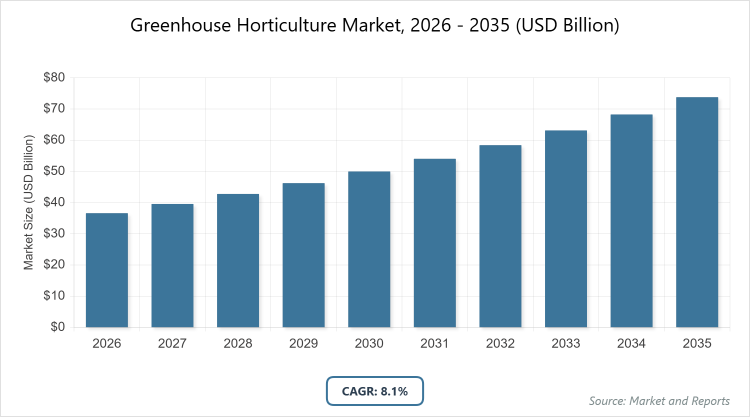
According to MarketnReports, the global Greenhouse Horticulture market size was estimated at USD 36.6 billion in 2025 and is expected to reach USD 73.7 billion by 2035, growing at a CAGR of 8.1% from 2026 to 2035. The rising demand for year-round fresh produce and advancements in controlled-environment agriculture.
What are the Key Insights into Greenhouse Horticulture?
- The global greenhouse horticulture market was valued at USD 36.6 billion in 2025 and is projected to reach USD 73.7 billion by 2035.
- The market is expected to grow at a CAGR of 8.1% during the forecast period from 2026 to 2035.
- The market is driven by increasing urbanization, demand for fresh produce, and adoption of sustainable farming practices.
- For product type, plastic greenhouses dominate with a 89.2% share due to their versatility, cost-effectiveness, and adaptability to various climates and crop needs.
- For application, vegetables dominate with a 60% share because of high consumer demand for year-round fresh supply and the efficiency of controlled environments in boosting yields for staples like tomatoes and cucumbers.
- For end-user, commercial horticulture dominates with a 75% share owing to large-scale operations focused on profitability, supply chain integration, and meeting global food demands.
- Europe dominates the regional market with a 44.2% share due to its emphasis on sustainability, advanced automation, and strong government support for energy-efficient agriculture.
What is the Greenhouse Horticulture?
Industry Overview
Greenhouse horticulture encompasses the cultivation of crops such as fruits, vegetables, flowers, and ornamentals within controlled-environment structures designed to optimize growth conditions, protect against external elements, and enable year-round production regardless of seasonal or climatic limitations. This market involves the integration of advanced technologies like hydroponics, climate control systems, and precision irrigation to enhance yield, resource efficiency, and sustainability. Market definition: It refers to the commercial and residential practice of using enclosed structures, typically covered with transparent or translucent materials, to create a microclimate that supports plant growth by regulating temperature, humidity, light, and nutrients, thereby addressing food security, urbanization pressures, and environmental challenges.
What are the Market Dynamics in Greenhouse Horticulture?
Growth Drivers
Rising demand for year-round fresh produce is a primary driver, as greenhouses enable a consistent supply of fruits, vegetables, and ornamentals, reducing dependency on seasonal imports and enhancing food security; for instance, initiatives like those from the USDA highlight potential revenue increases from domestic herb production, adding millions in returns through controlled cultivation that mitigates weather risks and pest issues.
Restraints
Energy dependence and sustainability constraints pose significant restraints, with high operational costs for heating, cooling, and lighting relying on fossil fuels, leading to volatile pricing and environmental regulations that demand carbon reductions; this is compounded by the need for substantial capital investment in renewable integrations, which can deter smaller operators in regions with inconsistent energy policies.
Opportunities
Supportive government policies and technological advancements present key opportunities, such as subsidies for water conservation and AI-driven systems that optimize resource use; for example, investments in low-carbon greenhouses and AI platforms like those funded in Europe and North America allow for scalable expansion in emerging markets, fostering innovation in hydroponics and vertical farming to address urban food shortages.
Challenges
Labor shortages and skill gaps represent major challenges, with increasing wages and a lack of trained workers for automated systems causing operational disruptions; seasonal workforce fluctuations further elevate training costs and impact production efficiency, particularly in tech-intensive setups requiring expertise in climate control and data analytics.
Greenhouse Horticulture Market: Report Scope
| Report Attributes | Report Details |
| Report Name | Greenhouse Horticulture Market |
| Market Size 2025 | USD 36.6 Billion |
| Market Forecast 2035 | USD 73.7 Billion |
| Growth Rate | CAGR of 8.1% |
| Report Pages | 220 |
| Key Companies Covered |
Richel Group, Netafim Ltd., Priva Holding B.V., Hoogendoorn Growth Management B.V., Dalsem B.V., and Others |
| Segments Covered | By Product Type, By Application, By End-User, and By Region |
| Regions Covered | North America, Europe, Asia Pacific (APAC), Latin America, and The Middle East and Africa (MEA) |
| Base Year | 2025 |
| Historical Year | 2020 – 2024 |
| Forecast Year | 2026 – 2035 |
| Customization Scope | Avail customized purchase options to meet your exact research needs. |
What is the Market Segmentation for Greenhouse Horticulture?
The Greenhouse Horticulture market is segmented by product type, application, end-user, and region.
Based on Product Type Segment, plastic greenhouses emerge as the most dominant with an 89.2% share, driven by their affordability, durability, and flexibility in design that suits diverse climates and crop varieties, while glass greenhouses are the second most dominant at around 8% due to superior light transmission and longevity; plastic’s dominance helps drive the market by enabling cost-effective scaling for commercial growers, reducing entry barriers and supporting higher yields through better insulation and UV protection, whereas glass contributes to premium applications like ornamentals by providing optimal environmental control that enhances product quality and market value.
Based on Application Segment, vegetables stand out as the most dominant with a 60% share, fueled by surging consumer demand for fresh, nutrient-rich produce year-round and the efficiency of greenhouses in cultivating high-volume crops like tomatoes and lettuce, while fruits are the second most dominant at approximately 25% owing to growing preferences for exotic and off-season varieties; vegetables drive market growth by addressing food security through maximized output in limited spaces via technologies like hydroponics, boosting profitability, and fruits aid expansion by catering to health-conscious trends, enabling premium pricing and export opportunities that stimulate investment in advanced cultivation methods.
Based on End-User Segment, commercial horticulture is the most dominant with a 75% share, propelled by large-scale operations aiming for efficiency and supply chain optimization to meet global retail demands, while residential users are the second most dominant at about 15% as urban gardening trends rise; commercial dominance propels the market forward by integrating automation and sustainability to achieve economies of scale, reducing waste and enhancing traceability, whereas residential use supports growth through accessible, small-scale systems that promote self-sufficiency and align with eco-friendly consumer lifestyles, encouraging broader adoption of greenhouse technologies.
What are the Recent Developments in Greenhouse Horticulture?
- In January 2026, Griffin Greenhouse Supplies expanded its Midwest operations to enhance support and delivery efficiency for regional growers, focusing on the streamlined supply of horticultural products amid growing demand.
- In December 2025, Metrolina Greenhouses merged with South-Central Growers to improve operational efficiency and omnichannel growth, combining expertise in plant production to better serve diverse markets.
- In January 2025, Windset Farms upgraded its facilities to LED-based greenhouses, achieving a 55% reduction in electricity usage through renewable energy integration, setting a benchmark for sustainable practices.
- In November 2025, Source.ag secured USD 17.5 million in funding to scale AI-driven solutions across Europe and North America, aiming to optimize crop yields and resource management.
- In October 2025, SABIC introduced high-tech greenhouse roofing using circular polyethylene in Saudi Arabia, promoting durability and environmental sustainability in arid regions.
- In April 2025, BrightFarms opened a new Illinois hub to increase production of leafy greens, emphasizing local sourcing to reduce transportation emissions.
- In February 2025, Oasthouse Ventures invested USD 104.8 million in a low-carbon greenhouse project in Virginia, supporting energy-efficient agriculture and job creation.
What is the Regional Analysis for Greenhouse Horticulture?
- Europe is to dominate the global market.
Europe leads the market with a 44.2% share, driven by countries like the Netherlands, Germany, UK, Spain, and Italy, where emphasis on sustainability, energy efficiency, and high-tech automation thrives; the Netherlands excels in R&D for innovations like tomato breeding in advanced greenhouses, while Germany’s CO₂ reduction programs target significant emission cuts by 2030, fostering a robust ecosystem of government incentives and technological advancements that enhance productivity and environmental compliance.
North America exhibits rapid growth, particularly in the U.S. and Canada, with dominating contributions from states like Texas and California; initiatives such as BrightFarms’ job-creating hubs and AeroFarms’ renewable-powered vertical farms, alongside Canada’s USD 10 million greenhouse program, underscore the region’s focus on controlled-environment agriculture (CEA) and incentives that address food security and urban expansion.
Asia Pacific holds a strong position, led by China, India, and Japan, where population growth and urbanization fuel demand; China’s intelligent agriculture parks integrate AI for efficient production, while India’s MIDH scheme has boosted vegetable output by 22% through protected cultivation, enabling resource-efficient farming in diverse climates to meet rising dietary needs.
Latin America shows emerging potential, with Brazil and Mexico as key players, benefiting from favorable climates and export-oriented horticulture; investments in modern greenhouses help overcome seasonal constraints, supporting fruit and vegetable exports while addressing local food demands through government-backed sustainability efforts.
The Middle East and Africa are gaining traction, dominated by Israel and South Africa, where water scarcity drives adoption of precision technologies like drip irrigation; Israel’s Netafim innovations exemplify efficient resource use, aiding arid-region farming and contributing to global knowledge transfer in sustainable horticulture.
Who are the Key Market Players in Greenhouse Horticulture?
- Richel Group (France): As a leader in greenhouse construction, Richel Group employs strategies focused on geographic expansion, climate-adapted designs, and sustainable practices to deliver customized solutions that enhance yield and resource efficiency for global clients.
- Netafim Ltd. (Israel): Specializing in precision irrigation, Netafim maximizes crop yields while minimizing water and nutrient use through drip and fertigation systems, with digital tools for monitoring; their strategy emphasizes expansion into water-scarce regions and partnerships for integrated farming solutions.
- Priva Holding B.V. (Netherlands): Priva excels in climate control and automation, integrating software, hardware, and analytics for optimized environments; their approach involves heavy R&D investment in cloud-based AI to provide data-driven insights, targeting commercial growers for enhanced profitability.
- Hoogendoorn Growth Management B.V. (Netherlands): Offering advanced climate and automation systems, Hoogendoorn focuses on user-friendly tools that improve efficiency; strategies include innovation in intelligent controls and global market penetration to support scalable, energy-efficient operations.
- Dalsem B.V. (Netherlands): As a greenhouse builder and integrator, Dalsem provides end-to-end solutions with modular, energy-efficient designs; their strategy centers on customization and technology integration to meet diverse crop needs, fostering long-term client relationships through comprehensive project management.
What are the Market Trends in Greenhouse Horticulture?
- Rising demand for year-round fresh produce amid urbanization and food security concerns.
- Adoption of AI, IoT, and robotics for precision agriculture and resource optimization.
- Shift toward sustainable practices, including renewable energy integration and vertical farming.
- Growing consumer preference for locally sourced, pesticide-free, and nutritious options.
- Expansion of hydroponics and soilless systems for water and nutrient efficiency.
What Market Segments and their Subsegments are Covered in the Greenhouse Horticulture Report?
By Product Type
- Polyethylene Film
- Polycarbonate Sheets
- Acrylic Panels
- Glass
- Fiberglass
- ETFE Film
- PVC Film
- Shade Cloth
- Insect Netting
- Anti-Condensation Film
- Others
By Application
- Vegetable Production
- Fruit Production
- Flower Production
- Ornamental Plants
- Nursery
- Herb Production
- Microgreens
- Seedling Production
- Research
- Hydroponic Farming
- Others
By End-User
- Commercial Growers
- Farmers
- Horticulturists
- Research Institutes
- Educational Institutions
- Residential Users
- Supermarkets
- Florists
- Landscapers
- Government Agencies
- Others
By Region
- North America
- U.S.
- Canada
- Europe
- UK
- Germany
- France
- Rest of Europe
- Asia Pacific
- China
- India
- Japan
- Rest of Asia Pacific
- Latin America
- Brazil
- Mexico
- Rest of Latin America
- Middle East & Africa
- UAE
- South Africa
- Rest of Middle East & Africa
Chapter 1. Preface
Chapter 2. Executive Summary
Chapter 3. Global Greenhouse Horticulture Market - Industry Analysis
Chapter 4. Global Greenhouse Horticulture Market- Competitive Landscape
Chapter 5. Global Greenhouse Horticulture Market - Product Type Analysis
Chapter 6. Global Greenhouse Horticulture Market - Application Analysis
Chapter 7. Global Greenhouse Horticulture Market - End-User Analysis
Chapter 8. Greenhouse Horticulture Market - Regional Analysis
Chapter 9. Company Profiles
Frequently Asked Questions
Greenhouse horticulture is the cultivation of crops, including fruits, vegetables, flowers, and ornamentals, in controlled-environment structures to optimize growth conditions and enable year-round production.
Key factors include rising demand for fresh produce, technological advancements in AI and hydroponics, government policies for sustainability, urbanization, and resource efficiency needs.
The market is projected to grow from USD 39.5 billion in 2026 to USD 73.7 billion by 2035.
The CAGR is expected to be 8.1% during 2026-2035.
Europe will contribute notably, holding a 44.2% share by 2035 due to its focus on sustainability and automation.
Major players include Richel Group, Netafim Ltd., Priva Holding B.V., Hoogendoorn Growth Management B.V., and Dalsem B.V.
The report provides in-depth analysis of market size, trends, segments, regional insights, key players, drivers, restraints, opportunities, and forecasts.
Stages include suppliers of structures and technologies, growers and producers, distributors and retailers, and end-consumers, with emphasis on integration for efficiency.
Trends are shifting toward AI-driven automation and sustainability, while consumers prefer locally sourced, pesticide-free produce for health and environmental reasons.
Regulations on carbon emissions, energy efficiency incentives, and water conservation policies are key, promoting renewables and sustainable practices.