
Fabric Conditioner Market Size, Share and Trends 2026 to 2035
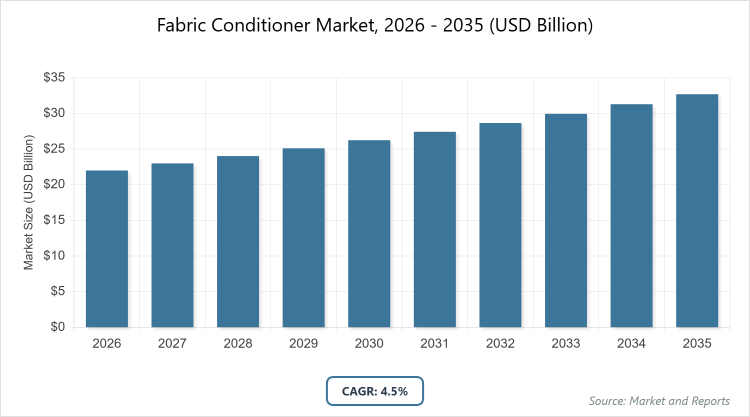
According to MarketnReports, the global Fabric Conditioner market size was estimated at USD 22 billion in 2025 and is expected to reach USD 34 billion by 2035, growing at a CAGR of 4.5% from 2026 to 2035. Fabric Conditioner Market is driven by increasing consumer awareness regarding hygiene and fabric care.
What are the Key Insights of the Fabric Conditioner Market?
- The global fabric conditioner market was valued at USD 22 billion in 2025 and is projected to reach USD 34 billion by 2035.
- The market is expected to grow at a CAGR of 4.5% during the forecast period from 2026 to 2035.
- The market is driven by rising hygiene awareness, urbanization, and demand for eco-friendly products.
- Liquid form dominates with approximately 89% market share due to its ease of use, effective softening properties, and widespread availability in various fragrances and formulations that appeal to a broad consumer base.
- Household application dominates with around 60% share because of high residential laundry volumes and consumer focus on personal fabric care.
- Supermarkets/hypermarkets dominate distribution channels with about 45% share owing to their extensive reach, promotional activities, and ability to stock diverse product options.
- Asia Pacific dominates with roughly 40% market share, attributed to rapid urbanization, growing middle-class populations, and increasing washing machine penetration in countries like China and India.
What is the Fabric Conditioner Market?
The fabric conditioner market encompasses products designed to soften fabrics, reduce static cling, and impart pleasant fragrances during the laundry process. These conditioners are typically added to the rinse cycle or used in dryer forms to enhance fabric feel and longevity. Market definition includes all formulations such as liquids, sheets, and beads that cater to both household and commercial needs, driven by consumer preferences for softer, fresher laundry outcomes.
What are the Growth Drivers of the Fabric Conditioner Market?
Rising consumer awareness about fabric maintenance and hygiene is a primary growth driver. With increasing urbanization and busy lifestyles, people seek convenient solutions that enhance clothing longevity, reduce wrinkles, and provide long-lasting freshness. The proliferation of washing machines in emerging markets further boosts demand, as conditioners complement automated laundry processes. Innovations in product formulations, such as hypoallergenic and plant-based options, cater to health-conscious consumers, expanding market penetration.
What are the Restraints of the Fabric Conditioner Market?
Environmental concerns pose significant restraints, as traditional conditioners often contain chemicals that contribute to water pollution and microplastic release. Stringent regulations on non-biodegradable ingredients increase production costs and limit formulation options. High prices of premium eco-friendly variants deter price-sensitive consumers in developing regions, while the availability of multifunctional detergents that incorporate softening agents reduces the need for separate conditioners.
What are the Opportunities of the Fabric Conditioner Market?
Opportunities lie in the shift toward sustainable and natural products, with growing demand for biodegradable, plant-derived conditioners free from harsh chemicals. Emerging markets in Asia and Latin America offer expansion potential due to rising disposable incomes and laundry appliance adoption. Technological advancements, like smart dispensing systems and concentrated formulas, can attract tech-savvy consumers. Partnerships with e-commerce platforms and subscription models present avenues for direct-to-consumer sales growth.
What are the Challenges of the Fabric Conditioner Market?
Intense competition from established brands and private labels challenges market entry for new players, requiring substantial marketing investments. Supply chain disruptions, such as raw material shortages for fragrances and surfactants, impact production stability. Consumer skepticism toward greenwashing claims necessitates transparent certifications, adding complexity. Adapting to diverse regional preferences and regulatory landscapes demands customized strategies, increasing operational hurdles.
Fabric Conditioner Market: Report Scope
| Report Attributes | Report Details |
| Report Name | Fabric Conditioner Market |
| Market Size 2025 | USD 22 Billion |
| Market Forecast 2035 | USD 34 Billion |
| Growth Rate | CAGR of 4.5% |
| Report Pages | 220 |
| Key Companies Covered |
Procter & Gamble, Unilever, Henkel, Colgate-Palmolive, Reckitt Benckiser, Church & Dwight, Kao Corporation, Lion Corporation, and Others |
| Segments Covered | By Form, By Application, By Distribution Channel, and By Region |
| Regions Covered | North America, Europe, Asia Pacific (APAC), Latin America, and The Middle East and Africa (MEA) |
| Base Year | 2025 |
| Historical Year | 2020 – 2024 |
| Forecast Year | 2026 – 2035 |
| Customization Scope | Avail customized purchase options to meet your exact research needs. |
How is the Fabric Conditioner Market Segmented?
The Fabric Conditioner market is segmented by form, application, distribution channel, and region.
Based on Form Segment. Liquid is the most dominant subsegment, holding around 89% share, followed by dryer sheets as the second most dominant with about 8% share. Liquid’s dominance stems from its versatility, easy integration into wash cycles, and superior softening efficacy compared to alternatives, driving market growth by meeting everyday consumer needs for quick and effective fabric care. Dryer sheets, while secondary, gain traction in regions with high dryer usage, contributing to overall market expansion through convenience in preventing static and adding fragrance post-wash.
Based on Application Segment. Household laundry is the most dominant subsegment, capturing approximately 60% share, with commercial laundries as the second most dominant at around 20%. Household laundry leads due to widespread residential use driven by daily laundry routines and preferences for personalized scents and softness, propelling market growth as consumers prioritize home-based fabric enhancement. Commercial laundries follow, supporting the market by fulfilling high-volume needs in professional settings, where durability and efficiency in fabric maintenance are key.
Based on Distribution Channel Segment. Supermarkets/hypermarkets are the most dominant, with about 45% share, and online retail is the second most dominant at roughly 25%. Supermarkets/hypermarkets dominate through their accessibility, bulk purchasing options, and in-store promotions that encourage impulse buys, fueling market growth by reaching mass consumers effectively. Online retail’s rise, driven by convenience and variety, aids market expansion by catering to digital-savvy shoppers seeking home delivery and reviews.
What are the Recent Developments in the Fabric Conditioner Market?
- In May 2025, Dr. Beckmann introduced Magic Leaves fabric conditioner sheets, featuring 75% less plastic than standard bottles and 72% natural ingredients, emphasizing sustainability to appeal to eco-conscious consumers.
- In May 2025, Unilever launched the Pure Heaven Scent range, including Comfort Pure Heaven Scent Fabric Conditioner, approved by the Skin Health Alliance for sensitive skin compatibility.
- In May 2024, P&G expanded its professional lineup with Downy Professional Fabric Softener, targeting commercial users for enhanced fabric care in high-volume settings.
- In February 2024, Procter & Gamble introduced the “Free & Clear” eco-friendly fabric conditioner in the United States, focusing on allergen-free and sustainable formulations.
- In March 2025, Unilever partnered with Google to develop a voice-activated fabric conditioner refill service, aiming to reduce plastic waste and improve consumer convenience.
What is the Regional Analysis of the Fabric Conditioner Market?
Asia Pacific to dominate the global market.
Asia Pacific holds the largest share, driven by rapid urbanization and increasing disposable incomes in dominating countries like China and India. The region’s growth is fueled by higher washing machine adoption and shifting consumer preferences toward premium fabric care products, with China leading due to its massive population and expanding middle class.
North America follows with steady demand, primarily from the United States as the dominating country, where consumers emphasize convenience and fragrance variety. The market benefits from advanced retail channels and innovations in eco-friendly options, supporting consistent growth.
Europe exhibits mature market characteristics, with Germany and the UK as key dominating countries. Stringent environmental regulations drive demand for sustainable conditioners, while high hygiene standards in households and hospitality sectors sustain expansion.
Latin America shows emerging potential, led by Brazil as the dominating country. Rising middle-class consumption and urbanization increase product penetration, though economic volatility poses challenges.
The Middle East and Africa experience gradual growth, with South Africa and Saudi Arabia as dominating countries. Increasing awareness of fabric care amid improving living standards drives demand, particularly in urban areas.
Who are the Key Market Players in the Fabric Conditioner Market?
- Procter & Gamble focuses on innovation and sustainability, launching eco-friendly lines like Downy Free & Clear and expanding professional products to capture commercial segments, while leveraging strong brand equity for market leadership.
- Unilever employs strategies centered on partnerships and product diversification, such as collaborating with Google for refill services and introducing skin-friendly ranges like Comfort Pure Heaven Scent to target sensitive consumers and reduce environmental impact.
- Henkel emphasizes premiumization and regional adaptation, investing in hypoallergenic formulations and expanding production capacities to meet growing demand in Asia and Europe, enhancing its competitive position through quality and efficiency.
- Colgate-Palmolive prioritizes affordability and accessibility, developing cost-effective variants for emerging markets while incorporating natural ingredients to align with global sustainability trends and broaden its consumer base.
- Reckitt Benckiser adopts aggressive marketing and e-commerce integration, promoting multifunctional products and leveraging digital platforms to reach younger demographics, driving growth through convenience and targeted campaigns.
- Church & Dwight concentrates on natural and odor-control innovations, such as Arm & Hammer lines, to appeal to health-conscious users, while optimizing supply chains for cost efficiency and market expansion.
- Kao Corporation invests in R&D for concentrated and biodegradable formulas, focusing on Asian markets to capitalize on local preferences and sustainability demands, strengthening its regional dominance.
- Lion Corporation pursues odor-removal technologies and premium offerings, like NANOX one integrations, to differentiate in competitive landscapes and foster loyalty through performance-driven products.
What are the Market Trends in the Fabric Conditioner Market?
- Shift toward eco-friendly and biodegradable formulations to meet sustainability demands.
- Rising popularity of concentrated liquids and dryer sheets for convenience and reduced packaging.
- Increasing demand for hypoallergenic and skin-friendly options amid growing health awareness.
- Growth in premium scented variants with long-lasting fragrances.
- Expansion of online sales channels and subscription models for direct consumer access.
- Integration of smart technologies, like voice-activated refills, for enhanced user experience.
- Focus on multifunctional products that combine softening with stain resistance or odor control.
- Adoption of plant-based ingredients to appeal to vegan and natural product seekers.
What Market Segments and their Subsegments are Covered in the Report?
By Form
- Liquid
- Dryer Sheets
- Beads
- Sprays
- Capsules
- Pods
- Bars
- Crystals
- Oils
- Powders
- Others
By Application
- Household Laundry
- Commercial Laundries
- Hospitality
- Healthcare
- Educational Institutions
- Sports Facilities
- Military
- Prisons
- Industrial
- Automotive
- Others
By Distribution Channel
- Supermarkets/Hypermarkets
- Convenience Stores
- Online Retail
- Department Stores
- Drugstores
- Specialty Stores
- Direct Sales
- Wholesale
- Vending Machines
- Independent Retailers
- Others
By Region
- North America
- U.S.
- Canada
- Europe
- UK
- Germany
- France
- Rest of Europe
- Asia Pacific
- China
- India
- Japan
- Rest of Asia Pacific
- Latin America
- Brazil
- Mexico
- Rest of Latin America
- Middle East & Africa
- UAE
- South Africa
- Rest of Middle East & Africa
Frequently Asked Questions
Fabric conditioners are laundry additives that soften fabrics, reduce static, and add fragrance, typically used in the rinse cycle or dryer to improve clothing feel and longevity.
Key factors include rising hygiene awareness, urbanization in emerging markets, demand for eco-friendly products, and innovations in sustainable formulations.
The market is projected to grow from approximately USD 23 billion in 2026 to USD 34 billion by 2035.
The CAGR is expected to be 4.5% during 2026-2035.
Asia Pacific will contribute notably, driven by population growth and urbanization in China and India.
Major players include Procter & Gamble, Unilever, Henkel, Colgate-Palmolive, and Reckitt Benckiser.
The report provides in-depth analysis of market size, trends, segments, regional insights, key players, and forecasts from 2026 to 2035.
Stages include raw material sourcing, manufacturing, distribution, retail, and end-use consumption.
Trends are shifting toward sustainable, hypoallergenic products, with consumers preferring long-lasting scents and convenient formats like sheets and beads.
Regulations on biodegradable ingredients and restrictions on harmful chemicals are pushing innovation toward eco-friendly options, impacting growth positively for compliant products.