
Automotive Rear Occupant Alert System Market Size, Share and Trends 2026 to 2035
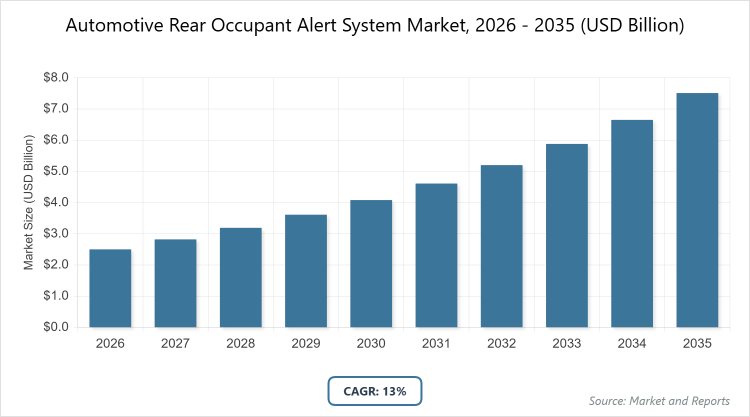
According to MarketnReports, the global Automotive Rear Occupant Alert System Market size was estimated at USD 2.5 billion in 2025 and is expected to reach USD 8.5 billion by 2035, growing at a CAGR of 13% from 2026 to 2035. Automotive Rear Occupant Alert System Market is driven by increasing safety regulations and awareness to prevent child heatstroke incidents in vehicles.What are the key insights into the Automotive Rear Occupant Alert System Market?
- The global Automotive Rear Occupant Alert System Market was valued at USD 2.5 billion in 2025 and is projected to reach USD 8.5 billion by 2035.
- The market is expected to grow at a CAGR of 13% during the forecast period from 2026 to 2035.
- The market is driven by stringent government regulations on vehicle safety, rising awareness of hot car deaths, and advancements in sensor technologies.
- In the sensor type segment, ultrasonic sensors dominate with approximately 55% market share due to their cost-effectiveness and reliability in detecting movement without complex processing.
- In the vehicle type segment, passenger cars hold about 75% share because of high consumer demand for family-oriented safety features in personal vehicles.
- In the sales channel segment, OEM dominates with around 80% share owing to mandatory integrations in new vehicles driven by safety standards and manufacturer initiatives.
- North America dominates the regional market with approximately 40% share, attributed to strict regulations like the U.S. Hot Cars Act and high awareness campaigns by organizations such as NHTSA.
What is the industry overview of the Automotive Rear Occupant Alert System Market?
The Automotive Rear Occupant Alert System Market encompasses technologies designed to detect and alert drivers about the presence of occupants, particularly children or pets, in the rear seats of vehicles to prevent accidental abandonment in hot conditions. Market definition refers to these systems as integrated safety features using sensors like ultrasonic, radar, or cameras to monitor rear occupancy, triggering visual, auditory, or haptic alerts upon vehicle shutdown. This market serves the automotive sector by addressing child safety concerns, complying with regulatory mandates, and enhancing vehicle intelligence through integration with advanced driver assistance systems, while evolving with the rise of electric and connected vehicles to promote preventive safety measures.
What are the market dynamics of the Automotive Rear Occupant Alert System Market?
Growth Drivers
The growth drivers of the Automotive Rear Occupant Alert System Market are primarily propelled by increasing regulatory mandates worldwide, such as the U.S. Infrastructure Investment and Jobs Act requiring rear occupant alerts in new vehicles by 2025, which compels automakers to integrate these systems to avoid penalties and enhance brand reputation. Heightened public awareness through campaigns by groups like KidsAndCars.org has amplified demand, particularly in regions with high incidences of child heatstroke deaths, driving adoption in passenger cars. Technological advancements in sensors, including radar for precise detection even under blankets, further fuel expansion by enabling seamless integration with ADAS and connected vehicle ecosystems, ultimately boosting market penetration in premium and mid-range segments.
Restraints
Restraints in the Automotive Rear Occupant Alert System Market include the high implementation costs associated with advanced sensors and software integration, which can increase vehicle prices by up to 5-10%, deterring adoption in price-sensitive emerging markets where basic safety features are prioritized over advanced ones. Limited awareness and regulatory enforcement in developing regions also hinder growth, as many consumers view these systems as non-essential luxuries. Additionally, technical challenges like false positives from moving objects or pets can lead to user frustration and reduced trust, prompting manufacturers to invest heavily in R&D, which strains smaller suppliers and slows overall market scalability.
Opportunities
Opportunities in the Automotive Rear Occupant Alert System Market emerge from the growing electrification of vehicles and the integration of AI-driven features, allowing for aftermarket retrofits in older fleets through partnerships with tech firms like Bosch, which can tap into the vast existing vehicle base. Expanding into commercial vehicles, such as delivery vans, presents potential amid rising e-commerce, where systems can prevent pet or cargo-related oversights. Moreover, collaborations with insurance companies offering premium discounts for equipped vehicles could incentivize adoption, while emerging markets in Asia-Pacific offer untapped growth through government incentives for safety tech, fostering innovation in cost-effective, scalable solutions.
Challenges
Challenges in the Automotive Rear Occupant Alert System Market revolve around achieving high accuracy without false alarms, as current ultrasonic systems may fail to detect sleeping children, necessitating costly hybrid sensor approaches that complicate supply chains amid semiconductor shortages. Regulatory variations across regions, such as Europe's focus on GDPR-compliant data handling versus the U.S.'s emphasis on heatstroke prevention, create compliance hurdles for global manufacturers. Intense competition from established players like Continental increases pressure on pricing and innovation, while educating consumers on system benefits remains difficult in low-awareness areas, potentially leading to underutilization and slower market maturation.
Automotive Rear Occupant Alert System Market: Report Scope
| Report Attributes | Report Details |
| Report Name | Automotive Rear Occupant Alert System Market |
| Market Size 2025 | USD 2.5 Billion |
| Market Forecast 2035 | USD 8.5 Billion |
| Growth Rate | CAGR of 13% |
| Report Pages | 220 |
| Key Companies Covered |
Robert Bosch GmbH, Continental AG, Hyundai Mobis Co. Ltd., Texas Instruments Incorporated, Aisin Corporation, and Others. |
| Segments Covered | By Sensor Type, By Vehicle Type, By Sales Channel, and By Region. |
| Regions Covered | North America, Europe, Asia Pacific (APAC), Latin America, and The Middle East and Africa (MEA) |
| Base Year | 2025 |
| Historical Year | 2020 - 2024 |
| Forecast Year | 2026 - 2035 |
| Customization Scope | Avail customized purchase options to meet your exact research needs. |
How is the Automotive Rear Occupant Alert System Market segmented?
The Automotive Rear Occupant Alert System Market is segmented by sensor type, vehicle type, sales channel, and region.By Sensor Type Segment, ultrasonic sensors are the most dominant, holding about 55% market share, followed by radar sensors as the second most dominant with around 30%. Ultrasonic sensors' dominance arises from their affordability, ease of integration, and effectiveness in detecting motion in enclosed spaces, driving the market by enabling widespread adoption in entry-level vehicles and complying with basic regulatory requirements; radar sensors contribute by offering superior accuracy in challenging conditions like covered occupants, propelling growth in premium segments through enhanced reliability and integration with autonomous driving tech.
By Vehicle Type Segment, passenger cars are the most dominant with approximately 75% share, while light commercial vehicles are the second most dominant at about 20%. Passenger cars lead due to their focus on family safety and high volume production, driving market expansion by incorporating these systems as standard features in sedans and SUVs to meet consumer demands and regulations; light commercial vehicles support growth by addressing fleet safety in delivery services, reducing liability risks and enhancing operational efficiency.
By Sales Channel Segment, OEM is the most dominant with around 80% share, followed by aftermarket as the second most dominant at roughly 20%. OEM's prevalence stems from manufacturer mandates and economies of scale in new vehicle assembly, driving the market through seamless integration and compliance with global safety standards; aftermarket aids expansion by providing retrofit options for existing vehicles, catering to cost-conscious consumers and extending system benefits to older models.
What are the recent developments in the Automotive Rear Occupant Alert System Market?
- In September 2024, Toyota introduced an advanced Rear Seat Reminder system in the 2025 Sienna, utilizing in-cabin millimeter-wave radar to detect rear occupants and provide alerts, enhancing detection accuracy beyond traditional sensors.
- In 2024, Bosch launched a new ultrasonic sensor system for rear occupant detection, focusing on improved energy efficiency and integration with vehicle infotainment, aimed at mid-range vehicles to broaden market accessibility.
- In December 2025, Continental partnered with a major automaker to develop AI-enhanced radar-based occupant alerts, incorporating machine learning to reduce false positives and support autonomous vehicle applications.
- Hyundai Mobis developed a radar-based rear occupant alert system, replacing ultrasonic sensors for better precision under various conditions, with rollout in select models to address limitations in detection reliability.
- Automakers like Hyundai committed to making rear occupant alerts standard by 2022, with ongoing updates including ultrasonic enhancements available in 2022 models to prevent child heatstroke incidents.
What is the regional analysis of the Automotive Rear Occupant Alert System Market?
North America to dominate the global market.North America leads the Automotive Rear Occupant Alert System Market, driven by robust regulatory frameworks like the U.S. Hot Cars Act mandating these systems in new vehicles, with the United States as the dominating country due to high awareness from NHTSA campaigns and over 900 reported child heatstroke deaths since 1998, fostering rapid adoption in passenger cars and collaborations with tech firms for advanced integrations.
Europe exhibits significant growth through stringent safety standards from Euro NCAP, emphasizing child protection, led by Germany as the dominating country with automotive leaders like Bosch and Continental innovating in radar and camera systems, supported by EU directives on vehicle safety that promote widespread implementation across premium and commercial vehicles.
Asia Pacific shows promising expansion fueled by rising vehicle production and urbanization, with China dominating due to government incentives for smart safety tech and increasing middle-class demand for family vehicles, enabling cost-effective ultrasonic systems to penetrate mass markets while addressing rising heat-related incidents.
Latin America presents emerging opportunities amid growing automotive sales and safety awareness, dominated by Brazil through its recovering manufacturing sector and regulatory pushes for emission and safety compliance, facilitating OEM integrations in passenger cars to reduce child abandonment risks in hot climates.
The Middle East and Africa offer niche growth from luxury vehicle imports and smart city initiatives, led by the United Arab Emirates with its focus on high-end EVs and safety features, while South Africa contributes via trade agreements promoting advanced tech adoption in commercial fleets.
Who are the key market players in the Automotive Rear Occupant Alert System Market?
Robert Bosch GmbH emphasizes innovation in ultrasonic and radar sensors, partnering with OEMs to integrate AI for reduced false alarms, strengthening its market position through sustainable and compliant safety solutions.
Continental AG focuses on hybrid sensor technologies and acquisitions to expand radar-based systems, leveraging global supply chains to offer scalable solutions for autonomous vehicles, driving growth in premium segments.
Hyundai Mobis Co. Ltd. prioritizes radar advancements over ultrasonics for precision, with strategies including standardizing systems in Hyundai and Kia models to capture Asia-Pacific demand and comply with international regulations.
Texas Instruments Incorporated adopts a component-focused approach, supplying chips for sensor processing, collaborating with automakers for cost-effective integrations that enhance system reliability and market penetration in emerging regions.
Aisin Corporation concentrates on camera and ultrasonic combinations, utilizing joint ventures for aftermarket kits, to address commercial vehicle needs and expand in Europe through regulatory-driven innovations.
What are the market trends in the Automotive Rear Occupant Alert System Market?
- Increasing adoption of radar and millimeter-wave sensors for improved detection accuracy under obstructions.
- Integration with advanced driver assistance systems (ADAS) and connected vehicle platforms for real-time alerts via apps.
- Shift toward AI and machine learning to minimize false positives and enhance user experience.
- Growing emphasis on regulatory compliance, with mandates like the U.S. Hot Cars Act accelerating standardizations.
- Expansion of aftermarket solutions for retrofitting older vehicles amid right-to-repair movements.
- Rise in collaborations between automakers and tech firms for hybrid sensor technologies in electric vehicles.
What market segments and their subsegments are covered in the Automotive Rear Occupant Alert System Market report?
By Sensor Type
- Ultrasonic Sensors
- Radar Sensors
- Camera Sensors
- Others
By Vehicle Type
- Passenger Cars
- Light Commercial Vehicles
- Heavy Commercial Vehicles
By Sales Channel
- OEM
- Aftermarket
By Region
- North America
- U.S.
- Canada
- Europe
- UK
- Germany
- France
- Rest of Europe
- Asia Pacific
- China
- India
- Japan
- Rest of Asia Pacific
- Latin America
- Brazil
- Mexico
- Rest of Latin America
- Middle East & Africa
- UAE
- South Africa
- Rest of Middle East & Africa
Frequently Asked Questions
The Automotive Rear Occupant Alert System Market involves safety technologies that detect rear seat occupants and alert drivers to prevent abandonment, using sensors integrated into vehicles.
Key factors include regulatory mandates, technological advancements in sensors, rising child safety awareness, and integration with ADAS.
The market is projected to grow from USD 2.5 billion in 2026 to USD 8.5 billion by 2035.
The CAGR is expected to be 13%.
North America will contribute notably, driven by strict safety regulations in the United States.
Major players include Robert Bosch GmbH, Continental AG, Hyundai Mobis Co. Ltd., Texas Instruments Incorporated, and Aisin Corporation.
The report offers detailed analysis of market size, trends, segments, regional insights, key players, and growth forecasts.
Stages include component sourcing, sensor manufacturing, system integration, vehicle assembly, distribution, and aftermarket services.
Trends are moving toward radar integration and AI, with consumers preferring reliable, app-connected systems for enhanced safety.
Factors include mandates like the U.S. Hot Cars Act and Euro NCAP ratings, promoting adoption to prevent heatstroke amid climate concerns.