
Organ Preservation Market Size, Share and Trends 2026 to 2035
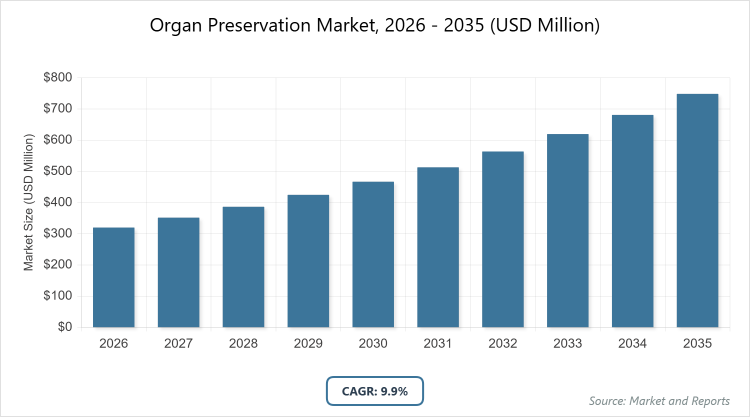
According to MarketnReports, the global Organ Preservation Market size was estimated at USD 320 million in 2025 and is expected to reach USD 820 million by 2035, growing at a CAGR of 9.9% from 2026 to 2035. Organ Preservation Market is driven by the growing demand for organ transplantation and advancements in preservation technologies.What are the Key Insights of the Organ Preservation Market?
- Market value estimated at USD 320 million in 2025, projected to reach USD 820 million by 2035.
- Compound annual growth rate (CAGR) of 9.9% during the forecast period from 2026 to 2035.
- Market is driven by increasing organ transplant demand and technological innovations in perfusion techniques.
- Static Cold Storage dominates the preservation technique segment with 60% share due to its widespread use, simplicity, and cost-effectiveness.
- Kidney dominates the organ type segment with 45% share as it is the most frequently transplanted organ worldwide.
- Hospitals & Transplant Centers dominate the end-user segment with 70% share owing to their central role in procurement and transplantation procedures.
- North America dominates with 40% market share because of high transplant volumes, advanced infrastructure, and strong research funding.
What is the Organ Preservation Market Industry Overview?
The Organ Preservation Market involves specialized solutions and technologies designed to maintain the viability of donated organs between procurement and transplantation, ensuring optimal function post-implant through controlled cooling, perfusion, oxygenation, and biochemical support. This market includes static cold storage solutions, machine perfusion devices, preservation solutions, and emerging techniques like normothermic perfusion and supercooling, aimed at extending safe ischemia times and reducing ischemia-reperfusion injury. Market definition refers to the ecosystem of products, devices, and services that bridge the critical period in organ transplantation by preserving cellular integrity, metabolic activity, and structural viability, driven by the need to increase the pool of usable organs amid chronic donor shortages and rising transplant demand.
What are the Market Dynamics of the Organ Preservation Market?
Growth Drivers
The growth drivers of the Organ Preservation Market are primarily propelled by the widening gap between organ demand and supply, with millions of patients on waiting lists globally, necessitating technologies that extend preservation time and improve graft outcomes to increase the utilization rate of marginal and extended-criteria donors. Advancements in machine perfusion—particularly hypothermic and normothermic systems—enable real-time organ assessment, viability testing, and therapeutic interventions during preservation, significantly boosting transplant success rates and attracting investment from both public and private sectors. Additionally, supportive government policies, rising awareness of organ donation, and increasing healthcare expenditure in emerging economies further accelerate adoption of sophisticated preservation solutions.
Restraints
Restraints in the Organ Preservation Market include the high cost of advanced perfusion devices and solutions, which limits adoption in low-resource settings and smaller transplant centers, restricting access to cutting-edge technologies. Logistical complexities, such as the need for specialized transport and trained personnel, along with limited organ availability and ethical/regulatory constraints on donation, reduce overall market volume. Furthermore, variable reimbursement policies across countries and the risk of organ discard due to prolonged ischemia or poor viability assessment continue to challenge widespread implementation.
Opportunities
Opportunities in the Organ Preservation Market emerge from the rapid development of normothermic machine perfusion and supercooling technologies, which promise to dramatically extend preservation windows and enable the use of previously discarded organs, opening new revenue streams for manufacturers and transplant centers. The integration of AI and biomarkers for real-time viability prediction and personalized preservation protocols presents a pathway to precision transplantation. Moreover, expanding transplant programs in Asia Pacific and Latin America, supported by growing healthcare investments and public-private partnerships, offer significant untapped potential for market penetration.
Challenges
Challenges facing the Organ Preservation Market involve achieving consistent outcomes across diverse donor profiles and organ types, as biological variability and ischemia-reperfusion injury remain difficult to fully mitigate, requiring continuous clinical validation. Global disparities in transplant infrastructure and training create uneven adoption, while competition among preservation technologies demands clear superiority evidence to drive clinician preference. Additionally, ethical considerations around organ allocation and the potential for commercial influence on donation practices necessitate robust oversight to maintain public trust.
Organ Preservation Market: Report Scope
| Report Attributes | Report Details |
| Report Name | Organ Preservation Market |
| Market Size 2025 | USD 320 Million |
| Market Forecast 2035 | USD 820 Million |
| Growth Rate | CAGR of 9.9% |
| Report Pages | 220 |
| Key Companies Covered |
OrganOx Limited, TransMedics Group, Inc., Bridge to Life Ltd., XVIVO Perfusion AB, Paragonix Technologies, 21st Century Medicine, Preservation Technologies, Dr. Franz Köhler Chemie GmbH, Biolife Solutions, Waters Medical Systems, and Others. |
| Segments Covered | By Preservation Technique, By Organ Type, By End-User, and By Region. |
| Regions Covered | North America, Europe, Asia Pacific (APAC), Latin America, and The Middle East and Africa (MEA) |
| Base Year | 2025 |
| Historical Year | 2020 - 2024 |
| Forecast Year | 2026 - 2035 |
| Customization Scope | Avail customized purchase options to meet your exact research needs. |
What is the Market Segmentation of the Organ Preservation Market?
The Organ Preservation Market is segmented by preservation technique, organ type, end-user, and region.By Preservation Technique Segment, static cold storage emerges as the most dominant subsegment, holding approximately 60% share, followed by hypothermic machine perfusion at 25%. Static cold storage dominates due to its long-established use, simplicity, low cost, and widespread availability in transplant centers globally, driving the market by enabling reliable short-term preservation for the majority of kidney and liver transplants.
By Organ Type Segment, kidney leads as the most dominant subsegment with 45% share, while liver ranks second at 30%. Kidney dominates because it is the most transplanted solid organ worldwide, with the largest waiting lists and longest safe preservation times, propelling market growth through high procedure volumes and ongoing demand for improved preservation to reduce discard rates.
By End-User Segment, hospitals & transplant centers stands out as the most dominant subsegment, capturing 70% share, with organ procurement organizations as the second at 15%. Hospitals & transplant centers dominate owing to their role as primary sites for procurement, preservation, and transplantation, fueling market expansion by driving demand for both standard and advanced preservation technologies.
What are the Recent Developments in the Organ Preservation Market?
- In January 2025, OrganOx announced FDA clearance for its metra normothermic liver perfusion system expansion, enabling longer preservation and viability assessment for extended criteria livers.
- In March 2025, TransMedics launched the next-generation OCS Heart Perfusion System with enhanced monitoring capabilities, improving outcomes in cardiac transplantation.
- In June 2025, Bridge to Life expanded its Belzer UW solution distribution network in Asia Pacific, targeting growing transplant programs in India and China.
What is the Regional Analysis of the Organ Preservation Market?
North America to dominate the global market.North America holds the dominant position in the Organ Preservation Market, accounting for about 40% share, with the United States as the leading country due to the highest transplant volumes globally, advanced perfusion technology adoption, substantial NIH funding, and strong regulatory support for innovation.
Europe maintains a strong presence, driven by coordinated organ sharing networks, with Germany as the key contributor through high kidney and liver transplant rates and leadership in machine perfusion research.
Asia Pacific is experiencing the fastest growth, fueled by rising transplant infrastructure, with China dominating through massive investment in organ donation systems and rapid increase in transplant centers.
Latin America shows emerging potential, led by Brazil with expanding public transplant programs and growing adoption of cold storage solutions amid increasing donor awareness.
The Middle East and Africa region is nascent but growing, with Turkey dominating through high transplant activity and strategic partnerships for advanced preservation technologies.
Who are the Key Market Players and Strategies in the Organ Preservation Market?
OrganOx Limited focuses on normothermic liver perfusion, investing in clinical trials to expand indications and global distribution.
TransMedics Group, Inc. prioritizes heart and lung perfusion systems, pursuing FDA approvals and partnerships to increase transplant utilization rates.
Bridge to Life Ltd. emphasizes preservation solutions like Belzer UW, expanding manufacturing capacity and entering emerging markets through licensing agreements.
XVIVO Perfusion AB develops lung and heart perfusion technologies, adopting a strategy of innovation and acquisitions to broaden its portfolio.
Paragonix Technologies specializes in static cold storage devices for heart preservation, focusing on commercial expansion in North America and Europe.
21st Century Medicine invests in supercooling and vitrification research, targeting long-term preservation breakthroughs through collaborations.
Preservation Technologies offers innovative cold storage solutions, emphasizing cost-effective products for developing regions.
Dr. Franz Köhler Chemie GmbH manufactures Custodiol HTK solution, pursuing regulatory approvals and distribution in Asia.
Biolife Solutions provides cryopreservation media and devices, integrating with machine perfusion systems for comprehensive offerings.
Waters Medical Systems focuses on kidney perfusion, leveraging clinical data to support adoption in transplant centers.
What are the Market Trends in the Organ Preservation Market?
- Shift from static cold storage to machine perfusion for extended criteria organs.
- Increasing adoption of normothermic perfusion for real-time viability assessment.
- Growth in organ-specific preservation devices and solutions.
- Integration of biomarkers and AI for predictive graft function.
- Expansion of preservation time through supercooling and oxygenated methods.
- Rising focus on marginal donor organ utilization.
- Emphasis on reducing ischemia-reperfusion injury through therapeutic additives.
What Market Segments and their Subsegments are Covered in the Organ Preservation Market Report?
By Preservation Technique
- Static Cold Storage
- Hypothermic Machine Perfusion
- Normothermic Machine Perfusion
- Supercooling
- Vitrification
- Ischemic Conditioning
- Oxygenated Preservation
- Room Temperature Preservation
- Others
By Organ Type
- Kidney
- Liver
- Heart
- Lung
- Pancreas
- Small Bowel
- Vascularized Composite Allografts
- Others
By End-User
- Hospitals & Transplant Centers
- Organ Procurement Organizations
- Research & Academic Institutes
- Specialty Clinics
- Ambulatory Surgical Centers
- Others
By Region
- North America
- U.S.
- Canada
- Europe
- UK
- Germany
- France
- Rest of Europe
- Asia Pacific
- China
- India
- Japan
- Rest of Asia Pacific
- Latin America
- Brazil
- Mexico
- Rest of Latin America
- Middle East & Africa
- UAE
- South Africa
- Rest of Middle East & Africa
Frequently Asked Questions
The Organ Preservation Market involves technologies and solutions to maintain organ viability between donation and transplantation.
Key factors include increasing transplant demand, machine perfusion advancements, and rising use of marginal donors.
The market is projected to grow from approximately USD 320 million in 2026 to USD 820 million by 2035.
The CAGR is expected to be 9.9% from 2026 to 2035.
North America will contribute notably, holding around 40% of the market value due to high transplant activity.
Major players include OrganOx Limited, TransMedics Group, Inc., Bridge to Life Ltd., XVIVO Perfusion AB, Paragonix Technologies, 21st Century Medicine, Preservation Technologies, Dr. Franz Köhler Chemie GmbH, Biolife Solutions, and Waters Medical Systems.
The report provides comprehensive analysis including market size, trends, segmentation, key players, regional insights, and forecasts from 2026 to 2035.
Stages include organ procurement, preservation solution/device application, transport, viability assessment, transplantation, and post-transplant monitoring.
Trends are shifting towards dynamic perfusion and extended preservation, while preferences favor technologies improving graft survival and utilization.
Factors include organ donation regulations, FDA approvals for new devices, and environmental considerations in transport and disposal.