
Organic Sugar Market Size, Share and Trends 2026 to 2035
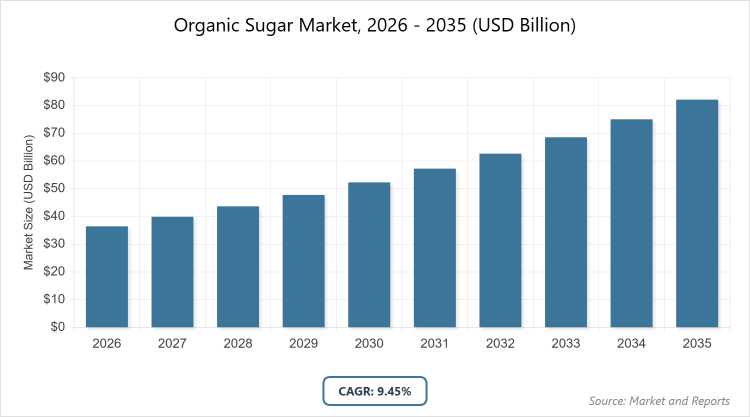
According to MarketnReports, the global Organic Sugar Market size was estimated at USD 36.43 billion in 2025 and is expected to reach USD 89.8 billion by 2035, growing at a CAGR of 9.45% from 2026 to 2035. Organic Sugar Market is driven by rising health consciousness and demand for natural, chemical-free sweeteners.What are the Key Insights of the Organic Sugar Market?
- Market value estimated at USD 36.43 billion in 2025, projected to reach USD 89.8 billion by 2035.
- Compound annual growth rate (CAGR) of 9.45% during the forecast period from 2026 to 2035.
- Market is driven by increasing consumer preference for natural and healthy food products.
- Cane sugar dominates the product type segment with 80% share; Food & beverage dominates the application segment with 70% share; Food & beverage industry dominates the end-user segment with 60% share.
- Cane sugar dominates due to its abundant cultivation in tropical regions, higher natural sucrose content, and perceived health benefits over processed alternatives.
- Food & beverage dominates because of widespread use in processed foods, drinks, and baked goods, where organic labeling appeals to health-conscious consumers.
- Food & beverage industry dominates owing to large-scale procurement for product formulation, driven by clean-label trends and regulatory support for organic ingredients.
- North America dominates with 35% market share because of high consumer awareness, stringent organic standards, and robust retail infrastructure for premium products.
What is the Organic Sugar Market Industry Overview?
The Organic Sugar Market comprises sweeteners derived from organically grown sugarcane or sugar beets, produced without synthetic pesticides, fertilizers, or genetically modified organisms, adhering to strict certification standards like USDA Organic or EU Organic to ensure environmental sustainability and health benefits. This market includes various forms such as granulated, brown, and liquid sugars, catering to consumers seeking natural alternatives to refined sugars amid growing awareness of processed food risks. Market definition encompasses the production, distribution, and consumption of sugar certified organic, emphasizing ethical farming practices that preserve soil health and biodiversity, while meeting the demand for clean-label products in food, beverages, and personal care sectors.
What are the Market Dynamics of the Organic Sugar Market?
Growth Drivers
The growth drivers of the Organic Sugar Market are largely propelled by heightened consumer awareness regarding the health risks associated with conventional sugars, such as obesity and diabetes, prompting a shift towards natural, unrefined alternatives that offer better nutritional profiles and fewer additives. Certifications and labeling initiatives, supported by governments and organizations like the USDA, enhance trust and accessibility, encouraging mainstream retailers to stock organic options. Additionally, the expansion of organic farming practices, aided by sustainable agriculture subsidies and technological advancements in yield optimization without chemicals, ensures supply chain reliability and cost competitiveness, further boosted by the integration of organic sugar in popular categories like functional beverages and clean-label snacks.
Restraints
Restraints in the Organic Sugar Market include the higher production costs stemming from labor-intensive organic farming methods and certification processes, which result in premium pricing that may deter price-sensitive consumers in developing regions. Supply chain vulnerabilities, such as weather-dependent harvests and limited arable land suitable for organic cultivation, lead to inconsistent availability and price volatility. Moreover, stringent regulatory requirements for organic verification can create barriers for small-scale producers, limiting market entry and diversity, while counterfeit products erode consumer confidence and hinder overall adoption.
Opportunities
Opportunities in the Organic Sugar Market lie in the burgeoning e-commerce platforms and direct-to-consumer models, which allow producers to reach niche health-focused demographics globally, bypassing traditional retail constraints and enabling personalized marketing. The rising demand for plant-based and vegan products opens avenues for organic sugar in innovative applications like alternative dairy and meat substitutes. Furthermore, partnerships with food tech companies for low-glycemic or fortified sugar variants can tap into the wellness trend, while expanding into emerging markets with growing middle-class populations offers untapped potential through localized production and education campaigns on organic benefits.
Challenges
Challenges facing the Organic Sugar Market involve maintaining consistent quality and supply amid climate change impacts, such as erratic weather patterns affecting crop yields in key producing regions like Brazil and India, necessitating resilient farming techniques and diversification. The competition from alternative sweeteners, including stevia and monk fruit, poses a threat as they gain traction for lower calorie counts. Additionally, navigating complex international trade regulations and tariffs for organic exports requires strategic alliances and compliance investments, while educating consumers on the value proposition over cheaper conventional sugars remains crucial for sustained demand.
Organic Sugar Market: Report Scope
| Report Attributes | Report Details |
| Report Name | Organic Sugar Market |
| Market Size 2025 | USD 36.43 Billion |
| Market Forecast 2035 | USD 89.8 Billion |
| Growth Rate | CAGR of 9.45% |
| Report Pages | 220 |
| Key Companies Covered |
Wholesome Sweeteners, Florida Crystals Corporation, Nordzucker AG, Agrana Beteiligungs-AG, ASR Group International, Inc., Associated British Foods plc, Bajaj Hindusthan Sugar Ltd., Cosan S.A., Tate & Lyle PLC, and Others. |
| Segments Covered | By Product Type, By Application, By End-User, and By Region. |
| Regions Covered | North America, Europe, Asia Pacific (APAC), Latin America, and The Middle East and Africa (MEA) |
| Base Year | 2025 |
| Historical Year | 2020 - 2024 |
| Forecast Year | 2026 - 2035 |
| Customization Scope | Avail customized purchase options to meet your exact research needs. |
What is the Market Segmentation of the Organic Sugar Market?
The Organic Sugar Market is segmented by product type, application, end-user, and region.By Product Type Segment, cane sugar emerges as the most dominant subsegment, holding approximately 80% share, followed by beet sugar at 15%. Cane sugar dominates due to its natural cultivation in favorable climates, higher perceived purity and flavor profile preferred in premium products, driving the market by enabling scalable production for global exports and supporting the clean-label movement that boosts consumer adoption across diverse applications.
By Application Segment, food & beverage leads as the most dominant subsegment with 70% share, while pharmaceuticals ranks second at 10%. Food & beverage dominates because of its integral role in enhancing taste and texture in everyday consumables like drinks and snacks, propelling market growth through innovation in organic formulations that align with health trends and expand retail presence.
By End-User Segment, food & beverage industry stands out as the most dominant subsegment, capturing 60% share, with households as the second at 20%. Food & beverage industry dominates owing to bulk requirements for manufacturing and branding organic lines, fueling market expansion by investing in sustainable sourcing that meets regulatory demands and caters to evolving consumer preferences for ethical products.
What are the Recent Developments in the Organic Sugar Market?
- In January 2024, Wholesome Sweeteners announced the launch of its new line of organic sugar in bulk packaging, aimed at expanding accessibility for commercial users and enhancing sustainability through reduced packaging waste.
- In March 2024, C&H Sugar entered into a strategic partnership with Organic Valley to source organic cane sugar from cooperative farmers, focusing on transparent supply chains and supporting rural communities.
- In May 2024, Florida Crystals acquired a 50% stake in Monasterio Sucre, a Colombian organic sugar producer, to strengthen its global supply and meet rising demand for certified organic products.
What is the Regional Analysis of the Organic Sugar Market?
North America to dominate the global market.North America holds the dominant position in the Organic Sugar Market, accounting for about 35% share, with the United States as the leading country due to strong consumer demand for health-oriented products, extensive retail networks like Whole Foods, and supportive policies promoting organic agriculture that drive innovation and market penetration.
Europe maintains a strong presence, emphasizing sustainability and clean eating, with Germany as the dominating country through its robust organic certification system, high per capita consumption of natural sweeteners, and EU subsidies for eco-friendly farming that enhance production and export capabilities.
Asia Pacific is experiencing the fastest growth, driven by urbanization and rising disposable incomes, with India leading as a major producer and exporter, leveraging vast sugarcane plantations and government initiatives for organic farming to cater to both domestic health trends and international markets.
Latin America shows emerging potential, fueled by abundant natural resources and export-oriented economies, led by Brazil with its large-scale organic cane farms, fair-trade certifications, and partnerships with global brands to supply premium sugar amid growing environmental awareness.
The Middle East and Africa region is nascent but growing, with South Africa dominating through investments in sustainable agriculture and increasing adoption of organic products in urban centers, supported by international aid for crop diversification and access to European export markets.
Who are the Key Market Players and Strategies in the Organic Sugar Market?
Wholesome Sweeteners focuses on sustainable sourcing from fair-trade farms, expanding product lines with innovative packaging and partnering with retailers to promote organic lifestyles, aiming to capture health-conscious consumers.
Florida Crystals Corporation emphasizes vertical integration from farm to table, investing in regenerative agriculture and certifications to ensure traceability, while pursuing acquisitions to broaden its global footprint.
Nordzucker AG prioritizes European market leadership through R&D in low-impact processing, collaborating with farmers for organic transitions and marketing premium beet-derived sugars for bakery applications.
Agrana Beteiligungs-AG leverages fruit and sugar synergies, adopting eco-friendly technologies and expanding into Asia via joint ventures to meet rising demand for natural sweeteners.
ASR Group International, Inc. employs a diversified portfolio strategy, focusing on brand acquisitions and supply chain optimization to deliver consistent organic cane sugar to industrial clients.
Associated British Foods plc integrates organic sugar into its grocery divisions, emphasizing cost efficiencies and sustainability reports to appeal to ethical investors and consumers.
Bajaj Hindusthan Sugar Ltd. targets export growth through capacity expansions in India, adopting organic certifications and tech for higher yields to compete in premium markets.
Cosan S.A. utilizes biofuel synergies for sustainable cane production, forming alliances with international buyers and investing in carbon-neutral initiatives.
Tate & Lyle PLC innovates with blended organic sweeteners, focusing on R&D for functional benefits and global distribution networks to penetrate food service sectors.
What are the Market Trends in the Organic Sugar Market?
- Increasing demand for sustainable and fair-trade certified products to ensure ethical sourcing.
- Rise in e-commerce platforms facilitating direct access to premium organic varieties.
- Growing preference for specialty sugars like coconut and palm for diverse flavor profiles.
- Expansion of clean-label trends in food and beverage formulations.
- Adoption of regenerative agriculture practices to enhance soil health and biodiversity.
- Surge in health-conscious consumption driving low-glycemic organic options.
- Integration of organic sugar in plant-based and vegan product innovations.
What Market Segments and their Subsegments are Covered in the Organic Sugar Market Report?
By Product Type
- Cane Sugar
- Beet Sugar
- Coconut Sugar
- Palm Sugar
- Date Sugar
- Maple Sugar
- Brown Sugar
- White Sugar
- Liquid Sugar
- Granulated Sugar
- Others
By Application
- Bakery
- Confectionery
- Beverages
- Dairy
- Pharmaceuticals
- Personal Care
- Food Processing
- Sweet Snacks
- Frozen Desserts
- Food Service
- Others
By End-User
- Food & Beverage Industry
- Pharmaceutical Industry
- Personal Care Industry
- Households
- Retailers
- Bakeries
- Confectioners
- Beverage Manufacturers
- Dairy Producers
- Restaurants
- Others
By Region
- North America
- U.S.
- Canada
- Europe
- UK
- Germany
- France
- Rest of Europe
- Asia Pacific
- China
- India
- Japan
- Rest of Asia Pacific
- Latin America
- Brazil
- Mexico
- Rest of Latin America
- Middle East & Africa
- UAE
- South Africa
- Rest of Middle East & Africa
Frequently Asked Questions
The Organic Sugar Market involves the production and distribution of sugars derived from organically grown crops without synthetic chemicals, certified for health and environmental benefits.
Key factors include rising health awareness, demand for natural sweeteners, sustainable farming practices, and expanding applications in food and beverages.
The market is projected to grow from approximately USD 36.43 billion in 2026 to USD 89.8 billion by 2035.
The CAGR is expected to be 9.45% from 2026 to 2035.
North America will contribute notably, holding around 35% of the market value due to high consumer awareness and infrastructure.
Major players include Wholesome Sweeteners, Florida Crystals Corporation, Nordzucker AG, Agrana Beteiligungs-AG, ASR Group International, Inc., Associated British Foods plc, Bajaj Hindusthan Sugar Ltd., Cosan S.A., and Tate & Lyle PLC.
The report provides comprehensive analysis including market size, trends, segmentation, key players, regional insights, and forecasts from 2026 to 2035.
Stages include organic farming and harvesting, milling and processing, certification and quality control, packaging and distribution, and retail or industrial use.
Trends are shifting towards sustainable and specialty varieties, while consumers prefer ethical, health-focused products with transparent sourcing.
Factors include strict organic certification standards, environmental policies promoting sustainable agriculture, and incentives for reducing chemical use in farming.