
Home Automation Market Size, Share and Trends 2026 to 2035
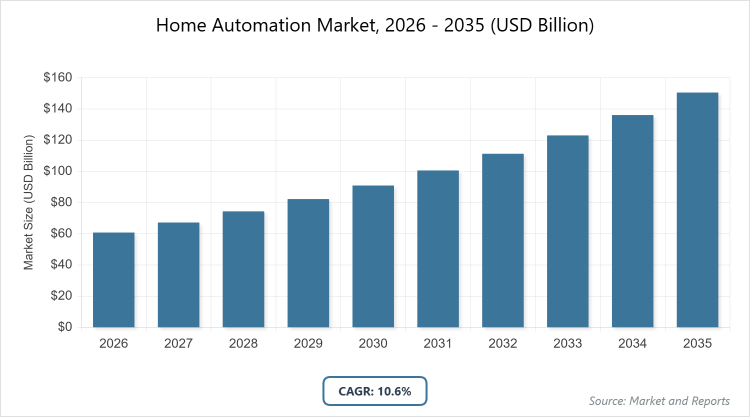
According to MarketnReports, the global Home Automation market size was estimated at USD 60.79 billion in 2025 and is expected to reach USD 166.97 billion by 2035, growing at a CAGR of 10.6% from 2026 to 2035. Home Automation Market is driven by increasing adoption of IoT devices and smart technologies for enhanced convenience and energy efficiency.
What is the Overview of Home Automation Market?
The home automation market involves the integration of technology and devices to control and automate various household functions, such as lighting, heating, security, and entertainment, through centralized systems or mobile applications for improved convenience, energy efficiency, and security. This market encompasses hardware like smart thermostats, cameras, and locks, alongside software platforms that enable seamless connectivity via IoT protocols. Market definition refers to the industry focused on smart home solutions that allow remote monitoring and management, catering to consumer demands for connected living spaces that enhance lifestyle while addressing sustainability and safety concerns, supported by advancements in AI, voice assistants, and wireless networks to create intelligent, responsive environments.
What are the Key Insights into Home Automation Market?
- The global home automation market was valued at USD 60.79 billion in 2025 and is projected to reach USD 166.97 billion by 2035.
- The market is expected to grow at a CAGR of 10.6% during the forecast period from 2026 to 2035.
- The market is driven by rising consumer demand for energy-efficient and connected smart devices amid urbanization and technological advancements.
- In the product type segment, smart security cameras dominate with a 28% share.
- This dominance is due to heightened focus on home safety and remote monitoring, driving market growth by integrating AI for real-time alerts and deterrence.
- In the application segment, security & surveillance dominates with a 43% share.
- This is attributed to increasing concerns over burglary and privacy, fueling expansion through advanced features like facial recognition and cloud storage.
- In the end-user segment, residential dominates with a 70% share.
- This stems from consumer preferences for personalized smart homes, propelling the market by enabling easy integration of devices for daily convenience.
- North America dominates the global market with a 36% share.
- This is owing to high technology adoption, presence of key players, and supportive infrastructure in the United States.
What are the Market Dynamics in Home Automation?
Growth Drivers
Growth drivers in the home automation market are primarily fueled by the proliferation of IoT devices and AI technologies that enable seamless integration and voice-controlled operations, attracting tech-savvy consumers seeking convenience and energy savings in modern lifestyles. Government incentives for smart energy management and green buildings further accelerate adoption, particularly in urban areas where remote access enhances security and efficiency. The rise of 5G networks supports faster connectivity for real-time monitoring, while partnerships between tech giants and appliance manufacturers expand product ecosystems. Additionally, aging populations benefit from automation in elderly care, driving demand for health-monitoring features that integrate with home systems for proactive assistance.
Restraints
Restraints in the home automation market include high initial installation costs and interoperability issues among devices from different brands, which deter budget-conscious consumers and complicate system setups in existing homes. Privacy and cybersecurity concerns arise from connected devices vulnerable to hacking, leading to hesitancy in adoption amid rising data breach incidents. Limited internet infrastructure in rural or developing regions restricts market penetration, while complex user interfaces alienate non-tech-savvy users. Moreover, dependency on electricity and network stability can cause system failures, impacting reliability perceptions.
Opportunities
Opportunities in the home automation market stem from the integration of AI and machine learning for predictive analytics, such as automated energy optimization and personalized routines, opening avenues for premium services in smart cities. Emerging markets in Asia-Pacific present untapped potential with rising middle-class incomes and urbanization, where affordable wireless solutions can gain traction. Collaborations with renewable energy providers for solar-integrated systems align with sustainability trends, attracting eco-conscious buyers. Furthermore, advancements in edge computing reduce latency, enabling innovative applications like real-time health monitoring for the elderly.
Challenges
Challenges in the home automation market encompass standardization issues across protocols like Zigbee and Z-Wave, leading to fragmentation that hinders seamless device communication and user experience. Rapid technological evolution requires frequent updates, straining consumer budgets and causing obsolescence concerns. Regulatory variations on data privacy across regions complicate global expansion for manufacturers. Additionally, supply chain disruptions for semiconductors affect production timelines, while educating consumers on benefits and setup remains a hurdle in less developed markets.
Home Automation Market: Report Scope
| Report Attributes | Report Details |
| Report Name | Home Automation Market |
| Market Size 2025 | USD 60.79 Billion |
| Market Forecast 2035 | USD 166.97 Billion |
| Growth Rate | CAGR of 10.6% |
| Report Pages | 220 |
| Key Companies Covered |
Amazon, Google, Honeywell, Siemens, Schneider Electric, and Others |
| Segments Covered | By Product Type, By Application, By End-User, and By Region |
| Regions Covered | North America, Europe, Asia Pacific (APAC), Latin America, and The Middle East and Africa (MEA) |
| Base Year | 2025 |
| Historical Year | 2020 – 2024 |
| Forecast Year | 2026 – 2035 |
| Customization Scope | Avail customized purchase options to meet your exact research needs. |
The Home Automation market is segmented by product type, application, end-user, and region.
Based on Product Type Segment, the most dominant subsegment is smart security cameras, while the second most dominant is smart lighting. Smart security cameras lead due to growing safety concerns and features like motion detection and cloud integration, driving market growth by enabling remote surveillance that enhances home protection and integrates with other devices for comprehensive security ecosystems; smart lighting ranks second as it offers energy savings and customizable ambiance through app controls, contributing to expansion by promoting sustainability and convenience in daily living.
Based on Application Segment, the most dominant subsegment is security & surveillance, while the second most dominant is HVAC control. Security & surveillance dominates owing to rising crime rates and demand for real-time monitoring, propelling market growth via AI-enhanced alerts that build consumer trust and encourage bundled smart home adoption; HVAC control follows as the second dominant, driven by energy efficiency needs, enhancing the market through automated climate adjustments that reduce utility costs and support green initiatives.
Based on End-User Segment, the most dominant subsegment is residential, while the second most dominant is commercial. Residential leads because of consumer desire for personalized, connected living spaces, fueling market growth by integrating devices for seamless control that improves lifestyle and property value; commercial ranks second with applications in offices and hospitality for operational efficiency, advancing the market through scalable systems that optimize energy use and enhance guest experiences.
What are Recent Developments in Home Automation?
- In 2025, major players like Amazon and Google enhanced interoperability with the Matter protocol, facilitating seamless device connections across brands to boost user adoption.
- In late 2024, Honeywell launched AI-powered thermostats integrating with renewable energy sources, targeting sustainable home solutions amid green building trends.
- In 2025, Siemens partnered with smart lock manufacturers to expand security offerings, focusing on biometric access for enhanced residential safety.
- In 2024, Schneider Electric acquired a startup specializing in voice assistants, strengthening its ecosystem for intuitive home control.
What is the Regional Analysis for Home Automation Market?
- North America to dominate the global market.
North America commands a leading position in the home automation market, bolstered by high disposable incomes, widespread broadband access, and a tech-savvy population driving demand for integrated smart devices. The region’s growth is fueled by innovations in AI and IoT, alongside supportive policies for energy efficiency. The United States dominates within North America, supported by tech giants like Amazon and Google headquartered there, enabling rapid product launches and ecosystem expansions in urban areas; Canada contributes through smart city initiatives, while Mexico benefits from manufacturing hubs, though affordability challenges persist in rural zones.
Europe holds a strong share in the home automation market, characterized by stringent energy regulations and a focus on sustainability that promote smart thermostats and lighting. The emphasis on data privacy via GDPR shapes secure system developments. Germany leads as the dominating country, driven by its engineering prowess and adoption in efficient homes, with companies like Siemens leading integrations; the UK and France follow with strong retail channels, while Eastern Europe offers growth in affordable retrofits, despite infrastructure variances.
Asia Pacific is the fastest-growing region in the home automation market, propelled by urbanization, rising middle-class populations, and government smart city projects. Increasing smartphone penetration accelerates app-based controls. China dominates within the region, fueled by massive production scales and firms like Xiaomi offering cost-effective devices; India contributes through digital initiatives, Japan emphasizes elderly care automation, but challenges include diverse regulatory environments.
Latin America exhibits steady growth in the home automation market, influenced by improving internet infrastructure and urban security needs. Affordable wireless solutions gain traction. Brazil dominates as the key country, with its large consumer base adopting security cameras amid crime concerns; Mexico benefits from US trade ties, Argentina focuses on energy management, though economic fluctuations hinder progress.
The Middle East and Africa (MEA) region shows emerging potential in the home automation market, driven by luxury developments and oil-funded smart homes. Investments in tourism boost hospitality applications. South Africa dominates within MEA, supported by urban tech adoption and security demands; the UAE invests in futuristic smart cities, Saudi Arabia through diversification, but limited infrastructure in Africa poses restraints.
Who are the Key Market Players in Home Automation?
Amazon focuses on ecosystem expansion through Alexa integrations and acquisitions, enhancing voice control for seamless device connectivity.
Google employs AI advancements in Nest products, prioritizing energy efficiency and partnerships for broader smart home compatibility.
Honeywell pursues sustainable solutions with thermostat innovations, targeting commercial and residential sectors for energy management.
Siemens adopts industrial expertise for secure automation, emphasizing interoperability via the Matter protocol.
Schneider Electric concentrates on electrical integrations, investing in IoT for comprehensive home energy systems.
Johnson Controls emphasizes building automation extensions to homes, leveraging HVAC controls for comfort and efficiency.
What are the Market Trends in Home Automation?
– Increasing integration of AI for predictive automation and personalized experiences.
- Rise in Matter protocol adoption for device interoperability across brands.
- Growth in energy-efficient solutions amid sustainability focuses.
- Expansion of voice assistants for hands-free control.
- Surge in security features with AI-driven surveillance.
- Emphasis on elderly care applications for health monitoring.
- Adoption of 5G for faster, reliable connectivity.
- Focus on affordable DIY installations for mass market.
What Market Segments and Subsegments are Covered in the Home Automation Report?
By Product Type
-
- Smart Lighting
- Smart Thermostats
- Smart Security Cameras
- Smart Locks
- Smart Appliances
- Voice Assistants
- Home Entertainment Systems
- Smart Plugs
- Smart Hubs
- Smart Sensors
- Others
By Application
-
- Lighting Control
- HVAC Control
- Security & Surveillance
- Entertainment
- Energy Management
- Appliance Control
- Elderly Care
- Remote Monitoring
- Access Control
- Fire Detection
- Others
By End-User
-
- Residential
- Commercial
- Hospitality
- Healthcare
- Retail
- Education
- Government
- Industrial
- Transportation
- Others
- Others
By Region
-
- North America
- U.S.
- Canada
- Europe
- UK
- Germany
- France
- Rest of Europe
- Asia Pacific
- China
- India
- Japan
- Rest of Asia Pacific
- Latin America
- Brazil
- Mexico
- Rest of Latin America
- Middle East & Africa
- UAE
- South Africa
- Rest of Middle East & Africa
- North America
Chapter 1. Preface
Chapter 2. Executive Summary
Chapter 3. Global Home Automation Market - Industry Analysis
Chapter 4. Global Home Automation Market- Competitive Landscape
Chapter 5. Global Home Automation Market - Product Type Analysis
Chapter 6. Global Home Automation Market - Application Analysis
Chapter 7. Global Home Automation Market - End-User Analysis
Chapter 8. Home Automation Market - Regional Analysis
Chapter 9. Company Profiles
Frequently Asked Questions
Home automation refers to systems that control household functions like lighting, security, and appliances via connected devices for convenience and efficiency.
Key factors include IoT advancements, AI integration, energy efficiency demands, urbanization, and smart city initiatives.
The Home Automation market is projected to grow from approximately USD 60.79 billion in 2025 to USD 166.97 billion by 2035.
The Home Automation market is expected to register a CAGR of 10.6% during the forecast period from 2026 to 2035.
North America will contribute notably, holding around 36% of the market share due to high adoption and infrastructure.
Major players include Amazon, Google, Honeywell, Siemens, Schneider Electric, and Johnson Controls, driving growth through innovations and ecosystems.
The report provides detailed analysis of size, trends, segmentation, regional insights, players, and forecasts.
The value chain includes component manufacturing, system integration, software development, distribution, and installation services.
Trends evolve toward AI and interoperability, with preferences shifting to energy-saving, secure, and user-friendly devices.
Regulatory factors include data privacy laws like GDPR, while environmental factors involve energy standards promoting efficient devices.