
VR Content Creation Market Size, Share and Trends 2026 to 2035
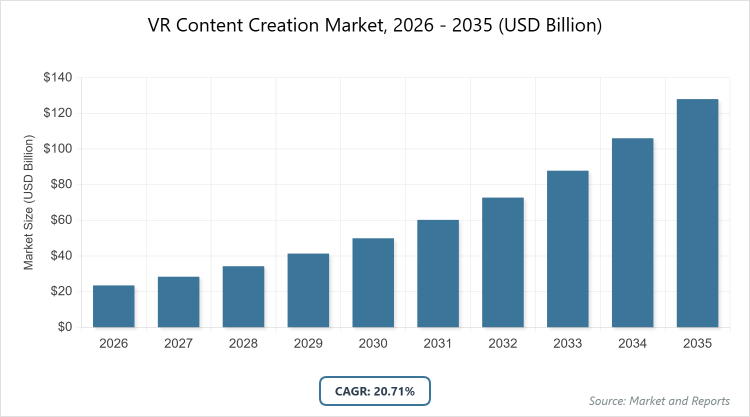
According to MarketnReports, the global VR Content Creation Market size was estimated at USD 23.53 billion in 2025 and is expected to reach USD 154.54 billion by 2035, growing at a CAGR of 20.71% from 2026 to 2035. VR Content Creation Market is driven by increasing demand for immersive experiences across industries like gaming, education, and healthcare.What are the Key Insights of the VR Content Creation Market?
- Market value estimated at USD 23.53 billion in 2025, projected to reach USD 154.54 billion by 2035.
- Compound annual growth rate (CAGR) of 20.71% during the forecast period from 2026 to 2035.
- Market is driven by rising adoption of VR technologies in gaming, education, and enterprise training.
- Software subsegment dominates the content type segment with 60% share due to its essential role in enabling efficient content development and editing through user-friendly tools like Unity and Unreal Engine.
- Videos subsegment dominates the application segment with 45% share as they provide accessible immersive storytelling, widely used in marketing and entertainment for their ease of production and broad appeal.
- Gaming subsegment dominates the end-user segment with 40% share owing to high consumer demand for interactive experiences and significant investments from major studios.
- North America dominates with 40% market share because of its advanced technological infrastructure, presence of key players like Meta and Unity, and high adoption rates in entertainment and tech sectors.
What is the VR Content Creation Market Industry Overview?
The VR Content Creation Market encompasses the development, production, and distribution of digital content specifically designed for virtual reality platforms, including immersive videos, interactive simulations, games, and 360-degree experiences that leverage VR hardware and software to create engaging, lifelike environments. This market involves tools, services, and technologies that enable creators to build high-quality VR content, catering to diverse applications from entertainment to professional training. Market definition refers to the ecosystem of software, hardware, and services used to generate VR-compatible media, driven by advancements in graphics rendering, AI integration, and accessible creation tools that democratize content production for both professionals and amateurs.
What are the Market Dynamics of the VR Content Creation Market?
Growth Drivers
The growth drivers of the VR Content Creation Market are primarily fueled by the rapid proliferation of affordable VR headsets and devices, which has expanded consumer access and spurred demand for diverse content. Advancements in real-time rendering technologies, such as those from NVIDIA and Unity, have simplified the creation process, allowing more creators to produce high-fidelity experiences without extensive resources. Additionally, the integration of AI tools for automated asset generation and personalization has accelerated production timelines, making VR content more viable for industries like education and healthcare, where immersive training simulations enhance learning outcomes and reduce costs.
Restraints
Restraints in the VR Content Creation Market include the high initial costs associated with specialized hardware and software, which can deter small-scale creators and startups from entering the space. Technical challenges, such as ensuring compatibility across various VR platforms and managing motion sickness in users, complicate content development and limit widespread adoption. Furthermore, the lack of standardized formats and the steep learning curve for advanced tools restrict market expansion, particularly in emerging regions where infrastructure and skilled talent are underdeveloped.
Opportunities
Opportunities in the VR Content Creation Market arise from the expanding metaverse ecosystem, where platforms like those from Meta offer new avenues for user-generated content and virtual economies. The growing application in remote collaboration and virtual events, accelerated by post-pandemic shifts, opens doors for enterprise solutions in training and marketing. Moreover, partnerships between tech giants and content studios can foster innovation, such as AI-enhanced creation tools, enabling scalable production for sectors like real estate and tourism, where virtual tours provide cost-effective alternatives to physical experiences.
Challenges
Challenges facing the VR Content Creation Market involve data privacy and security concerns, as immersive content often collects sensitive user information through tracking and biometrics, leading to regulatory hurdles like GDPR compliance. Content piracy and intellectual property issues are prevalent due to the digital nature of VR assets, complicating monetization strategies. Additionally, the need for high-bandwidth infrastructure to deliver seamless experiences poses barriers in regions with limited internet access, hindering global market penetration.
VR Content Creation Market: Report Scope
| Report Attributes | Report Details |
| Report Name | VR Content Creation Market |
| Market Size 2025 | USD 23.53 Billion |
| Market Forecast 2035 | USD 154.54 Billion |
| Growth Rate | CAGR of 20.71% |
| Report Pages | 220 |
| Key Companies Covered |
Meta Platforms Inc., Unity Technologies Inc., Epic Games Inc., Adobe Inc., NVIDIA Corporation, Autodesk Inc., Google LLC, Microsoft Corporation, Sony Interactive Entertainment Inc., and Others. |
| Segments Covered | By Content Type, By Application, By End User, and By Region. |
| Regions Covered | North America, Europe, Asia Pacific (APAC), Latin America, and The Middle East and Africa (MEA) |
| Base Year | 2025 |
| Historical Year | 2020 - 2024 |
| Forecast Year | 2026 - 2035 |
| Customization Scope | Avail customized purchase options to meet your exact research needs. |
What is the Market Segmentation of the VR Content Creation Market?
The VR Content Creation Market is segmented by content type, application, end-user, and region.By Content Type Segment, software emerges as the most dominant subsegment, holding approximately 60% share, followed by services at 25%. Software dominates due to its foundational role in providing platforms like Unity and Unreal Engine that streamline 3D modeling, animation, and rendering, driving the market by enabling rapid prototyping and cost-effective iteration, which accelerates content delivery across applications.
By Application Segment, videos lead as the most dominant subsegment with 45% share, while games rank second at 30%. Videos dominate because of their versatility in creating engaging narratives for marketing and education, propelling market growth through easy integration with social platforms and lower production barriers compared to complex interactive formats.
By End-User Segment, gaming stands out as the most dominant subsegment, capturing 40% share, with enterprises as the second at 20%. Gaming dominates owing to strong consumer demand for immersive escapism and e-sports integration, fueling market expansion by attracting investments and fostering ecosystem growth through hardware-software synergies.
What are the Recent Developments in the VR Content Creation Market?
- In 2025, Meta Platforms Inc. announced the launch of Horizon Worlds 2.0, an upgraded platform enhancing user-generated VR content tools with AI-assisted design features, aiming to boost creator participation and expand its metaverse ecosystem.
- Unity Technologies Inc. acquired a leading AI startup in mid-2025 to integrate advanced procedural generation capabilities into its engine, reducing content creation time by up to 50% and targeting enterprise clients in training simulations.
- Epic Games Inc. partnered with NVIDIA in late 2025 to optimize Unreal Engine 5 for real-time ray tracing in VR, enabling photorealistic content for gaming and film industries, which is expected to drive adoption among high-end developers.
What is the Regional Analysis of the VR Content Creation Market?
North America to dominate the global market.North America holds the dominant position in the VR Content Creation Market, accounting for about 40% share, with the United States as the leading country due to its concentration of tech innovators like Meta and Unity, supported by robust R&D investments and high consumer adoption in gaming and entertainment sectors.
Asia Pacific is experiencing the fastest growth, driven by increasing smartphone penetration and VR hardware manufacturing in countries like China and South Korea, where companies such as HTC lead in affordable devices, fostering content creation for education and e-commerce applications.
Europe maintains a strong presence, with Germany and the UK as key contributors, emphasizing VR in industrial training and automotive design, bolstered by government initiatives for digital innovation and collaborations between startups and established firms like Sony.
Latin America shows emerging potential, led by Brazil and Mexico, where rising internet access and mobile VR adoption are spurring content for tourism and real estate, though limited infrastructure challenges broader expansion.
The Middle East and Africa region is nascent but growing, with the UAE dominating through investments in smart cities and entertainment hubs like Dubai's VR parks, leveraging oil wealth for tech diversification into immersive media and education.
Who are the Key Market Players and Strategies in the VR Content Creation Market?
Meta Platforms Inc. focuses on building an integrated metaverse platform with tools like Spark AR and Horizon Workrooms, emphasizing user-generated content and partnerships with developers to expand its ecosystem and drive adoption through hardware subsidies.
Unity Technologies Inc. prioritizes cross-platform compatibility and AI enhancements in its engine, investing in acquisitions and developer education programs to capture market share in gaming and enterprise sectors by simplifying complex VR workflows.
Epic Games Inc. leverages Unreal Engine's high-fidelity graphics for premium content, employing a revenue-sharing model via its store and collaborating with film studios to bridge gaming and Hollywood, aiming for leadership in interactive storytelling.
Adobe Inc. integrates VR capabilities into its Creative Cloud suite, such as Substance 3D, targeting professional creators with subscription-based tools and focusing on seamless workflows for animation and design to penetrate media and advertising markets.
NVIDIA Corporation emphasizes GPU-accelerated rendering through Omniverse, partnering with software firms to optimize real-time collaboration, and investing in AI research to reduce creation barriers, positioning itself as a hardware enabler for high-end VR production.
Autodesk Inc. specializes in 3D modeling tools like Maya and 3ds Max for VR, adopting cloud-based strategies and industry-specific solutions for architecture and engineering to foster loyalty among professional users.
Google LLC develops AR/VR tools via Daydream and Tilt Brush, focusing on open-source initiatives and integration with Android ecosystems to democratize content creation for mobile users.
Microsoft Corporation advances mixed reality with HoloLens and Azure integration, targeting enterprise training through strategic alliances and emphasizing secure, scalable cloud services for collaborative VR development.
Sony Interactive Entertainment Inc. invests in PlayStation VR exclusives and content studios, using its gaming heritage to drive hardware-software synergy and expand into non-gaming applications like virtual concerts.
What are the Market Trends in the VR Content Creation Market?
- Integration of AI for automated asset creation and personalization, reducing production time and costs.
- Rise of cloud-based platforms enabling collaborative real-time editing across global teams.
- Growing emphasis on user-generated content through accessible tools and metaverse ecosystems.
- Expansion into non-entertainment sectors like healthcare simulations and virtual real estate tours.
- Adoption of 5G for seamless streaming of high-resolution VR experiences.
- Focus on sustainability with energy-efficient rendering technologies.
- Increasing cross-platform compatibility to broaden content accessibility.
What Market Segments and their Subsegments are Covered in the VR Content Creation Market Report?
By Content Type
- Videos
- 360 Degree Photos
- Games
- Interactive Experiences
- Simulations
- Training Modules
- Virtual Tours
- 3D Models
- Animations
- User-Generated Content
- Others
By Application
- Gaming
- Entertainment
- Education
- Healthcare
- Training
- Real Estate
- Automotive
- Retail
- Engineering
- Military
- Others
By End User
- Consumers
- Enterprises
- Media Companies
- Educational Institutions
- Healthcare Providers
- Gaming Studios
- Automotive Manufacturers
- Retailers
- Real Estate Agencies
- Government
- Others
By Region
- North America
- U.S.
- Canada
- Europe
- UK
- Germany
- France
- Rest of Europe
- Asia Pacific
- China
- India
- Japan
- Rest of Asia Pacific
- Latin America
- Brazil
- Mexico
- Rest of Latin America
- Middle East & Africa
- UAE
- South Africa
- Rest of Middle East & Africa
Frequently Asked Questions
The VR Content Creation Market involves the tools, software, services, and processes used to develop immersive digital content for virtual reality platforms, including games, videos, and simulations across various industries.
Key factors include technological advancements in VR hardware, rising demand for immersive experiences in gaming and education, AI integration for efficient production, and expanding applications in healthcare and enterprise training.
The market is projected to grow from approximately USD 23.53 billion in 2026 to USD 154.54 billion by 2035.
The CAGR is expected to be 20.71% from 2026 to 2035.
North America will contribute notably, holding around 40% of the market value due to its technological leadership and high adoption rates.
Major players include Meta Platforms Inc., Unity Technologies Inc., Epic Games Inc., Adobe Inc., NVIDIA Corporation, Autodesk Inc., Google LLC, Microsoft Corporation, and Sony Interactive Entertainment Inc.
The report provides comprehensive analysis including market size, trends, segmentation, key players, regional insights, and forecasts from 2026 to 2035.
Stages include content ideation and planning, asset creation and modeling, rendering and integration, testing and optimization, distribution and monetization, and user feedback incorporation.
Trends are shifting towards AI-driven personalization and cloud collaboration, while consumers prefer interactive, high-fidelity experiences in gaming and education, with growing interest in sustainable and accessible content.
Factors include data privacy regulations like GDPR impacting user tracking, environmental concerns over energy-intensive rendering, and accessibility standards requiring inclusive design for broader adoption.