
MEMS Gas Sensor Market Size, Share and Trends 2026 to 2035
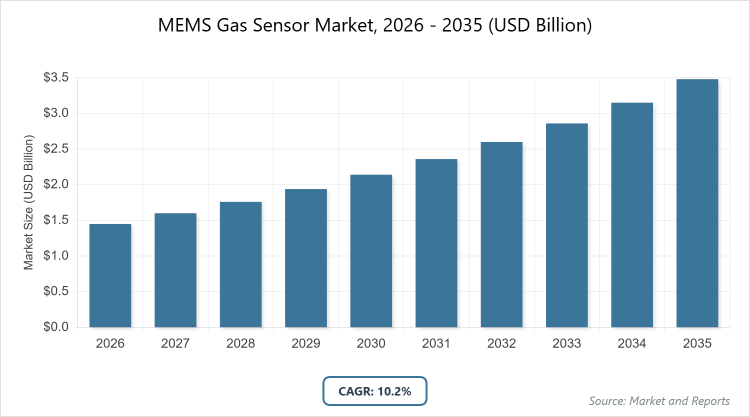
According to MarketnReports, the global MEMS Gas Sensor Market size was estimated at USD 1.45 billion in 2025 and is expected to reach USD 3.9 billion by 2035, growing at a CAGR of 10.2% from 2026 to 2035. MEMS Gas Sensor Market is driven by increasing demand for air quality monitoring and industrial safety.What are the Key Insights of the MEMS Gas Sensor Market?
- The global MEMS gas sensor market was valued at USD 1.45 billion in 2025 and is projected to reach USD 3.9 billion by 2035.
- The market is anticipated to grow at a CAGR of 10.2% during the forecast period from 2026 to 2035.
- The market is driven by rising air pollution concerns, stringent environmental regulations, and advancements in IoT integration.
- In type, chemical gas sensors dominate with a 50% share due to their high sensitivity in detecting toxic and combustible gases, enabling widespread use in safety-critical applications.
- In application, industrial dominates with a 35% share because of the need for hazardous gas detection in manufacturing and processing environments, enhancing worker safety and compliance.
- In end-user, automotive dominates with a 30% share owing to emissions monitoring and cabin air quality requirements in vehicles.
- Asia Pacific dominates the regional market with a 35% share, attributed to rapid industrialization, urbanization, and investments in smart cities in China and India.
What is the Industry Overview of the MEMS Gas Sensor Market?
The MEMS gas sensor market encompasses microelectromechanical systems designed to detect and measure various gases through miniaturized sensors that integrate mechanical and electrical components on a single chip, offering high sensitivity, low power consumption, and compact size. This market serves applications requiring real-time gas monitoring for safety, environmental, and health purposes, leveraging technologies like electrochemical and semiconductor methods to identify toxic, inflammable, or pollutant gases. Market definition includes sensors used in industrial safety, air quality assessment, automotive emissions control, and healthcare diagnostics, emphasizing integration with IoT for smart monitoring while addressing needs for accuracy, durability, and cost-efficiency in diverse environments.
What are the Market Dynamics of the MEMS Gas Sensor Market?
Growth Drivers
The growth drivers in the MEMS gas sensor market are fueled by escalating global concerns over air quality and environmental pollution, prompting governments to enforce stringent regulations on emissions and workplace safety, which in turn boosts demand for reliable detection technologies. Advancements in sensor miniaturization and integration with IoT platforms enable real-time monitoring and data analytics, enhancing applications in smart cities and industrial automation. Rising adoption in automotive sectors for exhaust gas analysis and in healthcare for breath diagnostics further accelerates market expansion, supported by technological innovations in materials like nanomaterials that improve sensitivity and selectivity. Additionally, increasing investments in R&D by key players and the proliferation of consumer electronics with built-in air quality features drive widespread accessibility and adoption across diverse industries.
Restraints
Restraints in the MEMS gas sensor market include high development and manufacturing costs associated with advanced technologies and specialized materials, which limit affordability for small-scale applications and emerging markets. Technical challenges such as sensor drift, cross-sensitivity to multiple gases, and limited lifespan in harsh environments reduce reliability and require frequent calibration, deterring adoption in critical sectors. Regulatory hurdles and varying standards across regions complicate product certification and global distribution. Moreover, competition from alternative sensing technologies like optical sensors, which may offer superior performance in specific scenarios, poses barriers to market penetration.
Opportunities
Opportunities in the MEMS gas sensor market arise from the integration of AI and machine learning for enhanced data interpretation and predictive maintenance, opening avenues in smart healthcare and environmental monitoring systems. Expanding applications in wearable devices for personal air quality tracking and in electric vehicles for battery safety monitoring present new growth prospects amid the shift to sustainable mobility. Emerging economies offer untapped potential through infrastructure development and pollution control initiatives, while collaborations between sensor manufacturers and tech firms can foster innovative hybrid solutions. Government grants for green technologies and the focus on carbon neutrality further encourage R&D in low-power, high-accuracy sensors.
Challenges
Challenges in the MEMS gas sensor market involve ensuring high selectivity and stability in complex gas mixtures, requiring ongoing advancements in sensor design to minimize false positives and improve accuracy. Supply chain disruptions for rare materials and components can affect production timelines and costs, while the need for skilled labor in fabrication adds operational hurdles. Data privacy concerns in IoT-connected sensors and ethical issues in AI-driven diagnostics necessitate robust security measures. Finally, balancing energy efficiency with performance in battery-powered applications remains a key challenge as the market scales to meet diverse demands.
MEMS Gas Sensor Market: Report Scope
| Report Attributes | Report Details |
| Report Name | MEMS Gas Sensor Market |
| Market Size 2025 | USD 1.45 Billion |
| Market Forecast 2035 | USD 3.9 Billion |
| Growth Rate | CAGR of 10.2% |
| Report Pages | 220 |
| Key Companies Covered |
Bosch Sensortec GmbH, STMicroelectronics, Honeywell International Inc., Amphenol Advanced Sensors, Sensirion AG, Figaro Engineering Inc., and Others |
| Segments Covered | By Type, By Application, By End-User, and By Region |
| Regions Covered | North America, Europe, Asia Pacific (APAC), Latin America, and The Middle East and Africa (MEA) |
| Base Year | 2025 |
| Historical Year | 2020 - 2024 |
| Forecast Year | 2026 - 2035 |
| Customization Scope | Avail customized purchase options to meet your exact research needs. |
What is the Market Segmentation of the MEMS Gas Sensor Market?
The MEMS Gas Sensor Market is segmented by type123, application123, end-user123, and region.By Type123 Segment, chemical gas sensors emerge as the most dominant subsegment, holding approximately 50% market share, followed by physical gas sensors as the second most dominant with around 30%. Chemical gas sensors dominate due to their superior sensitivity and specificity in detecting a wide range of toxic and combustible gases through chemical reactions, which is crucial for safety in industrial and environmental applications; this subsegment drives the market by enabling cost-effective, real-time monitoring solutions that comply with regulatory standards and integrate easily with IoT systems, boosting adoption in high-growth sectors like automotive and healthcare. Physical gas sensors, the second dominant, excel in durability and non-contact detection methods like infrared, propelling market growth by supporting applications in harsh environments where reliability is paramount.
By Application123 Segment, industrial stands out as the most dominant subsegment with a 35% share, while environmental monitoring follows as the second most dominant at about 25%. Industrial's dominance stems from the critical need for hazardous gas detection to ensure worker safety and process efficiency in manufacturing and mining, driving the market by facilitating compliance with occupational health standards and reducing downtime through predictive alerts; this helps propel growth by integrating with automation systems for smarter factories. Environmental monitoring, as the second dominant, addresses air pollution and climate concerns, advancing the market through deployment in smart cities and regulatory enforcement tools.
By End-User123 Segment, automotive is the most dominant subsegment, capturing 30% of the market, with healthcare as the second most dominant at 20%. Automotive leads due to stringent emission regulations and the need for in-vehicle air quality control, which drives the market by enhancing vehicle safety and efficiency in electric and autonomous models; this dominance supports growth by encouraging R&D in compact sensors for integration with advanced driver-assistance systems. Healthcare, the second dominant, utilizes sensors for diagnostic breath analysis and patient monitoring, aiding market expansion by enabling non-invasive, portable devices for remote care.
What are the Recent Developments in the MEMS Gas Sensor Market?
- In 2025, Bosch Sensortec launched the BME688, the first AI-based MEMS sensor combining gas, humidity, temperature, and pressure measurements, targeting air quality monitoring and scent detection applications.
- In September 2025, a comprehensive review on rational design and fabrication of MEMS gas sensors with long-term stability was published, highlighting advancements in materials and structures to improve performance in diverse environments.
- In December 2025, Interlink Electronics acquired SPEC Sensors and KWJ Engineering for $2 million, expanding its portfolio in gas sensing technologies for industrial and environmental applications.
What is the Regional Analysis of the MEMS Gas Sensor Market?
Asia Pacific to dominate the global market.Asia Pacific leads the MEMS gas sensor market with a 35% share, driven by rapid industrialization and urbanization that heighten demand for air quality and safety monitoring. China dominates the region, contributing significantly through massive manufacturing bases and government initiatives like air pollution control plans that promote sensor adoption in factories and cities; this dominance is bolstered by low-cost production and investments in smart infrastructure, fostering innovation in IoT-integrated sensors for export and domestic use. India supports through growing automotive and healthcare sectors, enhancing regional growth.
North America exhibits strong performance in the MEMS gas sensor market, supported by advanced technological ecosystems and regulatory frameworks for environmental protection. The United States dominates, leveraging R&D from companies like Honeywell to develop high-precision sensors for industrial and healthcare applications; this leadership drives expansion through federal funding for clean air initiatives and collaborations with tech firms for AI-enhanced monitoring. Canada contributes through resource extraction industries requiring robust safety sensors.
Europe is a key player in the MEMS gas sensor market, emphasized by stringent EU emission standards and sustainability goals. Germany dominates, home to Bosch Sensortec advancing automotive and environmental sensors; this supremacy stems from strong engineering heritage and policies promoting green technologies, driving growth in emission control and building automation. The UK and France add through healthcare innovations.
Latin America shows emerging potential in the MEMS gas sensor market, benefiting from industrial growth and environmental awareness. Brazil dominates, utilizing sensors in oil & gas and manufacturing for safety compliance; this position is strengthened by partnerships for local production, driving development amid urbanization. Mexico supports through automotive exports.
The Middle East and Africa region is progressively advancing in the MEMS gas sensor market, focused on oil & gas applications. The UAE emerges as the dominating country, with investments in smart cities and environmental monitoring; this leadership is driven by diversification efforts away from oil, promoting sensor use in infrastructure. South Africa contributes through mining safety needs.
Who are the Key Market Players and Strategies in the MEMS Gas Sensor Market?
Bosch Sensortec GmbH focuses on innovation in AI-integrated sensors, expanding through launches like BME688 to capture air quality and industrial markets.
STMicroelectronics emphasizes miniaturization and IoT compatibility, partnering with manufacturers for automotive and consumer electronics applications.
Honeywell International Inc. pursues reliability in harsh environments, investing in electrochemical technologies for industrial safety and emissions control.
Amphenol Advanced Sensors adopts acquisitions to broaden portfolios, targeting healthcare and environmental monitoring with high-sensitivity solutions.
Sensirion AG prioritizes precision and low-power designs, collaborating for wearable and smart home integrations.
Figaro Engineering Inc. strategies include cost-effective semiconductor sensors, focusing on Asia Pacific expansion for air quality devices.
What are the Market Trends in the MEMS Gas Sensor Market?
- Integration with IoT and AI for real-time multi-gas detection and predictive analytics.
- Miniaturization for wearable and portable applications in healthcare and consumer electronics.
- Shift towards sustainable materials and low-power consumption amid environmental regulations.
- Rise in hybrid technologies combining electrochemical and optical methods for improved selectivity.
- Expansion of wireless connectivity for remote monitoring in smart cities and industries.
- Focus on biological sensors for non-invasive disease diagnostics via breath analysis.
- Growth in automotive applications for EV battery safety and cabin air quality.
- Emphasis on long-term stability and calibration-free designs through advanced fabrication.
What Market Segments and their Subsegments are Covered in the Report for the MEMS Gas Sensor Market?
By Type- Chemical Gas Sensors
- Physical Gas Sensors
- Biological Gas Sensors
- Electrochemical
- Infrared
- Semiconductor
- Catalytic
- Photoionization Detectors
- Solid-State
- Optical
- Others
- Industrial
- Environmental Monitoring
- Automotive
- Healthcare
- Consumer Electronics
- Air Quality Monitoring
- Emission Control
- Research Application
- Storage Monitoring
- Oil & Gas
- Others
- Automotive
- Healthcare
- Water & Wastewater Treatment
- Metal Industry
- Building Automation
- Food & Beverage
- Mining Industry
- Power Stations
- Oil & Gas
- Consumer Electronics
- Others
By Region
- North America
- U.S.
- Canada
- Europe
- UK
- Germany
- France
- Rest of Europe
- Asia Pacific
- China
- India
- Japan
- Rest of Asia Pacific
- Latin America
- Brazil
- Mexico
- Rest of Latin America
- Middle East & Africa
- UAE
- South Africa
- Rest of Middle East & Africa
Frequently Asked Questions
The MEMS gas sensor market involves miniaturized sensors for detecting gases in industrial, environmental, and healthcare applications, offering high sensitivity and integration capabilities.
Key factors include regulatory compliance, IoT integration, air quality awareness, and technological advancements in sensor materials.
The market is projected to grow from post-2025 values USD 1.45 billion in 2025 and is expected to reach USD 3.9 billion by 2035.
The CAGR is expected to be 10.2% during 2026-2035.
Asia Pacific will contribute notably, driven by industrialization and smart city initiatives.
Major players include Bosch Sensortec GmbH, STMicroelectronics, Honeywell International Inc., Amphenol Advanced Sensors, Sensirion AG, and Figaro Engineering Inc.
The report provides in-depth analysis of size, trends, segments, regions, players, and forecasts.
Stages include raw material sourcing, fabrication, assembly, testing, distribution, and end-use integration.
Trends favor IoT-enabled and miniaturized sensors, with preferences shifting towards sustainable and wireless solutions.
Stringent emission standards and air quality regulations drive adoption, while sustainability focuses enhance eco-friendly sensor development.