
Microbiome Therapeutics Market Size, Share and Trends 2026 to 2035
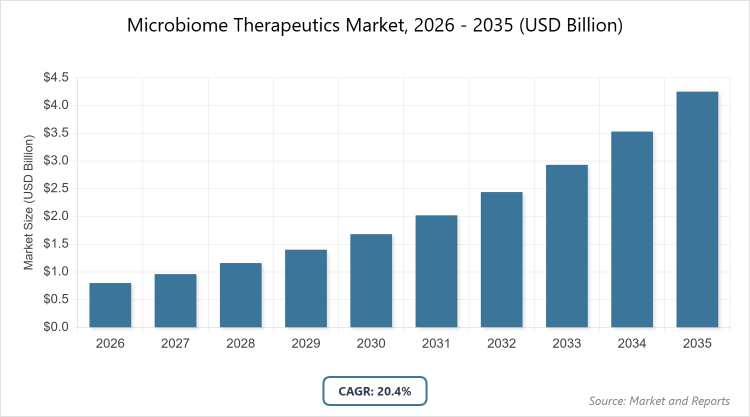
According to MarketnReports, the global Microbiome Therapeutics market size was estimated at USD 0.8 billion in 2025 and is expected to reach USD 6.1 billion by 2035, growing at a CAGR of 20.4% from 2026 to 2035. Microbiome Therapeutics Market is driven by rising prevalence of chronic diseases and advancements in personalized medicine.
What is the Overview of Microbiome Therapeutics Market?
The microbiome therapeutics market involves the development and commercialization of treatments that modulate the human microbiome—the trillions of microorganisms residing in the body—to restore balance and address various health conditions. This market encompasses innovative approaches like fecal microbiota transplantation (FMT), live biotherapeutic products (LBPs), and microbiome-targeted drugs, leveraging biotechnology to target dysbiosis linked to diseases.
Market definition pertains to the sector focused on therapeutic interventions that manipulate microbial communities in the gut, skin, or other sites to prevent, manage, or cure ailments, driven by growing understanding of the microbiome’s role in immunity, metabolism, and overall health. It bridges pharmaceuticals, biotechnology, and nutrition, offering potential for personalized therapies that go beyond traditional drugs by harnessing natural microbial ecosystems for improved patient outcomes.
What are the Key Insights into Microbiome Therapeutics Market?
- The global microbiome therapeutics market was valued at USD 0.8 billion in 2025 and is projected to reach USD 6.1 billion by 2035.
- The market is expected to grow at a CAGR of 20.4% during the forecast period from 2026 to 2035.
- The market is driven by increasing investments in R&D for microbiome-based treatments targeting chronic and infectious diseases.
- In the product type segment, FMT dominates with a 35% share.
- This dominance is due to its proven efficacy in treating recurrent C. difficile infections, supported by regulatory approvals, which drives market growth by establishing a foundation for broader microbiome applications and encouraging further clinical validations.
- In the application segment, gastrointestinal disorders dominate with a 45% share.
- This is attributed to the direct link between gut microbiome dysbiosis and conditions like IBD and IBS, fueling market expansion through targeted therapies that offer non-invasive alternatives to conventional treatments.
- In the end-user segment, hospitals dominate with a 40% share.
- This stems from the need for supervised administration of advanced therapies like FMT, propelling the market by integrating microbiome solutions into clinical protocols and enhancing treatment accessibility.
- North America dominates the global market with a 42% share.
- This is owing to robust R&D infrastructure, favorable regulatory environment from the FDA, and high venture capital investments in biotech firms.
What are the Market Dynamics in Microbiome Therapeutics?
Growth Drivers
Growth drivers in the microbiome therapeutics market are anchored in the escalating global burden of chronic diseases such as obesity, diabetes, and inflammatory bowel disease, where microbiome dysbiosis plays a pivotal role, prompting demand for innovative, targeted therapies. Advancements in next-generation sequencing and bioinformatics have accelerated the identification of beneficial microbes, enabling the development of precise LBPs and FMT procedures that offer superior efficacy over traditional antibiotics. Increasing collaborations between pharmaceutical giants and biotech startups, coupled with substantial funding from venture capitalists and government grants, are fostering rapid pipeline progression. Moreover, heightened awareness of the gut-brain axis and microbiome’s influence on mental health is expanding therapeutic indications, driving market growth through diversified applications and personalized medicine approaches.
Restraints
Restraints in the microbiome therapeutics market include stringent regulatory hurdles, as agencies like the FDA classify microbiome products as biologics requiring extensive clinical evidence, leading to prolonged approval timelines and high failure rates in trials. The complexity of microbiome composition varies greatly among individuals, complicating standardization and reproducibility of therapies, which can result in inconsistent outcomes and deter investor confidence.
High development costs for advanced manufacturing processes, such as anaerobic culturing and encapsulation technologies, pose barriers for smaller companies. Additionally, limited public understanding and skepticism toward microbial-based treatments compared to conventional pharmaceuticals hinder market adoption in conservative healthcare systems.
Opportunities
Opportunities in the microbiome therapeutics market emerge from the untapped potential in emerging economies, where rising healthcare expenditures and increasing disease prevalence create demand for affordable, microbiome-based solutions tailored to local microbial profiles. The integration of AI and machine learning in microbiome analysis offers prospects for predictive modeling and customized therapies, enhancing treatment precision and opening new revenue streams. Expanding applications beyond gastroenterology, such as in oncology for modulating immune responses or in neurology for conditions like Parkinson’s, present avenues for portfolio diversification. Strategic partnerships with probiotic manufacturers and diagnostic firms can streamline supply chains and accelerate market entry for novel therapeutics.
Challenges
Challenges in the microbiome therapeutics market revolve around the intricate nature of clinical trials, where establishing causality between microbiome alterations and therapeutic effects requires large, diverse cohorts and long-term follow-ups, often leading to data variability and trial delays. Intellectual property issues arise from the natural origin of microbes, making patenting difficult and inviting competition from generic equivalents. Supply chain vulnerabilities, including sourcing ethical donor materials for FMT and maintaining microbial viability during storage and transport, add operational complexities. Furthermore, ethical concerns over genetic manipulation of microbes and potential long-term ecological impacts on human microbiomes necessitate rigorous safety assessments, slowing innovation pace.
Microbiome Therapeutics Market: Report Scope
| Report Attributes | Report Details |
| Report Name | Microbiome Therapeutics Market |
| Market Size 2025 | USD 0.8 Billion |
| Market Forecast 2035 | USD 6.1 Billion |
| Growth Rate | CAGR of 20.4% |
| Report Pages | 220 |
| Key Companies Covered |
Seres Therapeutics, Ferring Pharmaceuticals, Vedanta Biosciences, Finch Therapeutics, Enterome, and Others |
| Segments Covered | By Product Type, By Application, By End-User, and By Region |
| Regions Covered | North America, Europe, Asia Pacific (APAC), Latin America, and The Middle East and Africa (MEA) |
| Base Year | 2025 |
| Historical Year | 2020 – 2024 |
| Forecast Year | 2026 – 2035 |
| Customization Scope | Avail customized purchase options to meet your exact research needs. |
The Microbiome Therapeutics market is segmented by product type, application, end-user, and region.
Based on Product Type Segment, the most dominant subsegment is FMT, while the second most dominant is LBPs. FMT leads due to its established clinical success in recurrent infections and regulatory backing, which drives market growth by providing a benchmark for efficacy and encouraging investments in scalable production methods; LBPs rank second as they offer engineered microbial consortia for broader indications, contributing to expansion through innovation in targeted delivery and reduced side effects compared to broad-spectrum antibiotics.
Based on Application Segment, the most dominant subsegment is gastrointestinal disorders, while the second most dominant is infectious diseases. Gastrointestinal disorders dominate owing to the microbiome’s central role in gut health and high prevalence of conditions like Crohn’s disease, propelling market growth via specialized therapies that restore microbial balance and improve patient quality of life; infectious diseases follow as the second dominant, driven by antibiotic resistance issues, boosting the market through microbiome restoration approaches that prevent recurrences and support global health initiatives.
Based on End-User Segment, the most dominant subsegment is hospitals, while the second most dominant is research institutes. Hospitals lead because they handle complex procedures requiring medical oversight, fueling market growth by integrating microbiome therapies into standard care protocols and facilitating large-scale adoption; research institutes rank second as they drive innovation through trials and collaborations, advancing the market by generating evidence-based data that accelerates regulatory approvals and commercial viability.
What are Recent Developments in Microbiome Therapeutics?
- In 2025, Seres Therapeutics announced positive Phase 3 trial results for SER-287, a microbiome therapeutic targeting ulcerative colitis, marking a significant step toward expanding indications beyond C. difficile and attracting further investments.
- In late 2024, Ferring Pharmaceuticals acquired a European biotech firm specializing in microbiome engineering, enhancing its Rebiotix portfolio with novel encapsulation technologies for improved LBP delivery.
- In 2025, Vedanta Biosciences secured a major partnership with a global pharma company to co-develop microbiome-based immunotherapies for oncology, leveraging AI-driven microbial selection to accelerate clinical advancements.
- In 2024, Finch Therapeutics initiated a multi-center trial for its oral microbiome drug aimed at autism spectrum disorders, highlighting the expanding scope of microbiome applications in neurology.
What is the Regional Analysis for Microbiome Therapeutics Market?
- North America to dominate the global market.
North America commands a leading position in the microbiome therapeutics market, bolstered by cutting-edge research facilities, substantial venture funding, and a supportive regulatory framework from the FDA that has approved pioneering products like SER-109. The region’s growth is propelled by high disease burdens in areas like obesity and IBD, alongside collaborations between academia and industry. The United States dominates within North America, driven by its concentration of biotech hubs in Boston and San Francisco, home to key players like Seres Therapeutics, which benefit from NIH grants and a mature clinical trial ecosystem; Canada contributes through innovative startups and cross-border partnerships, while Mexico leverages growing pharmaceutical manufacturing capabilities, though challenges include uneven healthcare access.
Europe holds a strong share in the microbiome therapeutics market, characterized by rigorous EMA regulations that ensure high safety standards, fostering trust in microbiome products. The region’s emphasis on personalized medicine and sustainability drives adoption, with significant public-private investments in microbiome research consortia. Germany emerges as the dominating country, supported by its robust biotech sector and institutions like the Max Planck Institute, enabling advancements in prebiotic and synbiotic therapies; the UK and France follow with strong clinical networks and funding from Horizon Europe programs, while Eastern Europe offers cost-effective manufacturing opportunities, despite restraints from varying regulatory harmonization.
Asia Pacific is witnessing rapid expansion in the microbiome therapeutics market, fueled by increasing healthcare investments, a large patient pool, and government initiatives in biotechnology. Urbanization and dietary shifts contributing to microbiome-related diseases accelerate demand for localized therapies. China dominates the region, propelled by its massive R&D spending, state-backed bio-parks, and companies like BGI focusing on microbiome sequencing for drug development; India contributes through affordable generics and growing clinical trials, Japan emphasizes precision medicine with firms like Yakult, but challenges persist in intellectual property protection and infrastructure in rural areas.
Latin America presents emerging growth in the microbiome therapeutics market, driven by rising awareness of gut health and collaborations with international firms for technology transfer. The region’s biodiversity offers unique microbial strains for therapeutic discovery, supported by improving regulatory environments. Brazil leads as the dominating country, with its vibrant pharma industry and institutions like Fiocruz advancing FMT research for tropical diseases; Mexico benefits from NAFTA ties for exports, Argentina focuses on probiotic integrations, though growth is hampered by economic instability and limited funding.
The Middle East and Africa (MEA) region is nascent in the microbiome therapeutics market, with potential driven by tourism-related healthcare and investments in biotech hubs. Challenges like arid climates affecting microbial studies are offset by international partnerships. South Africa dominates within MEA, bolstered by its advanced medical research at universities like Cape Town and focus on infectious disease therapies amid high HIV prevalence; the UAE invests in high-tech facilities for personalized medicine, Saudi Arabia through Vision 2030 initiatives, but the region faces restraints from import dependencies and geopolitical issues.
Who are the Key Market Players in Microbiome Therapeutics?
Seres Therapeutics pursues strategies centered on advancing its LBP pipeline through clinical trials and FDA collaborations, focusing on recurrent infections and inflammatory diseases to solidify its leadership in microbiome restoration therapies.
Ferring Pharmaceuticals employs acquisition-driven growth, integrating Rebiotix’s technologies to expand FMT offerings, while investing in global manufacturing to ensure supply chain resilience and market penetration in Europe and North America.
Vedanta Biosciences leverages AI and high-throughput screening for microbial consortia development, forming strategic alliances with pharma giants to accelerate oncology and autoimmune applications, enhancing its competitive positioning.
Finch Therapeutics focuses on oral microbiome delivery innovations and neurology expansions, securing grants for autism trials to diversify beyond GI indications and capture niche markets.
Enterome adopts a biomarker-driven approach, developing diagnostics alongside therapeutics for IBD and cancer, partnering with research institutes to validate precision medicine strategies.
MaaT Pharma emphasizes oncology supportive care through FMT, conducting multi-site trials and seeking EMA approvals to address chemotherapy-induced dysbiosis, building a specialized portfolio.
What are the Market Trends in Microbiome Therapeutics?
- Shift toward personalized microbiome therapies tailored to individual genetic and microbial profiles.
- Integration of AI and machine learning for predictive microbiome modeling and drug discovery.
- Expansion into non-GI indications, such as mental health and oncology immunomodulation.
- Growing emphasis on sustainable sourcing of microbial strains and eco-friendly manufacturing.
- Rise in combination therapies merging microbiome products with traditional pharmaceuticals.
- Increased focus on oral and encapsulated delivery systems for improved patient compliance.
- Surge in diagnostic tools for microbiome profiling to guide therapeutic decisions.
- Adoption of regulatory pathways for faster approvals of LBPs as biologics.
What Market Segments and Subsegments are Covered in the Microbiome Therapeutics Report?
By Product Type
-
- FMT
- LBPs
- Probiotics
- Prebiotics
- Synbiotics
- Postbiotics
- Diagnostic Tests
- Drugs
- Supplements
- Foods
- Others
By Application
-
- Gastrointestinal Disorders
- Metabolic Disorders
- Infectious Diseases
- Immunological Disorders
- Dermatological Disorders
- Neurological Disorders
- Oncological Disorders
- Respiratory Disorders
- Cardiovascular Disorders
- Hepatic Disorders
- Others
By End-User
-
- Hospitals
- Clinics
- Ambulatory Surgical Centers
- Homecare
- Research Institutes
- Pharmaceutical Companies
- Diagnostic Labs
- Academic Institutions
- Retail Pharmacies
- Online Pharmacies
- Others
Chapter 1. Preface
Chapter 2. Executive Summary
Chapter 3. Global Microbiome Therapeutics Market - Industry Analysis
Chapter 4. Global Microbiome Therapeutics Market- Competitive Landscape
Chapter 5. Global Microbiome Therapeutics Market - Product Type Analysis
Chapter 6. Global Microbiome Therapeutics Market - Application Analysis
Chapter 7. Global Microbiome Therapeutics Market - End-User Analysis
Chapter 8. Microbiome Therapeutics Market - Regional Analysis
Chapter 9. Company Profiles
Frequently Asked Questions
Microbiome therapeutics are treatments that modulate the human microbiome to restore microbial balance and address diseases, including FMT, LBPs, and targeted drugs.
Key factors include rising chronic disease prevalence, biotechnology advancements, regulatory approvals, increased R&D investments, and expanding applications in personalized medicine.
The Microbiome Therapeutics market is projected to grow from approximately USD 0.8 billion in 2025 to USD 6.1 billion by 2035.
The Microbiome Therapeutics market is expected to register a CAGR of 20.4% during the forecast period from 2026 to 2035.
North America will contribute notably, holding around 42% of the market share due to advanced R&D and regulatory support.
Major players include Seres Therapeutics, Ferring Pharmaceuticals, Vedanta Biosciences, Finch Therapeutics, Enterome, and MaaT Pharma, driving growth through innovation and clinical advancements.
The report offers in-depth analysis of market size, trends, segmentation, regional dynamics, key players, and forecasts to aid strategic decision-making for stakeholders.
The value chain encompasses research and discovery (microbial identification), development (formulation and trials), manufacturing (culturing and encapsulation), distribution (supply and logistics), and end-use (administration and monitoring).
Trends are evolving toward personalized, AI-enhanced therapies with preferences shifting to non-invasive, natural microbiome modulators for holistic health management.
Regulatory factors include FDA and EMA classifications as biologics requiring rigorous trials, while environmental factors involve sustainable microbial sourcing to minimize ecological disruption and ensure ethical practices.