
Natural Gas Storage Market Size, Share and Trends 2026 to 2035
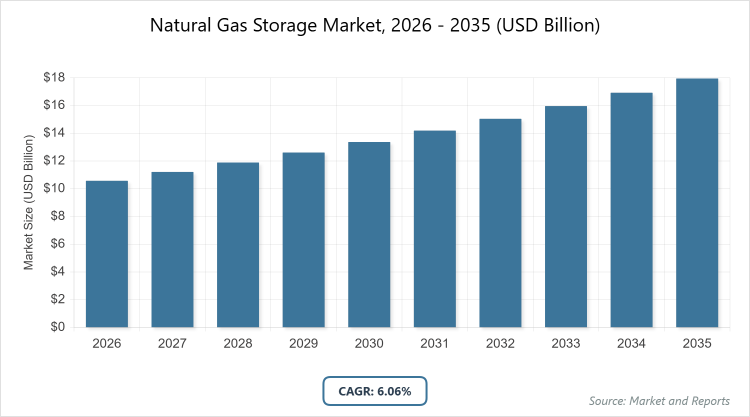
According to MarketnReports, the global Natural Gas Storage market size was estimated at USD 10.57 billion in 2025 and is expected to reach USD 19.03 billion by 2035, growing at a CAGR of 6.06% from 2026 to 2035. Natural Gas Storage Market is driven by increasing demand for energy security and efficient management of seasonal supply fluctuations.
What is the Industry Overview of Natural Gas Storage?
The natural gas storage market involves facilities and technologies used to store natural gas for later use, ensuring supply stability during peak demand periods or supply disruptions, encompassing underground reservoirs, above-ground tanks, and LNG storage solutions. This market supports the energy sector by balancing production and consumption, mitigating price volatility, and enhancing grid reliability. Market definition refers to the infrastructure and services for storing natural gas in various forms, driven by the transition to cleaner energy sources, geopolitical factors, and the need for flexible energy systems.
What are the Key Insights into Natural Gas Storage?
- The global Natural Gas Storage market size was estimated at USD 10.57 billion in 2025 and is expected to reach USD 19.03 billion by 2035.
- The market is expected to grow at a CAGR of 6.06% during the forecast period from 2026 to 2035.
- The market is driven by rising natural gas consumption, energy transition initiatives, and the need for supply-demand balancing.
- In the type segment, depleted reservoirs dominate with a 61% share due to their large capacity and cost-effectiveness for long-term storage.
- In the application segment, seasonal balancing holds the largest share at 58% because it addresses winter heating demands and summer surplus.
- In the end-user segment, utilities dominate with 42% share owing to their role in managing public energy supply and grid stability.
- North America dominates the market with a 40% share, attributed to extensive infrastructure and high production levels in the United States.
What are the Market Dynamics in Natural Gas Storage?
Growth Drivers
Growth drivers in the natural gas storage market include the global shift toward cleaner energy sources, with natural gas serving as a bridge fuel in reducing carbon emissions, coupled with increasing electricity demand from renewables integration requiring flexible storage. Government incentives for infrastructure development, such as subsidies for LNG terminals in Asia-Pacific, and technological advancements in storage efficiency further propel expansion. Geopolitical tensions and supply chain vulnerabilities emphasize the need for strategic reserves, driving investments in diverse storage solutions.
Restraints
Restraints include high capital costs for developing new storage facilities, particularly underground sites requiring geological assessments and regulatory approvals, limiting entry for smaller players. Environmental concerns over potential leaks and seismic risks associated with underground storage pose challenges, alongside fluctuating natural gas prices that affect investment returns. Stringent safety regulations and lengthy permitting processes also hinder rapid market growth.
Opportunities
Opportunities emerge from the expansion of LNG trade and regasification infrastructure in emerging markets, enabling diversified supply sources and storage needs. Integration with hydrogen and renewable gas blending offers innovative applications, while digital technologies like AI for predictive maintenance enhance operational efficiency. Partnerships for cross-border storage projects and carbon capture utilization in depleted reservoirs present sustainable growth avenues.
Challenges
Challenges encompass managing aging infrastructure in mature markets like North America, requiring significant upgrades to prevent capacity losses. Volatility in global energy markets and competition from alternative energies like renewables challenge demand forecasts. Regulatory inconsistencies across regions complicate international investments, while climate change impacts on weather patterns alter traditional seasonal storage patterns.
Natural Gas Storage Market: Report Scope
| Report Attributes | Report Details |
| Report Name | Natural Gas Storage Market |
| Market Size 2025 | USD 10.57 Billion |
| Market Forecast 2035 | USD 19.03 Billion |
| Growth Rate | CAGR of 6.06% |
| Report Pages | 220 |
| Key Companies Covered |
McDermott International, Inc., NAFTA A.S., TransCanada Corp., Royal Vopak N.V., Chart Industries, Uniper, Sempra, Enbridge, Inc., Gazprom, Martin Midstream Partners L.P., and Others |
| Segments Covered | By Type, By Application, By End-User, and By Region |
| Regions Covered | North America, Europe, Asia Pacific (APAC), Latin America, and The Middle East and Africa (MEA) |
| Base Year | 2025 |
| Historical Year | 2020 – 2024 |
| Forecast Year | 2026 – 2035 |
| Customization Scope | Avail customized purchase options to meet your exact research needs. |
The Natural Gas Storage market is segmented by type, application, end-user, and region.
Based on Type Segment, depleted reservoirs is the most dominant subsegment, holding approximately 61% market share, followed by salt caverns as the second most dominant. Depleted reservoirs dominate due to their vast capacity for bulk storage and lower development costs using existing geological formations, driving the market by enabling cost-effective management of large-scale supply fluctuations and supporting energy security; salt caverns follow, offering high deliverability rates for peak demand, contributing to growth through flexible and rapid gas injection/withdrawal capabilities.
Based on Application Segment, seasonal balancing is the most dominant subsegment with around 58% share, while peak shaving ranks second. Seasonal balancing leads because it addresses long-term supply-demand mismatches, crucial for heating seasons, thereby driving market growth via enhanced reliability and price stabilization; peak shaving follows, managing short-term spikes, expanding the market by optimizing grid operations and reducing infrastructure strain.
Based on End-User Segment, utilities dominate with about 42% share, with independent storage operators as the second dominant. Utilities’ dominance arises from their integral role in public energy distribution and regulatory compliance, propelling the market through large-scale investments in storage for grid stability; independent operators follow, offering flexible services to multiple clients, sustaining growth by fostering competition and innovation.
What are the Recent Developments in Natural Gas Storage?
- In June 2024, Aramco and Sempra signed a 20-year LNG offtake agreement for 5 million tonnes per annum from the Port Arthur LNG Phase 2 project, with Aramco taking 25% equity, aiming to bolster global energy security and reduce emissions.
- In June 2024, Vopak and Gasunie launched a market consultation for the EemsEnergyTerminal in the Netherlands, exploring uses for LNG, hydrogen, and CO2 beyond 2027 to support sustainable energy transitions amid reduced Russian gas supplies.
- In 2025, Enbridge expanded its underground storage capacity in North America through acquisitions, enhancing seasonal balancing capabilities for utilities.
- In early 2026, Chart Industries introduced advanced LNG tank technologies, improving above-ground storage efficiency for industrial applications.
- In 2025, Gazprom invested in salt cavern developments in Europe to meet peak demand, strengthening regional energy security.
How Does Regional Analysis Impact Natural Gas Storage?
- North America to dominate the global market.
North America holds the largest share, driven by extensive underground facilities, high natural gas production, and demand for heating and power generation, with the United States leading due to over 400 storage sites, shale gas boom, and investments in infrastructure to manage export demands and seasonal variations.
Europe maintains significant growth, fueled by energy transition policies and import reliance, with Germany dominating through its Energiewende initiative, expanding storage for renewable integration and reducing dependence on Russian supplies via diversified LNG imports.
Asia-Pacific is the fastest-growing region, propelled by urbanization and industrial expansion, with China leading via government mandates to increase natural gas usage, building massive underground and LNG storage to combat air pollution and ensure supply stability.
Latin America exhibits moderate growth, supported by emerging gas markets and infrastructure projects, with Brazil dominating through investments in depleted reservoirs and LNG terminals to support domestic consumption and exports.
The Middle East and Africa show potential in export-oriented storage, with the UAE leading in MEA through advanced LNG facilities and strategic reserves to facilitate global trade and domestic energy needs.
Who are the Key Market Players in Natural Gas Storage?
McDermott International, Inc. focuses on engineering advanced LNG storage solutions and strategic partnerships for global projects, enhancing capacity and efficiency.
NAFTA A.S. emphasizes underground storage operations in Europe, leveraging depleted reservoirs for seasonal balancing and energy security.
TransCanada Corp. pursues pipeline-integrated storage expansions in North America, offering risk management and supply reliability services.
Royal Vopak N.V. invests in above-ground terminals and sustainable energy transitions, expanding LNG and hydrogen storage networks.
Chart Industries develops cryogenic technologies for LNG tanks, targeting industrial and transportation applications for cost reduction.
Uniper adopts diversification strategies in Europe, focusing on salt caverns and renewable gas integration for peak shaving.
Sempra engages in long-term offtake agreements and equity investments in LNG projects to secure global supply chains.
Enbridge, Inc. prioritizes acquisitions and infrastructure upgrades for underground storage, supporting utility demands.
Gazprom concentrates on large-scale cavern developments and export-oriented storage to maintain market dominance.
Martin Midstream Partners L.P. offers flexible storage services for independent operators, emphasizing arbitrage opportunities.
What are the Market Trends Shaping Natural Gas Storage?
- Increasing adoption of underground storage for large-volume seasonal balancing.
- Growth in LNG above-ground facilities to support global trade and flexibility.
- Integration of digital technologies for real-time monitoring and efficiency.
- Shift toward sustainable storage with hydrogen and biogas blending.
- Expansion of salt caverns for high-deliverability peak demand management.
- Rising investments in Asia-Pacific for import infrastructure.
- Emphasis on energy security amid geopolitical uncertainties.
- Development of floating storage units for remote and offshore applications.
- Adoption of AI for predictive maintenance and optimization.
- Focus on reducing carbon emissions through advanced storage solutions.
By Type
-
- Depleted Reservoirs
- Salt Caverns
- Aquifers
- LNG Tanks
- Floating Storage
- Cylindrical Tanks
- Spherical Tanks
- Underground Caverns
- Above Ground Tanks
- Compressed Natural Gas Storage
- Others
By Application
-
- Power Generation
- Industrial Use
- Residential Heating
- Commercial Heating
- Transportation Fuel
- Peak Shaving
- Seasonal Balancing
- Arbitrage
- Emergency Backup
- Export/Import Buffering
- Others
By End-User
-
- Utilities
- Independent Storage Operators
- Oil & Gas Companies
- Industrial Users
- Government Entities
- Transportation Sector
- Chemical Industry
- Residential Consumers
- Commercial Entities
- Export Terminals
- Others
By Region
-
- North America
- U.S.
- Canada
- Europe
- UK
- Germany
- France
- Rest of Europe
- Asia Pacific
- China
- India
- Japan
- Rest of Asia Pacific
- Latin America
- Brazil
- Mexico
- Rest of Latin America
- Middle East & Africa
- UAE
- South Africa
- Rest of Middle East & Africa
- North America
Chapter 1. Preface
Chapter 2. Executive Summary
Chapter 3. Global Natural Gas Storage Market - Industry Analysis
Chapter 4. Global Natural Gas Storage Market- Competitive Landscape
Chapter 5. Global Natural Gas Storage Market - Type Analysis
Chapter 6. Global Natural Gas Storage Market - Application Analysis
Chapter 7. Global Natural Gas Storage Market - End-User Analysis
Chapter 8. Natural Gas Storage Market - Regional Analysis
Chapter 9. Company Profiles
Frequently Asked Questions
Natural gas storage refers to facilities and methods used to store natural gas for future use, including underground reservoirs and above-ground tanks, to balance supply and demand.
Key factors include energy transition to cleaner fuels, infrastructure expansions, geopolitical supply risks, and technological advancements in storage efficiency.
The market value is projected to grow from USD 10.57 billion in 2025 to USD 19.03 billion by 2035.
The market is expected to grow at a CAGR of 6.06% during the forecast period from 2026 to 2035.
North America will contribute notably, holding the largest share due to advanced infrastructure and high production.
Major players include McDermott International, Inc., NAFTA A.S., TransCanada Corp., Royal Vopak N.V., and Chart Industries.
The report provides comprehensive analysis of market size, trends, segmentation, regional insights, key players, and forecasts.
Stages include exploration and production, transportation, storage development, operations and maintenance, and distribution to end-users.
Trends favor sustainable and flexible storage solutions, with preferences shifting toward LNG and renewable gas integration for environmental compliance.
Regulations on emissions and safety, along with environmental pushes for cleaner energy, are driving investments in efficient and low-impact storage technologies.