
Cleanroom Technologies Market Size, Share and Trends 2026 to 2035
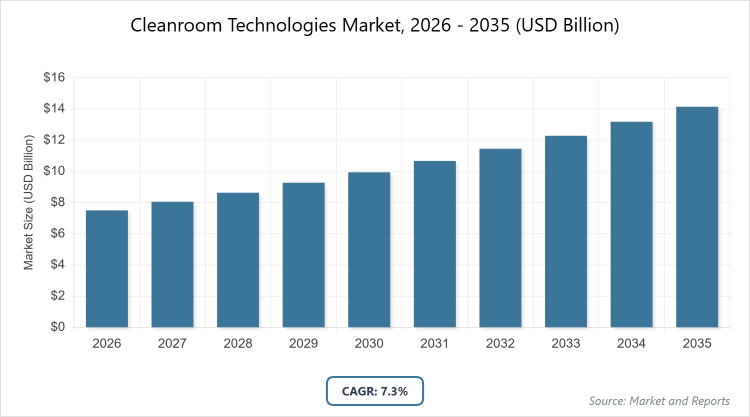
According to MarketnReports, the global Cleanroom Technologies market size was estimated at USD 7.5 billion in 2025 and is expected to reach USD 15.2 billion by 2035, growing at a CAGR of 7.3% from 2026 to 2035. The Cleanroom Technologies Market is driven by increasing demand for contamination-free environments in pharmaceuticals, biotechnology, and semiconductor manufacturing.
What are the Key Insights into Cleanroom Technologies?
- The global Cleanroom Technologies market was valued at USD 7.5 billion in 2025 and is projected to reach USD 15.2 billion by 2035.
- The market is expected to grow at a CAGR of 7.3% during the forecast period from 2026 to 2035.
- The market is driven by stringent regulatory requirements in pharma and semiconductors, growth in biopharma production, and adoption of modular cleanrooms for flexibility.
- In the type segment, consumables dominate with a 45% share due to recurring demand for gloves, wipes, and apparel to maintain sterility.
- In the application segment, pharmaceutical manufacturing dominates with a 40% share as it requires high-level contamination control for drug production.
- In the end-user segment, pharmaceutical companies dominate with a 35% share owing to strict GMP standards and increasing biologic drug output.
- Asia Pacific dominates the regional market with a 40% share, driven by booming pharma and semiconductor industries in China and India, low costs, and government support.
What is the Industry Overview of Cleanroom Technologies?
The Cleanroom Technologies market encompasses controlled environments designed to minimize airborne particles, microbes, and contaminants, utilizing specialized construction, filtration systems, and monitoring equipment to maintain stringent cleanliness standards for sensitive processes. Market definition includes modular and fixed cleanrooms, HVAC systems, HEPA filters, consumables like garments and wipes, and validation services that ensure compliance with ISO and FDA regulations, supporting industries requiring ultra-clean conditions while addressing challenges in energy efficiency, cost management, and scalability for diverse operational needs.
What are the Market Dynamics of Cleanroom Technologies?
Growth Drivers
The Cleanroom Technologies market is propelled by stringent regulatory standards from agencies like the FDA and EMA, mandating controlled environments for pharmaceutical and biotech production to ensure product safety and efficacy, driving investments in advanced filtration and monitoring systems. Growth in biopharmaceuticals, including cell and gene therapies, requires ultra-clean facilities with precise environmental controls, expanding market demand. Advancements in modular cleanrooms offer flexible, cost-effective solutions for rapid deployment, appealing to startups and expanding operations. Rising semiconductor fabrication for electronics and EVs necessitates particle-free environments, while global health concerns post-pandemic emphasize cleanroom use in hospitals and labs for infection control.
Restraints
High initial capital costs for cleanroom construction, HVAC installation, and ongoing validation limit adoption among small biotech firms and in developing regions. Energy-intensive operations with constant air filtration increase utility expenses, deterring cost-sensitive users. Stringent certification processes and maintenance requirements add operational complexity and downtime. Supply chain disruptions for specialized filters and materials, exacerbated by geopolitical tensions, raise prices. Competition from alternative contamination control methods like isolators reduces market share in certain pharma applications.
Opportunities
Opportunities emerge from the integration of IoT and AI for real-time monitoring and predictive maintenance, enhancing efficiency and compliance in smart cleanrooms. Expansion into emerging markets with growing pharma exports offers potential for affordable modular solutions. Partnerships between cleanroom providers and biopharma firms can develop customized facilities for advanced therapies. The rise of personalized medicine requires scalable, flexible cleanrooms, while sustainable designs with energy-efficient HVAC attract eco-conscious industries. Development of portable cleanrooms for field labs opens niches in disaster response and remote research.
Challenges
Challenges include maintaining ultra-low contamination levels amid evolving regulations, requiring continuous upgrades to filtration and airflow systems. Rapid technological changes demand skilled personnel for operation and validation, facing shortages in many regions. Energy consumption and carbon footprint concerns push for green innovations, adding R&D costs. Variability in global standards complicates international expansion and certification. Cybersecurity risks in connected monitoring systems threaten data integrity and operational security.
Cleanroom Technologies Market: Report Scope
| Report Attributes | Report Details |
| Report Name | Cleanroom Technologies Market |
| Market Size 2025 | USD 7.5 Billion |
| Market Forecast 2035 | USD 15.2 Billion |
| Growth Rate | CAGR of 7.3% |
| Report Pages | 220 |
| Key Companies Covered | Kimberly-Clark Corporation, DuPont, Illinois Tool Works (ITW), Royal Imtech N.V., M+W Group (Exyte), Azbil Corporation, Taikisha Ltd., Clean Air Products, and Others |
| Segments Covered | By Type, By Application, By End-User, and By Region |
| Regions Covered | North America, Europe, Asia Pacific (APAC), Latin America, and The Middle East and Africa (MEA) |
| Base Year | 2025 |
| Historical Year | 2020 – 2024 |
| Forecast Year | 2026 – 2035 |
| Customization Scope | Avail customized purchase options to meet your exact research needs. |
What is the Market Segmentation of Cleanroom Technologies?
The Cleanroom Technologies market is segmented by type, application, end-user, and region.
By Type. Consumables are the most dominant subsegment, holding approximately 45% market share, due to their essential, recurring use in maintaining hygiene through single-use items. This dominance drives the market by ensuring ongoing revenue streams and compliance in high-turnover environments like pharma production. Cleanroom equipment ranks as the second most dominant, with around 30% share, including air showers and pass-throughs, propelling growth through infrastructure upgrades for enhanced contamination control.
By Application. Pharmaceutical manufacturing emerges as the most dominant subsegment, capturing about 40% share, primarily because it demands ISO-class cleanrooms for sterile drug production. This leads to market growth by aligning with global pharma expansion and biologic drug trends. Biotechnology follows as the second most dominant, with roughly 25% share, requiring controlled spaces for cell culture, driving the market via innovation in gene therapies.
By End-User. Pharmaceutical companies represent the most dominant subsegment at about 35% share, driven by GMP compliance needs. This dominance accelerates market expansion through large-scale facility investments. Biotechnology firms rank second most dominant, holding around 25% share, due to R&D focus, contributing to growth via advanced therapy manufacturing.
What are the Recent Developments in Cleanroom Technologies?
- In October 2025, ABN Cleanroom Technology launched a new modular cleanroom design with integrated IoT monitoring for real-time environmental control.
- In July 2025, Kimberly-Clark expanded its consumables line with antimicrobial wipes compliant with new EU regulations.
- In April 2025, Terra Universal introduced energy-efficient HEPA fan filter units for sustainable cleanroom operations.
- In January 2025, M+W Group (Exyte) partnered with a biopharma firm for a turnkey cleanroom facility in Asia.
- In November 2024, AES Clean Technology acquired an HVAC specialist to enhance its modular offerings.
What is the Regional Analysis of Cleanroom Technologies?
- Asia Pacific to dominate the global market.
Asia Pacific holds the largest share at approximately 40%, with China as the dominating country, due to booming pharma exports, semiconductor fabrication, and government support for biotech parks. This region’s growth is fueled by low costs, skilled labor, and increasing FDI, positioning it as a global manufacturing hub for cleanroom-dependent industries. Massive semiconductor clusters in Taiwan drive demand for ultra-clean facilities. India’s pharma export growth requires GMP-compliant cleanrooms. Japan’s electronics precision favors high-end modular systems. South Korea’s display industry demands particle-free environments. Cultural emphasis on quality accelerates validation training. Export-oriented policies enhance global competitiveness. Rising middle-class consumption increases medical device cleanrooms. Environmental regulations push for energy-efficient designs.
North America follows closely, driven by advanced R&D and stringent FDA regulations, where the United States dominates through its biopharma leadership and tech innovation. Growth stems from high healthcare spending and demand for sterile manufacturing, though higher costs moderate expansion compared to Asia. Biotech clusters in Boston and San Francisco accelerate modular cleanroom adoption. NIH grants fund advanced filtration research. Defense applications in aerospace require contamination-free assembly. University-industry partnerships in MIT and Stanford advance monitoring technologies. High insurance coverage for biologics supports facility investments. Strict cGMP guidelines ensure market preference for validated systems.
Europe exhibits strong performance with emphasis on GMP compliance and sustainability, led by Germany through its pharma giants and engineering firms. The region’s expansion benefits from EU funding for clean tech and a focus on biologic production. Horizon Europe programs support collaborative cleanroom projects. The UK’s advanced biopharma hubs in Cambridge promote adoption in cell therapy. Multilingual compliance aids diverse markets like France and Italy. REACH regulations ensure safe material usage. Industry consortia share validation best practices. Aging infrastructure renewal projects adopt modular upgrades. Vocational training centers build expertise in cleanroom operations.
Latin America shows moderate advancement, dominated by Brazil’s pharma and biotech growth, supported by foreign investments, though limited by infrastructure; expansion is aided by regional trade agreements. Mexico benefits from NAFTA ties, facilitating tech transfers from North America. Government health initiatives in Argentina promote GMP facilities. The rise of generics in Chile creates demand for sterile production. However, economic variability affects consistent investments. Emerging medical device manufacturing in Colombia adopts cleanroom standards. Regional pacts like Mercosur ease equipment imports. Vocational programs in Peru build validation skills. Biodiversity concerns influence eco-friendly cleanroom materials. Urban expansion drives hospital cleanroom demand.
The Middle East and Africa remain emerging, with the United Arab Emirates leading through medical tourism and pharma diversification, constrained by lower tech access but promising via infrastructure projects. Saudi Arabia’s Vision 2030 funds advanced cleanroom facilities. South Africa’s biotech sector adapts for vaccine production. Technology partnerships with European firms build expertise in Egypt. However, water scarcity impacts HVAC cooling. Investments in solar-powered cleanrooms address energy needs. OPEC policies stabilize pharma-related applications. Vocational initiatives in Nigeria train for future jobs. Emerging labs in Kenya require imaging for medical research. Focus on sustainable development goals promotes green cleanroom innovations.
What are the Key Market Players in Cleanroom Technologies?
- Kimberly-Clark Corporation. Kimberly-Clark focuses on consumables innovation, investing in antimicrobial materials to meet pharma sterility needs.
- DuPont. DuPont emphasizes protective apparel and filters, pursuing sustainable fabrics for eco-friendly cleanrooms.
- Illinois Tool Works (ITW). ITW develops cleaning solutions, strategizing on global distribution for industrial cleanrooms.
- Royal Imtech N.V. Royal Imtech offers turnkey facilities, focusing on energy-efficient designs for biotech.
- M+W Group (Exyte). M+W Group specializes in modular cleanrooms, investing in AI monitoring for compliance.
- Azbil Corporation. Azbil targets HVAC systems, emphasizing precision control for semiconductor cleanrooms.
- Taikisha Ltd. focuses on air conditioning, pursuing green technologies for sustainable operations.
- Clean Air Products. Clean Air Products offers custom equipment, expanding into North American markets.
What are the Market Trends in Cleanroom Technologies?
- Increasing adoption of modular cleanrooms for flexibility and quick setup.
- Rise of IoT-enabled monitoring for real-time compliance.
- Growth in sustainable, energy-efficient HVAC designs.
- Expansion of single-use consumables to reduce contamination risks.
- Integration of AI for predictive maintenance and optimization.
- Focus on antimicrobial surfaces and materials.
What Market Segments and Subsegments are Covered in the Cleanroom Technologies Report?
By Type
- Modular Cleanrooms
- Hardwall Cleanrooms
- Softwall Cleanrooms
- Cleanroom Equipment
- Consumables
- HVAC Systems
- HEPA Filters
- Fan Filter Units
- Laminar Air Flow Systems
- Air Showers
- Others
By Application
- Pharmaceutical Manufacturing
- Biotechnology
- Semiconductor Manufacturing
- Medical Devices
- Electronics Assembly
- Food & Beverage Processing
- Hospital & Healthcare
- Aerospace
- Automotive Painting
- Research Laboratories
- Others
By End-User
- Pharmaceutical Companies
- Biotechnology Firms
- Electronics & Semiconductor Companies
- Hospitals & Healthcare Facilities
- Food & Beverage Industry
- Aerospace & Defense
- Automotive Industry
- Research Institutions
- Contract Manufacturing Organizations
- Government Agencies
- Others
By Region
-
- North America
- U.S.
- Canada
- Europe
- UK
- Germany
- France
- Rest of Europe
- Asia Pacific
- China
- India
- Japan
- Rest of Asia Pacific
- Latin America
- Brazil
- Mexico
- Rest of Latin America
- Middle East & Africa
- UAE
- South Africa
- Rest of Middle East & Africa
- North America
Frequently Asked Questions
Cleanroom Technologies are controlled environments and equipment designed to minimize contaminants for sensitive manufacturing and research processes.
Key factors include regulatory compliance, biopharma growth, semiconductor expansion, and modular technology adoption.
The market is projected to grow from USD 7.5 billion in 2025 to USD 15.2 billion by 2035.
The CAGR is expected to be 7.3%.
Asia Pacific will contribute notably, holding around 40% share due to pharma and semiconductor growth.
Major players include Kimberly-Clark Corporation, DuPont, Illinois Tool Works (ITW), Royal Imtech N.V., and M+W Group (Exyte).
The report provides detailed analysis of size, trends, segments, regional outlook, key players, and forecasts.
Stages include design, construction, equipment manufacturing, consumables production, installation, validation, and maintenance.
Trends evolve toward modular and IoT-integrated systems, with preferences for sustainable, energy-efficient solutions.
GMP and ISO standards mandate cleanroom compliance, while environmental regulations promote energy-efficient designs.