
Frozen Yogurt Market Size, Share and Trends 2026 to 2035
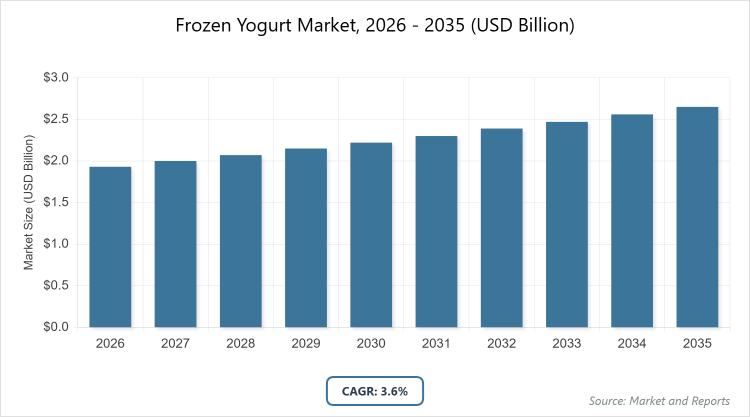
According to MarketnReports, the global Frozen Yogurt market size was estimated at USD 1.93 billion in 2025 and is expected to reach USD 2.75 billion by 2035, growing at a CAGR of 3.6% from 2026 to 2035. Frozen Yogurt Market is driven by the rising significance of healthy foods among young consumers.
What are the Key Insights for the Frozen Yogurt Market?
- Global Frozen Yogurt market valued at USD 1.93 billion in 2025 and projected to reach USD 2.75 billion by 2035.
- CAGR of 3.6% during the forecast period 2026-2035.
- Market is driven by increasing demand for healthier dessert alternatives with probiotic benefits.
- In flavors segment, chocolate dominates with 30% share due to its evergreen popularity among children and women, supported by innovations like flavored barks and mixes.
- In fat contents segment, low fat dominates with 60% share as it appeals to price-sensitive consumers in developing regions and offers a balance between taste and health.
- In distribution channel segment, specialty stores dominate with 33% share owing to the prevalence of self-serve models that allow customization and drive repeat visits.
- North America dominates with 48% share because of high concentration of manufacturers, strong demand for healthy desserts, and expansion of self-serve chains.
How is the Frozen Yogurt Industry Overview Defined?
Frozen yogurt is a dessert produced by freezing yogurt, often positioned as a healthier substitute for ice cream due to its lower fat content, probiotic properties, and nutrient profile including vitamins like B1, B2, A, D, and B12. The market encompasses the production, distribution, and consumption of this product, which appeals to health-conscious individuals seeking guilt-free indulgences. Market definition includes all forms of frozen yogurt, from traditional dairy-based to plant-based variants, emphasizing its role in the broader frozen dessert industry where it differentiates through live cultures and customizable options.
What are the Market Dynamics Affecting the Frozen Yogurt Sector?
Growth Drivers
The primary growth drivers in the frozen yogurt market stem from escalating consumer awareness about health and wellness, particularly among millennials and Gen Z, who prioritize probiotic-rich foods for digestive health and overall well-being. This trend is amplified by innovations in flavors and formats, such as tart varieties with reduced sugar, which cater to evolving tastes and dietary preferences. Additionally, the expansion of self-serve models in specialty stores enhances consumer engagement by allowing personalization, boosting sales volumes and market penetration in both developed and emerging economies.
Restraints
Restraints in the frozen yogurt market include intense competition from traditional ice creams and other desserts that often prioritize indulgent taste over health benefits, leading some consumers to opt for alternatives despite frozen yogurt’s nutritional advantages. High sugar levels in certain products can deter health-focused buyers, while market fragmentation with new entrants in saturated regions like North America increases pricing pressures and challenges established brands’ market share.
Opportunities
Opportunities abound in the frozen yogurt market through expansion into untapped developing regions like Asia Pacific and South America, where rising disposable incomes and shifting lifestyles toward healthier eating habits create demand for premium, probiotic desserts. The surge in vegan and plant-based options presents avenues for product diversification, alongside the growth of online channels that facilitate wider accessibility and innovative marketing strategies to attract tech-savvy consumers.
Challenges
Challenges facing the frozen yogurt market involve navigating regulatory standards for probiotic claims and fat content labeling, which vary across regions and can complicate global expansion efforts. Supply chain disruptions, such as fluctuations in dairy prices or ingredient sourcing, pose risks to profitability, while shifting consumer preferences toward ultra-low-calorie or non-dairy alternatives require continuous R&D investment to maintain relevance.
Frozen Yogurt Market: Report Scope
| Report Attributes | Report Details |
| Report Name | Frozen Yogurt Market |
| Market Size 2025 | USD 1.93 Billion |
| Market Forecast 2035 | USD 2.75 Billion |
| Growth Rate | CAGR of 3.6% |
| Report Pages | 220 |
| Key Companies Covered | Danone, Pinkberry, Honey Hill Farms, Scott Brothers Dairy, Red Mango Inc., Yogurtland Inc., Gujarat Cooperative Milk Marketing Federation, Nestle S.A., General Mills, and Others |
| Segments Covered | By Flavors, By Fat Contents, By Distribution Channel, and By Region |
| Regions Covered | North America, Europe, Asia Pacific (APAC), Latin America, and The Middle East and Africa (MEA) |
| Base Year | 2025 |
| Historical Year | 2020 – 2024 |
| Forecast Year | 2026 – 2035 |
| Customization Scope | Avail customized purchase options to meet your exact research needs. |
How is the Frozen Yogurt Market Segmented?
The Frozen Yogurt market is segmented by flavors, fat contents, distribution channel, and region.
Based on Flavors Segment, the most dominant segment is chocolate, holding the largest market share due to its universal appeal, especially among children and women, which drives consistent demand and encourages innovations like chocolate-infused barks and swirls that enhance product variety and boost overall market growth by attracting repeat purchases. The second most dominant is strawberry, popular for its refreshing taste and natural fruit associations, helping to drive the market through seasonal promotions and health-oriented pairings that expand consumer base in wellness-focused demographics.
Based on Fat Contents Segment, the most dominant segment is low fat (0.5%-2%), which leads because it strikes a balance between indulgence and health consciousness, particularly in price-sensitive emerging markets, driving market expansion by appealing to a broad audience seeking affordable yet nutritious options. The second most dominant is no fat (<0.5%), favored in developed regions for its alignment with strict diet regimens, contributing to market growth via premium positioning and innovations targeting fitness enthusiasts.
Based on Distribution Channel Segment, the most dominant segment is specialty stores, leading due to the integration of self-serve models that offer customization and experiential shopping, which drives higher foot traffic and sales volumes, propelling overall market growth through chain expansions. The second most dominant is online, growing rapidly with digitization, aiding market development by providing convenience and access to diverse flavors, especially in urban areas with busy lifestyles.
What are the Recent Developments in the Frozen Yogurt Market?
- August 2023: Unilever announced plans to expand its U.S.-based Yasso frozen yogurt brand into the U.K., introducing new flavors to capture health-conscious European consumers and strengthen international presence.
- March 2023: Halo Top introduced frozen yogurt pops featuring layers of yogurt, fruit, and granola in varieties like triple berry and strawberry, targeting on-the-go snacking trends to boost retail sales.
- April 2023: Pinkberry launched a fresh white peach tart frozen yogurt topped with blueberries, strawberries, and peach puree, capitalizing on seasonal fruit preferences to drive limited-time offerings and customer engagement.
- July 2021: Hi-Chew collaborated with Menchie’s to create a HI-CHEW Raspberry frozen yogurt flavor, blending candy-inspired tastes to attract younger demographics and enhance brand visibility.
- March 2021: Pinkberry unveiled a limited-time Strawberry Lemonade tart swirl, combining tangy flavors to appeal to summer palates and promote repeat visits through promotional campaigns.
- August 2020: Menchie’s introduced HI-CHEW Mango and HI-CHEW Passion Fruit flavors, which can be swirled into a Tropical Smoothie, innovating on exotic tastes to expand menu options and market reach.
How Does Regional Analysis Impact the Frozen Yogurt Market?
- North America to dominate the global market.
North America: This region holds the largest share, driven by a high concentration of key manufacturers, robust demand for healthier dessert options amid rising obesity concerns, and the widespread adoption of self-serve models in chains like Yogurtland and Pinkberry. The dominating country, the U.S., leads due to its innovative product launches, such as vegan variants, and expansive retail networks that cater to health trends, projecting significant growth through 2035 as consumers prioritize probiotic benefits.
Europe: Europe exhibits steady growth fueled by urban populations in countries like Germany and France emphasizing balanced diets, with preferences for no-fat options and unique flavors like tart varieties. Italy and Spain contribute through premium positioning in cafes, where regulatory support for probiotic foods enhances market penetration, though competition from traditional gelato poses challenges; overall, the region benefits from increasing online sales and health campaigns.
Asia Pacific: Rapid urbanization and rising disposable incomes in this region spur demand for frozen yogurt as a trendy, healthy snack, with international brands expanding chains in urban centers. China and India dominate as key countries, driven by youth-oriented marketing and introductions of local flavors like mango, helping to overcome initial low awareness and build a burgeoning market through e-commerce and supermarket integrations.
South America: Growth in South America is propelled by premium dessert trends in Brazil and Argentina, where international players introduce low-fat variants to align with emerging health consciousness. Brazil leads as the dominating country, supported by retail expansions and collaborations with local dairy suppliers, though economic volatility can impact affordability; the region holds potential through flavor innovations tailored to tropical preferences.
Middle East and Africa: This region experiences gradual expansion due to increasing tourism and expatriate populations seeking familiar healthy treats, with the UAE and South Africa leading adoption in malls and specialty outlets. Saudi Arabia emerges as a key country with growing interest in low-sugar options amid health initiatives, but challenges like limited cold chain infrastructure hinder faster growth, offset by opportunities in urban hubs.
Who are the Key Market Players in the Frozen Yogurt Industry?
- Danone: As a global leader, Danone focuses on expanding its portfolio with probiotic-enriched frozen yogurt variants, leveraging acquisitions and partnerships to enter emerging markets while emphasizing sustainable sourcing to appeal to eco-conscious consumers and drive long-term growth.
- Pinkberry: Pinkberry employs a strategy of limited-time flavor launches and self-serve store expansions, particularly in Asia Pacific, to enhance customer loyalty through customization and digital marketing, positioning itself as a premium brand in the health dessert space.
- Honey Hill Farms: This player prioritizes supply chain optimization and collaborations with retailers for private-label products, focusing on low-fat innovations to capture share in North American supermarkets and support market expansion through quality assurance.
- Scott Brothers Dairy: Scott Brothers Dairy adopts a regional focus in the U.S., investing in plant-based alternatives and direct-to-consumer sales to address vegan trends, thereby strengthening its competitive edge in the no-fat segment.
- Red Mango Inc.: Red Mango’s strategy involves campus and urban location expansions, coupled with menu diversification into tart flavors, to target young demographics and foster brand growth via franchising models.
- Yogurtland Inc.: Yogurtland emphasizes vegan and dairy-free options through R&D, expanding internationally with self-serve concepts to capitalize on health trends and increase market penetration in Canada and beyond.
- Gujarat Cooperative Milk Marketing Federation (Amul): Amul leverages its strong dairy network in India for affordable low-fat frozen yogurt, using local flavor integrations and e-commerce to drive accessibility and growth in Asia Pacific.
- Nestle S.A.: Nestle focuses on global R&D for sugar-reduced products, strategic mergers, and online distribution to broaden reach, aiming to dominate in Europe and emerging markets with health-aligned offerings.
- General Mills: General Mills pursues innovation in flavored pops and barks, alongside retail partnerships, to enhance visibility and capture share among health-conscious families in North America.
What are the Current Market Trends in Frozen Yogurt?
- Rising adoption of self-serve models, accounting for over two-thirds of stores globally, enabling consumer control over portions and toppings for personalized experiences.
- Introduction of tart and low-sugar flavors to cater to health-focused preferences, reducing calorie intake while maintaining taste appeal.
- Growth in plant-based and vegan variants, driven by dietary shifts and innovations like 100% vegan options in key markets.
- Expansion into developing regions through chain stores and local flavor adaptations to tap into increasing disposable incomes.
- Surge in online sales channels due to digitization, offering convenience and broader product access.
- Emphasis on probiotic and nutrient-rich claims to attract young consumers prioritizing digestive health.
- Sustainable packaging trends, shifting toward eco-friendly materials to align with environmental concerns.
What Market Segments and Subsegments are Covered in the Frozen Yogurt Report?
By Flavors
- Chocolate
- Mango
- Banana
- Pineapple
- Strawberry
- Peach
- Lemonade
- Vanilla
- Fruit
- Mixed
- Others
By Fat Contents
- Low fat (0.5%-2%)
- No fat (<0.5%)
- Full Fat
- Others
By Distribution Channel
- Specialty Stores
- Online
- Supermarket/Hypermarket
- Retailers (Grocery Stores)
- Convenience Stores
- Hypermarkets/Supermarkets
- Departmental Stores
- Food Service
- On-Trade
- Others
By Region
- North America
- U.S.
- Canada
- Europe
- UK
- Germany
- France
- Rest of Europe
- Asia Pacific
- China
- India
- Japan
- Rest of Asia Pacific
- Latin America
- Brazil
- Mexico
- Rest of Latin America
- Middle East & Africa
- UAE
- South Africa
- Rest of Middle East & Africa
Chapter 1. Preface
1.1 Report Description and Scope1.2 Research Scope1.3 Research Methodology1.3.1 Market Research Type1.3.2 Market Research MethodologyChapter 2. Executive Summary
2.1 Global Frozen Yogurt Market, (2026 - 2035) (USD Billion)2.2 Global Frozen Yogurt Market: SnapshotChapter 3. Global Frozen Yogurt Market - Industry Analysis
3.1 Frozen Yogurt Market: Market Dynamics3.2 Market Drivers3.2.1 The frozen yogurt market is driven by rising health and wellness awareness, demand for probiotic-rich and low-sugar options, innovative flavors, and the expansion of self-serve models that enhance personalization and consumer engagement.3.3 Market Restraints3.3.1 The frozen yogurt market is restrained by strong competition from indulgent desserts, high sugar content in some products, and intense market saturation that increases pricing pressure and limits brand differentiation.3.4 Market Opportunities3.4.1 The frozen yogurt market offers strong opportunities through expansion in emerging regions, growth of vegan and plant-based options, and rising online channels that broaden reach and attract health-conscious, tech-savvy consumers.3.5 Market Challenges3.5.1 The frozen yogurt market faces challenges from complex regulatory standards, supply chain volatility in dairy and ingredients, and shifting consumer preferences toward ultra-low-calorie and non-dairy alternatives that demand continuous innovation.3.6 Porter’s Five Forces Analysis3.7 Market Attractiveness Analysis3.7.1 Market Attractiveness Analysis By Flavors3.7.2 Market Attractiveness Analysis By Fat Contents3.7.3 Market Attractiveness Analysis By Distribution ChannelChapter 4. Global Frozen Yogurt Market- Competitive Landscape
4.1 Company Market Share Analysis4.1.1 Global Frozen Yogurt Market: Company Market Share, 20254.2 Strategic Development4.2.1 Acquisitions & mergers4.2.2 New Product launches4.2.3 Agreements, partnerships, collaborations, and joint ventures4.2.4 Research and development and regional expansion4.3 Price Trend AnalysisChapter 5. Global Frozen Yogurt Market - Flavors Analysis
5.1 Global Frozen Yogurt Market Overview: Flavors5.1.1 Global Frozen Yogurt Market share, By Flavors, 2025 and 20355.2 Chocolate5.2.1 Global Frozen Yogurt Market by Chocolate, 2026 - 2035 (USD Billion)5.3 Mango5.3.1 Global Frozen Yogurt Market by Mango, 2026 - 2035 (USD Billion)5.4 Banana5.4.1 Global Frozen Yogurt Market by Banana, 2026 - 2035 (USD Billion)5.5 Pineapple5.5.1 Global Frozen Yogurt Market by Pineapple, 2026 - 2035 (USD Billion)5.6 Strawberry5.6.1 Global Frozen Yogurt Market by Strawberry, 2026 - 2035 (USD Billion)5.7 Peach5.7.1 Global Frozen Yogurt Market by Peach, 2026 - 2035 (USD Billion)5.8 Lemonade5.8.1 Global Frozen Yogurt Market by Lemonade, 2026 - 2035 (USD Billion)5.9 Vanilla5.9.1 Global Frozen Yogurt Market by Vanilla, 2026 - 2035 (USD Billion)5.10 Fruit5.10.1 Global Frozen Yogurt Market by Fruit, 2026 - 2035 (USD Billion)5.11 Mixed5.11.1 Global Frozen Yogurt Market by Mixed, 2026 - 2035 (USD Billion)Chapter 6. Global Frozen Yogurt Market - Fat Contents Analysis
6.1 Global Frozen Yogurt Market Overview: Fat Contents6.1.1 Global Frozen Yogurt Market Share, By Fat Contents, 2025 and 20356.2 Low fat (0.5%-2%)6.2.1 Global Frozen Yogurt Market by Low fat (0.5%-2%), 2026 - 2035 (USD Billion)6.3 No fat (<0.5%)6.3.1 Global Frozen Yogurt Market by No fat (<0.5%), 2026 - 2035 (USD Billion)6.4 Full Fat6.4.1 Global Frozen Yogurt Market by Full Fat, 2026 - 2035 (USD Billion)6.5 Others6.5.1 Global Frozen Yogurt Market by Others, 2026 - 2035 (USD Billion)Chapter 7. Global Frozen Yogurt Market - Distribution Channel Analysis
7.1 Global Frozen Yogurt Market Overview: Distribution Channel7.1.1 Global Frozen Yogurt Market Share, By Distribution Channel, 2025 and 20357.2 Specialty Stores7.2.1 Global Frozen Yogurt Market by Specialty Stores, 2026 - 2035 (USD Billion)7.3 Online7.3.1 Global Frozen Yogurt Market by Online, 2026 - 2035 (USD Billion)7.4 Supermarket/Hypermarket7.4.1 Global Frozen Yogurt Market by Supermarket/Hypermarket, 2026 - 2035 (USD Billion)7.5 Retailers (Grocery Stores)7.5.1 Global Frozen Yogurt Market by Retailers (Grocery Stores), 2026 - 2035 (USD Billion)7.6 Convenience Stores7.6.1 Global Frozen Yogurt Market by Convenience Stores, 2026 - 2035 (USD Billion)7.7 Hypermarkets/Supermarkets7.7.1 Global Frozen Yogurt Market by Hypermarkets/Supermarkets, 2026 - 2035 (USD Billion)7.8 Departmental Stores7.8.1 Global Frozen Yogurt Market by Departmental Stores, 2026 - 2035 (USD Billion)7.9 Food Service7.9.1 Global Frozen Yogurt Market by Food Service, 2026 - 2035 (USD Billion)7.10 On-Trade7.10.1 Global Frozen Yogurt Market by On-Trade, 2026 - 2035 (USD Billion)7.11 Others7.11.1 Global Frozen Yogurt Market by Others, 2026 - 2035 (USD Billion)Chapter 8. Frozen Yogurt Market - Regional Analysis
8.1 Global Frozen Yogurt Market Regional Overview8.2 Global Frozen Yogurt Market Share, by Region, 2025 & 2035 (USD Billion)8.3 North America8.3.1 North America Frozen Yogurt Market, 2026 - 2035 (USD Billion)8.3.1.1 North America Frozen Yogurt Market, by Country, 2026 - 2035 (USD Billion)8.3.2 North America Frozen Yogurt Market, by Flavors, 2026 - 20358.3.2.1 North America Frozen Yogurt Market, by Flavors, 2026 - 2035 (USD Billion)8.3.3 North America Frozen Yogurt Market, by Fat Contents, 2026 - 20358.3.3.1 North America Frozen Yogurt Market, by Fat Contents, 2026 - 2035 (USD Billion)8.3.4 North America Frozen Yogurt Market, by Distribution Channel, 2026 - 20358.3.4.1 North America Frozen Yogurt Market, by Distribution Channel, 2026 - 2035 (USD Billion)8.4 Europe8.4.1 Europe Frozen Yogurt Market, 2026 - 2035 (USD Billion)8.4.1.1 Europe Frozen Yogurt Market, by Country, 2026 - 2035 (USD Billion)8.4.2 Europe Frozen Yogurt Market, by Flavors, 2026 - 20358.4.2.1 Europe Frozen Yogurt Market, by Flavors, 2026 - 2035 (USD Billion)8.4.3 Europe Frozen Yogurt Market, by Fat Contents, 2026 - 20358.4.3.1 Europe Frozen Yogurt Market, by Fat Contents, 2026 - 2035 (USD Billion)8.4.4 Europe Frozen Yogurt Market, by Distribution Channel, 2026 - 20358.4.4.1 Europe Frozen Yogurt Market, by Distribution Channel, 2026 - 2035 (USD Billion)8.5 Asia Pacific8.5.1 Asia Pacific Frozen Yogurt Market, 2026 - 2035 (USD Billion)8.5.1.1 Asia Pacific Frozen Yogurt Market, by Country, 2026 - 2035 (USD Billion)8.5.2 Asia Pacific Frozen Yogurt Market, by Flavors, 2026 - 20358.5.2.1 Asia Pacific Frozen Yogurt Market, by Flavors, 2026 - 2035 (USD Billion)8.5.3 Asia Pacific Frozen Yogurt Market, by Fat Contents, 2026 - 20358.5.3.1 Asia Pacific Frozen Yogurt Market, by Fat Contents, 2026 - 2035 (USD Billion)8.5.4 Asia Pacific Frozen Yogurt Market, by Distribution Channel, 2026 - 20358.5.4.1 Asia Pacific Frozen Yogurt Market, by Distribution Channel, 2026 - 2035 (USD Billion)8.6 Latin America8.6.1 Latin America Frozen Yogurt Market, 2026 - 2035 (USD Billion)8.6.1.1 Latin America Frozen Yogurt Market, by Country, 2026 - 2035 (USD Billion)8.6.2 Latin America Frozen Yogurt Market, by Flavors, 2026 - 20358.6.2.1 Latin America Frozen Yogurt Market, by Flavors, 2026 - 2035 (USD Billion)8.6.3 Latin America Frozen Yogurt Market, by Fat Contents, 2026 - 20358.6.3.1 Latin America Frozen Yogurt Market, by Fat Contents, 2026 - 2035 (USD Billion)8.6.4 Latin America Frozen Yogurt Market, by Distribution Channel, 2026 - 20358.6.4.1 Latin America Frozen Yogurt Market, by Distribution Channel, 2026 - 2035 (USD Billion)8.7 The Middle-East and Africa8.7.1 The Middle-East and Africa Frozen Yogurt Market, 2026 - 2035 (USD Billion)8.7.1.1 The Middle-East and Africa Frozen Yogurt Market, by Country, 2026 - 2035 (USD Billion)8.7.2 The Middle-East and Africa Frozen Yogurt Market, by Flavors, 2026 - 20358.7.2.1 The Middle-East and Africa Frozen Yogurt Market, by Flavors, 2026 - 2035 (USD Billion)8.7.3 The Middle-East and Africa Frozen Yogurt Market, by Fat Contents, 2026 - 20358.7.3.1 The Middle-East and Africa Frozen Yogurt Market, by Fat Contents, 2026 - 2035 (USD Billion)8.7.4 The Middle-East and Africa Frozen Yogurt Market, by Distribution Channel, 2026 - 20358.7.4.1 The Middle-East and Africa Frozen Yogurt Market, by Distribution Channel, 2026 - 2035 (USD Billion)Chapter 9. Company Profiles
9.1 Danone9.1.1 Overview9.1.2 Financials9.1.3 Product Portfolio9.1.4 Business Strategy9.1.5 Recent Developments9.2 Pinkberry9.2.1 Overview9.2.2 Financials9.2.3 Product Portfolio9.2.4 Business Strategy9.2.5 Recent Developments9.3 Honey Hill Farms9.3.1 Overview9.3.2 Financials9.3.3 Product Portfolio9.3.4 Business Strategy9.3.5 Recent Developments9.4 Scott Brothers Dairy9.4.1 Overview9.4.2 Financials9.4.3 Product Portfolio9.4.4 Business Strategy9.4.5 Recent Developments9.5 Red Mango Inc.9.5.1 Overview9.5.2 Financials9.5.3 Product Portfolio9.5.4 Business Strategy9.5.5 Recent Developments9.6 Yogurtland Inc.9.6.1 Overview9.6.2 Financials9.6.3 Product Portfolio9.6.4 Business Strategy9.6.5 Recent Developments9.7 Gujarat Cooperative Milk Marketing Federation9.7.1 Overview9.7.2 Financials9.7.3 Product Portfolio9.7.4 Business Strategy9.7.5 Recent Developments9.8 Nestle S.A.9.8.1 Overview9.8.2 Financials9.8.3 Product Portfolio9.8.4 Business Strategy9.8.5 Recent Developments9.9 General Mills9.9.1 Overview9.9.2 Financials9.9.3 Product Portfolio9.9.4 Business Strategy9.9.5 Recent Developments
Frequently Asked Questions
Frozen yogurt is a dessert made by freezing yogurt, often containing live cultures, and is marketed as a healthier alternative to ice cream with benefits like probiotics and lower fat content.
Key factors include rising health consciousness, flavor innovations, expansion of self-serve models, growth in vegan options, and increasing demand in emerging markets.
The market is projected to grow from approximately USD 1.93 billion in 2025 to USD 2.75 billion by 2035.
The CAGR is expected to be 3.6% during 2026-2035.
North America will contribute notably, holding around 48% of the market share due to strong manufacturer presence and health trends.
Major players include Danone, Pinkberry, Honey Hill Farms, Scott Brothers Dairy, Red Mango Inc., Yogurtland Inc., Gujarat Cooperative Milk Marketing Federation, Nestle S.A., and General Mills.
The report provides insights on market size, trends, segments, regional analysis, key players, drivers, restraints, opportunities, and forecasts.
Stages include raw material sourcing (dairy or plant-based), manufacturing and flavoring, packaging, distribution through channels like specialty stores, and end-consumer retail or consumption.
Trends are shifting toward tart flavors, vegan options, sustainable packaging, and self-serve customization, with consumers preferring low-sugar, probiotic-rich products.
Regulatory factors include probiotic labeling standards and fat content regulations, while environmental factors involve sustainable sourcing and eco-friendly packaging demands influencing production costs and innovations.