
Point-of-Sale Terminals Market Size, Share and Trends 2026 to 2035
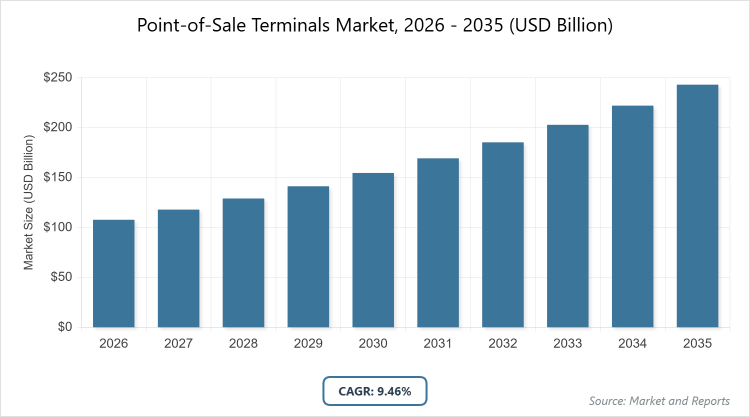
According to MarketnReports, the global Point-of-Sale Terminals market size was estimated at USD 107.75 billion in 2025 and is expected to reach USD 266.15 billion by 2035, growing at a CAGR of 9.46% from 2026 to 2035. Rising adoption of contactless payments and digital transformation in retail.
What are the Key Insights into the point-of-sale terminals market?
- The global Point-of-Sale Terminals market was valued at USD 107.75 billion in 2025 and is projected to reach USD 266.15 billion by 2035.
- The market is expected to grow at a CAGR of 9.46% during the forecast period.
- The market is driven by increasing digital payments and regulatory compliance requirements.
- In the component segment, hardware dominates with 55% share due to essential devices like terminals and card readers required for physical transactions.
- In the deployment mode segment, fixed dominates with 66% share as it provides reliable, high-volume processing in established retail environments.
- In the application segment, retail dominates with 46% share owing to high transaction volumes and demand for efficient checkout systems.
- In the end-use segment, supermarkets dominate with 30% share because of their scale and need for integrated inventory and payment solutions.
- Asia Pacific dominates the regional market with 41% share because of rapid retail expansion, digital payment adoption, and low-cost manufacturing in China and India.
What is the Point-of-Sale Terminals Market?
Industry Overview
The point-of-sale terminals market encompasses hardware, software, and services that facilitate transaction processing at retail, hospitality, and other service points, enabling secure payment acceptance, inventory management, and customer data collection through integrated systems like card readers, touchscreens, and cloud-based platforms. These terminals support various payment methods, including contactless, EMV, and mobile wallets, enhancing operational efficiency and customer experience while ensuring compliance with security standards such as PCI DSS. Market definition includes all devices and solutions used for real-time sales transactions, focusing on technological advancements in mobility, AI-driven analytics, and omnichannel integration to meet evolving consumer preferences for seamless, cashless interactions in a digital economy.
What are the Market Dynamics Shaping the Point-of-Sale Terminals Market?
Growth Drivers
The growth drivers in the point-of-sale terminals market are primarily fueled by the global shift toward cashless economies, where increasing adoption of contactless payments and mobile wallets necessitates advanced POS systems with NFC and EMV capabilities to ensure secure, fast transactions, thereby enhancing customer convenience and reducing fraud risks in retail and hospitality sectors. Technological innovations such as cloud-based POS and AI integration enable real-time data analytics, inventory management, and personalized customer experiences, driving efficiency for businesses amid rising e-commerce integration.
Government regulations promoting digital payments and financial inclusion, coupled with the expansion of organized retail in emerging markets, accelerate demand for scalable, compliant terminals. Additionally, the post-pandemic emphasis on hygiene has boosted touchless solutions, fostering market expansion through upgraded infrastructure investments.
Restraints
Restraints in the point-of-sale terminals market include high initial deployment costs for advanced systems, encompassing hardware, software, and integration with existing IT infrastructure, which burden small and medium enterprises, particularly in developing regions with limited budgets. Cybersecurity threats, such as data breaches and malware attacks on POS networks, erode trust and require ongoing investments in robust security measures like encryption and tokenization, complicating adoption. Interoperability issues between diverse payment platforms and legacy systems lead to technical challenges and downtime, while regulatory variations across countries increase compliance complexities and costs. Moreover, supply chain disruptions for components like chips affect availability and pricing, hindering market penetration.
Opportunities
Opportunities in the point-of-sale terminals market emerge from the integration of emerging technologies like AI and IoT, enabling predictive analytics for inventory and personalized promotions, which can be leveraged by retailers to enhance customer engagement and operational efficiency in omnichannel environments. The rise of fintech in emerging markets offers potential for affordable, mobile POS solutions tailored to unbanked populations, supported by digital inclusion initiatives. Expansion into non-traditional sectors like healthcare and transportation for seamless billing opens new revenue streams. Furthermore, sustainability-focused innovations, such as energy-efficient terminals, align with green regulations, attracting eco-conscious businesses and fostering partnerships for customized solutions.
Challenges
Challenges in the point-of-sale terminals market revolve around ensuring robust cybersecurity amid evolving threats, as sophisticated attacks target transaction data, requiring continuous updates and training that strain resources for smaller operators. Achieving seamless integration with diverse payment ecosystems and legacy systems demands significant technical expertise, often leading to compatibility issues and increased costs. Rapid technological obsolescence necessitates frequent upgrades, while consumer privacy concerns under regulations like GDPR complicate data handling. Additionally, economic volatility affects retail spending, impacting POS adoption in sensitive markets.
Point-of-Sale Terminals Market: Report Scope
| Report Attributes | Report Details |
| Report Name | Point-of-Sale Terminals Market |
| Market Size 2025 | USD 107.75 Billion |
| Market Forecast 2035 | USD 266.15 Billion |
| Growth Rate | CAGR of 9.46% |
| Report Pages | 220 |
| Key Companies Covered |
NCR Voyix, Verifone, Ingenico, PAX Technology, Toshiba Global Commerce Solutions, Square, and Others |
| Segments Covered | By Component, By Deployment Mode, By Application, By End-Use, and By Region |
| Regions Covered | North America, Europe, Asia Pacific (APAC), Latin America, and The Middle East and Africa (MEA) |
| Base Year | 2025 |
| Historical Year | 2020 – 2024 |
| Forecast Year | 2026 – 2035 |
| Customization Scope | Avail customized purchase options to meet your exact research needs. |
How is the Market Segmentation Structured in the Point-of-Sale Terminals Market?
The Point-of-Sale Terminals market is segmented by component, deployment mode, application, end-use, and region.
Based on Component Segment, hardware is the most dominant subsegment, followed by software as the second most dominant. Hardware dominates due to its foundational role in processing transactions with devices like scanners and card readers, driving the market by enabling secure, efficient operations in high-volume retail environments; software follows for its analytics and integration capabilities, propelling growth through customizable features that enhance user experience.
Based on the Deployment Mode Segment, fixed is the most dominant subsegment, followed by mobile as the second most dominant. Fixed leads because of its reliability for stationary high-throughput settings like supermarkets, accelerating market expansion by supporting complex inventory systems; mobile gains traction for flexibility in dynamic retail, driving the market via contactless on-the-go transactions.
Based on Application Segment, retail is the most dominant subsegment, followed by hospitality as the second most dominant. Retail dominates owing to vast transaction needs and omnichannel demands, fueling market growth through integrated payment solutions; hospitality thrives on quick service requirements, propelling the market via enhanced guest experiences.
Based on the end-use segment, supermarkets are the most dominant subsegment, followed by restaurants as the second most dominant. Supermarkets dominate due to scale and inventory integration, enhancing market penetration for efficient checkouts; restaurants rise with order management needs, driving adoption for seamless dining.
What are the Recent Developments inthe Point-of-Sale Terminals Market?
- In March 2025, FIS launched an AI-enhanced POS platform for real-time fraud detection and inventory analytics.
- In February 2025, NCR Voyix acquired a mobile POS startup to expand cloud offerings.
- In January 2025, Verifone introduced NFC-enabled terminals for emerging markets.
- In December 2024, Ingenico partnered with a fintech for integrated payment solutions.
How does Regional Analysis Impact the Point-of-Sale Terminals Market?
- Asia Pacific to dominate the global market.
Asia Pacific leads the point-of-sale terminals market, driven by rapid retail digitalization and mobile payment adoption; China dominates as the key country, with e-commerce growth and government digital initiatives.
North America exhibits strong growth in the point-of-sale terminals market, fueled by advanced technology integration; the United States is the dominating country, leveraging high consumer spending and EMV compliance.
Europe demonstrates substantial expansion in the point-of-sale terminals market, supported by GDPR and contactless trends; Germany emerges as the dominating country, with a robust retail infrastructure.
Latin America shows emerging potential in the point-of-sale terminals market, aided by financial inclusion; Brazil stands out as the dominating country, focusing on mobile POS for unbanked populations.
The Middle East and Africa represent nascent growth in the point-of-sale terminals market, propelled by tourism; the UAE dominates, with investments in smart retail systems.
Who are the Key Market Players in the Point-of-Sale Terminals Market?
- NCR Voyix focuses on cloud-based POS for retail analytics and security.
- Verifone employs mobile and contactless strategies for global expansion.
- Ingenico pursues partnerships for integrated payment ecosystems.
- PAX Technology adopts affordable hardware for emerging markets.
- Toshiba Global Commerce Solutions leverages AI for inventory optimization.
- Square concentrates on SME solutions with easy integration.
What are the Market Trends in the Point-of-Sale Terminals Market?
- Rise in contactless and NFC payments.
- Adoption of cloud-based POS for scalability.
- Integration of AI for fraud detection.
- Growth in mobile POS for flexibility.
- Emphasis on omnichannel retail experiences.
- Expansion of biometric authentication.
- Focus on sustainability in hardware design.
What Market Segments and their Subsegments are Covered in the Point-of-Sale Terminals Report?
By Component
- Hardware
- Software
- Services
- Others
By Deployment Mode
- Fixed
- Mobile
- Cloud-Based
- On-Premises
- Others
By Application
- Retail
- Hospitality
- Healthcare
- Entertainment
- Others
By End-Use
- Supermarkets
- Restaurants
- Pharmacies
- Gas Stations
- Others
By Region
- North America
- U.S.
- Canada
- Europe
- UK
- Germany
- France
- Rest of Europe
- Asia Pacific
- China
- India
- Japan
- Rest of Asia Pacific
- Latin America
- Brazil
- Mexico
- Rest of Latin America
- Middle East & Africa
- UAE
- South Africa
- Rest of Middle East & Africa
Chapter 1. Preface
Chapter 2. Executive Summary
Chapter 3. Global Point-of-Sale Terminals Market - Industry Analysis
Chapter 4. Global Point-of-Sale Terminals Market- Competitive Landscape
Chapter 5. Global Point-of-Sale Terminals Market - Component Analysis
Chapter 6. Global Point-of-Sale Terminals Market - Deployment Mode Analysis
Chapter 7. Global Point-of-Sale Terminals Market - Application Analysis
Chapter 8. Global Point-of-Sale Terminals Market - End-Use Analysis
Chapter 9. Point-of-Sale Terminals Market - Regional Analysis
Chapter 10. Company Profiles
Frequently Asked Questions
Point-of-sale terminals are devices that process transactions, manage inventory, and collect customer data at retail and service points.
Key factors include digital payment adoption, regulatory compliance, technological advancements, and retail expansion.
The point-of-sale terminals market is projected to grow from USD 107.75 billion in 2025 to USD 266.15 billion by 2035.
The market is expected to grow at a CAGR of 9.46% from 2026 to 2035.
Asia Pacific will contribute notably, holding around 41% market share due to digitalization and retail growth.
Major players include NCR Voyix, Verifone, Ingenico, PAX Technology, Toshiba Global Commerce Solutions, and Square, driving growth through innovations.
The report provides analysis on size, trends, segmentation, regions, players, and forecasts from 2026 to 2035.
Stages include component manufacturing, system integration, distribution, installation, and maintenance services.
Trends shift toward contactless and mobile solutions, with consumers preferring secure, seamless payment experiences.
Factors include PCI DSS compliance, EMV standards, and sustainability mandates for energy-efficient devices.