
Pharmaceutical Intermediates Market Size, Share and Trends 2026 to 2035
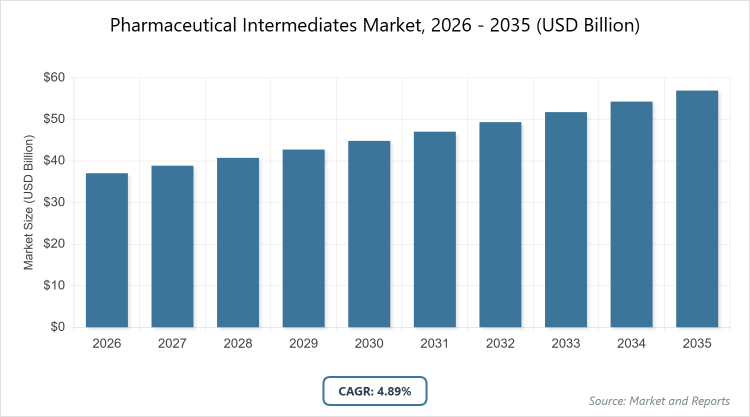
According to MarketnReports, the global Pharmaceutical Intermediates market size was estimated at USD 37.04 billion in 2025 and is expected to reach USD 59.70 billion by 2035, growing at a CAGR of 4.89% from 2026 to 2035. Growing demand for generic drugs and rising prevalence of chronic diseases.
What are the Key Insights into the Pharmaceutical Intermediates Market?
- The global Pharmaceutical Intermediates market was valued at USD 37.04 billion in 2025 and is projected to reach USD 59.70 billion by 2035.
- The market is expected to grow at a CAGR of 4.89% during the forecast period.
- The market is driven by increasing demand for generic drugs and rising chronic disease prevalence.
- In the type segment, bulk drug intermediates dominate with 48% share due to their essential role in large-scale API production for cost-effective generic drugs.
- In the application segment, analgesics dominate with 30% share as they address widespread pain management needs in chronic conditions.
- In the end-user segment, biotech and pharma companies dominate with 41% share owing to their direct involvement in drug development and manufacturing.
- Asia Pacific dominates the regional market with 40% share because of low-cost manufacturing hubs in China and India supporting global supply chains.
What is the Pharmaceutical Intermediates Market?
Industry Overview
The pharmaceutical intermediates market involves the production and supply of chemical compounds that serve as building blocks in the synthesis of active pharmaceutical ingredients (APIs), facilitating the manufacturing of finished drugs across various therapeutic categories. These intermediates, which can be organic or inorganic, undergo further reactions to form APIs, ensuring efficiency in drug development and production while meeting stringent quality and regulatory standards. Market definition encompasses all intermediate chemicals used in pharmaceutical synthesis, including bulk, custom, and specialty types, with a focus on enhancing process optimization, cost-effectiveness, and scalability to support the global pharmaceutical industry’s demand for innovative and generic medications.
What are the Market Dynamics Shaping the Pharmaceutical Intermediates Market?
Growth Drivers
The growth drivers in the pharmaceutical intermediates market are fueled by the surging demand for generic drugs, driven by patent expirations and cost-containment efforts in healthcare, which require efficient, scalable intermediates for API synthesis. The rising prevalence of chronic diseases like diabetes and cancer increases the need for specialized therapeutics, boosting intermediate production. Advancements in chemical synthesis and biocatalysis enhance yield and reduce environmental impact, attracting investments. Additionally, outsourcing to CMOs in emerging regions optimizes costs and accelerates time-to-market, supporting overall market expansion.
Restraints
Restraints in the pharmaceutical intermediates market include stringent regulatory compliance for quality and safety, which raises production costs and delays approvals. Volatility in raw material prices, influenced by geopolitical factors, disrupts supply chains. Environmental concerns over chemical waste and emissions lead to stricter controls, increasing operational expenses. Moreover, intellectual property issues and competition from low-cost generics erode margins for innovative intermediates.
Opportunities
Opportunities in the pharmaceutical intermediates market emerge from the growth of biopharmaceuticals, requiring advanced chiral and custom intermediates for biologics. Expansion in emerging markets offers low-cost production bases with rising domestic demand. Technological innovations like green chemistry and continuous manufacturing reduce costs and environmental impact. Furthermore, partnerships between pharma firms and CMOs foster specialized development, tapping into personalized medicine trends.
Challenges
Challenges in the pharmaceutical intermediates market involve managing supply chain disruptions from global events, affecting raw material availability. Achieving high purity levels amid complex syntheses demands advanced technology investments. Regulatory variations across regions complicate global operations. Additionally, addressing antimicrobial resistance requires novel intermediates, straining R&D resources.
Pharmaceutical Intermediates Market: Report Scope
| Report Attributes | Report Details |
| Report Name | Pharmaceutical Intermediates Market |
| Market Size 2025 | USD 37.04 Billion |
| Market Forecast 2035 | USD 59.70 Billion |
| Growth Rate | CAGR of 4.89% |
| Report Pages | 220 |
| Key Companies Covered |
BASF SE, Lonza, Evonik Industries AG, Merck KGaA, Sanofi, Pfizer, and Others |
| Segments Covered | By Type, By Application, By End-User, and By Region |
| Regions Covered | North America, Europe, Asia Pacific (APAC), Latin America, and The Middle East and Africa (MEA) |
| Base Year | 2025 |
| Historical Year | 2020 – 2024 |
| Forecast Year | 2026 – 2035 |
| Customization Scope | Avail customized purchase options to meet your exact research needs. |
How is the Market Segmentation Structured in the Pharmaceutical Intermediates Market?
The Pharmaceutical Intermediates market is segmented by type, application, end-user, and region.
Based on Type Segment, bulk drug intermediates are the most dominant subsegment, followed by chemical intermediates as the second most dominant. Bulk drug intermediates dominate due to their use in high-volume API production for generics, enabling cost efficiencies and scalability that drive the market by supporting affordable drug access globally; chemical intermediates follow for their versatility in custom synthesis, propelling growth through innovation in specialty drugs.
Based on Application Segment, analgesics are the most dominant subsegment, followed by anti-cancer drugs as the second most dominant. Analgesics lead because of high demand for pain relief in chronic conditions, accelerating market expansion by integrating intermediates into widely used formulations; anti-cancer drugs gain traction amid rising oncology needs, driving the market via advanced intermediates for targeted therapies.
Based on End-User Segment, biotech and pharma companies is the most dominant subsegment, followed by CMO/CRO as the second most dominant. Biotech and pharma companies dominate owing to in-house development needs, enhancing market penetration for innovative drugs; CMO/CRO thrive on outsourcing trends, propelling growth through specialized manufacturing services.
What are the Recent Developments in the Pharmaceutical Intermediates Market?
- In November 2025, BASF acquired InterChem Pharma to expand its pharma intermediates and solvent recovery capabilities.
- In November 2025, Evonik purchased MedIntermediates GmbH to strengthen custom synthesis offerings.
- In October 2024, Lonza collaborated with biopharma companies for antibody-drug conjugate manufacturing.
- In May 2024, BASF expanded its biomass balance offerings for chemical intermediates like PolyTHF.
How does Regional Analysis Impact the Pharmaceutical Intermediates Market?
- Asia Pacific to dominate the global market.
Asia Pacific leads the pharmaceutical intermediates market, driven by low-cost manufacturing, skilled labor, and government incentives for pharma exports; China dominates as the key country, with vast production capacity and supply chain integration supporting global API needs.
North America exhibits strong growth in the pharmaceutical intermediates market, fueled by R&D investments and reshoring initiatives; the United States is the dominating country, leveraging advanced technology and regulatory frameworks for high-value intermediates.
Europe demonstrates substantial expansion in the pharmaceutical intermediates market, supported by stringent quality standards and innovation; Germany stands out as the dominating country, with leading firms like BASF driving chemical synthesis advancements.
Latin America shows emerging potential in the pharmaceutical intermediates market, aided by resource availability; Brazil emerges as the dominating country, focusing on generic production and regional trade.
The Middle East and Africa represent nascent growth in the pharmaceutical intermediates market, propelled by investments; Saudi Arabia dominates, with diversification efforts into pharma manufacturing.
Who are the Key Market Players in Pharmaceutical Intermediates Market?
- BASF SE focuses on sustainable chemical intermediates through biomass balance expansions and acquisitions for enhanced production.
- Lonza employs collaborations for antibody-drug conjugates and custom manufacturing to expand biopharma offerings.
- Evonik Industries AG pursues acquisitions like MedIntermediates to strengthen custom synthesis and HPAPI capabilities.
- Merck KGaA leverages R&D for innovative intermediates, emphasizing quality and regulatory compliance.
- Sanofi adopts outsourcing strategies with CMOs for efficient API synthesis and global supply.
- Pfizer concentrates on in-house development and partnerships for oncology intermediates.
What are the Market Trends in the Pharmaceutical Intermediates Market?
- Increasing outsourcing to CMOs for cost-effective production.
- Rise in green chemistry and sustainable manufacturing practices.
- Growth in chiral intermediates for biopharmaceuticals.
- Expansion of generic drug intermediates amid patent expiries.
- Advancements in continuous flow chemistry for efficiency.
- Focus on high-potency API intermediates for oncology.
- Shift toward personalized medicine intermediates.
What Market Segments and their Subsegments are Covered in the Pharmaceutical Intermediates Report?
By Type
- Bulk Drug Intermediates
- Chemical Intermediates
- Custom Intermediates
- Chiral Intermediates
- Achiral Intermediates
- Others
By Application
- Analgesics
- Anti-Inflammatory Drugs
- Cardiovascular Drugs
- Anti-Diabetic Drugs
- Anti-Cancer Drugs
- Antimicrobial Drugs
- Others
By End-User
- Biotech and Pharma Companies
- Research Laboratories
- CMO/CRO
- Others
By Region
- North America
- U.S.
- Canada
- Europe
- UK
- Germany
- France
- Rest of Europe
- Asia Pacific
- China
- India
- Japan
- Rest of Asia Pacific
- Latin America
- Brazil
- Mexico
- Rest of Latin America
- Middle East & Africa
- UAE
- South Africa
- Rest of Middle East & Africa
Chapter 1. Preface
Chapter 2. Executive Summary
Chapter 3. Global Pharmaceutical Intermediates Market - Industry Analysis
Chapter 4. Global Pharmaceutical Intermediates Market- Competitive Landscape
Chapter 5. Global Pharmaceutical Intermediates Market - Type Analysis
Chapter 6. Global Pharmaceutical Intermediates Market - Application Analysis
Chapter 7. Global Pharmaceutical Intermediates Market - End-User Analysis
Chapter 8. Pharmaceutical Intermediates Market - Regional Analysis
Chapter 9. Company Profiles
Frequently Asked Questions
Pharmaceutical intermediates are chemical compounds used in the synthesis of active pharmaceutical ingredients, serving as building blocks for drug manufacturing.
Key factors include rising generic drug demand, chronic disease prevalence, outsourcing trends, and technological advancements in synthesis.
The pharmaceutical intermediates market is projected to grow from USD 37.04 billion in 2025 to USD 59.70 billion by 2035.
The market is expected to grow at a CAGR of 4.89% from 2026 to 2035.
Asia Pacific will contribute notably, holding around 40% market share due to manufacturing advantages.
Major players include BASF SE, Lonza, Evonik Industries AG, Merck KGaA, Sanofi, and Pfizer, driving growth through innovations and expansions.
The report provides comprehensive analysis including market size, trends, segmentation, regional insights, key players, and forecasts from 2026 to 2035.
Stages include raw material sourcing, chemical synthesis, purification, quality testing, and distribution to API manufacturers.
Trends evolve toward sustainable and green intermediates, with preferences for high-quality, cost-effective options for generics.
Factors include stringent FDA regulations, environmental compliance for waste management, and sustainability mandates driving green chemistry adoption.