
Hemp Juice Market Size, Share and Trends 2026 to 2035
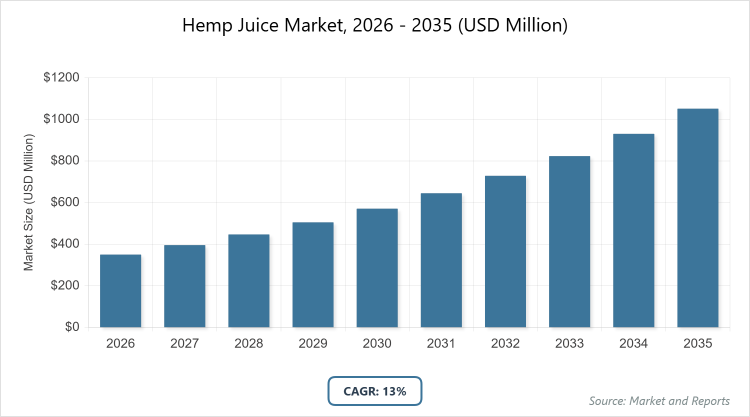
According to MarketnReports, the global Hemp Juice market size was estimated at USD 350 million in 2025 and is expected to reach USD 1,200 million by 2035, growing at a CAGR of 13% from 2026 to 2035. Rising consumer interest in natural, nutrient-rich functional beverages.
What are the Key Insights into the hemp juice market?
- The global Hemp Juice market was valued at USD 350 million in 2025 and is projected to reach USD 1,200 million by 2035.
- The market is expected to grow at a CAGR of 13% during the forecast period.
- The market is driven by growing demand for plant-based, nutrient-dense beverages amid health and wellness trends.
- In the type segment, organic hemp juice dominates with 65% share due to consumer preference for clean-label, chemical-free products with higher perceived health benefits.
- In the application segment, health & wellness dominates with 55% share as it aligns with functional beverage trends emphasizing nutrition and preventive health.
- In the end-user segment, individual consumers dominate with 45% share owing to direct retail purchases for personal health routines.
- North America dominates the regional market with 45% share because of favorable hemp regulations, high consumer awareness, and strong demand for functional foods.
What is the Hemp Juice Market?
Industry Overview
The hemp juice market involves the production, processing, and distribution of beverages derived from the leaves and stalks of industrial hemp plants, which are rich in omega fatty acids, vitamins, antioxidants, and other bioactive compounds without psychoactive THC content. This market focuses on cold-pressed or minimally processed juices that promote health benefits such as improved digestion, reduced inflammation, and enhanced nutrition, serving as a plant-based alternative to traditional juices. Market definition includes organic and conventional variants, packaged for direct consumption or incorporation into smoothies and functional drinks, emphasizing sustainability through eco-friendly cultivation and alignment with wellness trends in the broader functional beverage sector.
What are the Market Dynamics Shaping the Hemp Juice Market?
Growth Drivers
Growth drivers in the hemp juice market are rooted in increasing consumer awareness of hemp’s nutritional profile, including essential fatty acids and antioxidants, which position it as a superfood beverage in the wellness space. Legalization of industrial hemp in key regions has expanded cultivation and supply chains, enabling wider availability and innovation in flavors and formulations. Rising demand for plant-based alternatives amid vegan and clean-eating trends boosts adoption, while e-commerce growth facilitates access to niche products. Additionally, marketing by health influencers and endorsements highlighting benefits like immune support drive mainstream acceptance and sales in retail channels.
Restraints
Restraints in the hemp juice market include regulatory hurdles, as varying global laws on hemp cultivation and labeling create compliance challenges and limit export opportunities. The bitter taste and green color of pure hemp juice can deter mainstream consumers, requiring masking agents that may compromise natural appeal. Limited awareness in some markets and competition from established functional beverages like green juices or kombucha restrict penetration. High production costs from specialized processing and short shelf life further elevate prices, making it less accessible in price-sensitive segments.
Opportunities
Opportunities in the hemp juice market emerge from product innovation, such as flavored variants and ready-to-drink formats that improve palatability and appeal to younger demographics. Expanding into emerging markets with growing health consciousness offers growth potential through localized production and partnerships. Integration into functional blends with superfoods or probiotics can create premium offerings, while sustainability certifications attract eco-aware consumers. Additionally, rising interest in preventive health post-pandemic positions hemp juice for expansion in wellness retail and online channels.
Challenges
Challenges in the hemp juice market involve overcoming consumer misconceptions about hemp’s association with cannabis, which requires education and transparent labeling. Supply chain inconsistencies due to agricultural dependencies and seasonal variations affect availability and quality. Intense competition from synthetic or other plant-based juices demands differentiation through efficacy claims, while scaling production without compromising organic standards remains difficult. Furthermore, navigating evolving regulations on health claims and THC traces poses ongoing compliance risks.
Hemp Juice Market: Report Scope
| Report Attributes | Report Details |
| Report Name | Hemp Juice Market |
| Market Size 2025 | USD 350 Million |
| Market Forecast 2035 | USD 1,200 Million |
| Growth Rate | CAGR of 13% |
| Report Pages | 220 |
| Key Companies Covered |
Blue Moon Hemp, Cloud 9 Hemp, HANOJU, HempJuiced, Manitoba Harvest, Nutiva, and Others |
| Segments Covered | By Type, By Application, By End-User, and By Region |
| Regions Covered | North America, Europe, Asia Pacific (APAC), Latin America, and The Middle East and Africa (MEA) |
| Base Year | 2025 |
| Historical Year | 2020 – 2024 |
| Forecast Year | 2026 – 2035 |
| Customization Scope | Avail customized purchase options to meet your exact research needs. |
How is the Market Segmentation Structured in the Hemp Juice Market?
The Hemp Juice market is segmented by type, application, end-user, and region.
Based on Type Segment, organic hemp juice is the most dominant subsegment, followed by conventional hemp juice as the second most dominant. Organic hemp juice dominates due to strong consumer preference for pesticide-free, sustainable products that align with clean-label trends, driving the market by commanding premium pricing and loyalty in health-focused retail; conventional hemp juice supports growth through affordability and wider availability, enabling mass-market penetration in developing regions.
Based on Application Segment, health & wellness is the most dominant subsegment, followed by food & beverage as the second most dominant. Health & wellness leads because consumers seek nutrient-rich options for daily nutrition and preventive care, propelling the market by integrating hemp juice into supplements and functional drinks that enhance brand positioning; food & beverage gains traction through incorporation into smoothies and recipes, driving growth via versatility and appeal to culinary trends.
Based on End-User Segment, individual consumers are the most dominant subsegment, followed by retailers as the second most dominant. Individual consumers dominate due to direct purchases for personal health benefits, accelerating market expansion through repeat buys and word-of-mouth; retailers thrive on shelf space in health stores, propelling the market by facilitating broader distribution and visibility.
What are the Recent Developments in the Hemp Juice Market?
- In late 2025, several brands expanded flavored organic hemp juice lines to improve taste profiles and attract new consumers in North America and Europe.
- In 2025, partnerships between hemp cultivators and beverage companies focused on sustainable sourcing for cold-pressed hemp juice products.
- In 2024, innovations in packaging extended shelf life for hemp juice, enabling wider retail distribution.
How does Regional Analysis Impact the Hemp Juice Market?
- North America is expected to dominate the global market.
North America leads the hemp juice market, driven by progressive hemp legislation, high wellness spending, and a mature functional beverage sector; the United States dominates as the key country, with strong retail presence and consumer education supporting premium organic variants.
Europe shows steady growth in the hemp juice market, supported by EU hemp cultivation approvals and demand for natural products; Germany emerges as the dominating country, leveraging its health food market and strict organic standards.
Asia Pacific exhibits rapid expansion in the hemp juice market, fueled by rising middle-class health awareness and agricultural potential; China dominates as the key country, with increasing domestic production and export focus.
Latin America presents emerging opportunities in the hemp juice market, aided by natural resource availability; Brazil stands out as the dominating country, with growing interest in plant-based wellness.
The Middle East and Africa represent nascent growth in the hemp juice market, driven by health trends; South Africa emerges as a key player, with agricultural initiatives supporting local production.
Who are the Key Market Players in the Hemp Juice Market?
- Blue Moon Hemp focuses on organic, cold-pressed juices with emphasis on purity and sustainability to build loyal health-conscious customer bases.
- Cloud 9 Hemp pursues innovation in flavored variants and online distribution to expand reach in wellness channels.
- HANOJU leverages European market expertise for high-quality organic offerings, prioritizing certifications and export growth.
- HempJuiced emphasizes nutrient-dense formulations and partnerships with retailers for broader accessibility.
- Manitoba Harvest integrates hemp juice into broader hemp product lines, focusing on nutritional benefits and brand trust.
- Nutiva adopts a sustainable sourcing strategy, targeting health food stores with versatile hemp beverages.
What are the Market Trends in the Hemp Juice Market?
- Increasing preference for organic and cold-pressed variants for maximum nutrient retention.
- Rise in flavored and blended hemp juices to enhance palatability.
- Growth in e-commerce and direct-to-consumer sales for niche products.
- Emphasis on sustainability certifications and transparent supply chains.
- Integration into functional beverages with added superfoods.
- Rising demand in wellness and preventive health applications.
- Expansion of ready-to-drink formats for convenience.
What Market Segments and their Subsegments are Covered in the Hemp Juice Report?
By Type
- Organic Hemp Juice
- Conventional Hemp Juice
- Flavored Hemp Juice
- Unflavored Hemp Juice
- Others
By Application
- Health & Wellness
- Food & Beverage
- Cosmetics
- Pharmaceuticals
- Others
By End-User
- Individual Consumers
- Retailers
- Food Service
- Online Platforms
- Institutional Buyers
- Others
By Region
- North America
- U.S.
- Canada
- Europe
- UK
- Germany
- France
- Rest of Europe
- Asia Pacific
- China
- India
- Japan
- Rest of Asia Pacific
- Latin America
- Brazil
- Mexico
- Rest of Latin America
- Middle East & Africa
- UAE
- South Africa
- Rest of Middle East & Africa
Chapter 1. Preface
Chapter 2. Executive Summary
Chapter 3. Global Hemp Juice Market - Industry Analysis
Chapter 4. Global Hemp Juice Market- Competitive Landscape
Chapter 5. Global Hemp Juice Market - Type Analysis
Chapter 6. Global Hemp Juice Market - Application Analysis
Chapter 7. Global Hemp Juice Market - End-User Analysis
Chapter 8. Hemp Juice Market - Regional Analysis
Chapter 9. Company Profiles
Frequently Asked Questions
Hemp juice is a beverage made from the leaves and stalks of industrial hemp plants, offering nutritional benefits like omega fatty acids and vitamins without psychoactive effects.
Key factors include health awareness, legalization, functional beverage trends, and sustainability preferences.
The hemp juice market is projected to grow from USD 350 million in 2025 to USD 1,200 million by 2035.
The market is expected to grow at a CAGR of 13% from 2026 to 2035.
North America will contribute notably, holding around 45% market share due to regulatory support and wellness demand.
Major players include Blue Moon Hemp, Cloud 9 Hemp, HANOJU, HempJuiced, Manitoba Harvest, and Nutiva, driving growth through innovation and sustainability.
The report provides detailed analysis including market size, trends, segmentation, regional insights, key players, and forecasts from 2026 to 2035.
Stages include cultivation, harvesting, processing (cold-pressing), packaging, distribution, and retail sales.
Trends shift toward organic, flavored, and functional blends, with consumers favoring nutrient-rich, sustainable options.
Factors include hemp legalization, organic certifications, and sustainability mandates promoting eco-friendly cultivation.