
Smart Home Market Size, Share and Trends 2026 to 2035
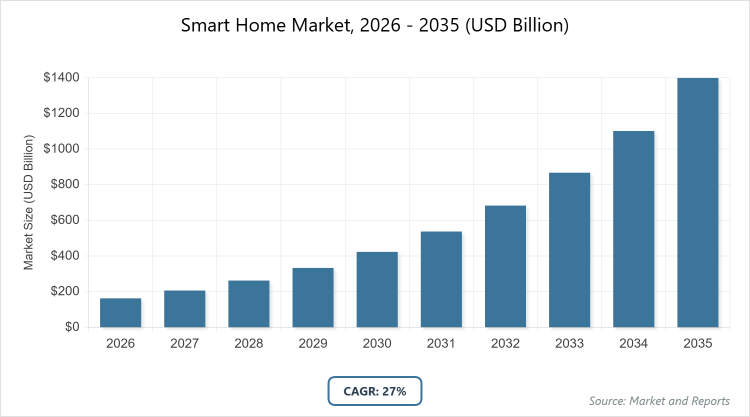
According to MarketnReports, the global Smart Home market size was estimated at USD 162.78 billion in 2025 and is expected to reach USD 1777 billion by 2035, growing at a CAGR of 27% from 2026 to 2035. Smart Home Market is driven by increasing adoption of IoT and AI technologies for enhanced home automation and energy efficiency.
What are the Key Insights of the Smart Home Market?
- The global Smart Home market was valued at USD 162.78 billion in 2025 and is projected to reach USD 1777 billion by 2035.
- The market is expected to grow at a CAGR of 27% during the forecast period from 2026 to 2035.
- The Smart Home market is driven by increasing demand for energy-efficient solutions, enhanced security systems, and AI-integrated devices.
- The Security & Access Controls subsegment dominated the product segment with over 29% share due to rising concerns over home safety and the need for real-time monitoring and remote access.
- The Hybrid Protocols subsegment dominated the protocol segment with the largest market share as it offers flexible connectivity combining wired and wireless advantages for reliable performance.
- The Retrofit subsegment dominated the application segment with the largest market share because it allows cost-effective upgrades to existing homes without major renovations.
- North America dominated the global market with over 25% share owing to high consumer adoption, advanced infrastructure, and government incentives for energy efficiency.
What is the Industry Overview of the Smart Home Market?
The smart home industry refers to the integration of connected devices and systems that automate and control various home functions, enhancing convenience, security, and energy efficiency. This market includes IoT-enabled appliances, lighting, security systems, and entertainment devices that can be managed remotely via smartphones, voice assistants, or centralized hubs. The market definition encompasses technologies that create intelligent living spaces by enabling seamless communication between devices, allowing users to monitor and optimize their home environments for comfort, sustainability, and safety. As consumer lifestyles evolve towards digitalization, the smart home sector continues to expand, driven by advancements in wireless connectivity and artificial intelligence.
What are the Market Dynamics in the Smart Home Market?
Growth Drivers
The primary growth drivers in the smart home market include the escalating demand for enhanced security and surveillance systems, as consumers prioritize protection against theft and intrusions through smart cameras, locks, and motion sensors that provide real-time alerts. Additionally, the push for energy-saving and low-carbon solutions is fueling adoption, with devices like smart thermostats and lighting controls reducing utility costs and environmental impact. Advancements in AI and IoT technologies are enabling seamless device integration and personalized user experiences, further accelerating market expansion. High disposable incomes, widespread internet penetration, and government incentives for sustainable living in developed regions also contribute significantly to this growth.
Restraints
Key restraints hindering the smart home market include high initial installation costs, which can deter budget-conscious consumers, especially in emerging economies where affordability remains a challenge. Privacy and cybersecurity concerns pose significant barriers, as interconnected devices are vulnerable to hacking and data breaches, eroding consumer trust. Interoperability issues among devices from different manufacturers complicate integration, leading to fragmented ecosystems that frustrate users. Moreover, limited awareness and technical expertise in certain demographics, coupled with unreliable internet infrastructure in rural areas, restrict broader market penetration.
Opportunities
Opportunities in the smart home market are abundant, particularly in the expansion of home healthcare solutions tailored for aging populations, offering remote monitoring, emergency alerts, and automated assistance to improve quality of life. The integration of AI and machine learning in wireless protocols presents avenues for more efficient, secure, and personalized automation systems. Growth in new construction projects incorporating built-in smart technologies from the outset provides a lucrative segment, especially in urbanizing regions. Emerging markets in Asia Pacific, with improving digital infrastructure and rising middle-class incomes, offer untapped potential for widespread adoption of connected devices.
Challenges
Challenges facing the smart home market encompass cybersecurity threats, as the proliferation of IoT devices increases the risk of vulnerabilities and requires robust protective measures. Ensuring device compatibility across brands remains a hurdle, demanding standardized protocols to avoid ecosystem silos. Regulatory compliance with evolving data privacy laws, such as GDPR, adds complexity for manufacturers and service providers. Additionally, supply chain disruptions and fluctuating raw material costs can impact production and pricing stability, while educating consumers on the benefits and usage of advanced technologies is essential to overcome resistance to change.
Smart Home Market: Report Scope
| Report Attributes | Report Details |
| Report Name | Smart Home Market |
| Market Size 2025 | USD 162.78 Billion |
| Market Forecast 2035 | USD 1777 Billion |
| Growth Rate | CAGR of 27% |
| Report Pages | 220 |
| Key Companies Covered | Siemens AG, Schneider Electric SE, Assa Abloy AB, Philips Lighting B.V. (Signify), LG Electronics, Inc., Amazon.com, Inc., Google Nest (Google LLC), Samsung Electronics Co., Ltd., Legrand S.A., Robert Bosch GmbH, and Others |
| Segments Covered | By Product, By Protocol, By Application, and By Region |
| Regions Covered | North America, Europe, Asia Pacific (APAC), Latin America, and The Middle East and Africa (MEA) |
| Base Year | 2025 |
| Historical Year | 2020 – 2024 |
| Forecast Year | 2026 – 2035 |
| Customization Scope | Avail customized purchase options to meet your exact research needs. |
What is the Market Segmentation of the Smart Home Market?
The Smart Home market is segmented by product, protocol, application, and region.
Based on Product Segment, the Security & Access Controls emerged as the most dominant subsegment with over 29% market share, driven by heightened consumer focus on home safety amid rising crime rates and the convenience of remote monitoring; this dominance helps propel the overall market by addressing core user needs for protection, thereby increasing adoption of integrated smart systems. The Lighting Control subsegment was the second most dominant, benefiting from energy efficiency demands and easy integration with voice assistants, which drives market growth through cost savings and enhanced user convenience in daily living.
Based on Protocol Segment, the Hybrid Protocols was the most dominant subsegment, holding the largest share due to its ability to combine the reliability of wired connections with the flexibility of wireless, making it ideal for comprehensive home setups; this leads market growth by enabling seamless interoperability and robust performance in diverse environments. The Wireless Protocols subsegment ranked second, propelled by advancements like Wi-Fi 6 and 5G for faster, more reliable connectivity, which accelerates market expansion through easier installations and broader device compatibility.
Based on Application Segment, the Retrofit was the most dominant subsegment, capturing the largest share as it allows upgrades to existing homes without extensive modifications, appealing to a wide consumer base; this drives the market by making smart technology accessible and affordable, boosting overall penetration rates. The New Construction subsegment was second, growing rapidly due to the integration of smart features in new builds from the design phase, which propels market growth by setting standards for future-proof homes and encouraging builder adoption.
What are the Recent Developments in the Smart Home Market?
- In February 2025, Amazon.com, Inc. unveiled Alexa+, an upgraded AI-powered virtual assistant integrating generative AI for natural conversations, contextual understanding, and autonomous task handling, enhancing user interaction and personalization in smart homes.
- In September 2024, Schneider Electric SE launched an AI-powered energy management feature on its Wiser Home app, optimizing consumption for water heaters and EV chargers based on user habits, weather, and tariffs to reduce bills and promote efficiency.
- In August 2024, LG Electronics unveiled the ThinQ AI Home Hub at IFA 2024, acting as a central control for smart appliances with AI-driven personalization and routine streamlining, improving overall home automation experiences.
What is the Regional Analysis of the Smart Home Market?
- North America to dominate the global market
North America: This region holds the largest market share of over 25%, driven by advanced technological infrastructure, high disposable incomes, and strong consumer demand for convenience and security; the United States dominates with a 72% share within the region, fueled by widespread adoption of smart thermostats, cameras, and AI integrations, supported by government incentives for energy conservation and a tech-savvy population that prioritizes home automation for enhanced living standards.
Asia Pacific: As the fastest-growing region with a projected CAGR of over 28%, Asia Pacific benefits from rapid urbanization, improving internet infrastructure, and a burgeoning middle class; China leads the dominance here, propelled by government smart city initiatives, investments from tech giants like Alibaba, and integration of 5G and AI in devices, enabling affordable and scalable smart home solutions amid increasing demands for energy efficiency and security.
Europe: Europe is anticipated to grow at a CAGR of over 26%, emphasizing sustainability and energy savings through smart device integrations; Germany stands out as the dominating country, driven by a focus on automation, environmental benefits, and incentives for energy-efficient technologies, with consumers adopting systems that reduce carbon footprints and enhance home convenience.
Latin America: This region shows emerging potential with gradual adoption influenced by urban growth and improving connectivity; Brazil dominates, supported by increasing awareness of smart security and energy management, though challenges like economic variability limit faster expansion, offering opportunities for affordable entry-level devices.
Middle East and Africa (MEA): MEA exhibits nascent growth driven by smart city projects and rising affluence in urban areas; the United Arab Emirates leads, with investments in high-tech infrastructure and demand for luxury smart homes integrating security and climate control, aided by government pushes for digital transformation.
Who are the Key Market Players in the Smart Home Market?
Siemens AG: Siemens AG focuses on technological leadership in automation and digitalization, offering smart home products like thermostats, lighting controls, and security systems; their strategies emphasize energy management, IoT integration, and partnerships to enhance efficiency and user convenience in connected environments.
Schneider Electric SE: Schneider Electric SE specializes in energy management and automation, providing connected devices for lighting, heating, and security; their strategies involve leveraging IoT and data analytics to optimize usage, reduce costs, and promote sustainable smart home solutions through innovative apps and AI features.
Assa Abloy AB: Assa Abloy AB excels in access solutions, offering smart locks and keyless entry systems; their strategies center on enhancing home security with digital technologies, focusing on user-friendly integrations and collaborations to expand market reach in residential automation.
Philips Lighting B.V. (Signify): Philips Lighting B.V., now Signify, provides energy-efficient smart lighting products controllable via apps and voice; their strategies include IoT-enabled systems for personalized lighting, emphasizing sustainability and partnerships with voice assistant platforms to drive adoption.
LG Electronics, Inc.: LG Electronics, Inc. offers a range of smart appliances and hubs like ThinQ AI; their strategies involve AI personalization, seamless connectivity, and product innovation to create integrated home ecosystems that improve daily routines and energy efficiency.
Amazon.com, Inc.: Amazon.com, Inc. leads with Alexa-enabled devices and ecosystems; their strategies focus on generative AI advancements, voice control, and expansive partnerships to deliver intuitive, autonomous smart home experiences across security, entertainment, and automation.
Google Nest (Google LLC): Google Nest provides integrated devices like thermostats and cameras; their strategies emphasize AI-driven insights, energy savings, and compatibility with Google Assistant to build secure, efficient smart homes through data analytics and user-centric designs.
Samsung Electronics Co., Ltd.: Samsung Electronics Co., Ltd. offers SmartThings platform for device connectivity; their strategies include IoT integration, 5G support, and AI enhancements to create versatile, user-friendly smart home solutions that span appliances and entertainment.
Legrand S.A.: Legrand S.A. focuses on electrical and digital infrastructures for smart homes; their strategies involve modular systems for lighting and security, prioritizing interoperability and energy management to cater to retrofit and new construction needs.
Robert Bosch GmbH: Robert Bosch GmbH provides smart home solutions in security and appliances; their strategies leverage IoT and AI for reliable, secure systems, emphasizing innovation and global partnerships to advance home automation technologies.
What are the Market Trends in the Smart Home Market?
- Surge in AI-powered devices enhancing automation and personalized user experiences.
- Integration of voice assistants like Alexa, Google Assistant, and Siri for hands-free control.
- Growing focus on energy efficiency through smart thermostats, lighting, and appliances.
- Rise of IoT for seamless device communication and optimization.
- Increasing demand for advanced security solutions with real-time monitoring and AI surveillance.
- Shift towards hybrid protocols for flexible and reliable connectivity.
- Expansion in retrofit applications for affordable upgrades to existing homes.
- Boom in home healthcare devices amid aging populations and health awareness.
- Adoption of smart technologies in new constructions for future-proof designs.
- Proliferation of 5G and Wi-Fi 6 enabling robust multi-device ecosystems.
What Market Segments and their Subsegments are Covered in the Report?
By Product
- Security & Access Controls
- Lighting Control
- Entertainment Devices
- HVAC Control
- Smart Kitchen Appliances
- Home Appliances
- Smart Furniture
- Home Healthcare
- Other Devices
By Protocol
- Wireless Protocols
- Wired Protocols
- Hybrid Protocols
By Application
- New Construction
- Retrofit
By Region
- North America
- U.S.
- Canada
- Europe
- UK
- Germany
- France
- Rest of Europe
- Asia Pacific
- China
- India
- Japan
- Rest of Asia Pacific
- Latin America
- Brazil
- Mexico
- Rest of Latin America
- Middle East & Africa
- UAE
- South Africa
- Rest of Middle East & Africa
Chapter 1. Preface
1.1 Report Description and Scope1.2 Research Scope1.3 Research Methodology1.3.1 Market Research Type1.3.2 Market Research MethodologyChapter 2. Executive Summary
2.1 Global Smart Home Market, (2026 - 2035) (USD Billion)2.2 Global Smart Home Market: SnapshotChapter 3. Global Smart Home Market - Industry Analysis
3.1 Smart Home Market: Market Dynamics3.2 Market Drivers3.2.1 The smart home market is driven by rising demand for security and surveillance, energy-efficient solutions, AI and IoT integration, higher disposable incomes, widespread internet access, and government incentives for sustainable living.3.3 Market Restraints3.3.1 The smart home market is restrained by high installation costs, privacy and cybersecurity risks, interoperability challenges, limited user awareness and technical skills, and unreliable internet infrastructure in many regions.3.4 Market Opportunities3.4.1 The smart home market presents opportunities through growth in home healthcare solutions, AI-driven automation, smart-enabled new construction, and expanding adoption in emerging markets—especially in Asia Pacific.3.5 Market Challenges3.5.1 The smart home market faces challenges from cybersecurity risks, device compatibility issues, evolving data privacy regulations, supply chain disruptions, and the need for consumer education on advanced technologies.3.6 Porter’s Five Forces Analysis3.7 Market Attractiveness Analysis3.7.1 Market Attractiveness Analysis By Product3.7.2 Market Attractiveness Analysis By Protocol3.7.3 Market Attractiveness Analysis By ApplicationChapter 4. Global Smart Home Market- Competitive Landscape
4.1 Company Market Share Analysis4.1.1 Global Smart Home Market: Company Market Share, 20254.2 Strategic Development4.2.1 Acquisitions & mergers4.2.2 New Product launches4.2.3 Agreements, partnerships, collaborations, and joint ventures4.2.4 Research and development and regional expansion4.3 Price Trend AnalysisChapter 5. Global Smart Home Market - Product Analysis
5.1 Global Smart Home Market Overview: Product5.1.1 Global Smart Home Market share, By Product, 2025 and 20355.2 Security & Access Controls5.2.1 Global Smart Home Market by Security & Access Controls, 2026 - 2035 (USD Billion)5.3 Lighting Control5.3.1 Global Smart Home Market by Lighting Control, 2026 - 2035 (USD Billion)5.4 Entertainment Devices5.4.1 Global Smart Home Market by Entertainment Devices, 2026 - 2035 (USD Billion)5.5 HVAC Control5.5.1 Global Smart Home Market by HVAC Control, 2026 - 2035 (USD Billion)5.6 Smart Kitchen Appliances5.6.1 Global Smart Home Market by Smart Kitchen Appliances, 2026 - 2035 (USD Billion)5.7 Home Appliances5.7.1 Global Smart Home Market by Home Appliances, 2026 - 2035 (USD Billion)5.8 Smart Furniture5.8.1 Global Smart Home Market by Smart Furniture, 2026 - 2035 (USD Billion)5.9 Home Healthcare5.9.1 Global Smart Home Market by Home Healthcare, 2026 - 2035 (USD Billion)5.10 Other Devices5.10.1 Global Smart Home Market by Other Devices, 2026 - 2035 (USD Billion)Chapter 6. Global Smart Home Market - Protocol Analysis
6.1 Global Smart Home Market Overview: Protocol6.1.1 Global Smart Home Market Share, By Protocol, 2025 and 20356.2 Wireless Protocols6.2.1 Global Smart Home Market by Wireless Protocols, 2026 - 2035 (USD Billion)6.3 Wired Protocols6.3.1 Global Smart Home Market by Wired Protocols, 2026 - 2035 (USD Billion)6.4 Hybrid Protocols6.4.1 Global Smart Home Market by Hybrid Protocols, 2026 - 2035 (USD Billion)Chapter 7. Global Smart Home Market - Application Analysis
7.1 Global Smart Home Market Overview: Application7.1.1 Global Smart Home Market Share, By Application, 2025 and 20357.2 New Construction7.2.1 Global Smart Home Market by New Construction, 2026 - 2035 (USD Billion)7.3 Retrofit7.3.1 Global Smart Home Market by Retrofit, 2026 - 2035 (USD Billion)Chapter 8. Smart Home Market - Regional Analysis
8.1 Global Smart Home Market Regional Overview8.2 Global Smart Home Market Share, by Region, 2025 & 2035 (USD Billion)8.3 North America8.3.1 North America Smart Home Market, 2026 - 2035 (USD Billion)8.3.1.1 North America Smart Home Market, by Country, 2026 - 2035 (USD Billion)8.3.2 North America Smart Home Market, by Product, 2026 - 20358.3.2.1 North America Smart Home Market, by Product, 2026 - 2035 (USD Billion)8.3.3 North America Smart Home Market, by Protocol, 2026 - 20358.3.3.1 North America Smart Home Market, by Protocol, 2026 - 2035 (USD Billion)8.3.4 North America Smart Home Market, by Application, 2026 - 20358.3.4.1 North America Smart Home Market, by Application, 2026 - 2035 (USD Billion)8.4 Europe8.4.1 Europe Smart Home Market, 2026 - 2035 (USD Billion)8.4.1.1 Europe Smart Home Market, by Country, 2026 - 2035 (USD Billion)8.4.2 Europe Smart Home Market, by Product, 2026 - 20358.4.2.1 Europe Smart Home Market, by Product, 2026 - 2035 (USD Billion)8.4.3 Europe Smart Home Market, by Protocol, 2026 - 20358.4.3.1 Europe Smart Home Market, by Protocol, 2026 - 2035 (USD Billion)8.4.4 Europe Smart Home Market, by Application, 2026 - 20358.4.4.1 Europe Smart Home Market, by Application, 2026 - 2035 (USD Billion)8.5 Asia Pacific8.5.1 Asia Pacific Smart Home Market, 2026 - 2035 (USD Billion)8.5.1.1 Asia Pacific Smart Home Market, by Country, 2026 - 2035 (USD Billion)8.5.2 Asia Pacific Smart Home Market, by Product, 2026 - 20358.5.2.1 Asia Pacific Smart Home Market, by Product, 2026 - 2035 (USD Billion)8.5.3 Asia Pacific Smart Home Market, by Protocol, 2026 - 20358.5.3.1 Asia Pacific Smart Home Market, by Protocol, 2026 - 2035 (USD Billion)8.5.4 Asia Pacific Smart Home Market, by Application, 2026 - 20358.5.4.1 Asia Pacific Smart Home Market, by Application, 2026 - 2035 (USD Billion)8.6 Latin America8.6.1 Latin America Smart Home Market, 2026 - 2035 (USD Billion)8.6.1.1 Latin America Smart Home Market, by Country, 2026 - 2035 (USD Billion)8.6.2 Latin America Smart Home Market, by Product, 2026 - 20358.6.2.1 Latin America Smart Home Market, by Product, 2026 - 2035 (USD Billion)8.6.3 Latin America Smart Home Market, by Protocol, 2026 - 20358.6.3.1 Latin America Smart Home Market, by Protocol, 2026 - 2035 (USD Billion)8.6.4 Latin America Smart Home Market, by Application, 2026 - 20358.6.4.1 Latin America Smart Home Market, by Application, 2026 - 2035 (USD Billion)8.7 The Middle-East and Africa8.7.1 The Middle-East and Africa Smart Home Market, 2026 - 2035 (USD Billion)8.7.1.1 The Middle-East and Africa Smart Home Market, by Country, 2026 - 2035 (USD Billion)8.7.2 The Middle-East and Africa Smart Home Market, by Product, 2026 - 20358.7.2.1 The Middle-East and Africa Smart Home Market, by Product, 2026 - 2035 (USD Billion)8.7.3 The Middle-East and Africa Smart Home Market, by Protocol, 2026 - 20358.7.3.1 The Middle-East and Africa Smart Home Market, by Protocol, 2026 - 2035 (USD Billion)8.7.4 The Middle-East and Africa Smart Home Market, by Application, 2026 - 20358.7.4.1 The Middle-East and Africa Smart Home Market, by Application, 2026 - 2035 (USD Billion)Chapter 9. Company Profiles
9.1 Siemens AG9.1.1 Overview9.1.2 Financials9.1.3 Product Portfolio9.1.4 Business Strategy9.1.5 Recent Developments9.2 Schneider Electric SE9.2.1 Overview9.2.2 Financials9.2.3 Product Portfolio9.2.4 Business Strategy9.2.5 Recent Developments9.3 Assa Abloy AB9.3.1 Overview9.3.2 Financials9.3.3 Product Portfolio9.3.4 Business Strategy9.3.5 Recent Developments9.4 Philips Lighting B.V. (Signify)9.4.1 Overview9.4.2 Financials9.4.3 Product Portfolio9.4.4 Business Strategy9.4.5 Recent Developments9.5 LG Electronics Inc.9.5.1 Overview9.5.2 Financials9.5.3 Product Portfolio9.5.4 Business Strategy9.5.5 Recent Developments9.6 Amazon.com9.6.1 Overview9.6.2 Financials9.6.3 Product Portfolio9.6.4 Business Strategy9.6.5 Recent Developments9.7 Google Nest (Google LLC)9.7.1 Overview9.7.2 Financials9.7.3 Product Portfolio9.7.4 Business Strategy9.7.5 Recent Developments9.8 Samsung Electronics Co.Ltd.9.8.1 Overview9.8.2 Financials9.8.3 Product Portfolio9.8.4 Business Strategy9.8.5 Recent Developments9.9 Legrand S.A.9.9.1 Overview9.9.2 Financials9.9.3 Product Portfolio9.9.4 Business Strategy9.9.5 Recent Developments9.10 Robert Bosch GmbH9.10.1 Overview9.10.2 Financials9.10.3 Product Portfolio9.10.4 Business Strategy9.10.5 Recent Developments
Frequently Asked Questions
Smart homes refer to residences equipped with connected devices and systems that automate functions like lighting, security, heating, and appliances, enabling remote control and optimization via IoT, AI, and internet connectivity for enhanced convenience, efficiency, and safety.
Key factors include advancements in AI and IoT, rising demand for energy-efficient and secure solutions, urbanization, government incentives for sustainability, and increasing consumer adoption of voice-assisted devices.
The Smart Home market is projected to grow from approximately USD 162.78 billion in 2025 to USD 1777 billion by 2035.
The CAGR value is expected to be 27% during 2026-2035.
North America will contribute notably, maintaining dominance with high adoption rates and advanced infrastructure.
Major players include Siemens AG, Schneider Electric SE, Assa Abloy AB, Philips Lighting B.V. (Signify), LG Electronics, Inc., Amazon.com, Inc., Google Nest (Google LLC), Samsung Electronics Co., Ltd., Legrand S.A., and Robert Bosch GmbH.
The report provides comprehensive analysis, including market size, trends, segmentation, regional insights, key players, growth drivers, and forecasts to aid strategic decision-making.
The value chain includes research and development, component manufacturing, device assembly, software integration, distribution and sales, installation services, and end-user support and maintenance.
Trends are shifting towards AI-driven personalization, sustainability-focused devices, and seamless integrations, with consumers preferring energy-efficient, secure, and voice-controlled systems for convenience.
Regulatory factors include data privacy laws like GDPR and cybersecurity standards, while environmental factors involve incentives for energy-efficient technologies and regulations promoting low-carbon solutions to combat climate change.