
Abrasion Resistant Coatings Market Size, Share, and Trends 2026 to 2035
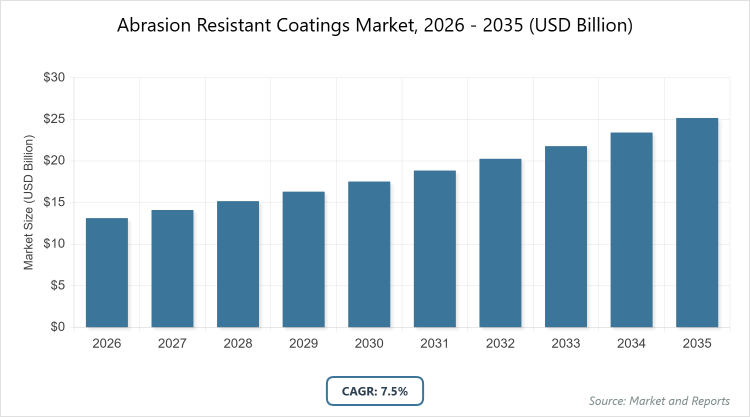
According to MarketnReports, the global Abrasion Resistant Coatings market size was estimated at USD 13.13 billion in 2025 and is expected to reach USD 27.06 billion by 2035, growing at a CAGR of 7.5% from 2026 to 2035. Abrasion Resistant Coatings Market is driven by increasing demand from industrial sectors for enhanced equipment durability and reduced maintenance costs.
What are the Key Insights into Abrasion Resistant Coatings?
- The global Abrasion Resistant Coatings market was valued at USD 13.13 billion in 2025 and is projected to reach USD 27.06 billion by 2035.
- The market is expected to grow at a CAGR of 7.5% during the forecast period from 2026 to 2035.
- The market is driven by expanding industrial activities, advancements in coating technologies, and rising focus on equipment longevity in sectors like oil & gas and mining.
- In the type segment, metal/ceramic coatings dominate with a 53% share due to their superior hardness and resistance in extreme conditions, ideal for heavy-duty applications.
- In the application segment, equipment protection dominates with a 40% share as it safeguards machinery from wear, extending operational life and reducing downtime.
- In the end-user segment, oil & gas dominates with a 25% share owing to high exposure to abrasive environments in drilling and pipelines.
- Asia Pacific dominates the regional market with a 35% share, driven by rapid industrialization, manufacturing growth in China and India, and cost-effective production capabilities.
What is the Industry Overview of Abrasion Resistant Coatings?
The Abrasion Resistant Coatings market comprises specialized protective layers applied to surfaces to withstand wear, erosion, and mechanical damage, utilizing materials like ceramics, polymers, and metals to extend the lifespan of equipment in harsh environments. Market definition includes coatings designed to resist abrasive forces from particles, friction, or impact, offering corrosion protection, thermal resistance, and improved performance in industries requiring robust surface treatments, while addressing challenges in application methods, environmental compliance, and customization for specific operational conditions.
What are the Market Dynamics of Abrasion Resistant Coatings?
Growth Drivers
The Abrasion Resistant Coatings market is propelled by the escalating need for durable surface protection in industries like oil & gas and mining, where coatings extend equipment life by resisting wear from sand, rocks, and chemicals, thereby reducing maintenance costs and downtime. Advancements in nanotechnology and hybrid formulations enhance coating performance, offering better adhesion, flexibility, and environmental resistance, attracting investments from manufacturers seeking sustainable solutions. Rising global infrastructure projects and renewable energy initiatives, such as wind turbines requiring blade protection, further drive demand. Regulatory pushes for low-VOC and eco-friendly coatings align with green manufacturing trends, fostering innovation and market expansion.
Restraints
High initial costs for advanced coatings and application equipment limit adoption among small and medium enterprises in developing regions, where traditional methods remain preferred due to budget constraints. Volatility in raw material prices, particularly for ceramics and specialty polymers, impacts profitability and supply chain stability. Stringent environmental regulations on solvent-based coatings increase compliance burdens, requiring reformulations that raise development expenses. Limited awareness and technical expertise in proper application techniques can lead to suboptimal performance, deterring potential users.
Opportunities
Opportunities exist in the development of smart coatings integrated with sensors for real-time wear monitoring, appealing to high-tech sectors like aerospace and automotive. Expansion into emerging markets with growing industrialization offers potential for affordable, localized solutions. Partnerships between coating manufacturers and end-users for custom formulations can address specific needs, while sustainable, bio-based materials attract eco-conscious consumers. The rise of electric vehicles and renewable energy infrastructure creates niches for specialized coatings protecting battery components and solar panels.
Challenges
Challenges include intense competition from alternative protection methods like liners and composites, which may offer similar benefits at lower costs. Rapid technological changes demand continuous R&D investment to stay competitive, straining resources for smaller players. Supply chain disruptions for critical raw materials, exacerbated by geopolitical tensions, affect availability. Ensuring consistent quality across diverse application environments requires rigorous testing, while evolving regulations on chemical safety complicate product approvals.
Abrasion Resistant Coatings Market: Report Scope
| Report Attributes | Report Details |
| Report Name | Abrasion Resistant Coatings Market |
| Market Size 2025 | USD 13.13 Billion |
| Market Forecast 2035 | USD 27.06 Billion |
| Growth Rate | CAGR of 7.5% |
| Report Pages | 205 |
| Key Companies Covered | AkzoNobel N.V., Saint-Gobain, Jotun A/S, The Sherwin-Williams Company, Hempel A/S, Praxair Surface Technologies, Henkel, Sika AG, and Others |
| Segments Covered | By Type, By Application, By End-User, and By Region |
| Regions Covered | North America, Europe, Asia Pacific (APAC), Latin America, and The Middle East and Africa (MEA) |
| Base Year | 2025 |
| Historical Year | 2020 – 2024 |
| Forecast Year | 2026 – 2035 |
| Customization Scope | Avail customized purchase options to meet your exact research needs. |
What is the Market Segmentation of Abrasion Resistant Coatings?
The Abrasion Resistant Coatings market is segmented by type, application, end-user, and region.
By Type. Metal/ceramic coatings are the most dominant subsegment, holding approximately 53% market share, due to their exceptional hardness and thermal stability, making them ideal for harsh industrial conditions. This dominance drives the market by providing long-lasting protection that reduces replacement frequency and operational costs in demanding applications. Polymer coatings rank as the second most dominant, with around 47% share, offering flexibility and corrosion resistance, propelling growth through versatile use in lighter-duty environments and easier application methods.
By Application. Equipment protection emerges as the most dominant subsegment, capturing about 40% share, primarily because it safeguards machinery from abrasive wear in continuous operations. This leads to market growth by enhancing asset longevity and efficiency across industries. Pipeline coatings follow as the second most dominant, with roughly 20% share, preventing erosion in fluid transport systems, driving the market via improved infrastructure durability and reduced leaks.
By End-User. Oil & gas represents the most dominant subsegment at about 25% share, driven by exposure to abrasive particles in exploration and extraction. This dominance accelerates market expansion through high-volume demand for protective solutions in critical operations. Power generation ranks second most dominant, holding around 15% share, due to turbine and generator protection needs, contributing to growth via reliable energy production.
What are the Recent Developments in Abrasion Resistant Coatings?
- In July 2022, AkzoNobel’s marine coatings division, International, unveiled an upgraded edition of its Interzone 945 product for enhanced damage protection, specifically the Interzone 945GF, offering robust abrasion and impact protection for offshore and chemical environments.
- In September 2022, Extreme Coatings introduced a new High Velocity Oxygen Fuel (HVOF) coating system for internal diameters, designed for oil and gas and industrial components, providing a high-performance tungsten carbide nano coating.
- In November, Sherwin-Williams announced the launch of a new line of eco-friendly abrasion resistant coatings aimed at the automotive sector, aligning with sustainability trends and positioning the company to capture a larger market share.
- In October, BASF expanded its production capabilities in Asia by investing €50 million in a new facility dedicated to the manufacturing of high-performance coatings, enhancing supply for regional demands.
- In September, PPG Industries entered into a strategic partnership with a leading technology firm to integrate AI-driven analytics into its manufacturing processes, improving coating efficiency and innovation.
What is the Regional Analysis of Abrasion Resistant Coatings?
- Asia Pacific to dominate the global market.
Asia Pacific holds the largest share at approximately 35%, with China as the dominating country, due to rapid industrialization, massive manufacturing bases, and government initiatives promoting infrastructure development. This region’s growth is fueled by low-cost labor, abundant raw materials, and increasing investments in oil & gas and mining, positioning it as a key hub for coating production and consumption. High urbanization rates drive demand in the construction and transportation sectors. India’s Make in India campaign boosts local manufacturing of coatings. Southeast Asian nations like Vietnam expand through foreign direct investments. Environmental policies push for low-VOC innovations. Strong export networks enhance global supply chains.
North America follows closely, driven by advanced technological adoption and stringent safety standards, where the United States dominates through its robust energy sector and R&D investments. Growth stems from shale gas exploration and renewable energy projects requiring durable coatings, though higher costs moderate expansion. Canadian oil sands operations demand specialized solutions for harsh climates. Government subsidies for green energy promote sustainable coatings. The region’s focus on aerospace and automotive industries requires high-performance materials. Collaborations between universities and companies foster innovation in nanotechnology.
Europe exhibits strong performance with emphasis on sustainability and regulation, led by Germany through its engineering excellence and firms like BASF. The region’s expansion benefits from EU environmental policies favoring low-VOC coatings and a focus on the marine and power industries. Horizon Europe funds research in eco-friendly formulations. The UK’s offshore wind farms increase demand for marine protection. Multilingual compliance aids exports to diverse markets like France and Italy. Circular economy initiatives recycle coating waste, reducing environmental impact.
Latin America shows steady but moderate advancement, dominated by Brazil’s oil & gas and mining sectors, supported by foreign investments, though limited by economic fluctuations. Mexico benefits from NAFTA ties, enhancing trade with North America for supply chains. Government infrastructure plans in Argentina promote road and bridge protection. The rise of renewable projects in Chile creates niches for wind turbine coatings. However, political instability affects consistent investments. Emerging mining in Peru demands wear-resistant solutions for equipment.
The Middle East and Africa remain emerging, with the United Arab Emirates and Saudi Arabia leading through oil-funded infrastructure, constrained by lower diversification but showing potential via energy projects. Vision 2030 in Saudi Arabia invests in downstream chemical processing. South Africa’s mining industry adopts conveyor and pump protections. Technology transfers from European partners build local expertise in Egypt. However, water scarcity influences waterborne coating preferences. Investments in solar farms create demand for dust-resistant surfaces in arid areas.
What are the Key Market Players in Abrasion Resistant Coatings?
- AkzoNobel N.V. AkzoNobel focuses on innovative marine and industrial coatings like Interzone series, investing in sustainable formulations to meet environmental regulations and expand in offshore markets.
- Saint-Gobain. Saint-Gobain leverages ceramic expertise for high-performance abrasion solutions, strategizing on R&D for advanced materials in mining and construction.
- Jotun A/S. Jotun emphasizes protective coatings for harsh environments, pursuing global partnerships to enhance marine and oil & gas applications.
- The Sherwin-Williams Company. Sherwin-Williams develops eco-friendly lines, focusing on automotive and industrial segments through acquisitions and technology integration.
- Hempel A/S. Hempel invests in low-VOC coatings, targeting power generation and transportation with durable, corrosion-resistant products.
- Praxair Surface Technologies. Praxair specializes in thermal spray coatings, strategizing on aerospace and energy sectors for superior wear resistance.
- Henkel. Henkel offers polymer-based solutions, emphasizing adhesives and coatings for manufacturing efficiency.
- Sika AG. Sika focuses on construction and mining coatings, pursuing sustainability through bio-based innovations.
What are the Market Trends in Abrasion Resistant Coatings?
- Development of nano-enhanced coatings for superior durability.
- Shift toward eco-friendly, low-VOC formulations.
- Integration of smart coatings with self-healing properties.
- Rise of hybrid metal-polymer composites.
- Expansion of waterborne coatings for environmental compliance.
- Adoption of AI for coating performance prediction.
What Market Segments and Subsegments are Covered in the Abrasion Resistant Coatings Report?
By Type
- Oxide Coatings
- Carbide Coatings
- Nitride Coatings
- Epoxy Coatings
- Polyurethane Coatings
- Fluoropolymer Coatings
- Polyester Coatings
- Ceramic Coatings
- Polymer Coatings
- Composite Coatings
- Others
By Application
- Equipment Protection
- Pipeline Coatings
- Floor Coatings
- Machinery Coatings
- Tool Coatings
- Valve Coatings
- Pump Coatings
- Structural Coatings
- Vessel Coatings
- Wear Parts Coatings
- Others
By End-User
- Oil & Gas
- Marine
- Power Generation
- Transportation
- Mining
- Construction
- Manufacturing
- Aerospace
- Automotive
- Chemical Processing
- Others
By Region
-
- North America
- U.S.
- Canada
- Europe
- UK
- Germany
- France
- Rest of Europe
- Asia Pacific
- China
- India
- Japan
- Rest of Asia Pacific
- Latin America
- Brazil
- Mexico
- Rest of Latin America
- Middle East & Africa
- UAE
- South Africa
- Rest of Middle East & Africa
- North America
Frequently Asked Questions
Abrasion Resistant Coatings are protective layers applied to surfaces to withstand wear, erosion, and mechanical damage in industrial environments.
Key factors include industrial expansion, technological advancements, and demand for sustainable solutions.
The market is projected to grow from USD 13.13 billion in 2025 to USD 27.06 billion by 2035.
The CAGR is expected to be 7.5%.
Asia Pacific will contribute notably, holding around 35% share due to industrialization.
Major players include AkzoNobel N.V., Saint-Gobain, Jotun A/S, The Sherwin-Williams Company, and Hempel A/S.
The report provides analysis of size, trends, segments, regions, players, and forecasts.
Stages include raw material sourcing, formulation, application, distribution, and end-use.
Trends evolve toward nano and eco-friendly coatings, with preferences for durable, sustainable products.
Regulations on VOC emissions and environmental pushes for green coatings influence formulation and adoption.