
Mobile Payment Technology Market Size, Share and Trends 2026 to 2035
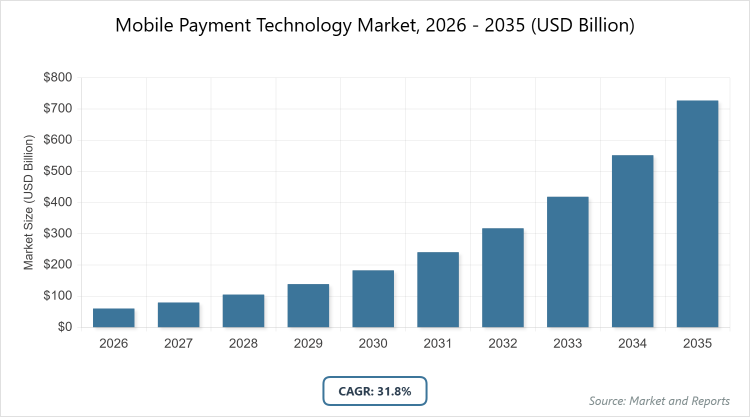
According to MarketnReports, the global Mobile Payment Technology Market size was estimated at USD 60.6 billion in 2025 and is expected to reach USD 215.6 billion by 2035, growing at a CAGR of 31.8% from 2026 to 2035. Mobile Payment Technology Market is driven by the increasing smartphone penetration and demand for contactless, secure transactions.What is the Mobile Payment Technology Market? Key Insights
- Global Mobile Payment Technology Market size valued at USD 60.6 billion in 2025 and projected to reach USD 215.6 billion by 2035.
- CAGR of 31.8% during the forecast period from 2026 to 2035.
- Market is driven by rising smartphone adoption, e-commerce growth, and demand for contactless payment solutions.
- Near Field Communication dominates the technology segment with 40% share.
- Near Field Communication's dominance is due to its seamless integration in smartphones for quick, secure transactions, enabling widespread use in retail and transit.
- Remote Payment dominates the payment type segment with 60% share.
- Remote Payment leads because of its convenience for online and app-based transactions, supporting the surge in digital commerce and cross-border payments.
- Retail & E-commerce dominates the end-user segment with 32% share.
- Retail & E-commerce holds the largest share owing to high transaction volumes in online shopping and the need for efficient, user-friendly payment gateways.
- Asia Pacific dominates with 35% share.
- Asia Pacific's dominance results from massive smartphone penetration in countries like China and India, coupled with government initiatives promoting digital economies.
What is the Mobile Payment Technology Market? Industry Overview
The Mobile Payment Technology Market refers to the ecosystem of hardware, software, and services that enable financial transactions via mobile devices, including smartphones, tablets, and wearables, facilitating seamless, secure exchanges between consumers, merchants, and financial institutions. This market encompasses technologies such as near-field communication for contactless payments, QR codes for quick scans, and digital wallets for storing payment information, emphasizing convenience, speed, and integration with e-commerce platforms. Market definition highlights mobile payment technology as a transformative force in digital finance, replacing traditional cash and card methods with encrypted, real-time solutions that support global commerce, enhance financial inclusion in underserved regions, and incorporate advanced security features like biometrics to mitigate fraud risks while adapting to evolving consumer behaviors toward cashless societies.
What is the Mobile Payment Technology Market? Market Dynamics
Growth Drivers
The growth drivers in the Mobile Payment Technology Market are propelled by the exponential rise in smartphone ownership globally, which has democratized access to digital financial services, allowing billions of users to conduct transactions without physical cards or cash, thereby boosting adoption in both urban and rural areas. The proliferation of e-commerce platforms and the shift toward online shopping, accelerated by post-pandemic behaviors, demand fast, secure payment methods that integrate seamlessly with mobile apps, reducing cart abandonment rates and enhancing user experience. Furthermore, advancements in security technologies, such as tokenization and end-to-end encryption, build consumer trust by minimizing fraud risks, while regulatory support for financial inclusion in emerging markets encourages investments in infrastructure, fostering innovation in contactless and peer-to-peer payment solutions.
Restraints
Restraints in the Mobile Payment Technology Market include concerns over data privacy and cybersecurity threats, as high-profile breaches erode consumer confidence and lead to hesitation in adopting new technologies, particularly in regions with limited regulatory oversight. Infrastructure limitations in developing areas, such as inconsistent internet connectivity and low digital literacy, hinder widespread implementation, restricting market penetration to urban centers and excluding potential users in remote locations. Additionally, interoperability issues between different payment systems and platforms create fragmentation, complicating cross-border transactions and increasing costs for merchants who must support multiple technologies to accommodate diverse customer preferences.
Opportunities
Opportunities in the Mobile Payment Technology Market stem from the integration of artificial intelligence and machine learning for personalized payment experiences, such as predictive analytics for fraud detection and tailored rewards programs, which can enhance user engagement and loyalty in competitive landscapes. The expansion of 5G networks promises faster transaction speeds and lower latency, enabling innovative applications like augmented reality shopping with instant payments, opening new revenue streams for technology providers. Moreover, partnerships between fintech firms and traditional banks in underserved regions offer potential for hybrid solutions that combine mobile technology with local financial services, promoting inclusion and capturing untapped markets with customized, low-cost offerings.
Challenges
Challenges in the Mobile Payment Technology Market involve navigating complex regulatory environments across countries, where varying compliance requirements for data protection and anti-money laundering can delay launches and increase operational costs for global players. The rapid evolution of technology demands continuous investment in R&D to stay ahead of obsolescence, while competition from emerging alternatives like cryptocurrencies poses risks to traditional mobile payment models. Additionally, addressing the digital divide requires innovative approaches to make technology accessible to non-tech-savvy users, ensuring equitable growth without alienating segments of the population reliant on cash-based systems.
Mobile Payment Technology Market: Report Scope
| Report Attributes | Report Details |
| Report Name | Mobile Payment Technology Market |
| Market Size 2025 | USD 60.6 Billion |
| Market Forecast 2035 | USD 215.6 Billion |
| Growth Rate | CAGR of 31.8% |
| Report Pages | 220 |
| Key Companies Covered |
Apple Inc., Google LLC, PayPal Holdings, Inc., Alibaba Group Holding Ltd., and Others. |
| Segments Covered | By Technology, By Payment Type, By End-User, and By Region. |
| Regions Covered | North America, Europe, Asia Pacific (APAC), Latin America, and The Middle East and Africa (MEA) |
| Base Year | 2025 |
| Historical Year | 2020 - 2024 |
| Forecast Year | 2026 - 2035 |
| Customization Scope | Avail customized purchase options to meet your exact research needs. |
What is the Mobile Payment Technology Market? Market Segmentation
The Mobile Payment Technology Market is segmented by technology, payment type, end-user, and region.By Technology Segment. Near Field Communication emerges as the most dominant subsegment, driven by its ability to facilitate quick, secure contactless transactions through built-in smartphone capabilities, which drives the market by enhancing convenience in retail and public transport while reducing processing times and encouraging widespread merchant adoption. QR Code ranks as the second most dominant, offering cost-effective, versatile scanning options that require minimal infrastructure, propelling market growth by enabling affordable entry for small businesses and supporting digital inclusion in emerging economies.
By Payment Type Segment. Remote Payment stands out as the most dominant subsegment, fueled by its suitability for online and in-app purchases amid booming e-commerce, driving the market through seamless integration with digital platforms that boost transaction volumes and user retention. Proximity Payment follows as the second most dominant, providing instant, touchless interactions at point-of-sale, fostering market expansion by aligning with health-conscious consumer preferences and accelerating adoption in high-traffic retail environments.
By End-User Segment. Retail & E-commerce is the most dominant subsegment, attributable to its high reliance on efficient transaction processing for online and in-store sales, accelerating market growth via enhanced customer experiences and data-driven personalization that increase sales conversion rates. BFSI represents the second most dominant, leveraging mobile payments for banking services and transfers, propelling the market forward through secure, real-time financial management tools that promote customer loyalty and operational efficiency.
What is the Mobile Payment Technology Market? Recent Developments
- In June 2025, FairPrice Group and Google Cloud launched the “Store of Tomorrow” concept, featuring cloud-connected carts, scan-and-pay technology, and biometric checkout to transform retail experiences with seamless mobile payments.
- In May 2025, Visa acquired Featurespace to integrate advanced behavioral fraud prevention into its mobile payment processing, enhancing real-time risk scoring for secure transactions.
- In April 2025, a U.S. court ruling against Apple for anti-steering practices allowed developers to promote alternative payment methods, potentially increasing competition in mobile payment ecosystems.
- In March 2025, T-money enabled Apple Pay compatibility for Korean transit, expanding NFC acceptance into everyday mobile payments beyond transportation.
What is the Mobile Payment Technology Market? Regional Analysis
Asia Pacific to dominate the global market.Asia Pacific commands the largest share, driven by explosive smartphone adoption and digital infrastructure growth, with China as the dominating country due to platforms like Alipay and WeChat Pay handling massive transaction volumes supported by government-backed digital economy initiatives.
North America shows strong performance through technological innovation and high consumer trust in digital wallets, where the United States dominates with key players like Apple Pay and Google Pay leading in contactless adoption amid robust regulatory frameworks.
Europe emphasizes secure and interoperable systems under GDPR guidelines, led by Germany as the dominating country, where advancements in open banking and NFC technology drive mobile payments in retail and public sectors.
Latin America exhibits emerging growth fueled by financial inclusion efforts, with Brazil dominating through Pix instant payments revolutionizing mobile transactions in e-commerce and peer-to-peer transfers.
The Middle East and Africa experience progressive adoption via mobile money services, where Kenya leads as the dominating country, propelled by M-Pesa's success in enabling unbanked populations to access financial services through simple mobile interfaces.
What is the Mobile Payment Technology Market? Key Market Players and Strategies
Apple Inc. Apple Inc. focuses on ecosystem integration, enhancing Apple Pay with features like augmented reality payments and partnerships for global expansion, prioritizing user privacy and seamless experiences to capture premium market segments.
Google LLC. Google LLC employs cloud-based innovations, expanding Google Pay through AI-driven fraud detection and collaborations with merchants for personalized rewards, aiming to dominate Android users with accessible, secure payment solutions.
PayPal Holdings, Inc. PayPal Holdings, Inc. pursues acquisitions and blockchain integrations, launching services like PayPal for Refugees to broaden reach, while emphasizing cross-border capabilities to strengthen its position in international transactions.
Alibaba Group Holding Ltd. Alibaba Group Holding Ltd. advances through Alipay+ for global connectivity, investing in RISC-V chips for efficient processing, targeting emerging markets with comprehensive fintech ecosystems.
Samsung Electronics Co. Ltd. Samsung Electronics Co. Ltd. leverages hardware-software synergy, updating Samsung Wallet with enhanced security and NFC features, focusing on partnerships for omnichannel experiences in consumer electronics.
Visa Inc. Visa Inc. adopts AI acquisitions like Featurespace for advanced analytics, promoting tokenization and real-time payments to ensure secure, interoperable solutions across global networks.
What is the Mobile Payment Technology Market? Market Trends
- Increasing integration of AI and machine learning for personalized fraud detection and user experiences.
- Growth in contactless and biometric authentication to enhance security and convenience.
- Expansion of cross-border payments through stablecoins and blockchain technologies.
- Rise of super-apps combining payments with services like e-commerce and transportation.
- Adoption of open banking regulations fostering innovation and interoperability.
- Focus on sustainable payments with eco-friendly digital alternatives to cash.
What is the Mobile Payment Technology Market? Market Segments and their subsegment Covered in the Report
By Technology- Near Field Communication
- Short Message Service
- Wireless Application Protocol
- QR Code
- Biometric Authentication
- Digital Wallets
- Mobile Point of Sale
- Mobile Banking
- Internet Payment
- Peer-to-Peer Payments
- Others
- Proximity Payment
- Remote Payment
- B2B
- B2C
- B2G
- mPOS
- Airtime Transfer and Top Ups
- Money Transfers and Bill Payments
- Merchandise and Coupons
- Travel and Ticketing
- Others
- BFSI
- Retail & E-commerce
- Media & Entertainment
- Healthcare
- Hospitality & Transportation
- Automotive
- Energy & Utilities
- Consumer Electronics
- Education
- Telecom & Information Technology
- Others
By Region
- North America
- U.S.
- Canada
- Europe
- UK
- Germany
- France
- Rest of Europe
- Asia Pacific
- China
- India
- Japan
- Rest of Asia Pacific
- Latin America
- Brazil
- Mexico
- Rest of Latin America
- Middle East & Africa
- UAE
- South Africa
- Rest of Middle East & Africa
Frequently Asked Questions
The Mobile Payment Technology Market encompasses technologies enabling transactions via mobile devices, including NFC, QR codes, and digital wallets for secure, convenient payments.
Key factors include smartphone proliferation, e-commerce expansion, contactless payment demand, regulatory support, and advancements in security technologies.
The market is projected to grow from USD 60.6 billion in 2026 to USD 215.6 billion by 2035.
The CAGR is expected to be 31.8% during 2026-2035.
Asia Pacific will contribute notably, driven by high adoption in China and India.
Major players include Apple Inc., Google LLC, PayPal Holdings, Inc., Alibaba Group Holding Ltd., Samsung Electronics Co. Ltd., and Visa Inc.
The report provides analysis of size, trends, segments, regional insights, key players, drivers, and forecasts.
Stages include technology development, platform integration, merchant adoption, consumer usage, and transaction processing.
Trends shift toward biometric security and integrated super-apps, with consumers preferring fast, contactless options for daily transactions.
Factors include data privacy regulations like GDPR and initiatives promoting digital inclusion to reduce cash dependency.