
Automotive Plastics Market Size, Share and Trends 2026 to 2035
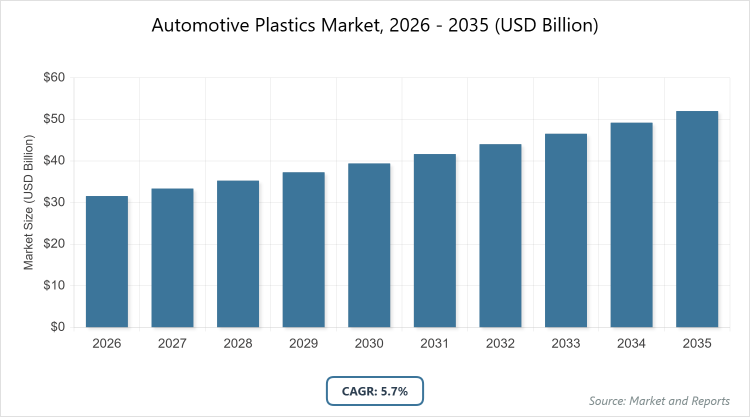
According to MarketnReports, the global Automotive Plastics Market size was estimated at USD 31.58 billion in 2025 and is expected to reach USD 54.97 billion by 2035, growing at a CAGR of 5.7% from 2026 to 2035. Automotive Plastics Market is driven by the increasing demand for lightweight materials to improve fuel efficiency and support electric vehicle adoption.What is the Automotive Plastics Market? Key Insights
- Global Automotive Plastics Market size valued at USD 31.58 billion in 2025 and projected to reach USD 54.97 billion by 2035.
- CAGR of 5.7% during the forecast period from 2026 to 2035.
- Market is driven by the growing emphasis on vehicle lightweighting, stringent emission regulations, and rising electric vehicle production.
- Polypropylene dominates the product type segment with 32% share.
- Polypropylene's dominance is due to its affordability, lightweight properties, and ease of processing, making it ideal for large-volume applications like bumpers and dashboards.
- Interior furnishings dominate the application segment with 44% share.
- Interior furnishings lead because they enhance vehicle comfort, reduce noise, and allow for customizable designs that align with consumer demands for premium interiors.
- Passenger cars dominate the vehicle type segment with 70% share.
- Passenger cars hold the largest share owing to high global production volumes, widespread adoption of plastics for fuel efficiency, and integration in mass-market models.
- Asia Pacific dominates with 46% share.
- Asia Pacific's dominance results from leading automotive manufacturing in China and India, low production costs, and government support for EV infrastructure.
What is the Automotive Plastics Market? Industry Overview
The Automotive Plastics Market refers to the sector involved in the development, production, and application of various plastic materials tailored for use in vehicles, encompassing a range of polymers that provide lightweight, durable, and cost-effective alternatives to traditional metals. This market includes materials used in interior components, exterior body parts, powertrains, and electrical systems, emphasizing attributes such as corrosion resistance, thermal stability, and design flexibility to meet evolving automotive needs. Market definition positions automotive plastics as critical enablers of vehicle innovation, facilitating weight reduction for enhanced fuel economy, enabling complex shapes for aesthetic and functional improvements, and supporting the transition to sustainable mobility through recyclable and bio-based variants in both conventional and electrified vehicles.
What is the Automotive Plastics Market? Market Dynamics
Growth Drivers
The primary growth drivers in the Automotive Plastics Market include the global push for fuel-efficient and low-emission vehicles, where plastics replace heavier metals to reduce overall vehicle weight by up to 20-30%, directly improving mileage and complying with regulations like Euro 7 standards. The surge in electric vehicle (EV) production, projected to exceed 20 million units annually by 2030, further propels demand for specialized plastics in battery enclosures and thermal management systems, offering insulation and impact resistance without compromising range. Technological advancements in polymer composites, such as carbon-fiber reinforced plastics, enhance strength-to-weight ratios, while rising consumer preferences for aesthetically pleasing and ergonomic interiors drive innovation in molding techniques, fostering market expansion across emerging economies with booming automotive sectors.
Restraints
Key restraints in the Automotive Plastics Market stem from fluctuating raw material prices, particularly for petrochemical-derived polymers, which can increase by 15-20% due to oil market volatility and supply chain disruptions, thereby elevating production costs for manufacturers. Environmental regulations targeting plastic waste, such as the EU's End-of-Life Vehicles Directive mandating 95% recyclability, pose challenges in material selection and disposal, limiting the use of non-recyclable thermosets. Additionally, competition from alternative materials like aluminum alloys in structural applications, which offer superior recyclability and crash performance in some scenarios, hinders broader adoption of plastics in high-safety components.
Opportunities
Opportunities in the Automotive Plastics Market are abundant with the shift toward sustainable materials, including bio-based plastics derived from renewable sources like corn starch, which could capture 10-15% market share by 2030 amid corporate sustainability goals. The expansion of autonomous and connected vehicles creates demand for advanced plastics in sensor housings and lightweight chassis, potentially adding USD 5-7 billion in value through enhanced durability and signal transparency. Emerging markets in Southeast Asia and Latin America present growth avenues due to infrastructure investments and rising middle-class vehicle ownership, while collaborations between plastic suppliers and automakers for custom-engineered solutions can unlock innovations in multi-material assemblies.
Challenges
Challenges in the Automotive Plastics Market include stringent safety and performance standards, requiring extensive testing for heat resistance and flame retardancy in under-hood applications, which can extend development timelines by 6-12 months and increase R&D costs. Global supply chain vulnerabilities, highlighted by recent semiconductor shortages, affect polymer availability and lead to production delays in automotive assembly lines. Moreover, consumer and regulatory scrutiny over microplastic pollution from tire wear and vehicle degradation necessitates investments in eco-friendly alternatives, potentially straining profit margins for smaller players in a consolidated market.
Automotive Plastics Market: Report Scope
| Report Attributes | Report Details |
| Report Name | Automotive Plastics Market |
| Market Size 2025 | USD 31.58 Billion |
| Market Forecast 2035 | USD 54.97 Billion |
| Growth Rate | CAGR of 5.7% |
| Report Pages | 220 |
| Key Companies Covered |
BASF SE, SABIC, Dow Inc., Covestro AG, and Others. |
| Segments Covered | By Product Type, By Application, By Vehicle Type, and By Region. |
| Regions Covered | North America, Europe, Asia Pacific (APAC), Latin America, and The Middle East and Africa (MEA) |
| Base Year | 2025 |
| Historical Year | 2020 - 2024 |
| Forecast Year | 2026 - 2035 |
| Customization Scope | Avail customized purchase options to meet your exact research needs. |
What is the Automotive Plastics Market? Market Segmentation
The Automotive Plastics Market is segmented by type, application, vehicle type, and region.By Type Segment. Polypropylene stands as the most dominant subsegment, driven by its versatility in molding complex shapes, low density for weight savings, and resistance to chemicals, which propels market growth by enabling cost-effective production of high-volume parts like instrument panels and contributing to overall vehicle efficiency in fuel and electric models. Polyurethane is the second most dominant, prized for its elasticity and energy absorption in foams and coatings, fostering market expansion through improved passenger comfort and safety features such as cushioned seats that meet crash test requirements.
By Application Segment. Interior furnishings emerge as the most dominant subsegment, fueled by the need for lightweight, durable materials that enhance acoustics and aesthetics while reducing vehicle noise by up to 10 dB, driving the market by aligning with trends in premium cabin experiences and supporting electrification through integrated electronics. Exterior furnishings rank second, offering weather resistance and impact protection in bumpers and grilles, advancing market growth by facilitating aerodynamic designs that improve fuel economy and comply with pedestrian safety norms.
By Vehicle Type Segment. Passenger cars are the most dominant subsegment, attributable to their sheer production numbers exceeding 60 million units globally and extensive use of plastics for personalization and efficiency, accelerating market growth via economies of scale in manufacturing and adaptation to hybrid powertrains. Electric vehicles follow as the second most dominant, utilizing plastics for battery protection and lightweight structures to extend range by 5-10%, propelling the market through alignment with global decarbonization efforts and incentives for green mobility.
What is the Automotive Plastics Market? Recent Developments
- In October 2025, Mitsui Chemicals, Inc. and Polyplastics Co., Ltd. announced a strategic partnership to optimize marketing for engineering plastics like ARLEN polyamide and AURUM thermoplastic polyimide, aiming to address increasing automotive demands for high-performance, sustainable materials in components such as electrical systems.
- In May 2025, Toyoda Gosei developed a horizontal recycling technology for automotive plastics, allowing high-quality recycled polypropylene from end-of-life vehicles to be reused in new parts like glove boxes for the Toyota Camry, supporting decarbonization initiatives and circular economy practices.
- In March 2025, the Global Impact Coalition launched a circularity pilot for automotive plastics involving companies like BASF, Covestro, and SABIC, focusing on recycling end-of-life plastics to create sustainable supply chains and reduce dependency on virgin materials.
- In April 2025, Covestro introduced a new range of post-consumer recycled polycarbonates from end-of-life automotive headlamps, enhancing sustainability in vehicle lighting and interior applications while maintaining optical clarity and durability.
What is the Automotive Plastics Market? Regional Analysis
Asia Pacific to dominate the global market.Asia Pacific commands the largest market share, propelled by unparalleled vehicle manufacturing output and rapid urbanization, with China as the dominating country due to its EV production exceeding 10 million units annually, bolstered by subsidies, vast supplier networks, and investments in polymer compounding facilities.
North America demonstrates robust growth through innovation in lightweight materials and EV adoption, where the United States dominates with major players like General Motors and Tesla integrating advanced plastics for range optimization and regulatory compliance under CAFE standards.
Europe emphasizes eco-friendly solutions and stringent emissions targets, led by Germany as the dominating country, where automakers such as Volkswagen and BMW pioneer bio-based plastics in premium models to achieve carbon neutrality goals by 2040.
Latin America exhibits potential with increasing automotive exports and infrastructure projects, with Brazil dominating through its ethanol-fueled vehicle market and local production of flexible plastics for durable components in challenging climates.
The Middle East and Africa show gradual progress via assembly hubs and oil-linked economies, where South Africa leads as the dominating country, leveraging plastics in commercial vehicles for mining and logistics sectors amid regional trade agreements.
What is the Automotive Plastics Market? Key Market Players and Strategies
BASF SE. BASF SE focuses on sustainable innovation, developing bio-based and recycled plastics like Luviset 360 for styling applications, while expanding production capacities in Europe to meet demand for emission-reducing materials in EVs.
SABIC. SABIC employs strategies centered on high-performance resins, partnering with OEMs for custom EV solutions and investing in circular economy initiatives to recycle plastics, enhancing its market position through cost-effective, lightweight offerings.
Dow Inc. Dow Inc. pursues acquisitions like Circulus to boost recycled content capabilities, emphasizing durable polymers for interiors and exteriors, with a focus on R&D to address thermal management in hybrid vehicles.
Covestro AG. Covestro AG prioritizes post-consumer recycled materials, launching PCR polycarbonates and collaborating on sustainability pilots, aiming to lead in transparent and impact-resistant plastics for automotive lighting and structures.
LyondellBasell Industries N.V. LyondellBasell Industries N.V. introduces advanced compounds like Schulamid ET100 for interiors, optimizing global supply chains and advancing recycled ocean plastics for eco-friendly automotive applications.
Evonik Industries AG. Evonik Industries AG concentrates on specialty additives and high-temperature polyamides, with strategies involving partnerships for sensor-integrated plastics in autonomous vehicles to capitalize on emerging tech trends.
What is the Automotive Plastics Market? Market Trends
- Surging adoption of bio-based and recycled plastics to comply with environmental regulations and reduce carbon footprints.
- Increased use of plastics in electric vehicles for battery enclosures and lightweight components to extend driving range.
- Shift toward advanced composites like carbon-fiber reinforced polymers for superior strength in structural applications.
- Growing integration of smart plastics with embedded sensors for autonomous vehicle functionalities.
- Expansion of injection molding and 3D printing techniques for customized, complex part designs.
- Rising demand for flame-retardant and UV-resistant materials in exterior and under-hood environments.
What is the Automotive Plastics Market? Market Segments and their subsegment Covered in the Report
Product Type- Polypropylene
- Polyurethane
- Acrylonitrile Butadiene Styrene
- Polyvinyl Chloride
- Polyethylene
- Polycarbonate
- Polyamide
- Polymethyl Methacrylate
- Polybutylene Terephthalate
- Polyethylene Terephthalate
- Others
- Interior Furnishings
- Exterior Furnishings
- Powertrain
- Electrical Components
- Under-the-Hood Components
- Chassis
- Bumpers
- Instrument Panels
- Door Panels
- Seating
- Others
- Passenger Cars
- Light Commercial Vehicles
- Heavy Commercial Vehicles
- Electric Vehicles
- Hybrid Vehicles
- Sports Utility Vehicles
- Multi-Utility Vehicles
- Two-Wheelers
- Off-Road Vehicles
- Autonomous Vehicles
- Others
By Region
- North America
- U.S.
- Canada
- Europe
- UK
- Germany
- France
- Rest of Europe
- Asia Pacific
- China
- India
- Japan
- Rest of Asia Pacific
- Latin America
- Brazil
- Mexico
- Rest of Latin America
- Middle East & Africa
- UAE
- South Africa
- Rest of Middle East & Africa
Frequently Asked Questions
The Automotive Plastics Market comprises the industry focused on polymers used in vehicle manufacturing for weight reduction, durability, and design flexibility, including materials like polypropylene and polyurethane for various components.
Key factors include vehicle lightweighting trends, EV proliferation, emission regulations, polymer innovations, and expanding automotive production in emerging regions.
The market value is anticipated to rise from approximately USD 31.58 billion in 2026 to USD 54.97 billion by 2035.
The expected CAGR is 5.7% over the period from 2026 to 2035.
Asia Pacific will contribute significantly, driven by high-volume manufacturing and EV growth in China and India.
Major players include BASF SE, SABIC, Dow Inc., Covestro AG, LyondellBasell Industries N.V., and Evonik Industries AG.
The report offers in-depth analysis of market size, trends, segments, regional insights, key players, drivers, and forecasts.
Stages encompass raw material extraction, polymer synthesis, compounding, part fabrication, vehicle integration, and recycling or disposal.
Trends are moving toward sustainable and smart plastics, with consumers favoring eco-friendly, comfortable, and tech-integrated vehicle features.
Factors include emission standards, recycling mandates like the EU's 95% vehicle recyclability target, and policies promoting bio-based materials to curb plastic waste.