
Digital Oscilloscope Market Size, Share and Trends 2026 to 2035
According to MarketnReports, the global Digital Oscilloscope market size was estimated at USD 3.3 billion in 2025 and is expected to reach USD 7.7 billion by 2035, growing at a CAGR of 8.8% from 2026 to 2035. The digital oscilloscope market is driven by increasing demand for high-precision testing in electronics, automotive, and telecommunications sectors.
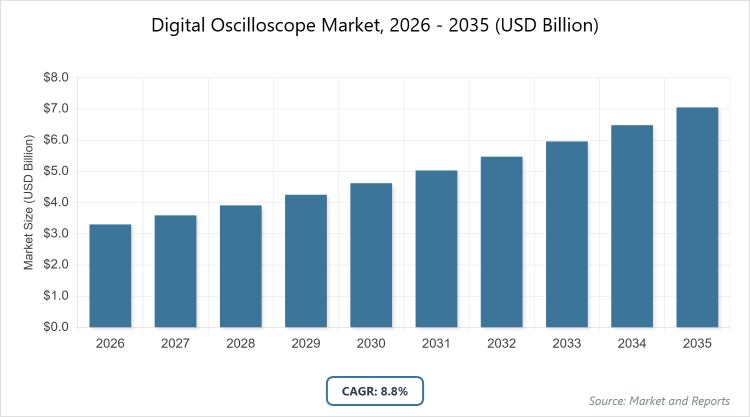
What are the Key Insights into the Digital Oscilloscope?
- The global Digital Oscilloscope market was valued at USD 3.3 billion in 2025 and is projected to reach USD 7.7 billion by 2035.
- The market is expected to grow at a CAGR of 8.8% during the forecast period from 2026 to 2035.
- The market is driven by technological advancements in high-speed data acquisition, rising adoption in 5G and IoT development, and expanding automotive electronics testing needs.
- In the type segment, digital storage oscilloscopes (DSOs) dominate with a 45% share due to their versatility in capturing and storing waveforms for detailed analysis in R&D and manufacturing.
- In the application segment, communications electronics dominates with a 30% share as it supports high-frequency signal testing crucial for telecom infrastructure and wireless technologies.
- In the end-user segment, the manufacturing sector dominates with a 35% share owing to widespread use in quality control and production line testing for electronic components.
- Asia Pacific dominates the regional market with a 40% share, driven by robust electronics manufacturing hubs in China and India, government support for tech innovation, and cost-effective production.
What is the Industry Overview of Digital Oscilloscope?
The Digital Oscilloscope market involves electronic test instruments that capture, analyze, and display electrical signals in digital format, offering advanced features like waveform storage, automated measurements, and signal processing for troubleshooting and design verification in various industries. Market definition encompasses devices that convert analog signals to digital data using analog-to-digital converters, providing high-resolution visualization, trigger capabilities, and connectivity options such as USB or Ethernet, essential for applications requiring precise timing, frequency analysis, and glitch detection in complex electronic systems.
What are the Market Dynamics of Digital Oscilloscope?
Growth Drivers
The Digital Oscilloscope market benefits from rapid advancements in semiconductor technology and the proliferation of high-speed communication networks like 5G, which necessitate precise signal integrity testing and validation, driving demand for high-bandwidth oscilloscopes with advanced triggering capabilities. The automotive industry’s shift toward electric vehicles and autonomous systems increases the need for oscilloscopes in battery management, sensor calibration, and power electronics analysis, enhancing market expansion. Growing investments in research and development across electronics and aerospace sectors, coupled with the rise of IoT devices requiring low-power signal monitoring, further propel adoption. Integration of AI for automated measurements and cloud connectivity for remote diagnostics also contributes to sustained growth by improving efficiency and accessibility.
Restraints
High costs associated with advanced digital oscilloscopes, particularly those with high sampling rates and deep memory, limit accessibility for small enterprises and educational institutions in emerging markets. Complex user interfaces and the need for specialized training to operate sophisticated features can deter widespread adoption, leading to underutilization. Supply chain disruptions for critical components like ADCs and displays, exacerbated by geopolitical tensions, increase prices and delay product availability. Stringent regulatory standards for electromagnetic compatibility testing add compliance burdens, potentially slowing innovation cycles.
Opportunities
Opportunities arise from the integration of oscilloscopes with AI and machine learning for predictive fault detection and automated waveform analysis, appealing to industries like telecommunications and healthcare. Expansion in emerging economies through affordable, portable models tailored for field testing in renewable energy and consumer electronics offers untapped potential. Partnerships between manufacturers and software developers for customizable apps and modular designs can enhance product versatility. The growing demand for mixed-domain oscilloscopes combining time and frequency analysis opens niches in RF testing for wireless applications.
Challenges
Intense competition from low-cost Chinese manufacturers erodes market share for premium brands, forcing price reductions and margin pressures. Rapid obsolescence due to evolving technology standards requires frequent upgrades, straining R&D budgets. Cybersecurity risks in connected oscilloscopes, such as data breaches during remote access, pose threats to sensitive industrial applications. Environmental concerns over electronic waste from outdated equipment necessitate sustainable design practices, adding complexity to production.
Digital Oscilloscope Market: Report Scope
| Report Attributes | Report Details |
| Report Name | Digital Oscilloscope Market |
| Market Size 2025 | USD 3.3 Billion |
| Market Forecast 2035 | USD 7.7 Billion |
| Growth Rate | CAGR of 8.8% |
| Report Pages | 195 |
| Key Companies Covered | Tektronix, Inc., Keysight Technologies, Rohde & Schwarz, Teledyne LeCroy, National Instruments (NI), RIGOL Technologies, Yokogawa Electric Corporation, GW Instek, and Others |
| Segments Covered | By Type, By Application, By End-User, and By Region |
| Regions Covered | North America, Europe, Asia Pacific (APAC), Latin America, and The Middle East and Africa (MEA) |
| Base Year | 2025 |
| Historical Year | 2020 – 2024 |
| Forecast Year | 2026 – 2035 |
| Customization Scope | Avail customized purchase options to meet your exact research needs. |
What is the Market Segmentation of Digital Oscilloscope?
The Digital Oscilloscope market is segmented by type, application, end-user, and region.
By Type. Digital storage oscilloscopes (DSO) are the most dominant subsegment, holding approximately 45% market share, owing to their ability to capture transient events and provide extensive post-acquisition analysis tools essential for debugging in electronics design. This dominance drives the market by enabling cost-effective, high-performance testing that accelerates product development cycles across industries. Mixed signal oscilloscopes (MSO) rank as the second most dominant, with around 25% share, combining analog and digital channels for comprehensive system-level troubleshooting, propelling growth through applications in embedded systems and IoT, where mixed-signal integrity is critical.
By Application. Communications electronics emerges as the most dominant subsegment, capturing about 30% share, primarily due to the need for high-bandwidth analysis in 5G deployment and network optimization. This leads to market growth by supporting faster data rates and signal fidelity testing vital for telecom advancements. Automotive electronics follows as the second most dominant, with roughly 20% share, aiding in vehicle electrification and ADAS development through precise power and sensor signal measurements, driving the market via integration with automotive R&D workflows.
By End-User. The manufacturing sector represents the most dominant subsegment at about 35% share, fueled by requirements for inline quality assurance and failure analysis in high-volume production. This dominance accelerates market expansion through scalable solutions that minimize downtime and ensure compliance. Aerospace and defense ranks second most dominant, holding around 20% share, due to stringent testing for avionics and radar systems, contributing to growth via high-reliability demands and government contracts.
What are the Recent Developments in Digital Oscilloscope?
- In October 2025, Keysight Technologies launched the Infiniium EXR-Series with 8 channels and 6 GHz bandwidth, targeting high-speed digital design and power integrity applications.
- In September 2025, Tektronix introduced the 3 Series MDO with enhanced spectrum analysis features, aimed at embedded and IoT developers for mixed-domain troubleshooting.
- In July 2025, Rohde & Schwarz expanded its RTO6 series with AI-powered anomaly detection, improving efficiency in automotive and telecom testing.
- In April 2025, Teledyne LeCroy announced the WavePro HD with 12-bit resolution and 8 GHz bandwidth, focusing on precision measurements in research labs.
- In January 2025, RIGOL Technologies released the DS8000-R series rack-mount oscilloscopes for automated test systems in manufacturing environments.
What is the Regional Analysis of Digital Oscilloscope?
- Asia Pacific to dominate the global market.
Asia Pacific holds the largest share at around 40%, with China as the dominating country due to its massive electronics manufacturing ecosystem, government initiatives like Made in China 2025 promoting advanced testing equipment, and rapid growth in 5G and EV production. The region’s expansion is fueled by low-cost labor, strong supply chains for components, and increasing R&D investments from local firms like RIGOL and Siglent, establishing it as a global hub for innovation and volume-driven demand. Export incentives and trade agreements further boost access to international markets for Asian-produced oscilloscopes. Vocational training programs in electronics are creating a skilled workforce proficient in using advanced digital tools. The rise of semiconductor foundries in Taiwan and South Korea amplifies needs for high-precision signal analysis.
North America follows closely, driven by technological innovation and a strong presence in aerospace and defense, where the United States dominates through companies like Tektronix and Keysight, supported by robust R&D funding. Growth is propelled by government grants for STEM education and defense contracts requiring high-end oscilloscopes, though higher costs temper expansion. Collaborations between universities and industry leaders foster cutting-edge developments in mixed-signal testing. The region’s focus on renewable energy projects increases demand for power electronics analysis tools. Reshoring of electronics manufacturing enhances domestic supply chains for test equipment.
Europe exhibits steady performance with emphasis on quality and regulatory compliance, led by Germany through engineering excellence and firms like Rohde & Schwarz. The region’s growth benefits from EU-funded research in automotive electrification and Industry 4.0, prioritizing energy-efficient and compliant oscilloscopes. Strict EMC standards drive adoption of advanced models for certification testing. Partnerships across the European Single Market facilitate cross-border innovation in telecom infrastructure. The aging workforce is addressed through apprenticeship programs in precision instrumentation.
Latin America shows moderate advancement, dominated by Brazil’s growing automotive and consumer electronics sectors, supported by foreign investments, though limited by economic instability. Mexico’s proximity to North American markets boosts nearshoring for test equipment in maquiladoras. Government incentives for tech parks encourage local adoption of affordable oscilloscopes. However, infrastructure challenges like unreliable power supply hinder high-end implementations. Emerging telecom upgrades create niche opportunities for communication testing tools.
The Middle East and Africa remain emerging, with the United Arab Emirates leading through investments in smart cities and oil & gas instrumentation, constrained by lower tech penetration but promising via diversification efforts. South Africa’s mining and telecom industries adopt oscilloscopes for maintenance and network optimization. Technology transfer from global players builds local capabilities. However, funding shortages and skill gaps slow broader uptake. Renewable energy projects in Saudi Arabia drive demand for power system analysis.
What are the Key Market Players in the Digital Oscilloscope?
- Tektronix, Inc. focuses on high-performance oscilloscopes with deep memory and advanced triggering, leveraging partnerships in automotive and 5G testing to maintain leadership through innovation and customer support.
- Keysight Technologies. Keysight emphasizes modular and software-defined instruments, investing in AI integration for automated analysis to serve aerospace and semiconductor markets effectively.
- Rohde & Schwarz. Rohde & Schwarz specializes in high-frequency oscilloscopes with superior signal integrity, pursuing strategies in defense and communications via global R&D centers.
- Teledyne LeCroy. Teledyne LeCroy prioritizes high-definition models with 12-bit resolution, targeting power electronics and research through acquisitions and technology upgrades.
- National Instruments (NI). NI integrates oscilloscopes with test automation software, focusing on scalable solutions for manufacturing and education via LabVIEW ecosystem.
- RIGOL Technologies. RIGOL offers cost-effective, high-value oscilloscopes, expanding in emerging markets through e-commerce and localized production.
- Yokogawa Electric Corporation. Yokogawa delivers precision instruments for industrial applications, emphasizing energy efficiency and IoT connectivity strategies.
- GW Instek. GW Instek targets entry-level and mid-range markets with reliable, user-friendly designs, building presence through educational partnerships.
What are the Market Trends in Digital Oscilloscope?
- Increasing integration of AI for automated waveform analysis and anomaly detection.
- Rise of modular and software-upgradable oscilloscopes for flexibility.
- Growing demand for high-bandwidth models supporting 5G and mmWave testing.
- Shift toward portable and handheld devices for field applications.
- Emphasis on mixed-domain analysis combining time and frequency domains.
- Adoption of cloud-based data storage and remote access features.
- Focus on energy-efficient designs with low power consumption.
What Market Segments and Subsegments are Covered in the Digital Oscilloscope Report?
By Type
- Digital Storage Oscilloscopes (DSO)
- Digital Phosphor Oscilloscopes (DPO)
- Mixed Signal Oscilloscopes (MSO)
- Digital Sampling Oscilloscopes
- Handheld Oscilloscopes
- Benchtop Oscilloscopes
- PC-Based Oscilloscopes
- High-Speed Oscilloscopes
- Low-Cost Oscilloscopes
- Modular Oscilloscopes
- Others
By Application
- Consumer Electronics
- Communications Electronics
- Aerospace Electronics
- Automotive Electronics
- Medical Electronics
- Industrial Electronics
- Research and Development
- Education and Training
- Defense and Military
- Power Electronics
- Others
By End-User
- Manufacturing Sector
- Research Institutes
- Educational Institutions
- Automotive Industry
- Aerospace and Defense
- Telecommunications
- Healthcare
- Electronics Repair Services
- Energy and Utilities
- Consumer Goods
- Others
By Region
-
- North America
- U.S.
- Canada
- Europe
- UK
- Germany
- France
- Rest of Europe
- Asia Pacific
- China
- India
- Japan
- Rest of Asia Pacific
- Latin America
- Brazil
- Mexico
- Rest of Latin America
- Middle East & Africa
- UAE
- South Africa
- Rest of Middle East & Africa
- North America
Frequently Asked Questions
Digital Oscilloscopes are electronic instruments that digitize and display electrical signals for analysis, offering features like waveform storage and automated measurements.
Key factors include 5G deployment, EV advancements, IoT expansion, AI integration, and increasing R&D in electronics.
The market is projected to grow from USD 3.3 billion in 2025 to USD 7.7 billion by 2035.
The CAGR is expected to be 8.8%.
Asia Pacific will contribute notably, holding around 40% share due to electronics manufacturing dominance.
Major players include Tektronix, Keysight Technologies, Rohde & Schwarz, Teledyne LeCroy, and National Instruments.
The report offers comprehensive insights on size, trends, segments, regions, players, and forecasts.
Stages include component sourcing, design and assembly, software development, distribution, sales, and after-sales service.
Trends shift toward AI-enhanced, portable, and cloud-connected devices, with preferences for user-friendly interfaces and high-resolution displays.
EMC regulations and e-waste directives influence design for compliance and sustainability, impacting costs and innovation.