
Air Separation Plant Market Size, Share and Trends 2026 to 2035
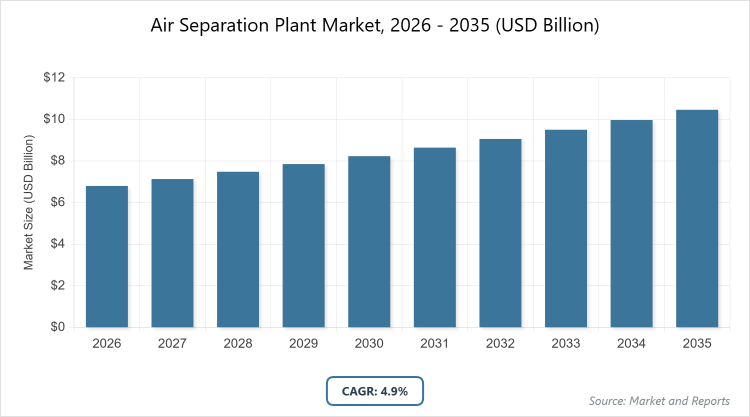
According to MarketnReports, the global Air Separation Plant market size was estimated at USD 6.8 billion in 2025 and is expected to reach USD 11 billion by 2035, growing at a CAGR of 4.9% from 2026 to 2035. Air Separation Plant Market is driven by increasing demand from the iron and steel industry and expanding healthcare infrastructure.
What are the Key Insights into Air Separation Plant Market?
- The global air separation plant market was valued at USD 6.8 billion in 2025 and is projected to reach USD 11 billion by 2035.
- The market is expected to grow at a CAGR of 4.9% during the forecast period from 2026 to 2035.
- The market is driven by rising steel production, healthcare expansion, and chemical industry growth.
- In the process segment, cryogenic air separation dominates with a 60.2% share due to its efficiency in large-scale, high-purity gas production.
- In the gas segment, oxygen holds the leading position with 60.6% share, driven by extensive use in steelmaking and medical applications.
- In the end-use industry segment, iron & steel commands 28% share, attributed to high oxygen consumption in blast furnaces and manufacturing processes.
- Asia Pacific dominates the regional landscape with a 48% share, owing to rapid industrialization and high steel output in countries like China and India.
What is the Industry Overview of Air Separation Plant Market?
The air separation plant market encompasses the production and supply of industrial gases through specialized facilities that separate atmospheric air into its primary components, such as oxygen, nitrogen, and argon. These plants utilize advanced technologies to purify and liquefy gases for various industrial applications, playing a critical role in sectors requiring high-purity gases for processes like combustion, preservation, and medical use. Market definition refers to the ecosystem involving the design, manufacturing, installation, and operation of equipment that employs cryogenic or non-cryogenic methods to extract gases from air, catering to end-users in manufacturing, energy, and healthcare while addressing global demands for efficient resource utilization and sustainability.
What are the Market Dynamics in Air Separation Plant Market?
Growth Drivers
The primary growth drivers in the air separation plant market stem from surging demand in the iron and steel sector, where oxygen is essential for enhancing combustion efficiency in blast furnaces, leading to increased production capacity and reduced energy consumption. Additionally, the expansion of healthcare infrastructure globally has heightened the need for reliable medical oxygen supplies, particularly post-pandemic, prompting investments in on-site air separation units to ensure uninterrupted availability. Furthermore, the chemical industry’s growth, requiring consistent supplies of nitrogen and argon for inerting and synthesis processes, fuels market expansion through long-term contracts and technological integrations that optimize gas purity and yield.
Restraints
High capital investments represent a significant restraint, as establishing large-scale cryogenic plants can cost between USD 50 million and USD 200 million, deterring smaller manufacturers and leading to reliance on merchant suppliers, which may limit market penetration in emerging economies. Energy-intensive operations also pose challenges, with cryogenic processes consuming substantial electricity, making the market vulnerable to power price fluctuations and increasing operational costs that could erode profit margins. Moreover, extended payback periods for these investments, often spanning several years, combined with complex regulatory approvals for plant setups, further hinder rapid market growth and expansion initiatives.
Opportunities
Opportunities abound in the integration of Industry 4.0 technologies, such as AI-driven optimization and predictive maintenance, which can enhance plant efficiency and reduce downtime, attracting investments in digital upgrades for existing facilities. The shift toward decarbonization and green hydrogen production opens avenues for modified air separation units that support low-carbon steelmaking and oxy-fuel combustion, aligning with global sustainability goals and creating demand for innovative, eco-friendly designs. Additionally, the rise of modular and scalable systems allows for quicker deployment in remote or growing markets, enabling energy-as-a-service models that offer performance guarantees and appeal to cost-conscious industries seeking flexible solutions.
Challenges
Challenges include managing complex construction projects, which involve integrating cryogenic equipment with existing industrial complexes, often leading to site preparation issues and potential supply disruptions during installation. Supply chain vulnerabilities, such as long lead times for specialized components and limited global suppliers, exacerbate risks of delays and cost overruns, particularly in volatile geopolitical environments. Furthermore, stringent regulatory compliance for emissions, refrigerant usage, and safety standards requires ongoing monitoring and can cause permitting delays, complicating expansions and increasing administrative burdens for market participants.
Air Separation Plant Market: Report Scope
| Report Attributes | Report Details |
| Report Name | Air Separation Plant Market |
| Market Size 2025 | USD 6.8 Billion |
| Market Forecast 2035 | USD 11 Billion |
| Growth Rate | CAGR of 4.9% |
| Report Pages | 220 |
| Key Companies Covered |
Linde plc, Air Liquide, Air Products and Chemicals Inc., Taiyo Nippon Sanso Corporation, Messer Group, and Others |
| Segments Covered | By Process (Cryogenic Air Separation, Pressure Swing Adsorption (PSA), Vacuum Pressure Swing Adsorption (VPSA), Membrane Separation, and Others), By Gas (Oxygen, Nitrogen, Argon, and Others), By End-Use Industry (Iron & Steel, Chemicals, Healthcare, Oil & Gas, Food & Beverage, Electronics, Pulp & Paper, and Others), and By Region |
| Regions Covered | North America, Europe, Asia Pacific (APAC), Latin America, and The Middle East and Africa (MEA) |
| Base Year | 2025 |
| Historical Year | 2020 – 2024 |
| Forecast Year | 2026 – 2035 |
| Customization Scope | Avail customized purchase options to meet your exact research needs. |
What is the Market Segmentation of Air Separation Plant Market?
The Air Separation Plant market is segmented by process, gas, end-use industry, and region.
Based on Process Segment. The process segment is led by cryogenic air separation, holding a 60.2% share, as it excels in producing high volumes of pure gases efficiently for large industrial applications, driving market growth through its scalability and cost-effectiveness in high-demand sectors. The second dominant is pressure swing adsorption (PSA) with an 18% share, valued for its energy efficiency in medium-scale nitrogen production, contributing to market expansion by enabling on-site generation that reduces transportation costs and enhances supply reliability.
Based on Gas Segment. Oxygen dominates the gas segment with 60.6% share, primarily due to its critical role in steel production and medical oxygen supply, propelling market growth by meeting the escalating needs of industrialization and healthcare advancements. Nitrogen follows as the second dominant with 26% share, essential for inerting in chemicals and food preservation, fostering market development through its versatility in preventing oxidation and supporting safe industrial processes.
Based on End-Use Industry Segment. The iron & steel industry holds the top position with 28% share, driven by oxygen’s use in enhancing furnace efficiency and output, significantly boosting the market by aligning with global steel demand surges. Chemicals rank second with 22% share, relying on nitrogen and argon for synthesis and protection, advancing the market through innovations in specialty chemicals and sustainable manufacturing practices.
What are the Recent Developments in Air Separation Plant Market?
- Linde plc announced the construction of a new large-scale air separation unit in China to supply oxygen and nitrogen to a major steel producer, enhancing capacity to meet rising industrial demand and incorporating energy-efficient technologies for reduced emissions.
- Air Liquide expanded its operations in India with a new cryogenic plant dedicated to healthcare and industrial gases, partnering with local firms to support medical oxygen needs and chemical sector growth amid infrastructure developments.
- Air Products and Chemicals Inc. launched a modular air separation system in the United States, targeting reshoring manufacturing initiatives and integrating digital monitoring for optimized performance in energy and chemical applications.
- Messer Group invested in low-carbon upgrades for existing plants in Germany, focusing on hydrogen integration for steel pilots, aligning with Europe’s decarbonization efforts and improving efficiency through AI-driven optimizations.
What is the Regional Analysis of Air Separation Plant Market?
Asia Pacific to dominate the global market.
Asia Pacific leads the market, driven by rapid industrialization in China, which dominates the region as the world’s largest steel producer, requiring extensive oxygen supplies from air separation plants to fuel manufacturing output and infrastructure projects.
North America follows with strong growth, particularly in the United States, where reshoring initiatives and hydrogen projects in energy sectors bolster demand for advanced air separation technologies, supported by investments in healthcare and chemical facilities.
Europe exhibits steady expansion, led by Germany, with its focus on chemical park retrofits and low-carbon steel production, emphasizing regulatory compliance and sustainability to maintain competitive industrial gas supplies.
Latin America shows emerging potential, with Brazil at the forefront due to oil & gas and mining activities that increase nitrogen and oxygen needs, though challenged by infrastructure limitations and economic volatility.
The Middle East and Africa are growing gradually, dominated by Saudi Arabia’s oil & gas sector expansions and LNG developments, which drive investments in air separation units for enhanced processing efficiency and export capabilities.
What are the Key Market Players and Strategies in Air Separation Plant Market?
- Linde plc focuses on engineering excellence and long-term build-own-operate (BOO) contracts, investing in digital twins and energy optimization to secure large-scale projects in steel and chemicals, ensuring reliable supply and cost efficiencies for clients.
- Air Liquide emphasizes technology innovation and global execution, pursuing modular systems and decarbonization integrations to expand in healthcare and energy markets, leveraging partnerships for rapid deployment and performance-based services.
- Air Products and Chemicals Inc. adopts a service-oriented approach with maintenance programs and high-purity solutions, targeting electronics and medical applications through value-based pricing and AI analytics to minimize total ownership costs.
- Taiyo Nippon Sanso Corporation prioritizes regional specialization and compliance, developing scalable units for Asia’s industrial growth, incorporating predictive maintenance to enhance reliability in food & beverage and pulp & paper sectors.
- Messer Group focuses on niche ultra-high purity gases and sustainability, offering data-driven optimizations and hydrogen support for European low-carbon initiatives, building ecosystems for integrated gas supply chains.
What are the Market Trends in Air Separation Plant Market?
- Integration of Industry 4.0 with real-time monitoring and AI for process optimization.
- Shift to decarbonization through hydrogen-based designs and carbon capture.
- Rise of modular and scalable systems for rapid deployment.
- Adoption of energy-as-a-service models with performance guarantees.
- Demand for high-purity specialty gases in electronics and medical fields.
- Growth in data and analytics services for operational benchmarking.
What Market Segments and their Subsegments are Covered in the Air Separation Plant Report?
By Process
- Cryogenic Air Separation
- Pressure Swing Adsorption (PSA)
- Vacuum Pressure Swing Adsorption (VPSA)
- Membrane Separation
- Others
By Gas
- Oxygen
- Nitrogen
- Argon
- Others
By End-Use Industry
- Iron & Steel
- Chemicals
- Healthcare
- Oil & Gas
- Food & Beverage
- Electronics
- Pulp & Paper
- Others
By Region
- North America
- U.S.
- Canada
- Europe
- UK
- Germany
- France
- Rest of Europe
- Asia Pacific
- China
- India
- Japan
- Rest of Asia Pacific
- Latin America
- Brazil
- Mexico
- Rest of Latin America
- Middle East & Africa
- UAE
- South Africa
- Rest of Middle East & Africa
Frequently Asked Questions
Air separation plants are facilities that extract and purify gases like oxygen, nitrogen, and argon from atmospheric air using cryogenic or non-cryogenic processes for industrial applications.
Key factors include rising steel production, healthcare expansion, chemical industry demands, technological integrations like Industry 4.0, and decarbonization initiatives.
The market is projected to grow from approximately USD 7.1 billion in 2026 to USD 11 billion by 2035.
The CAGR is expected to be 4.9%.
Asia Pacific will contribute notably, driven by industrialization in China and India.
Major players include Linde plc, Air Liquide, Air Products and Chemicals Inc., Taiyo Nippon Sanso Corporation, and Messer Group.
The report provides in-depth analysis of market size, segments, trends, dynamics, regional insights, key players, and forecasts.
Stages include raw material sourcing (air intake), separation and purification processes, storage and liquefaction, distribution via pipelines or cylinders, and end-user application integration.
Trends lean toward sustainable, modular designs and digital optimizations, with preferences shifting to high-purity, on-site generation for efficiency and reliability.
Factors include emissions regulations, refrigerant compliance, and incentives for low-carbon technologies, pushing for energy-efficient and eco-friendly plant operations.