
Dyes and Pigments Market Size, Share and Trends 2026 to 2035
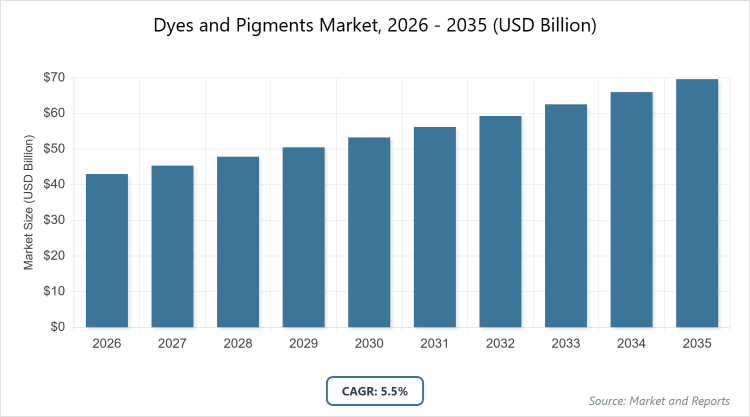
According to MarketnReports, the global Dyes and Pigments market size was estimated at USD 43 billion in 2025 and is expected to reach USD 78 billion by 2035, growing at a CAGR of 5.5% from 2026 to 2035. Increasing demand from textiles and paints industries.
Key Insights
- The global dyes and pigments market size was valued at USD 43 billion in 2025 and is projected to reach USD 78 billion by 2035.
- The market is anticipated to grow at a CAGR of 5.5% during the forecast period from 2026 to 2035.
- The market is driven by expanding textile production, rising construction activities, and demand for sustainable colorants.
- Reactive dyes dominate the type segment with a 25% share due to their strong bonding with fibers, making them ideal for cotton textiles in high-demand apparel markets.
- Textiles dominate the application segment with a 45% share because of the massive global apparel and home furnishings industry requiring vibrant, wash-fast colors.
- The textile industry dominates the end-use segment with a 40% share, owing to rapid fashion cycles and export growth in developing regions.
- Asia Pacific dominates the regional segment with a 50% share attributable to booming manufacturing in China and India, supported by low costs and high textile output.
What is the Dyes and Pigments Market?
The dyes and pigments market involves the production and distribution of colorants used to impart color to various materials, with dyes being soluble substances that chemically bond with substrates like textiles, and pigments being insoluble particles that provide color through dispersion in mediums such as paints and plastics. These products enhance aesthetic appeal, durability, and functionality across industries. The market definition encompasses organic and inorganic compounds specifically formulated for coloring applications, excluding natural food colorings or unrelated chemicals, and emphasizes advancements in eco-friendly and high-performance variants to meet regulatory and consumer preferences for sustainability.
Market Dynamics
Growth Drivers
The growth drivers in the dyes and pigments market are propelled by the surging demand from the textile sector, where rapid urbanization and rising disposable incomes in emerging economies fuel apparel consumption, necessitating vibrant and durable colorants. Advancements in sustainable formulations, such as bio-based dyes and low-VOC pigments, align with environmental regulations and consumer preferences for eco-friendly products. Additionally, expansion in the construction and automotive industries boosts pigment usage in paints and coatings for aesthetic and protective purposes, enhancing market momentum through innovation and diversified applications.
Restraints
Restraints in the dyes and pigments market stem from stringent environmental regulations on hazardous chemicals, increasing compliance costs, and limiting the use of traditional azo dyes linked to health risks. Volatility in raw material prices, particularly petroleum-based inputs, disrupts supply chains and erodes profit margins. Furthermore, competition from digital printing technologies reduces demand for conventional dyes in certain sectors, posing challenges for manufacturers reliant on legacy processes.
Opportunities
Opportunities in the dyes and pigments market arise from the shift toward green chemistry, with R&D in natural and biodegradable colorants attracting premium pricing in cosmetics and food industries. Emerging markets in Africa and Latin America offer untapped potential through industrialization and export-oriented textile growth. Strategic partnerships for customized solutions in high-tech applications, like electronics and pharmaceuticals, can drive innovation and capture niche segments.
Challenges
Challenges in the dyes and pigments market include navigating complex global supply chains amid geopolitical tensions, which affect raw material availability and lead to price instability. Ensuring product safety and efficacy under varying regulatory frameworks demands significant testing investments. Moreover, counterfeit products dilute brand value and market trust, requiring robust quality controls and anti-counterfeiting measures.
Dyes and Pigments Market: Report Scope
| Report Attributes | Report Details |
| Report Name | Dyes and Pigments Market |
| Market Size 2025 | USD 43 Billion |
| Market Forecast 2035 | USD 78 Billion |
| Growth Rate | CAGR of 5.5% |
| Report Pages | 220 |
| Key Companies Covered |
BASF SE, Clariant AG, DIC Corporation, Huntsman Corporation, Archroma, and Others |
| Segments Covered | By Type, By Application, By End-Use, and By Region |
| Regions Covered | North America, Europe, Asia Pacific (APAC), Latin America, and The Middle East and Africa (MEA) |
| Base Year | 2025 |
| Historical Year | 2020 – 2024 |
| Forecast Year | 2026 – 2035 |
| Customization Scope | Avail customized purchase options to meet your exact research needs. |
Market Segmentation
The Dyes and Pigments market is segmented by type, application, end-use, and region.
Based on Type Segment, Reactive dyes are the most dominant subsegment, holding 25% market share, followed by disperse dyes at around 20%. Reactive dyes lead due to their excellent color fastness and compatibility with natural fibers like cotton, which dominates global textile production, driving market growth by enabling high-quality, long-lasting apparel that meets consumer demands for durability in fast-fashion cycles.
Based on Application Segment, Textiles is the most dominant subsegment with 45% share, followed by paints & coatings at 25%. Textiles dominate because of the vast apparel and furnishing markets requiring versatile colorants for mass production, thereby propelling overall market expansion through sustained demand from export hubs in Asia.
Based on the End-Use Segment, The textile industry is the most dominant subsegment at 40%, followed by the paints & coatings industry at 20%. The textile industry leads owing to its scale in global manufacturing, which fuels market growth by increasing volume requirements for dyes in dyeing and printing processes.
Recent Developments
- In March 2025, BASF launched a new line of bio-based pigments for coatings, reducing environmental impact while maintaining performance for automotive applications.
- In June 2025, Clariant acquired a specialty dyes firm in India, expanding its portfolio for sustainable textile colorants amid rising eco-regulations.
- In September 2025, DIC Corporation introduced high-performance organic pigments for plastics, targeting the growing packaging sector with enhanced UV stability.
Asia Pacific to Dominate the Global Market
- Asia Pacific is poised to dominate the global dyes and pigments market
China leads Asia Pacific as the dominant country, with its massive textile exports and paint production, supported by low-cost manufacturing and government incentives for chemical industries in regions like Guangdong.
India follows, bolstered by its vibrant apparel sector and initiatives like Make in India, promoting dye usage in Surat and Tirupur textile clusters.
Europe maintains a steady share through innovation, with Germany and Italy leading in high-value pigments for automotive and fashion, under EU sustainability directives.
North America grows via advanced applications, with the U.S. dominating through coatings demand in construction, backed by infrastructure investments.
Latin America and the Middle East & Africa emerge, led by Brazil and Turkey, where textile and construction booms drive pigment adoption.
Key Market Players and Strategies
- BASF SE focuses on sustainability through bio-based innovations and acquisitions to expand in emerging markets.
- Clariant AG emphasizes R&D for eco-friendly dyes, partnering with textile firms for customized solutions.
- DIC Corporation invests in high-performance pigments, targeting Asia’s plastics growth via local production.
- Huntsman Corporation pursues cost efficiencies and green chemistry to comply with regulations.
- Archroma leverages acquisitions for specialty colorants, focusing on textile sustainability.
Market Trends
- Shift toward bio-based and natural dyes for environmental compliance.
- Increasing use of digital printing inks is reducing traditional dye waste.
- Growth in high-performance pigments for automotive and electronics.
- Adoption of low-VOC formulations in paints amid health concerns.
- Expansion of organic pigments in cosmetics for clean beauty trends.
Market Segments and their Subsegments Covered in the Report
By Type
- Reactive Dyes
- Disperse Dyes
- Acid Dyes
- Direct Dyes
- Vat Dyes
- Basic Dyes
- Organic Pigments
- Inorganic Pigments
- Titanium Dioxide
- Iron Oxides
- Others
By Application
- Textiles
- Paints & Coatings
- Plastics
- Printing Inks
- Paper
- Leather
- Cosmetics
- Food & Beverages
- Pharmaceuticals
- Construction
- Others
By End-Use
- Textile Industry
- Paints & Coatings Industry
- Plastics Industry
- Printing Industry
- Paper Industry
- Leather Industry
- Cosmetics Industry
- Food Industry
- Pharmaceutical Industry
- Construction Industry
- Others
By Region
- North America
- U.S.
- Canada
- Europe
- UK
- Germany
- France
- Rest of Europe
- Asia Pacific
- China
- India
- Japan
- Rest of Asia Pacific
- Latin America
- Brazil
- Mexico
- Rest of Latin America
- Middle East & Africa
- UAE
- South Africa
- Rest of Middle East & Africa
Chapter 1. Preface
Chapter 2. Executive Summary
Chapter 3. Global Dyes and Pigments Market - Industry Analysis
Chapter 4. Global Dyes and Pigments Market- Competitive Landscape
Chapter 5. Global Dyes and Pigments Market - Type Analysis
Chapter 6. Global Dyes and Pigments Market - Application Analysis
Chapter 7. Global Dyes and Pigments Market - End-Use Analysis
Chapter 8. Dyes and Pigments Market - Regional Analysis
Chapter 9. Company Profiles
Frequently Asked Questions
Dyes are soluble colorants that bond with substrates, while pigments are insoluble particles dispersed in mediums for coloring.
Key factors include textile demand, sustainability trends, and industrial expansions.
The market is projected to grow from approximately USD 45 billion in 2026 to USD 78 billion by 2035.
The CAGR is expected to be 5.5% during the forecast period.
Asia Pacific will contribute the most, driven by manufacturing hubs.
Major players include BASF SE, Clariant AG, DIC Corporation, Huntsman Corporation, and Archroma.
The report offers analysis of size, trends, segments, regions, and forecasts.
Stages include raw material sourcing, synthesis, formulation, distribution, and application.
Trends favor sustainable, bio-based options, with preferences for eco-friendly products.
Stricter chemical regulations and eco-standards push green innovations.