
5G Smart Antenna Market Size, Share and Trends 2026 to 2035
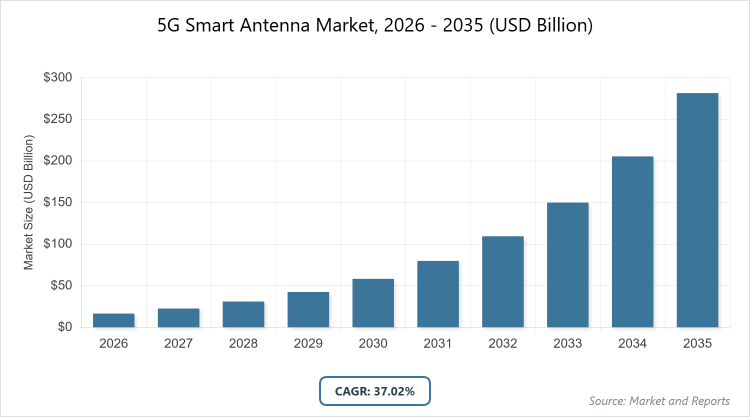
According to MarketnReports, the global 5G Smart Antenna market size was estimated at USD 16.54 billion in 2025 and is expected to reach USD 385.82 billion by 2035, growing at a CAGR of 37.02% from 2026 to 2035. Rapid deployment of 5G networks and demand for high-speed connectivity.
Key Insights
- The global 5G smart antenna market size was valued at USD 16.54 billion in 2025 and is projected to reach USD 385.82 billion by 2035.
- The market is anticipated to grow at a CAGR of 37.02% during the forecast period from 2026 to 2035.
- The market is driven by increasing 5G network deployments, rising IoT applications, and demand for enhanced connectivity.
- Active Antenna System dominates the type segment with a 55% share due to its integration of electronics for dynamic beamforming and improved network performance.
- Enhanced Mobile Broadband dominates the application segment with a 40% share because it supports high-speed data services essential for consumer and enterprise demands.
- Telecommunications dominates the end-use segment with a 60% share owing to massive investments in 5G infrastructure by operators.
- North America dominates the regional segment with a 35% share attributable to advanced telecom infrastructure and early 5G adoption.
What is the 5G Smart Antenna Market?
The 5G smart antenna market comprises advanced antenna technologies that enhance wireless communication by dynamically directing signals, improving coverage, capacity, and efficiency in 5G networks. These antennas utilize techniques like beamforming and massive MIMO to optimize data transmission, reduce interference, and support high-bandwidth applications. The market definition includes systems specifically designed for 5G infrastructure, excluding traditional antennas, and focuses on innovations that enable low-latency, high-reliability connectivity for IoT, smart cities, and mobile broadband, addressing the evolving demands of modern telecommunications.
Market Dynamics
Growth Drivers
The growth drivers in the 5G smart antenna market are fueled by the global rollout of 5G networks, which require advanced antennas for superior signal management and capacity in dense urban environments. Increasing data consumption from streaming, gaming, and remote work necessitates efficient spectrum utilization, where smart antennas excel through beamforming and MIMO technologies. Government initiatives for smart cities and digital transformation, combined with rising IoT device proliferation, further accelerate demand for reliable, low-latency connectivity solutions.
Restraints
Restraints in the 5G smart antenna market include high deployment costs associated with advanced materials and integration into existing infrastructure, limiting adoption in budget-constrained regions. Technical challenges like signal attenuation in mmWave frequencies and environmental interference complicate widespread implementation. Regulatory variations across countries regarding spectrum allocation and safety standards also delay market expansion and increase compliance burdens for manufacturers.
Opportunities
Opportunities in the 5G smart antenna market emerge from the integration with emerging technologies like AI for predictive beam steering and edge computing for real-time optimization. Expansion into verticals such as autonomous vehicles and industrial IoT offers new revenue streams through customized solutions. Collaborations with telecom operators for rural connectivity and sustainable designs using eco-friendly materials can tap into government incentives and growing environmental awareness.
Challenges
Challenges in the 5G smart antenna market involve overcoming propagation limitations in high-frequency bands, requiring innovative designs to ensure coverage in diverse terrains. Supply chain disruptions for semiconductor components and skilled labor shortages hinder production scalability. Moreover, competition from alternative technologies like satellite communication demands continuous R&D to maintain performance advantages.
5G Smart Antenna Market: Report Scope
| Report Attributes | Report Details |
| Report Name | 5G Smart Antenna Market |
| Market Size 2025 | USD 16.54 Billion |
| Market Forecast 2035 | USD 385.82 Billion |
| Growth Rate | CAGR of 37.02% |
| Report Pages | 220 |
| Key Companies Covered |
Qualcomm, Huawei Technologies Co. Ltd., Nokia, Ericsson, Samsung Electronics, and Others |
| Segments Covered | By Type, By Application, By End-Use, and By Region |
| Regions Covered | North America, Europe, Asia Pacific (APAC), Latin America, and The Middle East and Africa (MEA) |
| Base Year | 2025 |
| Historical Year | 2020 – 2024 |
| Forecast Year | 2026 – 2035 |
| Customization Scope | Avail customized purchase options to meet your exact research needs. |
Market Segmentation
The 5G Smart Antenna market is segmented by type, application, end-use, and region.
Based on Type Segment, Active Antenna System is the most dominant subsegment, holding 55% market share, followed by Massive MIMO Antenna at around 25%. Active Antenna System leads due to its ability to combine radio and antenna elements for efficient signal processing and energy savings, which drives market growth by enabling operators to upgrade networks cost-effectively and support higher data throughput.
Based on Application Segment, Enhanced Mobile Broadband is the most dominant subsegment with 40% share, followed by Massive Machine-Type Communications at 30%. Enhanced Mobile Broadband dominates because it caters to the surging demand for high-speed internet in consumer devices, thereby propelling overall market expansion through widespread 5G adoption in smartphones and broadband services.
Based on the End-Use Segment, Telecommunications is the most dominant subsegment at 60%, followed by Automotive at 15%. Telecommunications leads owing to heavy investments in base station upgrades for 5G coverage, which fuels market growth by addressing network densification needs in urban areas.
Recent Developments
- In Q2 2025, Ericsson and Qualcomm partnered to advance 5G antenna efficiency, focusing on beamforming for urban deployments.
- In Q3 2025, Huawei gained regulatory approval for 5G antenna deployments in India, expanding its market presence.
- In Q4 2025, Nokia launched a new MIMO antenna series for automotive applications, enhancing vehicle-to-everything communication.
North America to Dominate the Global Market
- North America is poised to dominate the global 5G smart antenna market
North America as the dominant country, driven by major telecom operators like Verizon and AT&T investing in massive MIMO for nationwide coverage, amid federal initiatives for 5G expansion.
Canada contributes through partnerships for rural connectivity, leveraging smart antennas to bridge digital divides in remote areas.
Europe holds a strong position with regulatory support for 5G, led by Germany and the UK focusing on industrial IoT and rail upgrades using adaptive antennas.
Asia Pacific exhibits rapid growth, with China dominating through Huawei and ZTE’s large-scale deployments in smart cities and manufacturing hubs.
Latin America and the Middle East & Africa show potential, led by Brazil and the UAE, where urbanization drives demand for enhanced broadband solutions.
Key Market Players and Strategies
- Qualcomm emphasizes R&D in mmWave and beamforming technologies, partnering with operators to integrate antennas in devices for seamless 5G experiences.
- Huawei Technologies Co., Ltd. focuses on global expansions and R&D facilities, developing adaptive arrays for industrial IoT to capture emerging markets.
- Nokia secures contracts for network upgrades, specializing in MIMO solutions for automotive and rail sectors to enhance reliability.
- Ericsson collaborates on efficiency improvements, investing in sustainable antenna designs to meet environmental standards.
- Samsung Electronics launches urban platforms, prioritizing partnerships for rural deployments to broaden accessibility.
Market Trends
- Increasing integration of AI for dynamic beam steering and network optimization.
- Shift toward energy-efficient and compact designs for sustainable 5G infrastructure.
- Growth in mmWave adoption for high-speed applications in urban environments.
- Expansion of smart antennas in IoT and connected vehicles for low-latency connectivity.
- Collaborations between manufacturers and regulators for standardized innovations.
Market Segments and their Subsegments Covered in the Report
By Type
- Switched Multi-Beam Antenna
- Adaptive Array Antenna
- Massive MIMO Antenna
- Beamforming Antenna
- Active Antenna System
- Passive Antenna System
- Dual-Polarized Antenna
- Single-Polarized Antenna
- Smart Antenna Modules
- Integrated Antenna Systems
- Others
By Application
- Enhanced Mobile Broadband
- Ultra-Reliable Low-Latency Communications
- Massive Machine-Type Communications
- Mobile Phones
- Factory Automation
- IoT Devices
- Connected Vehicles
- Smart Cities
- Base Stations
- Industrial Automation
- Others
By End-Use
- Telecommunications
- Automotive
- Consumer Electronics
- Healthcare
- Industrial
- Aerospace & Defense
- Smart Infrastructure
- Government & Public Sector
- Energy & Utilities
- Retail
- Others
By Region
- North America
- U.S.
- Canada
- Europe
- UK
- Germany
- France
- Rest of Europe
- Asia Pacific
- China
- India
- Japan
- Rest of Asia Pacific
- Latin America
- Brazil
- Mexico
- Rest of Latin America
- Middle East & Africa
- UAE
- South Africa
- Rest of Middle East & Africa
Frequently Asked Questions
5G smart antennas are advanced systems that dynamically direct signals using technologies like beamforming and MIMO to improve 5G network performance and efficiency.
Key factors include 5G network expansions, IoT proliferation, technological advancements, and smart city initiatives.
The market is projected to grow from approximately USD 22.66 billion in 2026 to USD 385.82 billion by 2035.
The CAGR is expected to be 37.02% during the forecast period.
North America will contribute the most, driven by advanced infrastructure and early adoption.
Major players include Qualcomm, Huawei Technologies Co. Ltd., Nokia, Ericsson, and Samsung Electronics.
The report provides insights on size, trends, segments, regions, players, and forecasts.
Stages include component manufacturing, system integration, deployment, and maintenance.
Trends focus on AI integration and sustainability, with preferences for high-efficiency, compact solutions.
Spectrum regulations and eco-friendly material mandates influence development and adoption.