
Whiskey Market Size, Share, and Trends 2026 to 2035
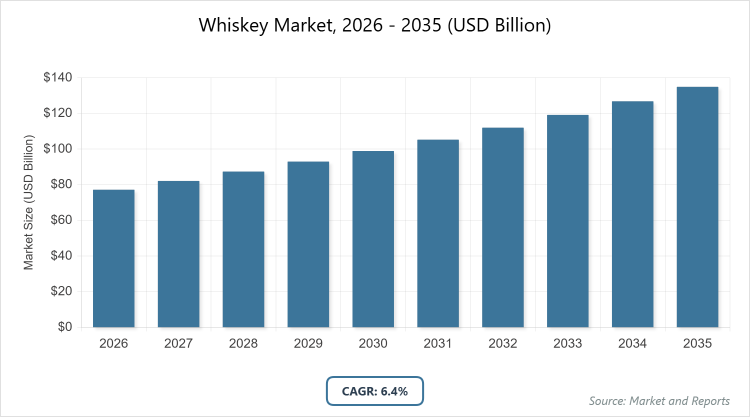
According to MarketnReports, the global Whiskey market size was estimated at USD 77.2 billion in 2025 and is expected to reach USD 145.1 billion by 2035, growing at a CAGR of 6.4% from 2026 to 2035. Driven by premiumization trends and increasing demand for craft and flavored varieties.
What are the Key Insights of the Whiskey Market?
- The Whiskey market was valued at USD 77.2 billion in 2025 and is projected to reach USD 145.1 billion by 2035.
- The Whiskey market is expected to grow at a CAGR of 6.4% during the forecast period 2026-2035.
- The Whiskey market is driven by rising disposable incomes, premiumization, cocktail culture, and global spirit tourism.
- Scotch Whiskey dominates the type segment with a 40% share, due to its global prestige, heritage, and strong export demand from regions like Europe.
- Off-Trade dominates the distribution channel segment with a 55% share, driven by convenience, e-commerce growth, and consumer preference for home consumption.
- Premium dominates the price point segment with a 45% share, as consumers seek high-quality, aged products for status and taste experiences.
- Asia Pacific dominates the regional segment with a 45% share, owing to rising middle-class consumption, urbanization, and increasing imports in countries like China and India.
What is the Whiskey Market?
Industry Overview
The Whiskey market encompasses distilled spirits produced from fermented grain mash, aged in wooden barrels, and categorized by grain type, origin, and production methods to create varieties like Scotch, Bourbon, and Irish whiskey. Market definition includes the production, distribution, and consumption of these alcoholic beverages, serving both on-trade channels like bars and off-trade retail, while addressing consumer preferences for premium, flavored, and sustainable options amid regulatory constraints on alcohol sales and health trends influencing consumption patterns.
What are the Market Dynamics in the Whiskey Market?
Growth Drivers
The Whiskey market is propelled by increasing consumer preference for premium and craft whiskeys, driven by rising disposable incomes in emerging economies and a growing cocktail culture that incorporates whiskey as a versatile base spirit. Innovations in flavor profiles, such as infused and aged variants, attract younger demographics and expand product appeal beyond traditional drinkers. Additionally, global spirit tourism and experiential marketing, including distillery visits and tastings, enhance brand loyalty and drive demand, supported by e-commerce expansions that facilitate easier access to diverse international offerings.
Restraints
Stringent government regulations on alcohol advertising, taxation, and sales restrict market growth, particularly in regions with high excise duties that increase retail prices and reduce affordability. Health concerns and anti-alcohol campaigns promote reduced consumption, impacting volumes in mature markets. Moreover, supply chain disruptions from climate change affecting grain harvests raise production costs, while counterfeit products erode trust in premium segments.
Opportunities
Opportunities arise from the shift towards sustainable and organic whiskeys, appealing to environmentally conscious consumers and opening premium pricing tiers. Expansion in untapped markets like Africa and Latin America, with rising urbanization and middle-class growth, presents potential for localized production and flavored variants. Furthermore, collaborations with mixologists for ready-to-drink cocktails and digital marketing strategies can capture Gen Z interest, fostering innovation in low-alcohol options.
Challenges
Challenges include navigating trade tariffs and geopolitical tensions that disrupt exports, as seen in ongoing U.S.-EU negotiations affecting whiskey shipments. Volatility in raw material prices due to weather impacts on barley and corn supplies strains margins. Additionally, competition from alternative spirits like gin and tequila requires continuous differentiation through branding and quality.
Whiskey Market: Report Scope
| Report Attributes | Report Details |
| Report Name | Whiskey Market |
| Market Size 2025 | USD 77.2 Billion |
| Market Forecast 2035 | USD 145.1 Billion |
| Growth Rate | CAGR of 6.4% |
| Report Pages | 220 |
| Key Companies Covered |
Diageo, Pernod Ricard, Suntory Holdings, Brown-Forman, Bacardi Limited, and Others |
| Segments Covered | By Type, By Distribution Channel, By Price Point, and By Region |
| Regions Covered | North America, Europe, Asia Pacific (APAC), Latin America, and The Middle East and Africa (MEA) |
| Base Year | 2025 |
| Historical Year | 2020 – 2024 |
| Forecast Year | 2026 – 2035 |
| Customization Scope | Avail customized purchase options to meet your exact research needs. |
What is the Market Segmentation of the Whiskey Market?
The Whiskey market is segmented by type, distribution channel, price point, and region.
Based on Type Segment, Scotch Whiskey is the most dominant, holding a 40% share, followed by Bourbon Whiskey at 30%. Scotch Whiskey’s dominance stems from its historical prestige, stringent production standards, and strong global export demand, driving the market by appealing to premium consumers and supporting international trade growth through brand loyalty and tourism.
Based on Distribution Channel Segment, off-trade is the most dominant with a 55% share, followed by on-trade at 45%. Off-trade leads due to convenience and e-commerce accessibility, propelling market growth by enabling direct-to-consumer sales and expanding reach in emerging regions with rising online retail.
Based on Price Point Segment, premium is the most dominant with a 45% share, followed by super premium at 25%. Premium dominates as consumers seek quality and status, fueling market expansion through higher margins and innovation in aged and flavored variants.
What are the Recent Developments in the Whiskey Market?
- In January 2026, Diageo announced a strategic reset for its Scotch portfolio, focusing on sustainable sourcing amid slower demand in key markets.
- In December 2025, Beam Suntory halted production at a Kentucky distillery due to trade uncertainties and declining exports.
- In November 2025, Pernod Ricard launched innovative flavored whiskeys targeting Gen Z, aligning with cocktail trends.
- In October 2025, Brown-Forman expanded its craft offerings through acquisitions to counter premium segment slowdowns.
What is the Regional Analysis of the Whiskey Market?
- Asia Pacific to dominate the global market.
Asia Pacific holds the largest share at 45%, with China as the dominating country due to rapid urbanization, rising middle-class consumption, and increasing imports of premium whiskeys that drive local production and market expansion.
North America accounts for a significant share, led by the United States through strong bourbon demand, craft distilleries, and export growth despite trade tariffs.
Europe maintains a mature market, with the United Kingdom dominating via Scotch heritage, tourism, and sustainable practices influencing global standards.
Latin America shows promising growth, dominated by Brazil with increasing cocktail culture and premium imports amid economic recovery.
The Middle East and Africa exhibit emerging potential, with South Africa leading through tourism and rising affluent consumers adopting international brands.
Who are the Key Market Players in the Whiskey Market?
- Diageo employs premiumization strategies, sustainable sourcing, and digital marketing to maintain leadership in Scotch and global exports.
- Pernod Ricard focuses on innovation in flavored whiskeys, acquisitions, and Gen Z-targeted campaigns for market diversification.
- Suntory Holdings prioritizes craft and premium segments, leveraging Asian growth and sustainability initiatives.
- Brown-Forman drives bourbon expansion through U.S. heritage brands, trade advocacy, and craft acquisitions.
- Bacardi Limited emphasizes cocktail integrations and emerging market penetrations for blended whiskeys.
What are the Market Trends in the Whiskey Market?
- Premiumization with focus on ultra-aged and craft expressions amid economic headwinds.
- Rise in flavored and low-alcohol variants targeting younger consumers.
- Sustainability emphasis through eco-friendly sourcing and packaging.
- Impact of trade tariffs on exports and pricing strategies.
- Growth in smaller bottle formats for mindful consumption.
What Market Segments and Subsegments are Covered in the Report?
By Type
- Scotch Whiskey
- Bourbon Whiskey
- Irish Whiskey
- Canadian Whiskey
- Rye Whiskey
- Blended Whiskey
- Single Malt Whiskey
- Flavored Whiskey
- Craft Whiskey
- Organic Whiskey
- Others
By Distribution Channel
- On-Trade
- Off-Trade
- Online Retail
- Duty-Free Shops
- Supermarkets & Hypermarkets
- Specialty Stores
- Convenience Stores
- Bars & Restaurants
- Liquor Stores
- E-commerce Platforms
- Others
By Price Point
- Economy
- Premium
- Super Premium
- High-End Premium
- Luxury
- Value
- Mid-Range
- Budget
- Ultra-Premium
- Collectible
- Others
By Region
- North America
- U.S.
- Canada
- Europe
- UK
- Germany
- France
- Rest of Europe
- Asia Pacific
- China
- India
- Japan
- Rest of Asia Pacific
- Latin America
- Brazil
- Mexico
- Rest of Latin America
- Middle East & Africa
- UAE
- South Africa
- Rest of Middle East & Africa
Frequently Asked Questions
Whiskey is a distilled alcoholic beverage made from fermented grain mash, aged in wooden barrels, and categorized by grain type and origin.
Factors include premiumization, cocktail culture, sustainability trends, and trade policies.
The market is projected to grow from USD 82.8 billion in 2026 to USD 145.1 billion by 2035.
The expected CAGR is 6.4% during 2026-2035.
Asia Pacific will contribute notably, driven by urbanization and middle-class growth.
Major players include Diageo, Pernod Ricard, Suntory Holdings, Brown-Forman, and Bacardi Limited.
The report provides analysis of size, trends, segments, regions, players, and forecasts.
Stages include raw material sourcing, distillation, aging, blending, packaging, and distribution.
Trends favor sustainable and flavored options, with preferences shifting to premium craft varieties.
Trade tariffs and sustainability mandates influence costs and innovation.